
BuddhistCatholicContemplativeEvangelicalGeneral ChristianHinduJewishLatter-day SaintMuslimNew VisionsProgressive Christian
Beliefs
- Buddhist
- Catholic
- Contemplative
- Evangelical
- General Christian
- Hindu
- Jewish
- Latter-day Saint
- More Voices
- Muslim
- New Visions
- Pagan
- Progressive Christian
Topics
- Religion News
- Food and Religion
- Sports and Religion
- Religious Art
- Religious Music and Entertainment
- Religious Events
- History and Religion
- Style and Religion
- Politics and Religion
- Women in Religion
- Recreation Outdoors and Religion
- Business Finance and Religion
- Careers Workplace and Religion
- Education and Religion
- Family Parenting and Religion
- Health Fitness and Religion
- Home and Religion
- Relationships and Religion
- Technology and Religion
- Travel and Religion
Columnists
- Buddhist Columnists
- Business Finance and Religion Columnists
- Careers Workplace and Religion Columnists
- Catholic Columnists
- Contemplative Columnists
- Education and Religion Columnists
- Evangelists Columnists
- Family Parenting and Religion Columnists
- General Christian Columnists
- Health Fitness and Religion Columnists
- Hindu Columnists
- History and Religion Columnists
- Home and Religion Columnists
- Jewish Columnists
- More Voices Columnists
- Latter Day Columnists
- Muslim Columnists
- New Visions Columnists
- Nonreligious Columnists
- Pagan Columnists
- Politics and Religion Columnists
- Progressive Columnists
- Recreation Outdoors and Religion Columnists
- Relationships and Religion Columnists
- Religion News Columnists
- Religious Art Columnists
- Religious Events Columnists
- Religious Music and Entertainment Columnists
- Sports and Religion Columnists
- Style and Religion Columnists
- Technology and Religion Columnists
- Travel and Religion Columnists
- Women in Religion Columnists
Resource Library
- 2026 Calendar
- Library of World Religions
- The 100 Most Holy Places on Earth
- Patheos Answers
- Podcasts
- Videos
- Faith Leaders Database
- Anglican Episcopalian
- Bahai
- Baptist
- Buddhism
- Christianity
- Confucianism
- Eastern Orthodoxy
- Hinduism
- Holiness and Pentecostal
- ISKCON
- Islam
- Judaism
- Lutheran
- Methodist
- The Church of Jesus Christ of Latter-day Saints
- New Age
- Paganism
- Presbytarian and Reformed
- Protestantism
- Religion Behind the Scenes
- Roman Catholic
- Scientology
- Shia Islam
- Sikhism
- Sufism
- Sunni Islam
- Taoism
- Zen
- See all religions
Research Tools
 Ad-Free & Subscriber Log-In Subscription Support
Follow Patheos 

- Trending:
- Advent
- |
- Forgiveness
- |
- Thanksgiving
- |
- Election
- |
- Seasonal Holidays
- |
- Marriage
 Love, Joy, Feminism
-
More
- Home
- Nonreligious
- Fifty Shades of Disagreement: Evangelicals and Feminists on Fifty Shades of Grey
Fifty Shades of Disagreement: Evangelicals and Feminists on Fifty Shades of Grey
Last updated on: January 26, 2016 at 8:51 pm by Libby Anne
Fifty Shades of Disagreement: Evangelicals and Feminists on Fifty Shades of Grey 2016-01-26T20:51:54-04:00 Libby Anne
Patheos Explore the world's faith through different perspectives on religion and spirituality! Patheos has the views of the prevalent religions and spiritualities of the world.
I’ve avoided discussing Fifty Shades of Grey, but I do feel the need to touch on a specific aspect of the controversy that surrounds the book (and now, the film). Namely, I’m fascinated that feminists and evangelical Christians have been the book’s most vocal critics. The two would seem unlikely allies! But then, while both groups have tended to condemn Fifty Shades of Grey as toxic, they aren’t truly allies in this, because they oppose the books for completely different reasons. Feminists speak of the book’s endorsement of abuse and its problematic treatment of consent while evangelicals condemn the book for its positive treatment of premarital sex and BDSM.
An article on the Gospel Coalition was titled Rejecting the Industrialized Sex of “Fifty Shades”. In it the author, Joe Carter, focuses on both premarital sex and having multiple sexual partners before marriage. In his post he gives us a fascinating glimpse of the evangelical position on sex and sexual relationships. He uses Fifty Shades of Grey as a taking off point, stating that:
I was reminded of [Wendell] Berry’s insight [that sex has been industrialized] because of the release of the new film, 50 Shades of Grey, which epitomizes and promotes this view of industrialized sex. Too much has already been written about the stupidity and vulgarity of the novel, so I won’t waste time rehashing why no Christian should engage with that pornography. Instead, just as Berry offers advice on how to recover the pleasures of eating from consumerism, I want to offer a few modest suggestions for how Christians can recover sex from industrialization.
In the remainder of his post, the author condemns pornography, fetishes, premarital sex, having more than one sexual partner over a lifetime, withholding sex from one’s partner, and sex for the sole sake of pleasure. For Carter, Fifty Shades of Grey “epitomizes and promotes” an “industrialized” view of sex.
In an article in Christianity Today, Jonalyn Fincher put her objections like this:
I do have concerns, for the following reasons:
– Genesis 1:18-19 teaches that men and women are made in God’s image; this means that all we do, including our love-making, should tell the world the truth about what God is like.
– Genesis 3 introduces the roots of what we’ve come to call the gender war where man is judged to rule over women (Gen 3:15), and we’ve been attempting to dominate each other ever since. This isn’t the way we were created to be.
– BDSM includes humiliation and domination, practices that are at odds with the way we were created as equals and at odds with honoring our spouse’s bodies as temples of God’s Holy Spirit (1 Cor 6:18).
– Even Hebrews 13:4—”The marriage bed is not defiled”—does not give Christians a blank check to engage in any sexual behavior as long as it’s consenting adults.
– Our bodies are as sacred as our souls; our bodies belong to God first (1 Cor. 6:19-20) and then our spouse (1 Cor. 7:4). There are some things you cannot do with a sacred vessel.
Again, note that there is nothing about abuse. Instead, it’s all about premarital sex and BDSM, and the importance of containing sex to marriage and keeping it vanilla.
What about feminists? What has been the main critique there?
In a recent post on Feministe, Capterton explained it as follows:
Valentine’s Day is coming up! That day of romance, of togetherness, of coupledom, of… domestic abuse… Valentine’s Day is the release date of 50 Shades of Grey, that sensationalistic movie based on the “How to Spot an Abuser” pamphlet in your college guidance counselor’s office. Women and men who have read the book and know perfectly well what the story is about will flock to theatres, either a) dreaming of the day that they’ll be stalked and violated by someone as dreamy as Christian, or b) hoping to score on Valentine’s night with the person they took to the movie.
As much as I hate to be a buzzkill (note: This is true. I do, in fact, hate being a buzzkill), I can’t not point out that the book is a horrible, awful book, and that unless the movie carves the entire storyline down to the glider scene and some of the scenes with Kate, who seems cool, it’s going to be a horrible, awful movie as well. Moreover, though, it’s a book that romanticizes a seriously abusive relationship, and while people are free to publish whatever they want and read whatever they want and get their rocks off to whatever they want (within certain limits), it’s important to acknowledge that what may (for some reason) come across as sultry and sexy on the page would, in real life, be a Razorbacks halftime show’s worth of red flags.
Other bloggers have made the same argument, pointing out that Christian Grey, the protagonist, is manipulative and controlling and—yes—abusive.
This isn’t about portraying consensual BDSM as de facto abuse. Rather, throughout the entire book, from beginning to end, Christian is jealous, violent, and unpredictable. He repeatedly walks ignores her wishes and runs roughshod over her consent. He gaslights her and uses emotional abuse to get what he wants. He sexually assaults her and threatens her with violence—outside of what the BDSM.

But even the BDSM part is done badly. At one point Christian beats Ana with a belt to the point where she loses the ability to say their safe word, and when Christian finds out he gets mad at her, and claims he can’t trust her. When Ana tells Christian she would rather not do a given act, or that something makes her feel abused, he gives her no end of grief in an effort to manipulate and coerce her into doing the act anyway. I mean good grief, he manipulates Ana into the BDSM relationship in the first place! This is not best practices for BDSM in anyone’s book. You can read more about the problems with the book’s portrayal of BDSM at the end of this article.
Both feminists and evangelical Christians have had a problem with the book’s portrayal of BDSM, feminists because what is portrayed is not entirely consensual and and evangelical Christians because BDSM is (they say) a perversion of God’s design for sex. Both feminists and evangelical Christians have had a problem with the books as a whole, too, feminists because they glamorize an abusive relationship and evangelical Christians because they glamorize premarital sex.
In a blog post I wrote a few years back, I explained the difference as follows:
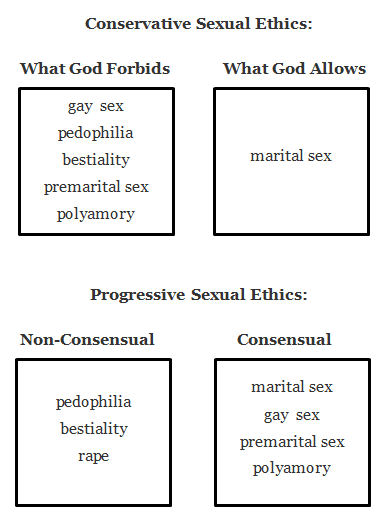 In other words, evangelical Christians’ critique of Fifty Shades of Grey is based in their belief that God has forbidden certain sexual acts—such as premarital sex and (apparently) BDSM. In contrast, feminists’ critique of Fifty Shades of Grey is based in their embrace of consent-based sexual ethics, which use consent as a yardstick to evaluate sexual acts.
To be perfectly fair, some evangelicals have also picked up on the abusive themes in Fifty Shades of Grey. Evangelical blogger Rebecca Florence Miller connected the book to intimate partner violence. But in general, what has evangelicals up in arms over Fifty Shades of Grey is its endorsement of premarital relationships and kinky sex, while what has feminists up in arms is its glorification of abuse and its perversion of kinky sex. This disagreement is rooted in a huge divergence in the two groups’ underlying sexual ethics.
Previous Post

February 14, 2015
What I Love about My Feminist Husband
Next Post
February 17, 2015 On Being a Prodigal
Browse Our Archives
Select a Category Atheism Evangelicalism/Fundamentalism Family Feminism Homeschool Meta Parenting Patriarchy Politics Purity Quiverfull Social Justice Uncategorized Worthwhile reads
Select a Month February 2021 January 2021 December 2020 November 2020 October 2020 September 2020 August 2020 July 2020 June 2020 May 2020 April 2020 March 2020 February 2020 January 2020 December 2019 November 2019 October 2019 September 2019 August 2019 July 2019 June 2019 May 2019 April 2019 March 2019 February 2019 January 2019 December 2018 November 2018 October 2018 September 2018 August 2018 July 2018 June 2018 May 2018 April 2018 March 2018 February 2018 January 2018 December 2017 November 2017 October 2017 September 2017 August 2017 July 2017 June 2017 May 2017 April 2017 March 2017 February 2017 January 2017 December 2016 November 2016 October 2016 September 2016 August 2016 July 2016 June 2016 May 2016 April 2016 March 2016 February 2016 January 2016 December 2015 November 2015 October 2015 September 2015 August 2015 July 2015 June 2015 May 2015 April 2015 March 2015 February 2015 January 2015 December 2014 November 2014 October 2014 September 2014 August 2014 July 2014 June 2014 May 2014 April 2014 March 2014 February 2014 January 2014 December 2013 November 2013 October 2013 September 2013 August 2013 July 2013 June 2013 May 2013 April 2013 March 2013 February 2013 January 2013 December 2012 November 2012 October 2012 September 2012 August 2012 July 2012 June 2012 May 2012 April 2012 March 2012 February 2012 January 2012 December 2011 November 2011 October 2011 September 2011 August 2011 July 2011 June 2011
Follow Us!
TAKE THE
Religious Wisdom Quiz
Which Christian group follows the Five Points of Calvinism?
Select your answer to see how you score.
Pentecostals Baptists Methodists Reformed
Related posts from Love, Joy, Feminism

Maybe Let's Not Read More Puritans


"So Your Problem with Christianity is the Jesus...

TRENDING AT PATHEOS Nonreligious

Dethroning Jesus and Enthroning Yourself
Jesus Never Asked to Be Worshipped. He Asked to Be Understood. Christianity...

Why Most Christians are Really Paulians and Jobians
I Don't Care, But It Matters Let's get this out of the...

Essential Tips to Successfully Navigate the Selling Process
Selling a house can feel overwhelming, but it doesn’t have to be....

To Make Remote Work Effective, Think About Others
The COVID-19 pandemic forced many companies to rapidly transition to remote work....

Flexibility Is Key to Solving Problems of Tomorrow
The world of work is undergoing a dramatic transformation. The COVID-19 pandemic...
view all Nonreligious blogs
Ad-Free & Subscriber Log-In Subscription Support
- About Us
- 2026 Calendar
- Videos
- Podcasts
- Library of World Religions
- Faith In Media Tracker
- Advertise With Us
- Write for Us
- Privacy Policy
- Terms of Service
- Do Not Sell My Data
- Contact Us
- Radiant Digital
- Manage Newsletter Subscriptions
- Unsubscribe From Notifications
- Sitemap
Copyright 2008-2026, Patheos, part of the Radiant Digital network of media brands. All rights reserved.
Subscription Support Ad-Free & Subscriber Log-In
Follow Patheos