
BuddhistCatholicContemplativeEvangelicalGeneral ChristianHinduJewishLatter-day SaintMuslimNew VisionsProgressive Christian
Beliefs
- Buddhist
- Catholic
- Contemplative
- Evangelical
- General Christian
- Hindu
- Jewish
- Latter-day Saint
- More Voices
- Muslim
- New Visions
- Pagan
- Progressive Christian
Topics
- Religion News
- Food and Religion
- Sports and Religion
- Religious Art
- Religious Music and Entertainment
- Religious Events
- History and Religion
- Style and Religion
- Politics and Religion
- Women in Religion
- Recreation Outdoors and Religion
- Business Finance and Religion
- Careers Workplace and Religion
- Education and Religion
- Family Parenting and Religion
- Health Fitness and Religion
- Home and Religion
- Relationships and Religion
- Technology and Religion
- Travel and Religion
Columnists
- Buddhist Columnists
- Business Finance and Religion Columnists
- Careers Workplace and Religion Columnists
- Catholic Columnists
- Contemplative Columnists
- Education and Religion Columnists
- Evangelists Columnists
- Family Parenting and Religion Columnists
- General Christian Columnists
- Health Fitness and Religion Columnists
- Hindu Columnists
- History and Religion Columnists
- Home and Religion Columnists
- Jewish Columnists
- More Voices Columnists
- Latter Day Columnists
- Muslim Columnists
- New Visions Columnists
- Nonreligious Columnists
- Pagan Columnists
- Politics and Religion Columnists
- Progressive Columnists
- Recreation Outdoors and Religion Columnists
- Relationships and Religion Columnists
- Religion News Columnists
- Religious Art Columnists
- Religious Events Columnists
- Religious Music and Entertainment Columnists
- Sports and Religion Columnists
- Style and Religion Columnists
- Technology and Religion Columnists
- Travel and Religion Columnists
- Women in Religion Columnists
Resource Library
- 2026 Calendar
- Library of World Religions
- The 100 Most Holy Places on Earth
- Patheos Answers
- Podcasts
- Videos
- Faith Leaders Database
- Anglican Episcopalian
- Bahai
- Baptist
- Buddhism
- Christianity
- Confucianism
- Eastern Orthodoxy
- Hinduism
- Holiness and Pentecostal
- ISKCON
- Islam
- Judaism
- Lutheran
- Methodist
- The Church of Jesus Christ of Latter-day Saints
- New Age
- Paganism
- Presbytarian and Reformed
- Protestantism
- Religion Behind the Scenes
- Roman Catholic
- Scientology
- Shia Islam
- Sikhism
- Sufism
- Sunni Islam
- Taoism
- Zen
- See all religions
Research Tools
 Ad-Free & Subscriber Log-In Subscription Support
Ad-Free & Subscriber Log-In Subscription Support
Follow Patheos 

- Trending:
- Forgiveness
- |
- Marriage
- |
- Consciousness
- |
- Death Penalty
- |
- Election
- |
- Halloween
 Love, Joy, Feminism
-
More
- Home
- Nonreligious
- Lourdes Torres, Christian Homeschooling, and Consent
Lourdes Torres, Christian Homeschooling, and Consent
Last updated on: April 20, 2014 at 9:11 pm by Libby Anne
Lourdes Torres, Christian Homeschooling, and Consent 2014-04-20T21:11:01-04:00 Libby Anne
Patheos Explore the world's faith through different perspectives on religion and spirituality! Patheos has the views of the prevalent religions and spiritualities of the world.
I recently came upon an excellent example of what I was talking about when I wrote my “The Tale of Two Boxes” post several years ago. Homeschool leader Chris Jeub had this to say in a recent blog post titled “Patriarchy Has Got To Go“:
In a nutshell, Phillips is being sued by his former nanny, someone he knew for over a decade and was very close to the Phillips family. Her lawyers have graphic details of Phillips forcing himself sexually, and Phillips’ lawyers are denying little of it, claiming “consensual” contact between adults.
For those of us in the Christian homeschool community, this is just as bad as guilty. Phillips is a married man and father of eight children. This behavior is inexcusable.
Jeub writes that a married man having a consensual affair is “just as bad” as a married man sexually assaulting a woman, because both involve sexual immorality. When Jeub posted this piece on his facebook wall, a lively discussion ensued between him and a number of homeschool graduates. In that discussion, Jeub admitted that consent is “a topic that I don’t know much about.” I want to weigh in here because of the relevance of my two boxes thesis to this conversation.
First, I want to note that the Christian homeschooling world has a problem with consent, and with sex education in general. In a followup to her February expose on Patrick Henry College’s handling of sexual assault, journalist Kiera Feldman revealed that the board of Patrick Henry College has acknowledged that sex education has often been limited for those growing up in Christian homeschool families.
Of all the developments at Patrick Henry in the past month or so, this was perhaps the most heartening: Daniel Noa, the president of the alumni association, reported back from the spring Board of Trustees meeting, where the article was discussed at great length. Noa wrote:
There was definitely a consensus among the board members, many of whom have had long associations with homeschooling, that sex education in homeschooling circles has often been quite inadequate, particularly in dealing with the issues of consent, assault, aggressive advances, and other relevant issues. The board instructed administration officials to look into models of how this could be addressed with students as part of the orientation process. Instructions were also given to look into expanding the provision for mental health needs that the college is already offering.
This was definitely my experience—growing up homeschooled K-12, I was not introduced to the concept of consent until college (I attended a state university). What is perhaps distressing, though, is the realization that it is not just homeschooled students in these communities who lack an understanding of consent but also homeschool leaders like Jeub. This is a problem that needs correcting.
In his post, Jeub dismisses the relevance of consent to the Doug Phillips scandal because the primary point, for him, appears to be whether there was sexual immorality (aka extramarital sex), not whether there was consent. Given that there was sexual immorality regardless, Jeub doesn’t see the point of arguing about whether or not there was consent.
But consent matters. Consent matters a lot.
In a consent-based system of sexual ethics, a married man who has consensual sex with a woman he is not married to, but does so with the consent of his wife, has not done anything wrong. A married man who sexually assaults a woman he is not married to behind his wife’s back, in contrast, has wronged both women. In a traditional evangelical system of sexual ethics, however, there is no difference between these two cases—both are wrong because both involve sexual immorality. Consent is irrelevant—and that is why Jeub wrote that consensual sex between two unmarried adults was “just as bad as” rape.
In “The Tale of Two Boxes” I illustrated how thoroughly different a consent-based system of sexual ethics is from the traditional evangelical system of sexual ethics. The two systems determine which sex acts are right or wrong by a drastically different metric and with drastically different results.
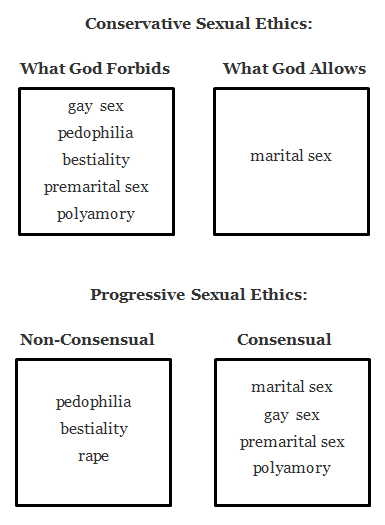
In one of his facebook comments, Jeub acknowledged that Phillips’ position as Lourdes employer put him in a place of dominance over her that enabled him to manipulate her, and recognized that this makes Phillips a cad and a predator. But Jeub seemed primarily concerned that Phillips took advantage of his position to “pervert on” a woman in his charge. He found whether Lourdes was assaulted and coerced or a willing and active participant irrelevant. The concern appeared to be less about consent than about corruption. And that, quite frankly, is a problem.
I would urge Jeub and other homeschool leaders to shift from judging sexual acts by whether or not they involve marital sex to judging them by whether or not there is consent. A sexual ethic that puts rape in the same category as consensual premarital sex is fatally flawed. That Lourdes’ relationship with Phillips was not consensual matters a great deal, and not just legally. It matters ethically as well—or at least it very much ought to.
I’m tired of reading about sexual assault as a violation of purity rather than as a violation of personhood.
For additional reading, see Let’s Talk about Christian Culture and the Concept of Consent in Relationships, Why Purity Culture Doesn’t Teach Consent part 1, and Why Purity Culture Doesn’t Teach Consent part 2.
Previous Post

April 20, 2014
CTNAHM: Sexual Sins as Far as the Eye Can See
Next Post
April 21, 2014 TTUAC: Bad Attitudes Are a Disease
Browse Our Archives
Select a Category Atheism Evangelicalism/Fundamentalism Family Feminism Homeschool Meta Parenting Patriarchy Politics Purity Quiverfull Social Justice Uncategorized Worthwhile reads
Select a Month February 2021 January 2021 December 2020 November 2020 October 2020 September 2020 August 2020 July 2020 June 2020 May 2020 April 2020 March 2020 February 2020 January 2020 December 2019 November 2019 October 2019 September 2019 August 2019 July 2019 June 2019 May 2019 April 2019 March 2019 February 2019 January 2019 December 2018 November 2018 October 2018 September 2018 August 2018 July 2018 June 2018 May 2018 April 2018 March 2018 February 2018 January 2018 December 2017 November 2017 October 2017 September 2017 August 2017 July 2017 June 2017 May 2017 April 2017 March 2017 February 2017 January 2017 December 2016 November 2016 October 2016 September 2016 August 2016 July 2016 June 2016 May 2016 April 2016 March 2016 February 2016 January 2016 December 2015 November 2015 October 2015 September 2015 August 2015 July 2015 June 2015 May 2015 April 2015 March 2015 February 2015 January 2015 December 2014 November 2014 October 2014 September 2014 August 2014 July 2014 June 2014 May 2014 April 2014 March 2014 February 2014 January 2014 December 2013 November 2013 October 2013 September 2013 August 2013 July 2013 June 2013 May 2013 April 2013 March 2013 February 2013 January 2013 December 2012 November 2012 October 2012 September 2012 August 2012 July 2012 June 2012 May 2012 April 2012 March 2012 February 2012 January 2012 December 2011 November 2011 October 2011 September 2011 August 2011 July 2011 June 2011
Follow Us!
TAKE THE
Religious Wisdom Quiz
What Christian group primarily follows the teachings of Martin Luther?
Select your answer to see how you score.
Methodists Lutherans Baptists Presbyterians
Related posts from Love, Joy, Feminism

Maybe Let's Not Read More Puritans


"So Your Problem with Christianity is the Jesus...

No, the "Second Shift" Isn't Feminism's Fault
TRENDING AT PATHEOS Nonreligious

Dethroning Jesus and Enthroning Yourself
Jesus Never Asked to Be Worshipped. He Asked to Be Understood. Christianity...

Why Most Christians are Really Paulians and Jobians
I Don't Care, But It Matters Let's get this out of the...

Essential Tips to Successfully Navigate the Selling Process
Selling a house can feel overwhelming, but it doesn’t have to be....

To Make Remote Work Effective, Think About Others
The COVID-19 pandemic forced many companies to rapidly transition to remote work....

Flexibility Is Key to Solving Problems of Tomorrow
The world of work is undergoing a dramatic transformation. The COVID-19 pandemic...
view all Nonreligious blogs
Ad-Free & Subscriber Log-In Subscription Support
- About Us
- 2026 Calendar
- Videos
- Podcasts
- Library of World Religions
- Faith In Media Tracker
- Advertise With Us
- Write for Us
- Privacy Policy
- Terms of Service
- Do Not Sell My Data
- Contact Us
- Radiant Digital
- Manage Newsletter Subscriptions
- Unsubscribe From Notifications
- Sitemap
Copyright 2008-2026, Patheos. All rights reserved.
Subscription Support Ad-Free & Subscriber Log-In
Follow Patheos