
BuddhistCatholicContemplativeEvangelicalGeneral ChristianHinduJewishLatter-day SaintMuslimNew VisionsProgressive Christian
Beliefs
- Buddhist
- Catholic
- Contemplative
- Evangelical
- General Christian
- Hindu
- Jewish
- Latter-day Saint
- More Voices
- Muslim
- New Visions
- Pagan
- Progressive Christian
Topics
- Religion News
- Food and Religion
- Sports and Religion
- Religious Art
- Religious Music and Entertainment
- Religious Events
- History and Religion
- Style and Religion
- Politics and Religion
- Women in Religion
- Recreation Outdoors and Religion
- Business Finance and Religion
- Careers Workplace and Religion
- Education and Religion
- Family Parenting and Religion
- Health Fitness and Religion
- Home and Religion
- Relationships and Religion
- Technology and Religion
- Travel and Religion
Columnists
- Buddhist Columnists
- Business Finance and Religion Columnists
- Careers Workplace and Religion Columnists
- Catholic Columnists
- Contemplative Columnists
- Education and Religion Columnists
- Evangelists Columnists
- Family Parenting and Religion Columnists
- General Christian Columnists
- Health Fitness and Religion Columnists
- Hindu Columnists
- History and Religion Columnists
- Home and Religion Columnists
- Jewish Columnists
- More Voices Columnists
- Latter Day Columnists
- Muslim Columnists
- New Visions Columnists
- Nonreligious Columnists
- Pagan Columnists
- Politics and Religion Columnists
- Progressive Columnists
- Recreation Outdoors and Religion Columnists
- Relationships and Religion Columnists
- Religion News Columnists
- Religious Art Columnists
- Religious Events Columnists
- Religious Music and Entertainment Columnists
- Sports and Religion Columnists
- Style and Religion Columnists
- Technology and Religion Columnists
- Travel and Religion Columnists
- Women in Religion Columnists
Resource Library
- 2026 Calendar
- Library of World Religions
- The 100 Most Holy Places on Earth
- Patheos Answers
- Podcasts
- Videos
- Faith Leaders Database
- Anglican Episcopalian
- Bahai
- Baptist
- Buddhism
- Christianity
- Confucianism
- Eastern Orthodoxy
- Hinduism
- Holiness and Pentecostal
- ISKCON
- Islam
- Judaism
- Lutheran
- Methodist
- The Church of Jesus Christ of Latter-day Saints
- New Age
- Paganism
- Presbytarian and Reformed
- Protestantism
- Religion Behind the Scenes
- Roman Catholic
- Scientology
- Shia Islam
- Sikhism
- Sufism
- Sunni Islam
- Taoism
- Zen
- See all religions
Research Tools
 Ad-Free & Subscriber Log-In Subscription Support
Follow Patheos 

- Trending:
- Advent
- |
- Forgiveness
- |
- Thanksgiving
- |
- Election
- |
- Seasonal Holidays
- |
- Marriage
 Love, Joy, Feminism
-
More
- Home
- Nonreligious
- Who Owns the Bible?
Who Owns the Bible?
Last updated on: October 23, 2012 at 8:32 am by Libby Anne
Who Owns the Bible? 2012-10-23T08:32:05-04:00 Libby Anne
Patheos Explore the world's faith through different perspectives on religion and spirituality! Patheos has the views of the prevalent religions and spiritualities of the world.
After writing yesterday’s post I read an exchange between Chris Hallquist and James McGrath regarding Fred Clark’s quote. This exchange got me thinking about how evangelicals/fundamentalists and liberal Christians approach the Bible, and about how atheists approach evangelicals/fundamentalists and liberal Christians.
First, Chris’s post:
A pet peeve of mine is liberal Christians who make ridiculous accusations against fundamentalists. For example, this quote from Fred Clarke, posted a few days ago by James McGrath:
Anyone passingly familiar with fundamentalists knows that this is obviously false, as shown by the fact that fundamentalists, yes even fundamentalists, sometimes do admit they were wrong about something. That includes changing their mind about points of Biblical interpretation.
As someone who cares about the truth, I find the idea of people passing around such obvious falsehoods disturbing. Yes, fundamentalists are awful, but that fact doesn’t justify nonsense like this. In fact, it makes it unnecessary: by a wide margin, there’s enough wrong with fundamentalists that we don’t need to go around making stuff up about them.
Falsehoods about fundamentalists on this scale seem to be a specialty of liberal Christians. I suspect this is because accurate criticisms of fundamentalism–like “the book which fundamentalists claim is inerrant is actually deeply flawed”–are closed off to liberal Christians, because such criticisms would involve admitting things which are embarrassing to Christians of every stripe.
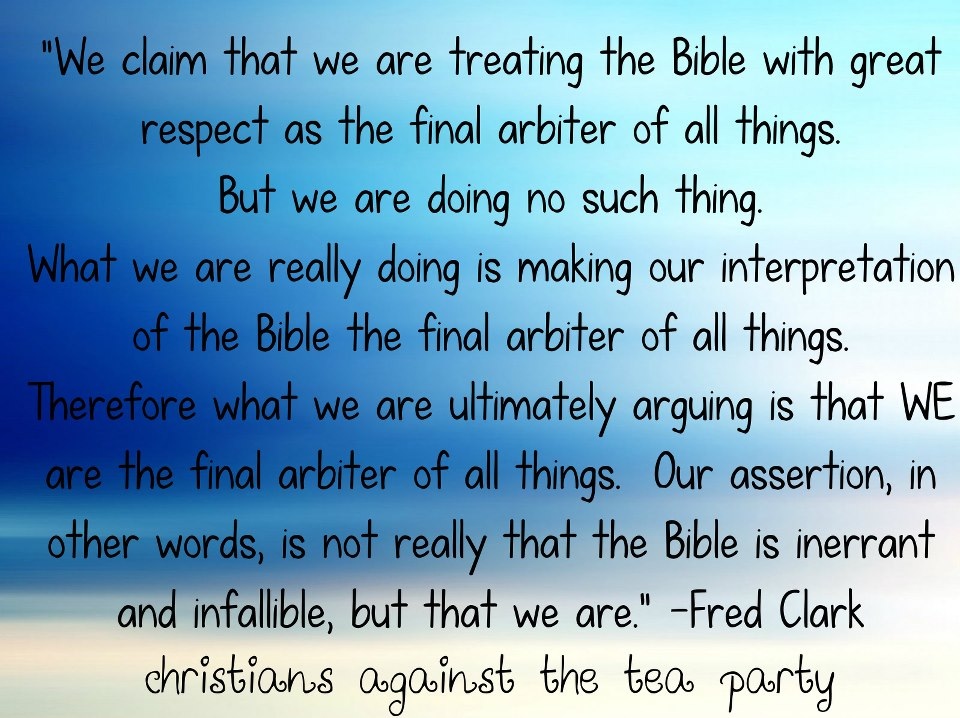
As I said yesterday, Fred’s quote rings very true to me, and it outlines something I myself have run up against. I don’t see how, as Chris claims, saying that evangelicals and fundamentalists are making “their interpretation of the Bible the final arbiter of all things” is “making stuff up about them” or “passing around” “obvious falsehoods” for the simple reason that I don’t think it’s a falsehood. I’d love to hear more from Chris on what exactly he means here, since his post is more of an assertion that an explanation.
But Chris’s post does raise some thoughts. The Bible is a mixed up jumble of books that has to be understood through some sort of interpretive framework. The fact that the doctrine of the Trinity is never stated explicitly and that early Christians argued for hundreds of years about the divinity or humanity of Christ makes this clear. This shouldn’t be surprising given that the Bible is an amalgam of material from different periods and by different authors and written for different purposes. Every Christian ever has formed some sort of grand interpretation of what is written in the Bible. The fact that evangelicals and fundamentalists sometimes change their minds, slightly shifting their interpretation, does not mean that they don’t nevertheless move forward holding to their slightly altered interpretations as Infallible Truth.
I think that one thing that is going on here is that evangelicals and fundamentalists claim over and over and over again that all they are doing is taking the Bible “at face value.” According to evangelicals and fundamentalists, they are the ones who are actually following the Bible and liberal Christians are not. Liberal Christians, they say, have rejected the Bible and simply do and believe whatever they think best. Because evangelicals and fundamentalists trumpet this message so loudly, it can be easy to end up taking them at their word.
Growing up as an evangelical, I accepted and internalized the message that we were the ones actually following the Bible and that all other Christians ignored or rejected it. When I went off to college and stepped out of my evangelical bubble, I was surprised to find that this was incorrect. For a time I stepped into liberal Christianity, glorying in the fascinating interpretations and understandings of the Bible I found there. Not every Christian approaches or understands the Bible identically.
I said yesterday that while I don’t see any reason to think the Bible is divinely inspired I do think some interpretations of the Bible are more “correct” than others. As an evangelical, there was very little examination of the cultural context of the Bible, and there certainly wasn’t any higher criticism. We thought that all we needed to understand what the Bible said was … the Bible. What I found in liberal Christianity was very different. There was an attempt to understand cultural context, a desire to truly dig into who wrote the different books and for what purposes, and a willingness to admit that some sections were added later and some passages doctored to prove a point. There was an openness to seeing the Bible as fallible and containing errors. I found that liberal Christians had a completely different approach to the Bible.
While I very much enjoyed exploring liberal Christian understandings and interpretations of the Bible, in the end I ended up realizing that I saw no reason at all to view the Bible as divinely inspired, or, indeed, as anything more than a man-made book. I also became a bit disillusioned at all that liberal Christians sometimes had to do to explain away certain passages or ideas. I began to feel that while liberal Christians did not stick their heads in the sand the way evangelicals and fundamentalists so often do, they, too, were concocting an interpretation of the Bible that, while more “correct” in a technical sense, also involved a selective reading. Of course, liberal Christians don’t claim to be bound by the Bible in the same way evangelicals and fundamentalists do, so seeing the Bible as more and more man-made was not the only thing that led me away from Christianity entirely (there was also the fact that basic Christian doctrine simply stopped making sense, and the fact that I realized that my “relationship with Jesus” was almost certainly just a figment of my imagination).
Anyway, after Chris posted the above James McGrath responded as follows:
There is a rather bizarre post by Chris Hallq on his blog “The Uncredible Hallq” in which he takes aim at liberal Christians, and in particular myself and Fred Clark.
…
Hallq … suggests that liberal Christians don’t point out that the problem with fundamentalists is not their own flawed perspective but the flawed text of the Bible itself, saying that this would involve admitting something that is “embarrassing to Christians of every stripe.”
To which I can do little but shake my head in disappointment that someone would criticize a phenomenon they understand so little and about the history of which they are so poorly informed.
Liberal Christianity pioneered Biblical criticism, the tools and methods that exposed the Bible’s fallibility. The methods and the results of that approach are widely embraced by atheists like Hallq. For them to then turn around and suggest that the results of them are an embarrassment to liberal Christians, rather than something liberal Christians were among the first to draw attention to, is rather insulting – as I’ve said before.
Like I said above, I think evangelicals and fundamentalists have been so good at getting their message out – the idea that they are following the Bible while other Christians ignore it – that they have a sort of cultural monopoly on the Bible. This is extremely unfortunate because liberal Christians’ interpretation of the Bible generally includes things like gender equality and social justice while evangelicals and fundamentalists’ interpretation of the Bible is incredibly harmful.
I’ve seen a good number of liberal Christian bloggers in recent months suggest that atheists read the Bible like fundamentalists. I have found this discussion fascinating. The conversation will go like this:
Atheist: “How could a loving God torture people in hell for eternity?”
Liberal Christian: “I don’t believe in hell.”
Atheist: “Wait, what? But the Bible is very clear that hell exists!”
And then the atheist will start pulling out proof texts like a fundamentalist. This same conversation takes place regarding creationism – “but the Bible says the world was created in six days!” – and the Old Testament genocides – “how can you say those didn’t happen? It says right here in plain English that they did!”
I think we atheists need to remember something: Not everyone interprets the Bible like a fundamentalist or evangelical. Liberal Christians are generally more than ready to admit that the Bible is flawed or contains errors. I think we can become so used to combating evangelicalism and fundamentalism that we forget that those strains of Christianity are both not the only ones out there and not the oldest ones out there either. In some sense, this is not surprising. Evangelical and fundamentalist positions are, after all, extremely easy to pick on. Further, evangelicals and fundamentalists are doing a lot of damage in our society today and it’s thus only natural that they should so often be the focus.
There is something else too, though. I think it can be easy to become so used to hearing the rhetoric of evangelicals and fundamentalists that we end up thinking that, as far as Christianity is concerned, the evangelicals and fundamentalists have it right and all others who call themselves “Christians” are doing it wrong. This is where we start trying to convince liberal Christians that yes, the Bible does say hell exists and means eternal torture, and yes, the Bible does say that God commands genocide, etc, forgetting that liberal Christians don’t approach the way evangelicals and fundamentalists do. Of course, some atheists may honestly be convinced that the evangelical/fundamentalist approach is the only intellectually honest Christian position out there, and that liberal Christians are just hedging. They may thus see convincing liberal Christians of this as a valid strategy in an attempt to get a liberal Christian to leave Christianity, and that’s fine. This is not, however, a strategy I use or necessarily think wise. I personally see it as overly simplistic and intellectually lazy. It also involves ignoring thousands of years of Christian history.
Now I’m not saying that we atheists can’t or shouldn’t discuss the problems we see with liberal Christian beliefs or faith in general. I’m not saying that we atheists should necessarily give liberal Christians a “pass.” What I am saying is that we need to be aware that just because fundamentalists and evangelicals claim to have a monopoly on the Bible does not mean that they do. We need to be aware that the set of tools and arguments we use against fundamentalists or evangelicals won’t always work on liberal Christians. We need to get over the idea that just because we understand evangelicalism and fundamentalism (or at least think we do) that does not mean that we automatically understand liberal Christianity. We need to stop siding with the evangelicals and fundamentalists when they say that they are interpreting the Bible “right” and those other Christians out there are doing it “wrong.”
Of course, some atheists are more concerned with helping improve the associations people have with the term “atheist” than with actually attacking religious beliefs. Some atheists are more concerned with protecting the separation of church and state than anything else. Some atheists focus on taking down evangelical and fundamentalist proofs for the existence of God while others are more interested in attacking the idea of “faith” in general. Some atheists focus on things like equality and social justice and are willing to make alliances with liberal Christians who share their goals and ideals in these areas. Some atheists don’t care about any of this and just focus on living their lives. Everyone has different interests and motivations, and that’s as it should be. But at the very least, we should avoid the assumption that evangelicals can or should speak for all Christians. At the very least we should be willing to admit the diversity of Christianity and careful to avoid thinking like fundamentalists.
For another really good discussion on this same issue over on Camels with Hammers, click over to Why Let the Fundamentalists Define Their Religions? It’s an excellent read.
Previous Post

October 22, 2012
Do you mean the Bible is inerrant, or that you are inerrant?
Next Post
October 23, 2012 A Few More Thoughts on the Bible
Browse Our Archives
Select a Category Atheism Evangelicalism/Fundamentalism Family Feminism Homeschool Meta Parenting Patriarchy Politics Purity Quiverfull Social Justice Uncategorized Worthwhile reads
Select a Month February 2021 January 2021 December 2020 November 2020 October 2020 September 2020 August 2020 July 2020 June 2020 May 2020 April 2020 March 2020 February 2020 January 2020 December 2019 November 2019 October 2019 September 2019 August 2019 July 2019 June 2019 May 2019 April 2019 March 2019 February 2019 January 2019 December 2018 November 2018 October 2018 September 2018 August 2018 July 2018 June 2018 May 2018 April 2018 March 2018 February 2018 January 2018 December 2017 November 2017 October 2017 September 2017 August 2017 July 2017 June 2017 May 2017 April 2017 March 2017 February 2017 January 2017 December 2016 November 2016 October 2016 September 2016 August 2016 July 2016 June 2016 May 2016 April 2016 March 2016 February 2016 January 2016 December 2015 November 2015 October 2015 September 2015 August 2015 July 2015 June 2015 May 2015 April 2015 March 2015 February 2015 January 2015 December 2014 November 2014 October 2014 September 2014 August 2014 July 2014 June 2014 May 2014 April 2014 March 2014 February 2014 January 2014 December 2013 November 2013 October 2013 September 2013 August 2013 July 2013 June 2013 May 2013 April 2013 March 2013 February 2013 January 2013 December 2012 November 2012 October 2012 September 2012 August 2012 July 2012 June 2012 May 2012 April 2012 March 2012 February 2012 January 2012 December 2011 November 2011 October 2011 September 2011 August 2011 July 2011 June 2011
Follow Us!
TAKE THE
Religious Wisdom Quiz
I carried a letter from the king giving me authority and resources to rebuild Jerusalem. Who am I?
Select your answer to see how you score.
Nehemiah Ezra Artaxerxes Zerubbabel
Related posts from Love, Joy, Feminism

Maybe Let's Not Read More Puritans

"So Your Problem with Christianity is the Jesus...

No, the "Second Shift" Isn't Feminism's Fault
TRENDING AT PATHEOS Nonreligious

Dethroning Jesus and Enthroning Yourself
Jesus Never Asked to Be Worshipped. He Asked to Be Understood. Christianity...

Why Most Christians are Really Paulians and Jobians
I Don't Care, But It Matters Let's get this out of the...

Essential Tips to Successfully Navigate the Selling Process
Selling a house can feel overwhelming, but it doesn’t have to be....

To Make Remote Work Effective, Think About Others
The COVID-19 pandemic forced many companies to rapidly transition to remote work....

Flexibility Is Key to Solving Problems of Tomorrow
The world of work is undergoing a dramatic transformation. The COVID-19 pandemic...
view all Nonreligious blogs
Ad-Free & Subscriber Log-In Subscription Support
- About Us
- 2026 Calendar
- Videos
- Podcasts
- Library of World Religions
- Faith In Media Tracker
- Advertise With Us
- Write for Us
- Privacy Policy
- Terms of Service
- Do Not Sell My Data
- Contact Us
- Radiant Digital
- Manage Newsletter Subscriptions
- Unsubscribe From Notifications
- Sitemap
Copyright 2008-2026, Patheos, part of the Radiant Digital network of media brands. All rights reserved.
Subscription Support Ad-Free & Subscriber Log-In
Follow Patheos