
BuddhistCatholicContemplativeEvangelicalGeneral ChristianHinduJewishLatter-day SaintMuslimNew VisionsProgressive Christian
Beliefs
- Buddhist
- Catholic
- Contemplative
- Evangelical
- General Christian
- Hindu
- Jewish
- Latter-day Saint
- More Voices
- Muslim
- New Visions
- Pagan
- Progressive Christian
Topics
- Religion News
- Food and Religion
- Sports and Religion
- Religious Art
- Religious Music and Entertainment
- Religious Events
- History and Religion
- Style and Religion
- Politics and Religion
- Women in Religion
- Recreation Outdoors and Religion
- Business Finance and Religion
- Careers Workplace and Religion
- Education and Religion
- Family Parenting and Religion
- Health Fitness and Religion
- Home and Religion
- Relationships and Religion
- Technology and Religion
- Travel and Religion
Columnists
- Buddhist Columnists
- Business Finance and Religion Columnists
- Careers Workplace and Religion Columnists
- Catholic Columnists
- Contemplative Columnists
- Education and Religion Columnists
- Evangelists Columnists
- Family Parenting and Religion Columnists
- General Christian Columnists
- Health Fitness and Religion Columnists
- Hindu Columnists
- History and Religion Columnists
- Home and Religion Columnists
- Jewish Columnists
- More Voices Columnists
- Latter Day Columnists
- Muslim Columnists
- New Visions Columnists
- Nonreligious Columnists
- Pagan Columnists
- Politics and Religion Columnists
- Progressive Columnists
- Recreation Outdoors and Religion Columnists
- Relationships and Religion Columnists
- Religion News Columnists
- Religious Art Columnists
- Religious Events Columnists
- Religious Music and Entertainment Columnists
- Sports and Religion Columnists
- Style and Religion Columnists
- Technology and Religion Columnists
- Travel and Religion Columnists
- Women in Religion Columnists
Resource Library
- 2026 Calendar
- Library of World Religions
- The 100 Most Holy Places on Earth
- Patheos Answers
- Podcasts
- Videos
- Faith Leaders Database
- Anglican Episcopalian
- Bahai
- Baptist
- Buddhism
- Christianity
- Confucianism
- Eastern Orthodoxy
- Hinduism
- Holiness and Pentecostal
- ISKCON
- Islam
- Judaism
- Lutheran
- Methodist
- The Church of Jesus Christ of Latter-day Saints
- New Age
- Paganism
- Presbytarian and Reformed
- Protestantism
- Religion Behind the Scenes
- Roman Catholic
- Scientology
- Shia Islam
- Sikhism
- Sufism
- Sunni Islam
- Taoism
- Zen
- See all religions
Research Tools
 Ad-Free & Subscriber Log-In Subscription Support
Ad-Free & Subscriber Log-In Subscription Support
Follow Patheos 

- Trending:
- Forgiveness
- |
- Marriage
- |
- Consciousness
- |
- Death Penalty
- |
- Election
- |
- Halloween
 Love, Joy, Feminism
-
More
- Home
- Nonreligious
- Do you mean the Bible is inerrant, or that you are inerrant?
Do you mean the Bible is inerrant, or that you are inerrant?
Last updated on: October 22, 2012 at 10:22 am by Libby Anne
Do you mean the Bible is inerrant, or that you are inerrant? 2012-10-22T10:22:40-04:00 Libby Anne
Patheos Explore the world's faith through different perspectives on religion and spirituality! Patheos has the views of the prevalent religions and spiritualities of the world.
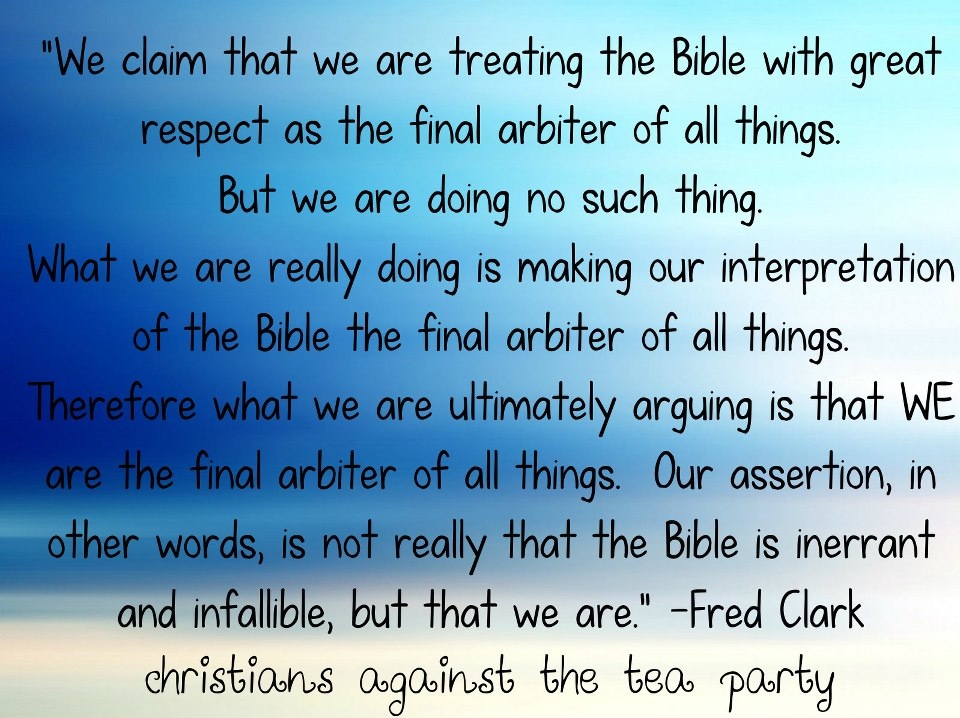
I recently came upon the following quote attributed to Fred Clark of The Slacktivist:
Text: “We claim that we are treating the Bible with great respect as the final arbiter of all things. What we are really doing is making our interpretation of the Bible the final arbiter of all things. Therefore what we are ultimately arguing is that WE are the final arbiter of all things. Our assertion, in other words, is not really that the Bible is inerrant and infallible, but that we are.”
Evangelicals and fundamentalists are not like Catholics. There is no one leader setting down doctrine and no accepted catechism of beliefs. Instead, evangelicals and fundamentalists insist that the Bible is the final authority in all things, and that all they are doing is following the Bible. The trouble is that not only do evangelicals and fundamentalists disagree with other faith traditions on how to interpret the Bible, they also disagree among themselves. In other words, while they all agree that the Bible is the final authority in all things, they do not and cannot agree on what the Bible means. This is why when the United States’ earliest public schools were founded they included Bible reading, but did not allow teachers to make any explanation at all of what was read – after all, every denomination agreed that the Bible was the inerrant word of God, but they could not agree on how to interpret it.
And this is where Fred’s quote comes in. Evangelicals and fundamentalists claim that they are simply following the Bible and holding it to be inerrant, but because there is disagreement on what the Bible actually says, Fred suggests that what they are really doing is holding their own interpretations as inerrant. And in doing that, they are holding themselves as inerrant.
There are two contributing factors that help convince evangelicals and fundamentalists that their interpretations are inerrant. First, they will claim that they are not “interpreting” the Bible at all, but simply accepting what it says at face value. This seems to make sense until you realize that that’s often not actually what they’re doing, and that besides, those claiming that they are simply accepting the Bible at face value inevitably contradict each other. Second, they will also claim that they are indwelt by the Holy Spirit, which helps them interpret the Bible and guides them to the correct understanding. Once again, this makes sense on some level until you realize that they all claim this and yet often contradict each other.
I ran into a lot of this with my own family when I began questioning some of their beliefs. At the time, mind you, I didn’t question the inerrancy and inspiration of the Bible. I simply questioned their understanding and interpretation of the Bible. But it didn’t matter. To them, I had questioned not simply their understanding of the Bible but the Bible itself. At the time, I wanted to ask “do you mean that the Bible is inerrant, or that you are inerrant?” But because my parents were convinced that their interpretation of the Bible was right and every other one was wrong, they would likely not have admitted the distinction. And of course, both they and I claimed to be listening to and following the lead of the Holy Spirit.
While many/most evangelicals and fundamentalists go to churches that belong to specific denominations and therefore embrace specific creeds or lists of beliefs, I grew up in a nondenominational megachurch. Basically, this meant that the senior pastor’s interpretation of the Bible was what went for the rest of the church. There are thousands of churches like this across the country, whether they are strictly nondenominational or nominally belong to a denomination, where the senior pastor (or only pastor, in the cases of small churches) sets the doctrine with his own personal interpretation of the Bible. Interestingly, replacing a senior pastor can be a very trying time for a nondenominational, more so than for churches that belong to denominations, because it’s so important for the church that the new pastor believe the same things the former pastor did.
For many in homeschooling families influenced by the Quiverfull and Christian Patriarchy movements, it’s less about what the pastor believes than about what their father beliefs. Some families even form “home churches,” making the supremacy of the father/pastor’s interpretation of the Bible completely obvious. In my case, we grew up knowing that even though we went to said nondenominational megachurch, we as a family disagreed with the theology and practice on several points. Why? Because dad disagreed.
Yet this very function of evangelicalism and fundamentalism that grants so much theological power to individual pastors or fathers also serves as a tool to be used in resistance. When I began questioning my father’s interpretation of the Bible, I used my own developing interpretation of that same book to buttress and support my arguments. Of course, doing so didn’t mean my father accepted my interpretations as valid. He didn’t. It meant, however, that I could use the Bible as a tool of resistance and that questioning my father’s beliefs did not necessarily have to mean giving up my faith entirely.
And here is where we get to the sticky point. What does all this tell us? Do all Christians who believe the Bible is inerrant in effect fancy themselves inerrant? The only way to get around the problem would be to arrive at the True and Correct Interpretation of the Bible. And there are Christian scholars who do study the history of the Bible, its cultural context, and the original languages in which it was written. There are Christian scholars who engage in higher criticism of the Bible, examining it as a text. Is it possible, then, to arrive at an objectively “true” and “correct” interpretation of the Bible?
The trouble I kept running into is that there are verses and passages that are downright contradictory. Whatever view you take, you’re going to have to explain some other passage away. You point to the verses about female submission to support complementarianism (i.e. patriarchy)? Okay, but what about instances of female leadership in the Bible? You have to explain those away. You point to instances of female leadership in the Bible to support egalitarianism? Okay, but what about the verses about female submission? You’re going to have to explain those away.
At this point it honestly appears to me that people find what they want to find in the Bible. You believe that women should be stay-at-home moms and homemakers? There’s an interpretation of the Bible just right for you. You believe that women should be able to get jobs alongside men, and that childcare should be shared between men and women? There’s an interpretation of the Bible just right for you, too! Personally, this is a huge part of why the Bible appears to me to be no more than a man-made book.
Note: After writing yesterday’s post I read an exchange between Chris Hallquist and James McGrath regarding this very quote by Fred Clark. Tomorrow I will respond to their posts with some additional thoughts.
Previous Post

October 22, 2012
Raised Evangelical: Rebekka's Story
Next Post
October 23, 2012 Who Owns the Bible?
Browse Our Archives
Select a Category Atheism Evangelicalism/Fundamentalism Family Feminism Homeschool Meta Parenting Patriarchy Politics Purity Quiverfull Social Justice Uncategorized Worthwhile reads
Select a Month February 2021 January 2021 December 2020 November 2020 October 2020 September 2020 August 2020 July 2020 June 2020 May 2020 April 2020 March 2020 February 2020 January 2020 December 2019 November 2019 October 2019 September 2019 August 2019 July 2019 June 2019 May 2019 April 2019 March 2019 February 2019 January 2019 December 2018 November 2018 October 2018 September 2018 August 2018 July 2018 June 2018 May 2018 April 2018 March 2018 February 2018 January 2018 December 2017 November 2017 October 2017 September 2017 August 2017 July 2017 June 2017 May 2017 April 2017 March 2017 February 2017 January 2017 December 2016 November 2016 October 2016 September 2016 August 2016 July 2016 June 2016 May 2016 April 2016 March 2016 February 2016 January 2016 December 2015 November 2015 October 2015 September 2015 August 2015 July 2015 June 2015 May 2015 April 2015 March 2015 February 2015 January 2015 December 2014 November 2014 October 2014 September 2014 August 2014 July 2014 June 2014 May 2014 April 2014 March 2014 February 2014 January 2014 December 2013 November 2013 October 2013 September 2013 August 2013 July 2013 June 2013 May 2013 April 2013 March 2013 February 2013 January 2013 December 2012 November 2012 October 2012 September 2012 August 2012 July 2012 June 2012 May 2012 April 2012 March 2012 February 2012 January 2012 December 2011 November 2011 October 2011 September 2011 August 2011 July 2011 June 2011
Follow Us!
TAKE THE
Religious Wisdom Quiz
What Jewish festival celebrates deliverance from Egypt?
Select your answer to see how you score.
Passover Purim Tabernacles Pentecost
Related posts from Love, Joy, Feminism

Maybe Let's Not Read More Puritans


"So Your Problem with Christianity is the Jesus...

No, the "Second Shift" Isn't Feminism's Fault
TRENDING AT PATHEOS Nonreligious

Dethroning Jesus and Enthroning Yourself
Jesus Never Asked to Be Worshipped. He Asked to Be Understood. Christianity...

Why Most Christians are Really Paulians and Jobians
I Don't Care, But It Matters Let's get this out of the...

Essential Tips to Successfully Navigate the Selling Process
Selling a house can feel overwhelming, but it doesn’t have to be....

To Make Remote Work Effective, Think About Others
The COVID-19 pandemic forced many companies to rapidly transition to remote work....

Flexibility Is Key to Solving Problems of Tomorrow
The world of work is undergoing a dramatic transformation. The COVID-19 pandemic...
view all Nonreligious blogs
Ad-Free & Subscriber Log-In Subscription Support
- About Us
- 2026 Calendar
- Videos
- Podcasts
- Library of World Religions
- Faith In Media Tracker
- Advertise With Us
- Write for Us
- Privacy Policy
- Terms of Service
- Do Not Sell My Data
- Contact Us
- Radiant Digital
- Manage Newsletter Subscriptions
- Unsubscribe From Notifications
- Sitemap
Copyright 2008-2026, Patheos. All rights reserved.
Subscription Support Ad-Free & Subscriber Log-In
Follow Patheos