
BuddhistCatholicContemplativeEvangelicalGeneral ChristianHinduJewishLatter-day SaintMuslimNew VisionsProgressive Christian
Beliefs
- Buddhist
- Catholic
- Contemplative
- Evangelical
- General Christian
- Hindu
- Jewish
- Latter-day Saint
- More Voices
- Muslim
- New Visions
- Pagan
- Progressive Christian
Topics
- Religion News
- Food and Religion
- Sports and Religion
- Religious Art
- Religious Music and Entertainment
- Religious Events
- History and Religion
- Style and Religion
- Politics and Religion
- Women in Religion
- Recreation Outdoors and Religion
- Business Finance and Religion
- Careers Workplace and Religion
- Education and Religion
- Family Parenting and Religion
- Health Fitness and Religion
- Home and Religion
- Relationships and Religion
- Technology and Religion
- Travel and Religion
Columnists
- Buddhist Columnists
- Business Finance and Religion Columnists
- Careers Workplace and Religion Columnists
- Catholic Columnists
- Contemplative Columnists
- Education and Religion Columnists
- Evangelists Columnists
- Family Parenting and Religion Columnists
- General Christian Columnists
- Health Fitness and Religion Columnists
- Hindu Columnists
- History and Religion Columnists
- Home and Religion Columnists
- Jewish Columnists
- More Voices Columnists
- Latter Day Columnists
- Muslim Columnists
- New Visions Columnists
- Nonreligious Columnists
- Pagan Columnists
- Politics and Religion Columnists
- Progressive Columnists
- Recreation Outdoors and Religion Columnists
- Relationships and Religion Columnists
- Religion News Columnists
- Religious Art Columnists
- Religious Events Columnists
- Religious Music and Entertainment Columnists
- Sports and Religion Columnists
- Style and Religion Columnists
- Technology and Religion Columnists
- Travel and Religion Columnists
- Women in Religion Columnists
Resource Library
- 2026 Calendar
- Library of World Religions
- The 100 Most Holy Places on Earth
- Patheos Answers
- Podcasts
- Videos
- Faith Leaders Database
- Anglican Episcopalian
- Bahai
- Baptist
- Buddhism
- Christianity
- Confucianism
- Eastern Orthodoxy
- Hinduism
- Holiness and Pentecostal
- ISKCON
- Islam
- Judaism
- Lutheran
- Methodist
- The Church of Jesus Christ of Latter-day Saints
- New Age
- Paganism
- Presbytarian and Reformed
- Protestantism
- Religion Behind the Scenes
- Roman Catholic
- Scientology
- Shia Islam
- Sikhism
- Sufism
- Sunni Islam
- Taoism
- Zen
- See all religions
Research Tools
 Ad-Free & Subscriber Log-In Subscription Support
Ad-Free & Subscriber Log-In Subscription Support
Follow Patheos 

- Trending:
- Forgiveness
- |
- Marriage
- |
- Consciousness
- |
- Death Penalty
- |
- Election
- |
- Halloween
 Love, Joy, Feminism
-
More
- Home
- Nonreligious
- Catholicism and My Desire for Beauty
Catholicism and My Desire for Beauty
Last updated on: August 7, 2012 at 9:59 pm by Libby Anne
Catholicism and My Desire for Beauty 2012-08-07T21:59:14-04:00 Libby Anne
Patheos Explore the world's faith through different perspectives on religion and spirituality! Patheos has the views of the prevalent religions and spiritualities of the world.
I wrote several days ago about how I was attracted to Catholicism because it offered me infallibility immediately after my belief in the infallibility of the Bible had been shaken. A second reason I was attracted to Catholicism was the beauty and ritual it offered.

The first Catholic mass I ever went to was Easter vigil. I went with some Catholic college friends because I was curious. Easter vigil begins at 9:00 p.m. the night before Easter and ends at midnight. It starts outside with a huge bonfire, and then proceeds inside.
(As a side note, Catholics “proceed” completely differently than fundamentalists or evangelicals; there are lighted candles, there is solemn or joyful music, there is incense and collective motion. In a fundamentalist or evangelical church everyone would just walk from point A to point B talking and chatting.)
Anyway, inside there is beautiful music, there are beautiful prayers, there is scripture reading and incense and ceremony. At Easter vigil, catechumens are baptized and join the Church. (This surprised me. People joined the Catholic Church? I thought it only went the other way – people leaving the Catholic Church.) At midnight, I left the church slightly shaken, because what I’d experienced was so beautiful and so fundamentally moving.
At the church I grew up in, church services went like this: Everyone comes in and finds a seat, chatting as they do so. The worship leader and the worship team take the stage and lead the congregation in song for a half hour. Someone comes up and makes announcements. Offering is taken while a final song is sung. The pastor comes in and preaches for half an hour. Then it’s over. We didn’t even have communion more than once every three or four months. Simple, straightforward, plain.
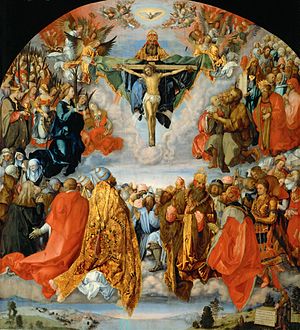
In contrast to the church of my upbringing, the Catholic Church offered beauty and ritual every single week. Communion was treated as something wonderful, something to marvel at, and the mass followed thousands of years of tradition (the Catholic Church literally tries to structure its mass after what we know of the earliest early church meetings from the writings that survive). I was fascinated by the beauty I found, and I delved into Catholic teaching in an effort to understand what it all meant.
I met saints and early church fathers, I learned the meaning behind each step of the mass, I read about the history behind the Eucharist and baptism, and there was something intrinsically compelling about it. I loved the history the Catholic Church offered, and I loved that everything meant something, and often something ancient, something tying me to generations of Catholics. As I came to understand the Eucharist, to understand the reasoning behind infant baptism, to understand the importance of first communion and confirmation, it all fit together into a beautiful experience of collective Christian life that spanned both centuries and nations.
I also loved that the mass and the beliefs were the same no matter what Catholic Church you happened to step into. I first wondered if the Catholic church I was attending at college was an exception, was perhaps the only Catholic Church where people spoke with love and understanding of Jesus and seemed to lead rich spiritual lives, so I tried some other churches and found them to be the same. Every Catholic church practices the same mass and adheres to the same catechism. This was so different from the Protestant churches I was familiar with, where every church taught something different. I loved this universalism. I loved feeling tied together with millions and millions of other Christians by the same prayers and same beliefs.

A lot of fundamentalists see Catholic ritual as something that comes between the Christian and God, blocking what should be a clear and open communication. Actually, I found it to be the opposite. The ritual, the meaning, the connection to other Christians past and present, it all enhanced my understanding of God. Reading the lives of the Saints and talking to them made me feel closer to God, not further from him. (The Catholic Church holds to something called “the communion of the Saints.” Basically, the Saints in heaven can hear what we say to them and are interested in our lives, so when we’re going through something similar to what one of them did, we can talk to them and find comfort in our understanding.) I found that Catholic ritual made my relationship with God more beautiful and more deep, not more cloudy or distant. The history, the millenia of theology and great religious thinkers, the century upon century of role models – I loved it.

I didn’t leave the Catholic Church because I stopped loving all of this. I still do. I still find the Catholic Church attractive, and I still enjoy attending mass now and then. I love the beauty, the depth, the history, the meaning. I left the Catholic Church simply because (a) I found some of its beliefs and practices troubling (i.e. those on sexuality) and (b) certain universal Christian doctrines, like substitutionary atonement and the trinity, stopped making sense to me. I still think the ritual, community, and universality of the Catholic Church is beautiful, and I probably always will.
Previous Post

November 18, 2011
Catholicism and My Search for Infallibility
Next Post
November 20, 2011 Religious Homophobia, Gay Youth, and Unconditional Love
Browse Our Archives
Select a Category Atheism Evangelicalism/Fundamentalism Family Feminism Homeschool Meta Parenting Patriarchy Politics Purity Quiverfull Social Justice Uncategorized Worthwhile reads
Select a Month February 2021 January 2021 December 2020 November 2020 October 2020 September 2020 August 2020 July 2020 June 2020 May 2020 April 2020 March 2020 February 2020 January 2020 December 2019 November 2019 October 2019 September 2019 August 2019 July 2019 June 2019 May 2019 April 2019 March 2019 February 2019 January 2019 December 2018 November 2018 October 2018 September 2018 August 2018 July 2018 June 2018 May 2018 April 2018 March 2018 February 2018 January 2018 December 2017 November 2017 October 2017 September 2017 August 2017 July 2017 June 2017 May 2017 April 2017 March 2017 February 2017 January 2017 December 2016 November 2016 October 2016 September 2016 August 2016 July 2016 June 2016 May 2016 April 2016 March 2016 February 2016 January 2016 December 2015 November 2015 October 2015 September 2015 August 2015 July 2015 June 2015 May 2015 April 2015 March 2015 February 2015 January 2015 December 2014 November 2014 October 2014 September 2014 August 2014 July 2014 June 2014 May 2014 April 2014 March 2014 February 2014 January 2014 December 2013 November 2013 October 2013 September 2013 August 2013 July 2013 June 2013 May 2013 April 2013 March 2013 February 2013 January 2013 December 2012 November 2012 October 2012 September 2012 August 2012 July 2012 June 2012 May 2012 April 2012 March 2012 February 2012 January 2012 December 2011 November 2011 October 2011 September 2011 August 2011 July 2011 June 2011
Follow Us!
TAKE THE
Religious Wisdom Quiz
What did fire from heaven consume to prove Elijah's God was real?
Select your answer to see how you score.
The temple Sacrifice on Mount Carmel A chariot A golden calf
Related posts from Love, Joy, Feminism

Maybe Let's Not Read More Puritans


"So Your Problem with Christianity is the Jesus...

No, the "Second Shift" Isn't Feminism's Fault
TRENDING AT PATHEOS Nonreligious

Dethroning Jesus and Enthroning Yourself
Jesus Never Asked to Be Worshipped. He Asked to Be Understood. Christianity...

Why Most Christians are Really Paulians and Jobians
I Don't Care, But It Matters Let's get this out of the...

Essential Tips to Successfully Navigate the Selling Process
Selling a house can feel overwhelming, but it doesn’t have to be....

To Make Remote Work Effective, Think About Others
The COVID-19 pandemic forced many companies to rapidly transition to remote work....

Flexibility Is Key to Solving Problems of Tomorrow
The world of work is undergoing a dramatic transformation. The COVID-19 pandemic...
view all Nonreligious blogs
Ad-Free & Subscriber Log-In Subscription Support
- About Us
- 2026 Calendar
- Videos
- Podcasts
- Library of World Religions
- Faith In Media Tracker
- Advertise With Us
- Write for Us
- Privacy Policy
- Terms of Service
- Do Not Sell My Data
- Contact Us
- Radiant Digital
- Manage Newsletter Subscriptions
- Unsubscribe From Notifications
- Sitemap
Copyright 2008-2026, Patheos. All rights reserved.
Subscription Support Ad-Free & Subscriber Log-In
Follow Patheos