
BuddhistCatholicContemplativeEvangelicalGeneral ChristianHinduJewishLatter-day SaintMuslimNew VisionsProgressive Christian
Beliefs
- Buddhist
- Catholic
- Contemplative
- Evangelical
- General Christian
- Hindu
- Jewish
- Latter-day Saint
- More Voices
- Muslim
- New Visions
- Pagan
- Progressive Christian
Topics
- Religion News
- Food and Religion
- Sports and Religion
- Religious Art
- Religious Music and Entertainment
- Religious Events
- History and Religion
- Style and Religion
- Politics and Religion
- Women in Religion
- Recreation Outdoors and Religion
- Business Finance and Religion
- Careers Workplace and Religion
- Education and Religion
- Family Parenting and Religion
- Health Fitness and Religion
- Home and Religion
- Relationships and Religion
- Technology and Religion
- Travel and Religion
Columnists
- Buddhist Columnists
- Business Finance and Religion Columnists
- Careers Workplace and Religion Columnists
- Catholic Columnists
- Contemplative Columnists
- Education and Religion Columnists
- Evangelists Columnists
- Family Parenting and Religion Columnists
- General Christian Columnists
- Health Fitness and Religion Columnists
- Hindu Columnists
- History and Religion Columnists
- Home and Religion Columnists
- Jewish Columnists
- More Voices Columnists
- Latter Day Columnists
- Muslim Columnists
- New Visions Columnists
- Nonreligious Columnists
- Pagan Columnists
- Politics and Religion Columnists
- Progressive Columnists
- Recreation Outdoors and Religion Columnists
- Relationships and Religion Columnists
- Religion News Columnists
- Religious Art Columnists
- Religious Events Columnists
- Religious Music and Entertainment Columnists
- Sports and Religion Columnists
- Style and Religion Columnists
- Technology and Religion Columnists
- Travel and Religion Columnists
- Women in Religion Columnists
Resource Library
- 2026 Calendar
- Library of World Religions
- The 100 Most Holy Places on Earth
- Patheos Answers
- Podcasts
- Videos
- Faith Leaders Database
- Anglican Episcopalian
- Bahai
- Baptist
- Buddhism
- Christianity
- Confucianism
- Eastern Orthodoxy
- Hinduism
- Holiness and Pentecostal
- ISKCON
- Islam
- Judaism
- Lutheran
- Methodist
- The Church of Jesus Christ of Latter-day Saints
- New Age
- Paganism
- Presbytarian and Reformed
- Protestantism
- Religion Behind the Scenes
- Roman Catholic
- Scientology
- Shia Islam
- Sikhism
- Sufism
- Sunni Islam
- Taoism
- Zen
- See all religions
Research Tools
 Ad-Free & Subscriber Log-In Subscription Support
Ad-Free & Subscriber Log-In Subscription Support
Follow Patheos 

- Trending:
- Forgiveness
- |
- Marriage
- |
- Consciousness
- |
- Death Penalty
- |
- Election
- |
- Halloween
 Love is an Orientation
- Home
- Evangelical
- The Bible’s Answer to the Problem of Sexism (Part 1)
The Bible’s Answer to the Problem of Sexism (Part 1)
Last updated on: June 16, 2014 at 2:33 pm by Andrew Marin
The Bible’s Answer to the Problem of Sexism (Part 1) 2014-06-16T14:33:25-05:00 Andrew Marin
Patheos Explore the world's faith through different perspectives on religion and spirituality! Patheos has the views of the prevalent religions and spiritualities of the world.
 The following post is by Jason Bilbrey, our Director of Pastoral Care here at The Marin Foundation. You can read more from Jason at his blog, www.jasonbilbrey.com or follow him on Twitter at @JasonBilbrey.
I’m not very active on Twitter, but even I couldn’t remain ignorant of the hashtag #YesAllWomen that catalyzed national (and international) dialogue on gender relations last weekend in the wake of Elliot Rodger’s misogynistic killing spree in Santa Barbara. While my understanding of the problem was broadened by the sheer number of contributions from women all over the world, one tweet in particular actually amended my personal definition of sexism:
“‘I have a boyfriend’ is the easiest way to get a man to leave you alone. Because he respects another man more than you. #yesallwomen” (from @JBRylah).
I know this tweet is painting with pretty broad strokes, but it highlights an aspect of sexism that goes beyond objectification. It’s about ownership. It’s about territory. It’s about men becoming possessors, and women becoming possessions.
The Bible, perhaps unsurprisingly, is full of examples. Exhibit A: “Thou shalt not covet.” This is the tenth commandment in its abbreviated form, which, let’s face it, is better for Sunday School posters. It also also gives the Ten Commandments an air of universality. They seem timeless and true for all ages. But the unabridged version chips away at this perception:
“You shall not covet your neighbor’s house. You shall not covet your neighbor’s wife, or his male or female servant, his ox or donkey, or anything that belongs to your neighbor” (Exodus 20:17, NIV).
All of a sudden, the Ten Commandments don’t seem so timeless. They assume a male audience, and list a male neighbor’s wife among his other possessions (like his slaves, tellingly). Coveting, within this context, is not synonymous with lusting or objectifying. Coveting is not an offense against the woman, but against her husband. Nor is it a matter of the heart, but a matter of keeping community peace, much like “You shall not give false testimony against your neighbor,” or “You shall not steal.”
To talk about women so nonchalantly in the context of property rights is jarring to us today. The blunt truth is women were indeed seen as property in many ancient patriarchal societies. And the Bible’s role in either propagating or merely reflecting this reality is worthy of a hundred books, not just one blog post. But I would argue what seems, from our vantage point, to be abhorrently backward might have been fairly progressive for its time.
Like being forced to marry your rapist. It’s hard to find an example more offensive to our modern sensibilities than the law outlined in Deuteronomy 22:28-29:
“If a man happens to meet a virgin who is not pledged to be married and rapes her and they are discovered, he shall pay her father fifty shekels of silver. He must marry the young woman, for he has violated her. He can never divorce her as long as he lives.”
There’s so much going on in this text, it’s hard to know where to start. If this reads like tacit approval of rape to you, I won’t argue. The powerlessness of the woman being molested is compounded by her powerless in the economic transaction to follow. One day she is the property of her father, and the next she is violently possessed and purchased by another man. Her value is in her virginity, which literally has a price: fifty shekels of silver. Of course, the woman isn’t paid any of it (as if she were the owner of her own body), and must live the rest of her life married to her rapist. This scenario is so bleak it’s easy to miss what the purpose of this law is, which is (and stay with me here) to protect women.
To show you what I mean, let’s look at how this played out with Tamar in II Samuel 13. Tamar had a stalker, her own brother Amnon. One day, Tamar gets word Amnon is sick and wants her to come to his tent and make him some food. The whole time she’s baking bread, Amnon watches her like a creep. He sends everyone else out of the tent. He wants her to hand feed him in bed. Then, of course, he rapes her.
The most remarkable part of the story is Tamar’s response when Amnon is finished with her and tells her to get out: “No!” she said to him. “Sending me away would be a greater wrong than what you have already done to me” (II Sam. 13:16). Why on earth would she say something like that? How does she not find her brother so repulsive that she runs as soon as she has the chance?
Here’s why: In a society where women are possessions, they can be thrown away when they lose their value. Tamar losing her virginity outside this system of property transaction places her in a position of incredible economic vulnerability. And the story unfortunately verifies that risk, ending with Amnon’s refusal to marry her, and Tamar living the rest of her life “a desolate woman.”
Perhaps the law closest to “marry your rape victim” is “marry your dead brother’s widow” (Deut 25:5, obviously paraphrased). In both cases, they are concerned with protecting women in danger of having no place in society. That’s the dramatic tension that drives the account of Ruth and Naomi, for example. Ruth and her mother-in-law, Naomi, have no business surviving in a patriarchal society after their husbands die. But they do. It seems that they also have no business having their own book of the Bible, told from their perspective. But they do.
I’d argue that there’s a subtle disruption of gender hierarchy at work here in the Old Testament–in the laws, in the stories. But it’s way too subtle. It need to be more explicit, and with the coming of Jesus, it will be. If much of the Old Testament worked within this system of oppression to advocate for women, the New Testament works to dismantle the system entirely.
But that’s part 2. I hope you’ll join me then.
Previous Post

May 27, 2014
Share Your Story of Compelling Love
Next Post
June 6, 2014 Special Living in the Tension Gathering: Preventing LGBTQ Teen Suicide
Browse Our Archives
Select a Category Book Reviews Bridging Opposing Worldviews Culture Don't Drink and Drive Faith Guest Posts I'm Sorry Campaign Interviews Language Laura Statesir LGBT Living in the Tension Living in the Tension Gatherings Love Is an Orientation Love Is an Orientation Blog Love Is an Orientation Book Love Is an Orientation DVD Melinda Guerra Memory My One Sentence Bible Newsletter Our Last Option Parents & Families Politics Quick Quotes Quotes ReEngaging Civility Sexuality Speaking The Marin Foundation Theology Uncategorized Us Versus Us Videos Warren Perry Youth and Campus Ministry
Select a Month June 2016 May 2016 December 2015 June 2015 May 2015 April 2015 March 2015 February 2015 January 2015 December 2014 November 2014 October 2014 September 2014 August 2014 July 2014 June 2014 May 2014 April 2014 March 2014 February 2014 January 2014 December 2013 November 2013 October 2013 September 2013 August 2013 July 2013 June 2013 May 2013 April 2013 March 2013 February 2013 January 2013 December 2012 November 2012 October 2012 September 2012 August 2012 July 2012 June 2012 May 2012 April 2012 March 2012 February 2012 January 2012 December 2011 November 2011 October 2011 September 2011 August 2011 July 2011 June 2011 May 2011 April 2011 March 2011 February 2011 January 2011 December 2010 November 2010 October 2010 September 2010 August 2010 July 2010 June 2010 May 2010 April 2010 March 2010 February 2010 January 2010 December 2009 November 2009 October 2009 September 2009 August 2009 July 2009 June 2009 May 2009 April 2009 March 2009 February 2009 January 2009 December 2008 November 2008 October 2008 September 2008
Follow Us!
TAKE THE
Religious Wisdom Quiz
Who was Melchizedek?
Select your answer to see how you score.
A priest and king An angel A prophet A Roman official
Related posts from Love is an Orientation

Don't Let Your Anger Turn Into Their Hate


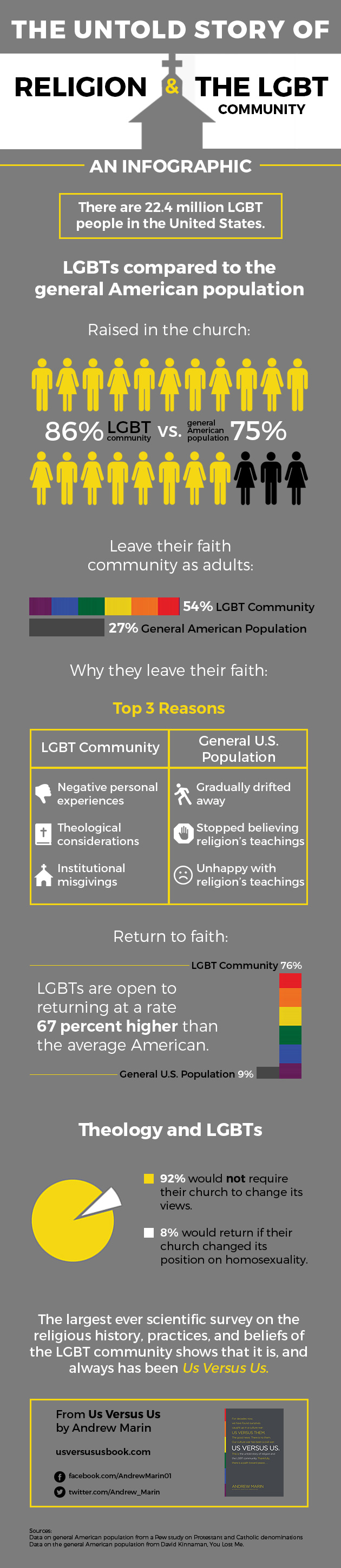
Great Infographic for Research Findings in Us Versus...
TRENDING AT PATHEOS Evangelical

The REST of Your Life: A Creative Wrestles...
This week I had a conversation with a good friend from church....

How the author of the world's best hymn...
I've been working with John Newton for a while now. This makes...

Long before this Lectio Divina, Psalm 130 - the song - started...

What About the Trees? Another Living Parable
After I finished writing the last article about falling leaves as a...

Why Classical Education Is a Conversation, Not a...
Come and Read: Joy in Classical Education When I was a little...

Cornell University has received a great deal of negative publicity and intense...
view all Evangelical blogs
Ad-Free & Subscriber Log-In Subscription Support
- About Us
- 2026 Calendar
- Videos
- Podcasts
- Library of World Religions
- Faith In Media Tracker
- Advertise With Us
- Write for Us
- Privacy Policy
- Terms of Service
- Do Not Sell My Data
- Contact Us
- Radiant Digital
- Manage Newsletter Subscriptions
- Unsubscribe From Notifications
- Sitemap
Copyright 2008-2026, Patheos. All rights reserved.
Subscription Support Ad-Free & Subscriber Log-In
Follow Patheos