
BuddhistCatholicContemplativeEvangelicalGeneral ChristianHinduJewishLatter-day SaintMuslimNew VisionsProgressive Christian
Beliefs
- Buddhist
- Catholic
- Contemplative
- Evangelical
- General Christian
- Hindu
- Jewish
- Latter-day Saint
- More Voices
- Muslim
- New Visions
- Pagan
- Progressive Christian
Topics
- Religion News
- Food and Religion
- Sports and Religion
- Religious Art
- Religious Music and Entertainment
- Religious Events
- History and Religion
- Style and Religion
- Politics and Religion
- Women in Religion
- Recreation Outdoors and Religion
- Business Finance and Religion
- Careers Workplace and Religion
- Education and Religion
- Family Parenting and Religion
- Health Fitness and Religion
- Home and Religion
- Relationships and Religion
- Technology and Religion
- Travel and Religion
Columnists
- Buddhist Columnists
- Business Finance and Religion Columnists
- Careers Workplace and Religion Columnists
- Catholic Columnists
- Contemplative Columnists
- Education and Religion Columnists
- Evangelists Columnists
- Family Parenting and Religion Columnists
- General Christian Columnists
- Health Fitness and Religion Columnists
- Hindu Columnists
- History and Religion Columnists
- Home and Religion Columnists
- Jewish Columnists
- More Voices Columnists
- Latter Day Columnists
- Muslim Columnists
- New Visions Columnists
- Nonreligious Columnists
- Pagan Columnists
- Politics and Religion Columnists
- Progressive Columnists
- Recreation Outdoors and Religion Columnists
- Relationships and Religion Columnists
- Religion News Columnists
- Religious Art Columnists
- Religious Events Columnists
- Religious Music and Entertainment Columnists
- Sports and Religion Columnists
- Style and Religion Columnists
- Technology and Religion Columnists
- Travel and Religion Columnists
- Women in Religion Columnists
Resource Library
- 2026 Calendar
- Library of World Religions
- The 100 Most Holy Places on Earth
- Patheos Answers
- Podcasts
- Videos
- Faith Leaders Database
- Anglican Episcopalian
- Bahai
- Baptist
- Buddhism
- Christianity
- Confucianism
- Eastern Orthodoxy
- Hinduism
- Holiness and Pentecostal
- ISKCON
- Islam
- Judaism
- Lutheran
- Methodist
- The Church of Jesus Christ of Latter-day Saints
- New Age
- Paganism
- Presbytarian and Reformed
- Protestantism
- Religion Behind the Scenes
- Roman Catholic
- Scientology
- Shia Islam
- Sikhism
- Sufism
- Sunni Islam
- Taoism
- Zen
- See all religions
Research Tools
 Ad-Free & Subscriber Log-In Subscription Support
Ad-Free & Subscriber Log-In Subscription Support
Follow Patheos 

- Trending:
- Forgiveness
- |
- Marriage
- |
- Consciousness
- |
- Death Penalty
- |
- Election
- |
- Halloween
 Love is an Orientation
- Home
- Evangelical
- “Bigot”
“Bigot”
Last updated on: November 18, 2013 at 10:09 am by Andrew Marin
“Bigot” 2013-11-18T10:09:53-06:00 Andrew Marin
Patheos Explore the world's faith through different perspectives on religion and spirituality! Patheos has the views of the prevalent religions and spiritualities of the world.
 The following post is by Jason Bilbrey, Director of Pastoral Care at The Marin Foundation. You can read more from Jason at his blog, www.jasonbilbrey.com.
I was recently having lunch with a friend. Great guy. Conservative in a mainstream Evangelical way and also really bright, reasonable and charitable. I’ve known him for years. We were talking about (what else, right?) homosexuality and the LGBT community.
“I never know how to engage in this conversation,” he said. “It’s not like I don’t have strong convictions, I’m just hesitant to voice them. I don’t want to be–”
“Labeled a bigot?” I asked.
“Exactly!”
I could finish his thought not so much because we’re great friends–though we are–but because this is a sentiment I’ve heard again and again from other conservatives I talked to. This particular epithet, “Bigot,” seems to strike a nerve.
I’m sure this is good news to many LGBT folks and their allies. As public opinion shifts in favor of gay rights and marriage equality, perhaps it’s time for those holding to a traditional/conservative stance on the issue to be the recipients of stigma, rather than the perpetrators. And I can’t deny that there’s a part of me that finds this turning of the tables deliciously ironic.
And yet, sitting in my friend’s living room, I looked at him and said, “You’re not a bigot.” To me, it’s not a conservative/traditional stance on homosexuality that makes you a bigot. It’s how you act on those beliefs. In other words, bigotry is not a thought, it’s an expression.
Let me be the first to say that this is not a water-tight definition. If I make the comparison to, say, civil rights, I could easily see how someone might be deemed a racist simply for believing that black folks should be excluded from the rights and privileges that white folks enjoy. You wouldn’t have to act on that belief, necessarily, to earn the label of “racist.” I can see how a similar kind of labeling might befit someone who simply believes that LGBT folks should be excluded from the rights and privileges straight folks enjoy.
But to parse out the difference between beliefs and actions, let me offer a few counterexamples:
1. I’m a feminist. I believe that women are equally capable and deserving as men to hold positions of power. So my wife and I are pretty egalitarian and non-traditional in our marriage. She works full-time and does the finances (she’s better at them), and I’m the primary caregiver to our daughter. Now, we have many married friends who have a defined set of gender roles and expectations. For them, the husband is the head of the house. I can roll my eyes every time the wife talks about “submitting to her husband in love” (without the qualification that he should reciprocate), but at the end of the day, I have to look at how their marriage functions and whether or not they honor each other. In other words, I’m pretty hesitant to label the guy a “misogynist” or “sexist” if the expression of his beliefs about gender differences speak to his love for his wife.
2. I’m a pacifist. I believe killing people is always wrong. But I fully realize that that belief, if inappropriately expressed, could earn me any number of undesirable labels (ingrate, apostate, a**hole), especially on days like Veterans Day, which our nation celebrated just last week. I can be a pacifist and still acknowledge and voice my gratitude for those who served our country protecting freedoms that I enjoy everyday (many in my own family). I would argue it’s not my conviction about non-violence itself that warrants any of those undesirable labels, it’s how I act on it. It’s not the what. It’s the how, when, why and to whom.
Likewise, to me the term “bigot” seems best reserved for those who manifest their conservative beliefs about homosexuality in ways that seek to offend, defame or impoverish the LGBT community. It’s not that anti-gay beliefs in and of themselves are harmless, but bigotry is a strong term and it should be a designation of equally strong characteristics.
Ok, I’ve made my case for a working definition of bigot: not beliefs, but harmful expressions of those beliefs. Here’s one caveat to my definition: it’s hard to imagine someone having conservative/traditional beliefs about homosexuality going their whole life without ever giving harmful expression to those beliefs in some (perhaps unintentional) way, especially with marriage for gay and lesbian individuals showing up in more and more ballot boxes across the country. (Did I mention my definition isn’t water-tight?)
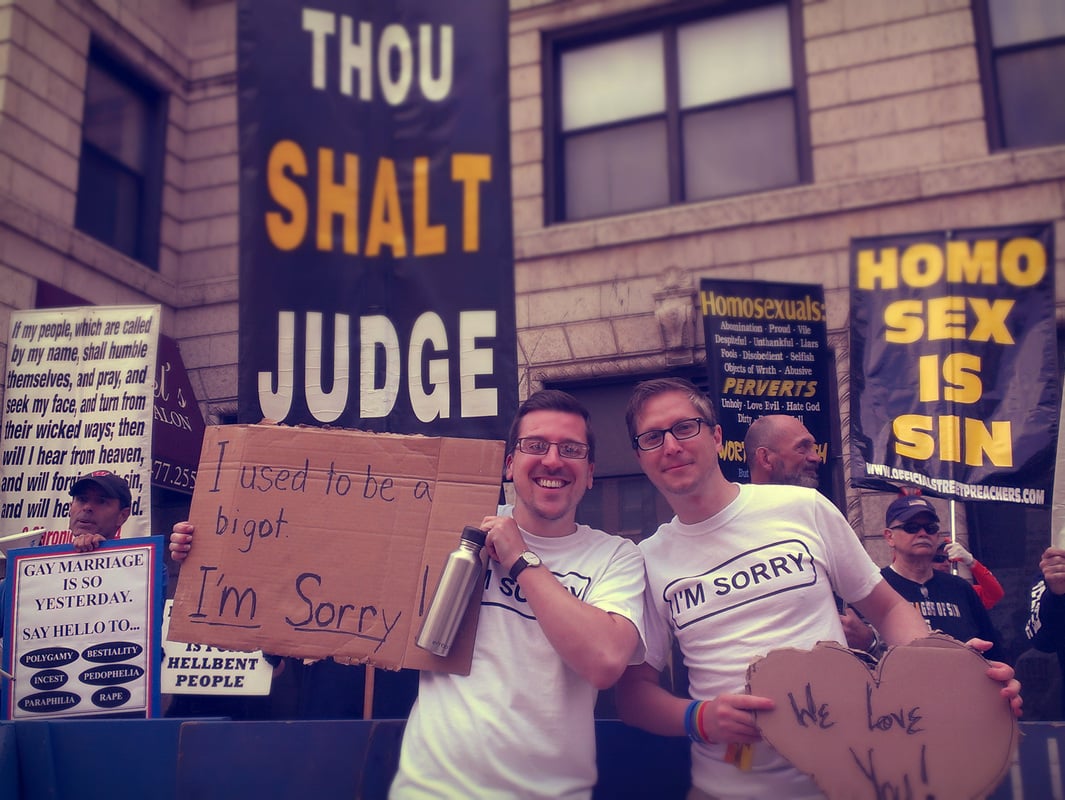
I’m not out to police people’s appropriation of certain terms, and I do think there is a time to use strong and inflammatory language. (Case in point, I used the word “bigot” in the picture above, which was taken at TMF’s I’m Sorry Campaign during Chicago’s Gay Pride Parade). But I think Brent’s post last week is spot on. Strong language risks coming across as alienating, dismissive and conversation-ending.
I told my friend, the not-a-bigot one, that if we had a mutual friend who was gay, I couldn’t imagine there would be any difference between the way he and I treated that person. He agreed. And to me, that’s what it all comes down to. I don’t care what you think about same-sex relationships and intercourse. I don’t care what you believe about the LGBT community. I don’t care how you define marriage. What I care about is how you manifest those convictions.
So, I’m going to toss all this out to you, dear readers. How do you personally define the word bigot? What am I missing? What’s wrong about my definition? What’s right about it? I’ll meet you in the comments.
Much love.
Previous Post

November 15, 2013
Living in the Tension Gathering - 11/18
Next Post
November 20, 2013 The Self is Hardly a Neutral Observer of the World
Browse Our Archives
Select a Category Book Reviews Bridging Opposing Worldviews Culture Don't Drink and Drive Faith Guest Posts I'm Sorry Campaign Interviews Language Laura Statesir LGBT Living in the Tension Living in the Tension Gatherings Love Is an Orientation Love Is an Orientation Blog Love Is an Orientation Book Love Is an Orientation DVD Melinda Guerra Memory My One Sentence Bible Newsletter Our Last Option Parents & Families Politics Quick Quotes Quotes ReEngaging Civility Sexuality Speaking The Marin Foundation Theology Uncategorized Us Versus Us Videos Warren Perry Youth and Campus Ministry
Select a Month June 2016 May 2016 December 2015 June 2015 May 2015 April 2015 March 2015 February 2015 January 2015 December 2014 November 2014 October 2014 September 2014 August 2014 July 2014 June 2014 May 2014 April 2014 March 2014 February 2014 January 2014 December 2013 November 2013 October 2013 September 2013 August 2013 July 2013 June 2013 May 2013 April 2013 March 2013 February 2013 January 2013 December 2012 November 2012 October 2012 September 2012 August 2012 July 2012 June 2012 May 2012 April 2012 March 2012 February 2012 January 2012 December 2011 November 2011 October 2011 September 2011 August 2011 July 2011 June 2011 May 2011 April 2011 March 2011 February 2011 January 2011 December 2010 November 2010 October 2010 September 2010 August 2010 July 2010 June 2010 May 2010 April 2010 March 2010 February 2010 January 2010 December 2009 November 2009 October 2009 September 2009 August 2009 July 2009 June 2009 May 2009 April 2009 March 2009 February 2009 January 2009 December 2008 November 2008 October 2008 September 2008
Follow Us!
TAKE THE
Religious Wisdom Quiz
Who said, "It is more blessed to give than to receive"?
Select your answer to see how you score.
Solomon Paul Peter Jesus
Related posts from Love is an Orientation

Don't Let Your Anger Turn Into Their Hate

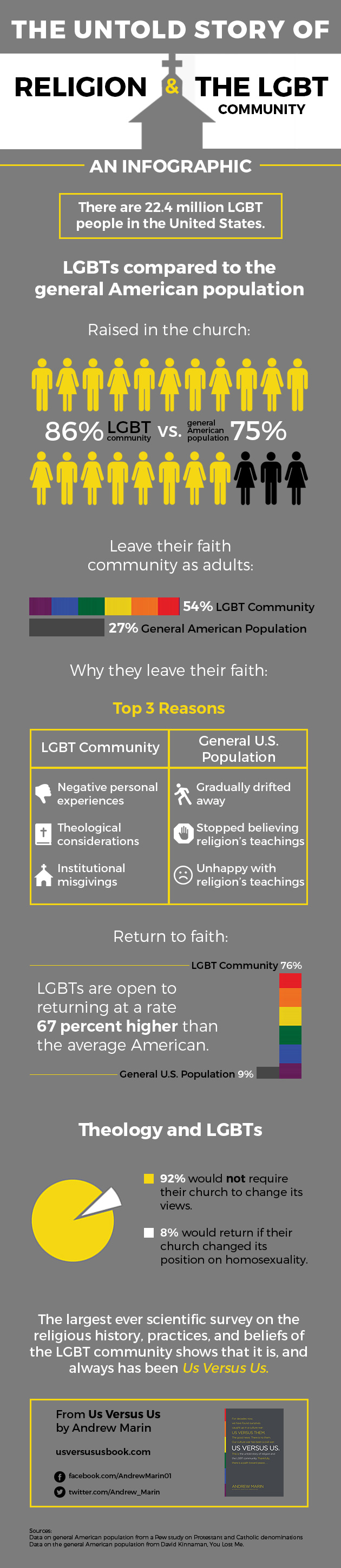
Great Infographic for Research Findings in Us Versus...

My ebook, Our Last Option, is Patheos Book...
TRENDING AT PATHEOS Evangelical

How the author of the world's best hymn...
I've been working with John Newton for a while now. This makes...

Long before this Lectio Divina, Psalm 130 - the song - started...

What About the Trees? Another Living Parable
After I finished writing the last article about falling leaves as a...

Why Classical Education Is a Conversation, Not a...
Come and Read: Joy in Classical Education When I was a little...

Falling Leaves: A Living Parable on Letting Go
I’ve spent the vast majority of my life in the southeast corner...

Cornell University has received a great deal of negative publicity and intense...
view all Evangelical blogs
Ad-Free & Subscriber Log-In Subscription Support
- About Us
- 2026 Calendar
- Videos
- Podcasts
- Library of World Religions
- Faith In Media Tracker
- Advertise With Us
- Write for Us
- Privacy Policy
- Terms of Service
- Do Not Sell My Data
- Contact Us
- Radiant Digital
- Manage Newsletter Subscriptions
- Unsubscribe From Notifications
- Sitemap
Copyright 2008-2026, Patheos. All rights reserved.
Subscription Support Ad-Free & Subscriber Log-In
Follow Patheos