
BuddhistCatholicContemplativeEvangelicalGeneral ChristianHinduJewishLatter-day SaintMuslimNew VisionsProgressive Christian
Beliefs
- Buddhist
- Catholic
- Contemplative
- Evangelical
- General Christian
- Hindu
- Jewish
- Latter-day Saint
- More Voices
- Muslim
- New Visions
- Pagan
- Progressive Christian
Topics
- Religion News
- Food and Religion
- Sports and Religion
- Religious Art
- Religious Music and Entertainment
- Religious Events
- History and Religion
- Style and Religion
- Politics and Religion
- Women in Religion
- Recreation Outdoors and Religion
- Business Finance and Religion
- Careers Workplace and Religion
- Education and Religion
- Family Parenting and Religion
- Health Fitness and Religion
- Home and Religion
- Relationships and Religion
- Technology and Religion
- Travel and Religion
Columnists
- Buddhist Columnists
- Business Finance and Religion Columnists
- Careers Workplace and Religion Columnists
- Catholic Columnists
- Contemplative Columnists
- Education and Religion Columnists
- Evangelists Columnists
- Family Parenting and Religion Columnists
- General Christian Columnists
- Health Fitness and Religion Columnists
- Hindu Columnists
- History and Religion Columnists
- Home and Religion Columnists
- Jewish Columnists
- More Voices Columnists
- Latter Day Columnists
- Muslim Columnists
- New Visions Columnists
- Nonreligious Columnists
- Pagan Columnists
- Politics and Religion Columnists
- Progressive Columnists
- Recreation Outdoors and Religion Columnists
- Relationships and Religion Columnists
- Religion News Columnists
- Religious Art Columnists
- Religious Events Columnists
- Religious Music and Entertainment Columnists
- Sports and Religion Columnists
- Style and Religion Columnists
- Technology and Religion Columnists
- Travel and Religion Columnists
- Women in Religion Columnists
Resource Library
- 2026 Calendar
- Library of World Religions
- The 100 Most Holy Places on Earth
- Patheos Answers
- Podcasts
- Videos
- Faith Leaders Database
- Anglican Episcopalian
- Bahai
- Baptist
- Buddhism
- Christianity
- Confucianism
- Eastern Orthodoxy
- Hinduism
- Holiness and Pentecostal
- ISKCON
- Islam
- Judaism
- Lutheran
- Methodist
- The Church of Jesus Christ of Latter-day Saints
- New Age
- Paganism
- Presbytarian and Reformed
- Protestantism
- Religion Behind the Scenes
- Roman Catholic
- Scientology
- Shia Islam
- Sikhism
- Sufism
- Sunni Islam
- Taoism
- Zen
- See all religions
Research Tools
 Ad-Free & Subscriber Log-In Subscription Support
Ad-Free & Subscriber Log-In Subscription Support
Follow Patheos 

- Trending:
- Forgiveness
- |
- Marriage
- |
- Consciousness
- |
- Death Penalty
- |
- Election
- |
- Halloween
 Love is an Orientation
- Home
- Evangelical
- Stunted by Shame
Stunted by Shame
Last updated on: March 27, 2013 at 8:00 am by Andrew Marin
Stunted by Shame 2013-03-26T23:03:47-05:00 Andrew Marin
Patheos Explore the world's faith through different perspectives on religion and spirituality! Patheos has the views of the prevalent religions and spiritualities of the world.

 The following post is from Michael Overman. Michael is interning with us this year while working towards his Masters of Divinity at Garrett-Evangelical Theological Seminary. You can check out his blog at findingthebalance.net.
As I was growing up, one of the primary ways I was disciplined was through the mechanism of shame. When I would do something wrong, rather than making it clear that my actions were wrong, I was often made to believe that something was wrong with me, that something within my character was skewed and distorted, and that distortion was the reason for my mistakes of behavior. The problem with this type of discipline is that it strips a person of his or her agency. It tells them, “You make mistakes because it’s part of who you are. You don’t really have a choice.” However, when a person who has done wrong uses this same logic while being confronted by his or her accuser, they’re seen as irresponsible and illogical. “The Devil [inside you] didn’t make you do it. You chose to do it. You made your bed, and now you have to lie in it.”
We can’t have it both ways. Either we are inherently so controlled by our “sinful nature” that we bare no responsibility for our actions, or we are inherently good but have the capacity to act in wrong ways. Most of evangelical Christianity would say that we are only truly controlled and enslaved by sin up to the point of conversion, and beyond that, we bare full responsibility, a logic that stems from Romans 6. In a world where Christianity is no longer the leading faith tradition, it’s necessary to rethink this logic as it pertains to those who practice their faith in other contexts. Otherwise, we need to rethink our entire legal system and how we choose to hold someone accountable for their crimes.
So how does shame fit into all this? From my perspective, shaming often takes place under the guise of accountability but is more about control and power than it is about fostering right behavior. Shame is inherently harmful. As a form of punishment, it doesn’t actually foster right behavior or thought. Instead it devalues and dehumanizes the person being shamed. It says to them, “How can you live with yourself? I can’t believe you did that. What were you thinking? Were you even thinking at all? You should be ashamed of yourself.” Notice how the last one is not, “You should be ashamed of your actions.” What makes shame so harmful is that it makes it next to impossible to differentiate between actions and personhood. When a person faces shame, it doesn’t just evince shame over actions. It manifests shame over self.
Shame is also harmful because, after we experience it being imposed on us by others, it becomes far too easy for us to impose it upon ourselves. This is what I’ve been struggling with more recently. Shame for having an astronomical amount of debt. Shame for being gay. Shame for being partnered. Shame for not having a relationship with my parents. Shame for not spending as much time as I can with my partner, or for wanting to spend time with other people besides him (neither of which are imposed upon me by him). Shame for sleeping too much, for having too much wine, for smoking too much when I’m stressed, for not communicating or being more assertive. Here’s the thing about shame: it’s a boulder that has the capacity to snowball and grow larger and larger until we can no longer bear its cumbersome load. Without facing it, it can crush us.
It’s important to understand that what I’m not saying here is that we should not be held accountable to our actions. In fact, I think we all need some form of accountability in our lives. Without accountability, we risk becoming stunted or fragmented in our natural course of development. Without someone to reflect back to me a realistic image of who I am and how I live, I stand the chance of becoming disillusioned about myself and my actions. But the common misnomer is that accountability requires shame. This is a lie, and a dangerous one at that. Shame, in my opinion, actually hinders what accountability is supposed to do. Rather than catalyzing thoughtfulness, reflection, and change, shame puts on a set of blinders with a funhouse mirror in front of them. Not only does shame keep you from seeing the bigger picture, but it is a coerced reflection using a mirror that does not reflect reality back to the viewer.
Shame isn’t so much about what a person says to us as it is about how he or she says it. There’s a demeaning, dehumanizing way to ask a person, “Why did you do that?” and there’s a kind, thoughtful, reflective way of asking the same question. In this sense, accountability is not only about the person being held accountable but also about the person enacting accountability. For healthy accountability to take place, the person enacting it must have an awareness of the one they are holding accountable as well as an awareness of self. Not only should they have awareness, but there needs to also be respect. Without both awareness and respect, the doorway to shame is left open.
Shame is a reality that we cannot escape, for as long as humans have existed, for as long as the world has been broken, shame has lived. We all face it in some way, shape, or form. Brené Brown, one of my favorite researchers and speakers for TED, spent six years researching shame before her work led her into the topic of vulnerability. In her most recent talk, Listening to Shame, she says, “You gotta dance with the one who brung ya… I did not learn about vulnerability and courage and creativity and innovation. I learned about these things from studying shame.” She discusses how, recently, there’s been a national if not global call to talk about and face the issue of race. She continues, “You cannot talk about race without talking about privilege. And when people start talking about privilege, they get paralyzed by shame.” That’s what shame does when it goes unchecked: it cripples and debilitates. We all have shame, and when we go through life without naming and embracing our shame, it cages us and limits us from becoming our true selves.
Teddy Roosevelt once said, “It is not the critic who counts: not the man who points out how the strong man stumbles or where the doer of deeds could have done better. The credit belongs to the man who is actually in the arena, whose face is marred by dust and sweat and blood, who strives valiantly, who errs and comes up short again and again, because there is no effort without error or shortcoming, but who knows the great enthusiasms, the great devotions, who spends himself for a worthy cause; who, at the best, knows, in the end, the triumph of high achievement, and who, at the worst, if he fails, at least he fails while daring greatly, so that his place shall never be with those cold and timid souls who knew neither victory nor defeat.”
Brown goes on to remark that, if we walk into the arena of life having mustered up the courage to do, to live, when we look out into the stands, the critic we most often face is ourselves. Even when we experience being shamed by someone else, the nature of shame is to become internalized. The voice of the other becomes the voice of myself, and most often, that voices either says, “You’re not good enough,” or, “Who do you think you are?” Shame is different from guilt, she says, in that shame is about self whereas guilt is about behavior. Guilt, or in dogmatic terms, conviction, is meant to affect change. Shame, on the other hand, leaves its victim bloody and bruised, often unable to move for long periods of time.
In the end, as individuals, as a society, and as the church, we need to learn to stop using shame as a means of catalyzing transformation. Shame cannot perform this task. It’s not in shame’s nature. Instead, we must learn to reconceptualize relationship, both internal and external, and reorient ourselves towards love, towards hope, towards faith, and towards unhindered, unstunted wholeness. Shame keeps us from being whole. Love makes us whole. Therein lies the difference, and therein lies our goal.
Much love.
Previous Post

March 25, 2013
The Blame Game
Next Post
March 29, 2013 Reminder.
Browse Our Archives
Select a Category Book Reviews Bridging Opposing Worldviews Culture Don't Drink and Drive Faith Guest Posts I'm Sorry Campaign Interviews Language Laura Statesir LGBT Living in the Tension Living in the Tension Gatherings Love Is an Orientation Love Is an Orientation Blog Love Is an Orientation Book Love Is an Orientation DVD Melinda Guerra Memory My One Sentence Bible Newsletter Our Last Option Parents & Families Politics Quick Quotes Quotes ReEngaging Civility Sexuality Speaking The Marin Foundation Theology Uncategorized Us Versus Us Videos Warren Perry Youth and Campus Ministry
Select a Month June 2016 May 2016 December 2015 June 2015 May 2015 April 2015 March 2015 February 2015 January 2015 December 2014 November 2014 October 2014 September 2014 August 2014 July 2014 June 2014 May 2014 April 2014 March 2014 February 2014 January 2014 December 2013 November 2013 October 2013 September 2013 August 2013 July 2013 June 2013 May 2013 April 2013 March 2013 February 2013 January 2013 December 2012 November 2012 October 2012 September 2012 August 2012 July 2012 June 2012 May 2012 April 2012 March 2012 February 2012 January 2012 December 2011 November 2011 October 2011 September 2011 August 2011 July 2011 June 2011 May 2011 April 2011 March 2011 February 2011 January 2011 December 2010 November 2010 October 2010 September 2010 August 2010 July 2010 June 2010 May 2010 April 2010 March 2010 February 2010 January 2010 December 2009 November 2009 October 2009 September 2009 August 2009 July 2009 June 2009 May 2009 April 2009 March 2009 February 2009 January 2009 December 2008 November 2008 October 2008 September 2008
Follow Us!
TAKE THE
Religious Wisdom Quiz
True or False: James says that whoever keeps the whole law but stumbles at just one point is guilty of breaking all of it.
Select your answer to see how you score.
TRUE FALSE
Related posts from Love is an Orientation

Don't Let Your Anger Turn Into Their Hate

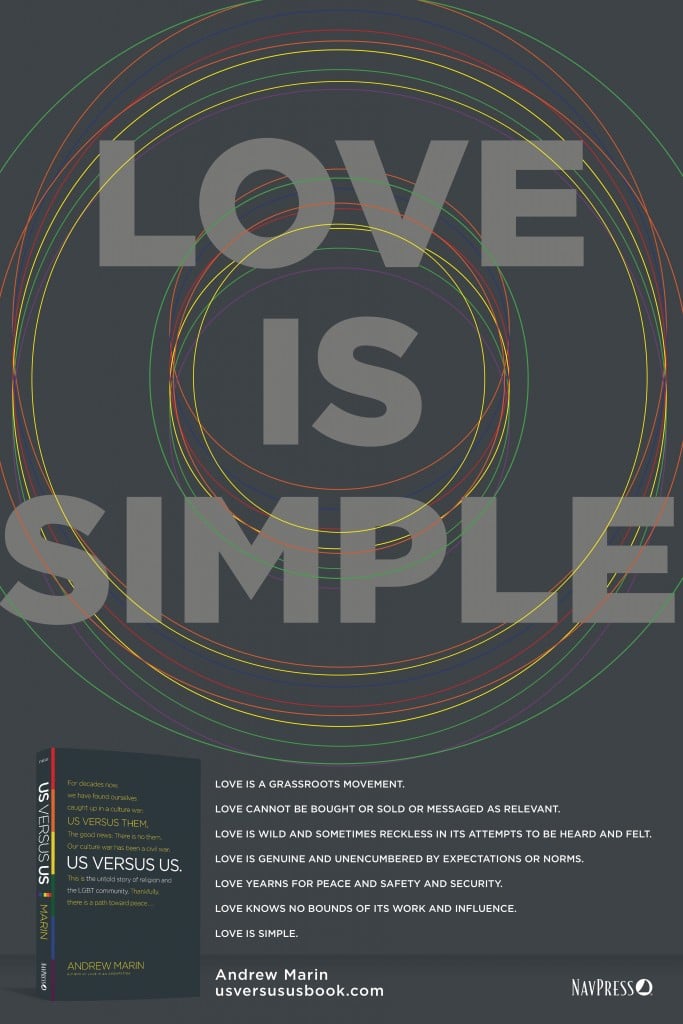
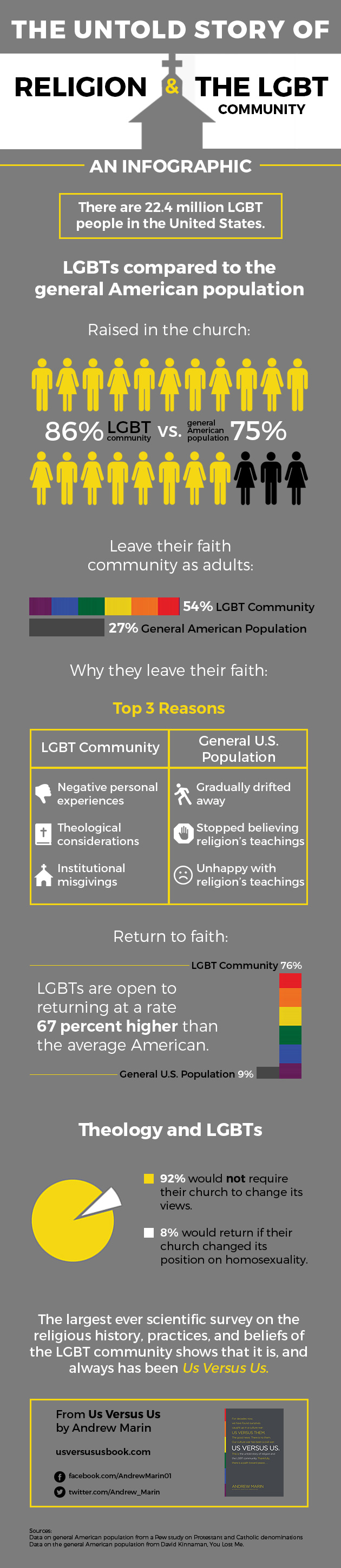
Great Infographic for Research Findings in Us Versus...
TRENDING AT PATHEOS Evangelical

The REST of Your Life: A Creative Wrestles...
This week I had a conversation with a good friend from church....

How the author of the world's best hymn...
I've been working with John Newton for a while now. This makes...

Long before this Lectio Divina, Psalm 130 - the song - started...

What About the Trees? Another Living Parable
After I finished writing the last article about falling leaves as a...

Why Classical Education Is a Conversation, Not a...
Come and Read: Joy in Classical Education When I was a little...

Cornell University has received a great deal of negative publicity and intense...
view all Evangelical blogs
Ad-Free & Subscriber Log-In Subscription Support
- About Us
- 2026 Calendar
- Videos
- Podcasts
- Library of World Religions
- Faith In Media Tracker
- Advertise With Us
- Write for Us
- Privacy Policy
- Terms of Service
- Do Not Sell My Data
- Contact Us
- Radiant Digital
- Manage Newsletter Subscriptions
- Unsubscribe From Notifications
- Sitemap
Copyright 2008-2026, Patheos. All rights reserved.
Subscription Support Ad-Free & Subscriber Log-In
Follow Patheos