
BuddhistCatholicContemplativeEvangelicalGeneral ChristianHinduJewishLatter-day SaintMuslimNew VisionsProgressive Christian
Beliefs
- Buddhist
- Catholic
- Contemplative
- Evangelical
- General Christian
- Hindu
- Jewish
- Latter-day Saint
- More Voices
- Muslim
- New Visions
- Pagan
- Progressive Christian
Topics
- Religion News
- Food and Religion
- Sports and Religion
- Religious Art
- Religious Music and Entertainment
- Religious Events
- History and Religion
- Style and Religion
- Politics and Religion
- Women in Religion
- Recreation Outdoors and Religion
- Business Finance and Religion
- Careers Workplace and Religion
- Education and Religion
- Family Parenting and Religion
- Health Fitness and Religion
- Home and Religion
- Relationships and Religion
- Technology and Religion
- Travel and Religion
Columnists
- Buddhist Columnists
- Business Finance and Religion Columnists
- Careers Workplace and Religion Columnists
- Catholic Columnists
- Contemplative Columnists
- Education and Religion Columnists
- Evangelists Columnists
- Family Parenting and Religion Columnists
- General Christian Columnists
- Health Fitness and Religion Columnists
- Hindu Columnists
- History and Religion Columnists
- Home and Religion Columnists
- Jewish Columnists
- More Voices Columnists
- Latter Day Columnists
- Muslim Columnists
- New Visions Columnists
- Nonreligious Columnists
- Pagan Columnists
- Politics and Religion Columnists
- Progressive Columnists
- Recreation Outdoors and Religion Columnists
- Relationships and Religion Columnists
- Religion News Columnists
- Religious Art Columnists
- Religious Events Columnists
- Religious Music and Entertainment Columnists
- Sports and Religion Columnists
- Style and Religion Columnists
- Technology and Religion Columnists
- Travel and Religion Columnists
- Women in Religion Columnists
Resource Library
- 2026 Calendar
- Library of World Religions
- The 100 Most Holy Places on Earth
- Patheos Answers
- Podcasts
- Videos
- Faith Leaders Database
- Anglican Episcopalian
- Bahai
- Baptist
- Buddhism
- Christianity
- Confucianism
- Eastern Orthodoxy
- Hinduism
- Holiness and Pentecostal
- ISKCON
- Islam
- Judaism
- Lutheran
- Methodist
- The Church of Jesus Christ of Latter-day Saints
- New Age
- Paganism
- Presbytarian and Reformed
- Protestantism
- Religion Behind the Scenes
- Roman Catholic
- Scientology
- Shia Islam
- Sikhism
- Sufism
- Sunni Islam
- Taoism
- Zen
- See all religions
Research Tools
 Ad-Free & Subscriber Log-In Subscription Support
Ad-Free & Subscriber Log-In Subscription Support
Follow Patheos 

- Trending:
- Forgiveness
- |
- Marriage
- |
- Consciousness
- |
- Death Penalty
- |
- Election
- |
- Halloween
 Love is an Orientation
- Home
- Evangelical
- Part 4: United Kingdom
Part 4: United Kingdom
Last updated on: December 17, 2012 at 2:32 am by Andrew Marin
Part 4: United Kingdom 2012-12-17T02:32:10-06:00 Andrew Marin
Patheos Explore the world's faith through different perspectives on religion and spirituality! Patheos has the views of the prevalent religions and spiritualities of the world.

Over the next couple of days I will be posting a Q & A I did with Dr. Andrew Goddard, Professor of Christian Ethics at Trinity College, and editor of the UK’s Anvil Theological Journal. He asked me 14 questions, some of which you all have heard me answer before. So instead of posting any repeated information, I will only post the questions that he asked that I have never been asked before – most of which focus on the differences between the State and the UK.
Here you go (yes, the spelling is British version):
Most of your work has obviously been focused in the US but a few months back you visited the UK. What did you discover on that visit and what do you think might help Christians in the UK?
I spent a significant amount of time in my recent tour throughout the UK interviewing people from both the GLBT community (secular and Christian) and the straight Christian community (liberal and conservative), including scholars, theologians, bishops, pastors, believers, non-believers, members of Parliament and everyday people on the street.
If there is one common thread that arose throughout these different populations it’s that culturally, the most common large-scale practice regarding faith and sexuality is just safely to avoid the awkwardness that is inherent with the disconnect between the two topics. This observation was no more apparent than in the significant political and religious apathy, especially in the younger generations. That caused me to wonder how tightly correlated is the culture of secularism woven into the potential works, impact and relevance of the Church?
Statistically speaking, with such a minority of the UK population professing Christianity, it is rightly categorized as a post-Christian nation; especially in the light of almost 70% of Americans who claim Christianity as their faith. I would argue, however, that from what I experienced, the small percentage of Christians in the UK are more passionate than the 70% of American Christians have ever been throughout my lifetime. I would also argue that, despite the grand number of Americans claiming their Christianity, America is also a post-Christian culture. To me, Christianity should never be a label, but an action. The moment the actions stop, no amount of intellectualization can tangibly reclaim and regain an impactful relevance. The pure and honest love and hunger I experienced throughout the churches I attended in the UK left me pondering: if there is so much excitement inside the church walls, why is there so little impact outside of those walls?
Sociology adds a few important thoughts to these quandaries. First, minority cultures usually form tighter bonds to each other within their inner-group settings. Thus vibrant Christian communities flourish amongst themselves; together they are united around a common minority structure which is based, in this case, on belief in God. Second, the dominant culture sets the tone for the minority culture outside of the minority’s own gatherings. After a gathering I spoke at on the recent tour, one UK Christian leader told me, ‘The Church is more concerned with preserving a perception of respectability than it is with realistic Kingdom work’. I was shocked by that statement and the bluntness in which it was so boldly claimed. Since the Church is already numerically small, add to that the institutional hierarchy’s fear of becoming completely obsolete and one can see how the majority secular culture does indeed influence a potential Christian impact outside the walls of the minority Christian gatherings. Therefore, instead of risking further irrelevance, it is more rational for many institutional leaders to remain relatively silent on divisive and potential ‘relevance–threatening’ topics such as homosexuality.
One UK gay leader gave me a variety of examples where there have been pockets of public conversations between the GLBT and Christian communities at seminaries throughout the country. He also noted however that these types of dialogues are not sustainable because very few from either community are willing to put themselves out there to take the attacks that will come from both sides and yet still keep pressing on building a bridge. Once again, the fear of entering into a perceived no-win journey trumps what could turn into a countercultural Movement towards a very public biblical reconciliation. The most succinct summary about the lack of structural dialogue regarding homosexuality was what I was told by a UK Christian leader: ‘It is easier and safer to just not say or do anything’. That strategy, however, has backfired.
A good friend of mine who works for a religious organization in the UK recently told me a story about an experience she had while attending a UK Christian conference. From what many other UK Christians have corroborated it gives a well-balanced picture of the current landscape regarding homosexuality. She was talking to a group of five teenage boys and asked them, ‘What is the biggest ethical dilemma you face in your lives today regarding your faith?’. Their response? Each of them said homosexuality. Why? ‘Because the Church isn’t giving us a framework of engagement, the silence leaves us wondering what teachings are right: the Church or mainstream society’. In a post-Christian culture, in which secularism dominates perception, is it any wonder the younger generations, even those who are Christian, are solidifying and aligning themselves more with a mainstream point of view? As one young person, who was raised in the church, told me when I stopped to talk to him on the street: ‘It’s just too easy to walk away from the Church because they’re not running after us’.
Shortly after that conversation I was interviewing a youth pastor from London and when I told him what that youth had just said, he prophetically stated, ‘The Church needs to realize that power and relevance do not come from a denomination; they come from the incarnation’. I believe his words provide the final answer to solve the issue of regaining cultural relevance amidst a dominant secular society: sustainable cultural influence can only be achieved through a movement of believers incarnationally living out the power of the gospel outside the safety of their own minority gatherings. This is so difficult because it is the exact opposite of human intuition that innately gravitates towards those who we are most similar. Yet sometimes a forced reassessment of how belief and life need to intertwine can be the exact awakening the Church needs to unleash a radical love filled with an unquenching passion that cares not about image, but about living a faith that even mainstream culture stands up and notices is uniquely inspired, no matter what the outcome. Just as in Joshua 3, it only takes one step into the place where death is a certainty before God parts the waters for the faithful who care about doing His work in real time, in a really messy life. Intellectually understanding such a construct and actually living it out are worlds apart. Whether in the UK or the States, my passion is to see the Church remove the cultural burdens of oppression from herself and live in the power we have been given through the incarnation, and the Incarnate’s death and resurrection.
What do you think about this assessment, both from you all in the UK, and also how this relates to the US for all of you Americans (or your own country if not from either of these two)?
Much love.
Previous Post

January 8, 2010
Random Thoughts
Next Post
January 9, 2010 Part 5: United Kingdom
Browse Our Archives
Select a Category Book Reviews Bridging Opposing Worldviews Culture Don't Drink and Drive Faith Guest Posts I'm Sorry Campaign Interviews Language Laura Statesir LGBT Living in the Tension Living in the Tension Gatherings Love Is an Orientation Love Is an Orientation Blog Love Is an Orientation Book Love Is an Orientation DVD Melinda Guerra Memory My One Sentence Bible Newsletter Our Last Option Parents & Families Politics Quick Quotes Quotes ReEngaging Civility Sexuality Speaking The Marin Foundation Theology Uncategorized Us Versus Us Videos Warren Perry Youth and Campus Ministry
Select a Month June 2016 May 2016 December 2015 June 2015 May 2015 April 2015 March 2015 February 2015 January 2015 December 2014 November 2014 October 2014 September 2014 August 2014 July 2014 June 2014 May 2014 April 2014 March 2014 February 2014 January 2014 December 2013 November 2013 October 2013 September 2013 August 2013 July 2013 June 2013 May 2013 April 2013 March 2013 February 2013 January 2013 December 2012 November 2012 October 2012 September 2012 August 2012 July 2012 June 2012 May 2012 April 2012 March 2012 February 2012 January 2012 December 2011 November 2011 October 2011 September 2011 August 2011 July 2011 June 2011 May 2011 April 2011 March 2011 February 2011 January 2011 December 2010 November 2010 October 2010 September 2010 August 2010 July 2010 June 2010 May 2010 April 2010 March 2010 February 2010 January 2010 December 2009 November 2009 October 2009 September 2009 August 2009 July 2009 June 2009 May 2009 April 2009 March 2009 February 2009 January 2009 December 2008 November 2008 October 2008 September 2008
Follow Us!
TAKE THE
Religious Wisdom Quiz
What is the longest Gospel?
Select your answer to see how you score.
Mark John Matthew Luke
Related posts from Love is an Orientation

Don't Let Your Anger Turn Into Their Hate

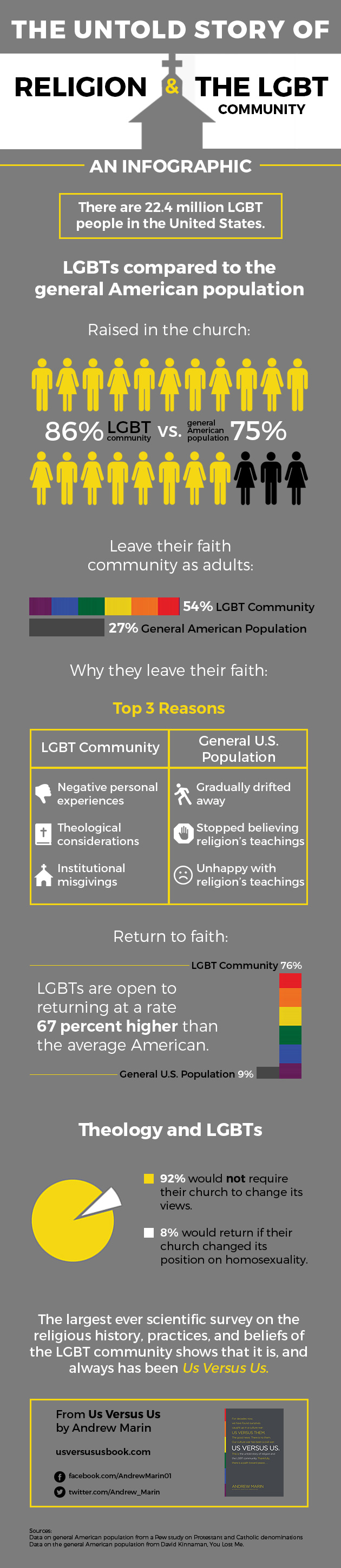
Great Infographic for Research Findings in Us Versus...

My ebook, Our Last Option, is Patheos Book...
TRENDING AT PATHEOS Evangelical

The REST of Your Life: A Creative Wrestles...
This week I had a conversation with a good friend from church....

How the author of the world's best hymn...
I've been working with John Newton for a while now. This makes...

Long before this Lectio Divina, Psalm 130 - the song - started...

What About the Trees? Another Living Parable
After I finished writing the last article about falling leaves as a...

Why Classical Education Is a Conversation, Not a...
Come and Read: Joy in Classical Education When I was a little...

Cornell University has received a great deal of negative publicity and intense...
view all Evangelical blogs
Ad-Free & Subscriber Log-In Subscription Support
- About Us
- 2026 Calendar
- Videos
- Podcasts
- Library of World Religions
- Faith In Media Tracker
- Advertise With Us
- Write for Us
- Privacy Policy
- Terms of Service
- Do Not Sell My Data
- Contact Us
- Radiant Digital
- Manage Newsletter Subscriptions
- Unsubscribe From Notifications
- Sitemap
Copyright 2008-2026, Patheos. All rights reserved.
Subscription Support Ad-Free & Subscriber Log-In
Follow Patheos