
BuddhistCatholicContemplativeEvangelicalGeneral ChristianHinduJewishLatter-day SaintMuslimNew VisionsProgressive Christian
Beliefs
- Buddhist
- Catholic
- Contemplative
- Evangelical
- General Christian
- Hindu
- Jewish
- Latter-day Saint
- More Voices
- Muslim
- New Visions
- Pagan
- Progressive Christian
Topics
- Religion News
- Food and Religion
- Sports and Religion
- Religious Art
- Religious Music and Entertainment
- Religious Events
- History and Religion
- Style and Religion
- Politics and Religion
- Women in Religion
- Recreation Outdoors and Religion
- Business Finance and Religion
- Careers Workplace and Religion
- Education and Religion
- Family Parenting and Religion
- Health Fitness and Religion
- Home and Religion
- Relationships and Religion
- Technology and Religion
- Travel and Religion
Columnists
- Buddhist Columnists
- Business Finance and Religion Columnists
- Careers Workplace and Religion Columnists
- Catholic Columnists
- Contemplative Columnists
- Education and Religion Columnists
- Evangelists Columnists
- Family Parenting and Religion Columnists
- General Christian Columnists
- Health Fitness and Religion Columnists
- Hindu Columnists
- History and Religion Columnists
- Home and Religion Columnists
- Jewish Columnists
- More Voices Columnists
- Latter Day Columnists
- Muslim Columnists
- New Visions Columnists
- Nonreligious Columnists
- Pagan Columnists
- Politics and Religion Columnists
- Progressive Columnists
- Recreation Outdoors and Religion Columnists
- Relationships and Religion Columnists
- Religion News Columnists
- Religious Art Columnists
- Religious Events Columnists
- Religious Music and Entertainment Columnists
- Sports and Religion Columnists
- Style and Religion Columnists
- Technology and Religion Columnists
- Travel and Religion Columnists
- Women in Religion Columnists
Resource Library
- 2026 Calendar
- Library of World Religions
- The 100 Most Holy Places on Earth
- Patheos Answers
- Podcasts
- Videos
- Faith Leaders Database
- Anglican Episcopalian
- Bahai
- Baptist
- Buddhism
- Christianity
- Confucianism
- Eastern Orthodoxy
- Hinduism
- Holiness and Pentecostal
- ISKCON
- Islam
- Judaism
- Lutheran
- Methodist
- The Church of Jesus Christ of Latter-day Saints
- New Age
- Paganism
- Presbytarian and Reformed
- Protestantism
- Religion Behind the Scenes
- Roman Catholic
- Scientology
- Shia Islam
- Sikhism
- Sufism
- Sunni Islam
- Taoism
- Zen
- See all religions
Research Tools
 Ad-Free & Subscriber Log-In Subscription Support
Ad-Free & Subscriber Log-In Subscription Support
Follow Patheos 

- Trending:
- Forgiveness
- |
- Marriage
- |
- Consciousness
- |
- Death Penalty
- |
- Election
- |
- Halloween
 Love, InshAllah
- Home
- Muslim
- Relationships and Religion
- Bridging the Gap
Bridging the Gap
Last updated on: November 3, 2014 at 11:13 am by Posted by The Editors
Bridging the Gap 2014-11-03T11:13:27-07:00 Posted by The Editors
Patheos Explore the world's faith through different perspectives on religion and spirituality! Patheos has the views of the prevalent religions and spiritualities of the world.

My grandmother’s name is Raj Kumari, which means “princess” in English. She has always been in my life and is part of my earliest memories. As a child, I had a habit of stealing butter and ghee from the kitchen, hiding under the table and eating it. My grandmother would walk in; see me eating butter out of the container, smile and say: “You look like Lord Krishna!”
Hands down, she’s the best cook in my entire family, and because of her we grew up eating great Punjabi food. Saag, muttar paneer, kheer, aloo paratha, gajjar ka halwa – ask for it, and my grandma can make it.
I’m now “of age”, so she is teaching me to cook and training me to become “a good Punjabi wife.” I use that phrase jokingly, but if I’m honest, it fills me with a sense of dread. I’ve grown up with an unusual family dynamic: my mother abandoned us eight years ago and my grandma stepped in to help bring up my younger brother and me. Many South Asians don’t understand our family set up and have often judged us quite harshly. I remember being told: “You’ll end up on welfare because your family is broken.” I never felt like my family was broken. My grandma was the glue that kept us all together.
I used to hate anything to do with cooking and housework because it was always forced on me with the words: “When you get married you’ll have to do this every day.” This was usually said by my father as well as aunties – both familial aunties and those in the community. My grandmother has never said that to me. I am lucky that she understands my ambitions and my feelings, and has always been there for me.
She understands that it’s tough growing up in the West, and that times have changed from when she was my age. My grandmother was born in Tanzania and grew up in poverty. She was the eldest child and had familial responsibilities thrust upon her at a very young age because her mother died young. It was her father who taught her how to cook and look after the family.
She brought up her siblings but, as a result, she couldn’t continue her own education. At the age of 19 she got married and had two children before she turned 23. Her life within my grandpa’s family was far from ideal; whenever she tells me her story it always hurts me because she had to cope with so much by herself at a very young age.
My grandparents lost everything in the Nairobi military coups in the 1970s and 80s: home, businesses, livelihood. Penniless and traumatized, they came to the UK for a better life, but found that they were not accepted by the Brits or Indians there because they were Punjabi, and the only non-whites living in a very racist white area.
My grandma worked long hours in my grandpa’s newsagent, she learnt to balance books, run a business, do stock keeping, and interact with a variety of people, all the while still looking after her family. My grandma is the most confident woman of her generation; she speaks the best English, and is the most resilient of all my great aunts.
My grandma is the only woman in my immediate family and it’s comforting to know that she is there. She stands by me when the aunty network drops the “M” word and on one occasion she told them: “My Chayya is a tigress; she will eat a boy for dinner if he isn’t strong, ambitious or smart enough for her.”
When I graduated from university, she was very emotional and full of happiness. My grandma always told me to educate myself as much as I could, be independent and strong enough to stand on my own two feet. She encouraged me to achieve my ambitions and to work hard, but to never forget my roots.
A large part of my Punjabi heritage is food – we seriously love our food – and the sense of comfort that comes from eating it. I’ve always believed that food brings people together. It nourishes you physically and spiritually. Plus, it’s therapeutic as well – there’s nothing more satisfying than pounding up garlic, green chillies and ginger!
One of my favourite dishes is called rajmaa chawal – rice and red kidney beans. I used to call it the “princess dish” because it sounds like my grandma’s name. Funnily enough, she never ate rajmaa chawal when she was younger. When I asked her why, she said: “Because that’s what prisoners in our local jail used to eat.”
Regardless, for prisoners or your loved ones, rajmaa chawal truly is a delicious and filling dish.
—
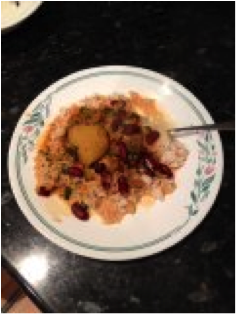
Rajmaa Chawal Recipe
Adjust seasonings according to taste.
Ingredients:
2 tablespoons of oil
1 large white onion, diced
3 cloves of garlic, sliced thinly
1 teaspoon salt
1 teaspoon pepper
¼ teaspoon of turmeric
1 teaspoon ground coriander seeds
1 teaspoon ground cumin seeds
1 medium potato, chopped
1 can of chopped or peeled tomatoes, pureed
1 can of red kidney beans
Fresh coriander, chopped
1 cup of rice
Method:
Add oil to the pot, over medium to high heat – it’s important to have a hot pan!
Add onion to hot oil. When the onions turn translucent, add the garlic.
Puree the can of tomatoes in a blender or food processor. Reserve half for a future dish, and refrigerate. Add seasoning to remaining tomatoes.
When the onions are soft and golden, add the seasoned tomatoes. It will sizzle, but do not lower the heat – stir like crazy until all the water has evaporated and you are left with a paste. Then, lower the heat.
Drain and wash the kidney beans. Add them to the paste. Peel and quarter the potato and add in.
Fill half the blender container with water. Pour in the water to the mixture and stir; it should be very soupy. Because it’s served with rice you need to have enough liquid to moisten the dish. Add water until it covers the potatoes. If more water is needed later, you can add freshly boiled water from the kettle at the very end.
Put the lid on and leave to simmer.
Wash rice thoroughly, three times. Add 2 cups of water to the washed rice with a ¼ teaspoon of salt and a splash of oil in a pot. Turn the heat to low, and cover pot. It should take 20 minutes to cook, but keep checking.
Once you can put a knife through a potato the rajmaa Is cooked! Add in a good amount of chopped fresh coriander.
Spoon rajmaa over the rice and enjoy!
—
Cha’yya is a freelance journalist and writer from London, UK. She writes about Asian diasporic issues and is deeply passionate about women’s rights, ethnic identity and youth issues. You can read more at www.avidscribbler1.wordpress.com and find her on Twitter @c_syal.
Previous Post

October 6, 2014
What's Your Name
Next Post

October 8, 2014 The Single Girl’s Survival Guide for Desi Weddings
Browse Our Archives
Select a Category Book Reviews Brown Girl Dreaming Editors Flirting with Fate and other Disasters of an Intersectional Muslimah Food, Love, & Memories Friday Love Halal Since 22 Integrity of Heart Life After Death Literary Mama Literature Love Inshallah Podcast Love InshAllah writers Media My Infidel Husband Not Without Love Poetry Monday Radical Love Reflections & Readings Reviews of Love InshAllah Salaam Love Writers Sex & The Ummah Single in the City Spotlight Story & Chai Book Club The Geekologist The Love Tour The Male Gaze Things I Wish I'd Known Thoughts of a Wasat Girl Uncategorized Your Sunny Side Up Your voices
Select a Month May 2015 April 2015 March 2015 February 2015 January 2015 December 2014 November 2014 October 2014 September 2014 August 2014 July 2014 June 2014 May 2014 April 2014 March 2014 February 2014 January 2014 December 2013 November 2013 October 2013 September 2013 August 2013 July 2013 June 2013 May 2013 April 2013 March 2013 February 2013 January 2013 December 2012 November 2012 October 2012 September 2012 August 2012 July 2012 June 2012 May 2012 April 2012 March 2012 February 2012 January 2012 December 2011 November 2011
Follow Us!
TAKE THE
Religious Wisdom Quiz
What is Jesus' most famous sermon called?
Select your answer to see how you score.
The Last Supper The Parable of the Sower The Sermon on the Mount The Beatitudes
Related posts from Love, InshAllah



Hip-Hop Hijabis: Spitting Rhymes About Being Muslim And...

TRENDING AT PATHEOS Muslim

25 Years Later: How Much Has Changed for...
As we approach the 25th anniversary of September 11th, I’ve found myself...

Podcast: Third Spaces & The Rise of Yemeni...
In the latest episode of The Artistic Foodies Podcast, hosts Abbas...

HalalFest Picks: Best 60 Halal Spots for Super...
Back in 2016, I came up with a list of 29...

Unity Is America’s Strength — Division Is Its...
by Hidayatullah Ahsan When Valentina Gomez, a Republican candidate for Congress in...

Zohran Mamdani and New York’s Fight Against Islamophobia
This past June, against all odds, Zohran Mamdani won the Democratic primary...

What the Fourth of July Means to a...
As we mark another Fourth of July, millions of Americans will celebrate...
view all Muslim blogs
Ad-Free & Subscriber Log-In Subscription Support
- About Us
- 2026 Calendar
- Videos
- Podcasts
- Library of World Religions
- Faith In Media Tracker
- Advertise With Us
- Write for Us
- Privacy Policy
- Terms of Service
- Do Not Sell My Data
- Contact Us
- Radiant Digital
- Manage Newsletter Subscriptions
- Unsubscribe From Notifications
- Sitemap
Copyright 2008-2026, Patheos. All rights reserved.
Subscription Support Ad-Free & Subscriber Log-In
Follow Patheos