
BuddhistCatholicContemplativeEvangelicalGeneral ChristianHinduJewishLatter-day SaintMuslimNew VisionsProgressive Christian
Beliefs
- Buddhist
- Catholic
- Contemplative
- Evangelical
- General Christian
- Hindu
- Jewish
- Latter-day Saint
- More Voices
- Muslim
- New Visions
- Pagan
- Progressive Christian
Topics
- Religion News
- Food and Religion
- Sports and Religion
- Religious Art
- Religious Music and Entertainment
- Religious Events
- History and Religion
- Style and Religion
- Politics and Religion
- Women in Religion
- Recreation Outdoors and Religion
- Business Finance and Religion
- Careers Workplace and Religion
- Education and Religion
- Family Parenting and Religion
- Health Fitness and Religion
- Home and Religion
- Relationships and Religion
- Technology and Religion
- Travel and Religion
Columnists
- Buddhist Columnists
- Business Finance and Religion Columnists
- Careers Workplace and Religion Columnists
- Catholic Columnists
- Contemplative Columnists
- Education and Religion Columnists
- Evangelists Columnists
- Family Parenting and Religion Columnists
- General Christian Columnists
- Health Fitness and Religion Columnists
- Hindu Columnists
- History and Religion Columnists
- Home and Religion Columnists
- Jewish Columnists
- More Voices Columnists
- Latter Day Columnists
- Muslim Columnists
- New Visions Columnists
- Nonreligious Columnists
- Pagan Columnists
- Politics and Religion Columnists
- Progressive Columnists
- Recreation Outdoors and Religion Columnists
- Relationships and Religion Columnists
- Religion News Columnists
- Religious Art Columnists
- Religious Events Columnists
- Religious Music and Entertainment Columnists
- Sports and Religion Columnists
- Style and Religion Columnists
- Technology and Religion Columnists
- Travel and Religion Columnists
- Women in Religion Columnists
Resource Library
- 2026 Calendar
- Library of World Religions
- The 100 Most Holy Places on Earth
- Patheos Answers
- Podcasts
- Videos
- Faith Leaders Database
- Anglican Episcopalian
- Bahai
- Baptist
- Buddhism
- Christianity
- Confucianism
- Eastern Orthodoxy
- Hinduism
- Holiness and Pentecostal
- ISKCON
- Islam
- Judaism
- Lutheran
- Methodist
- The Church of Jesus Christ of Latter-day Saints
- New Age
- Paganism
- Presbytarian and Reformed
- Protestantism
- Religion Behind the Scenes
- Roman Catholic
- Scientology
- Shia Islam
- Sikhism
- Sufism
- Sunni Islam
- Taoism
- Zen
- See all religions
Research Tools
 Ad-Free & Subscriber Log-In Subscription Support
Ad-Free & Subscriber Log-In Subscription Support
Follow Patheos 

- Trending:
- Forgiveness
- |
- Marriage
- |
- Consciousness
- |
- Death Penalty
- |
- Election
- |
- Halloween
 Love Among the Ruins
- Home
- Catholic
- How C.S. Lewis Used Aliens to Show Humanity’s Failings
How C.S. Lewis Used Aliens to Show Humanity’s Failings
Last updated on: February 13, 2016 at 9:09 am by Jack Butler
How C.S. Lewis Used Aliens to Show Humanity’s Failings 2016-02-13T09:09:23-04:00 Jack Butler
Patheos Explore the world's faith through different perspectives on religion and spirituality! Patheos has the views of the prevalent religions and spiritualities of the world.
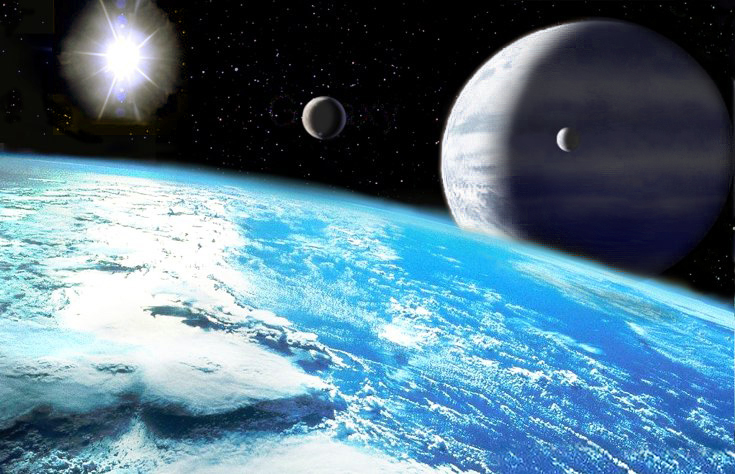
Image courtesy of Wikipedia
[Editor’s Note: This essay is Part 1 of a series on C.S. Lewis’ Space Trilogy, beginning with Out of the Silent Planet. Look for upcoming analysis of Perelandra and That Hideous Strength, both of which prove to be just as fruitful when read along side John Paul II!]
Would you baptize an extraterrestrial?
This highly speculative question has received surprisingly high-profile attention. It was the title of a 2014 book by Guy Consolmagno and Paul Mueller, two Vatican Observatory astronomers. Later in 2014, Pope Francis answered their question in the affirmative (provided the alien asked first). “Who are we to close doors?” he characteristically wondered.
“But C.S. Lewis, in 1938’s ‘Out of the Silent Planet,’ preempted them all. The first book in Lewis’ Space Trilogy,’ ‘Out of the Silent Planet’ tells the story of Elwin Ransom, a philology professor (and Lewis stand-in) who travels to the planet Malacandra (Mars)–albeit against his will. For he is the captive of two men: Dr. Weston, who thinks man’s achievements justify the conquest of other worlds, and Dick Devine, his more straightforwardly power-hungry assistant.”
Complications arise upon arrival; learning his captors mean to sacrifice him to native life, Ransom flees at his first chance. Yet Ransom learns on Malacandra that its inhabitants would reject a sacrificial offering, for they are rational, soul-bearing creatures from whom mankind could learn. Ransom’s journey both shows what mankind might have been and critiques what it has become instead. The lessons Lewis imparts, moreover, cohere with the principles of John Paul II’s Theology of the Body.
Though initially fearing Malacandra’s creatures, Ransom eventually sees in their prelapsarian holisticness–what John Paul II would call original innocence–lessons for fallen man. Ransom first comes to know hrossa, friendly, bipedal, seal-like creatures whose acceptance of their planet’s natural order he comes to admire. The first hross Ransom encounters shocks him; he assumes it irrational. But an intergalactic lingual courtship, which Ransom analogizes to “the meeting of the first man and the first woman in the world,” echoing the centrality of the Creation narrative to the Theology of the Body, steadily reveals it to possess speech, reason, and innocence “as though Paradise had never been lost and earliest dreams were true.”
As Ransom spends more time among the hrossa, he accepts they may have something to teach mankind. Speaking with one hross about its species’ contentment with monogamy compels Ransom to wonder if they ever desire pleasures they cannot have, or long for what has passed. The hross’ reply bespeaks a fundamental contentment with a natural order that has avoided Earth’s corruption. Hrossa long not for what they cannot or no longer have because “[a] pleasure is full grown only when it is remembered. You are speaking…as if the pleasure were one thing and the memory another. It is all one thing.” Hrossa treat all aspects of reality, not just memory, with the same gratitude, supremely satisfied with what Malacandra provides. This attitude recalls the original innocence of man, the state of mutual self-gift in which he existed before the Fall, that John Paul II describes in the Theology of the Body. The profound deference to Malacandra’s naturally-ordained order inspires Ransom, compelling him to reconsider his own relation to these creatures. Though initially “haunted by a conscientious scruple as to whether it might not be his duty to undertake their religious instruction,” after spending sufficient time among them, Ransom realizes “it was not they, but his own species, that were the puzzle” for having forsaken innocence. Ransom need not teach the hrossa; they, instead, teach him.
But the hrossa are only one stage of Malacandra’s extraterrestrial pedagogy. He also encounters the seroni, a massive, ghastly, reedy, vaguely humanoid but ultimately friendly and wise race. Though neither the hrossa nor the seroni would claim to be wiser than the other, content with aptitudes in different areas, the seroni possess greater insight about history, theology, and the place of Malacandra in the universe. This perspective broadens Ransom’s own, preparing him for a deeper understanding of mankind. One sorn Ransom meets elaborates on certain mysteries the hrossa only teased: Earth as a “silent planet” lacking Malacandra’s spiritual vitality; the eldila, angelic, invisible, but powerful beings who would have populated Earth’s spiritual plane had it not become silent; and Oyarsa, the spiritual archangel of Malacandra, who apparently lacks a terrestrial counterpart. Other seroni ponder Earth’s sinful history upon hearing it from Ransom.
“It is because they have no Oyarsa,” offers one. “It is because every one of them wants to be a little Oyarsa himself, “ suggests another. “They cannot help it…These creatures [men] have no eldila. They are like one trying to lift himself by his own hair–or one trying to to see over a whole country when he is on a level with it–like a female trying to beget young on herself,” proffers a third. All suggestions assume mankind’s fundamental break from deference to the created order, resulting in a spiritually compromised world of spiritually compromised inhabitants–John Paul II’s ‘historical man,” his nature wounded after the Fall. From the seroni, then, Ransom deepens his understanding of man’s attenuated connection to an ordained order.
Yet both species are mere preparations for his ultimate encounter with Oyarsa, who describes and demonstrates through Weston the defects of humanity.
Oyarsa first reveals what distinguishes Earth from other worlds: the ramifications of its Fall have rendered it spiritually barren. Earth’s Oyarsa–we could call him Lucifer–not only revolted against God and corrupted the Earth, but sought the same for other worlds. But they fought back, binding him to Earth, and unfortunately requiring their rendering it a spiritual vacuum to deprive its corrupted patron of his power. “There doubtless he lies to this hour, and we know no more of that planet,” Malacandra’s Oyarsa laments. “It is silent.” Thus, the Fall becomes not just theological but cosmological: it has removed Earth from the company of kindred worlds where spiritual and physical planes never diverged.
Oyarsa also demonstrates, through Weston, what this separation hath wrought in man’s soul. His interrogation of Weston draws out these defects, revealing Weston an able ambassador of what John Paul II called the “anti-civilization.” Weston, an admittedly brilliant mind, revels in a scientific triumphalism of the materialistic, Darwinistic, anthropic sort. He responds to Ransom’s skepticism of his plans to conquer other worlds for mankind and to eradicate native life if necessary by saying that “small claims must give way to great.” Since mankind has learned how “to jump off the speck of matter on which our species began…infinity, and therefore perhaps eternity, is being put into the hands of the human race,” it has an epochal destiny against which no antiquated morality, in Weston’s view, could possibly stand. He makes the same defense against Oyarsa himself, claiming that mankind’s achievements provide its “right to supersede you…the right of the higher over the lower.” This would justify mankind’s claiming as many worlds as it desires, “superseding, where necessary, the lower forms of life that we find, claiming planet after planet, system after system, till our posterity–whatever strange form and yet unguessed mentality they have assumed–dwell in the universe where the universe is habitable.” John Paul II knew this argument well, even if Weston applied it beyond Earth. As he wrote in his Letter to Families,
“…the development of contemporary civilization is linked to a scientific and technological progress which is often achieved in a one-sided way, and thus appears purely positivistic. Positivism, as we know, results in agnosticism in theory and utilitarianism in practice and in ethics. In our own day, history is in a way repeating itself. Utilitarianism is a civilization of production and of use, a civilization of “things” and not of “persons”, a civilization in which persons are used in the same way as things are used…”
Though John Paul II wrote of this materialism-driven utilitarianism specifically concerning the family, it threatens all aspects of life if not resisted. For there is more to man than the material, and for man to use his reason merely to devise ever-better ways to use others would not elevate him to the angels but render him merely a clever beast. Indeed, Oyarsa retorts to Weston that, while Weston possesses impressive scientific knowledge, “…in all other things you have the mind of an animal”–that is, a creature only thinking of other life as objects to be used. And even the end to Weston’s callow means proves hollow; as Oyarsa discovers, the corrupted Oyarsa of Earth has cemented “the love of kindred” (i.e., mankind) as Weston’s sole aim; though an important principle, it is not the highest one, and Weston’s single-minded pursuit of it blinds him to higher moralities that the eldila, the hrossa, the seroni, and Malacandra’s Oyarsa himself obey. Mankind’s defect is not just in falling short of these higher moralities, but in deferring to a materialism that divorces him from the spiritual.
Thus do three humans travel to a world two of them consider benighted, yet where one of them discovers it quite the opposite. Ransom finds that it is, rather, the full flowering of a world that never diverged from the naturally ordained order of its Creator, as the supreme contentment and harmony of its inhabitants bear out. Instead, Earth is the place that needs help, as it is the domain of humans of a wounded nature. It’s the extraterrestrials, lacking such wounds, who might need to baptize us.
***

Jack Butler, a 2015 graduate of Hillsdale College, is a writer living in Washington, D.C.

Next Post

March 5, 2016 I'll Be There for You: How the Power of Marriage Brings about Healing
Browse Our Archives
Select a Category Uncategorized
Select a Month May 2016 April 2016 March 2016 February 2016 January 2016 December 2015 November 2015 October 2015 July 2015 June 2015 May 2015 April 2015 March 2015 February 2015 January 2015
TAKE THE
Religious Wisdom Quiz
Which prophet was exiled to Babylon and saw a vision of four living creatures?
Select your answer to see how you score.
Jeremiah Joel Ezekiel Hosea
Related posts from Love Among the Ruins

That Hideous Strength: When Marriage Saved the Universe
What if You Could Stop the Fall of...
Finding Redemption in the Blackness: Good Friday with...
TRENDING AT PATHEOS Catholic

Creation, Preservation, and Teleology in Catholic Theology
As I write this, it is very early Monday morning. Like millions...

The Parable Of The Sower And The Word...
One of Christ’s most famous parables is that of the sower who...

Rejecting Doom: Christian Hope And Human Action
Christianity is a religion of hope. We are to have hope and...

Why I Choose the Eucharist Over the Sermon
Choose the Eucharist, Not the Sermon What are we supposed to get...

5 Design Elements Found in Spiritually Rooted Homes
Putting Spirituality Into Home Decor Our homes are more than our living...

Credo: A Story of God Told with the...
About 10 years ago, I began to imagine a personal "Credo" that...
view all Catholic blogs
Ad-Free & Subscriber Log-In Subscription Support
- About Us
- 2026 Calendar
- Videos
- Podcasts
- Library of World Religions
- Faith In Media Tracker
- Advertise With Us
- Write for Us
- Privacy Policy
- Terms of Service
- Do Not Sell My Data
- Contact Us
- Radiant Digital
- Manage Newsletter Subscriptions
- Unsubscribe From Notifications
- Sitemap
Copyright 2008-2026, Patheos. All rights reserved.
Subscription Support Ad-Free & Subscriber Log-In
Follow Patheos