
BuddhistCatholicContemplativeEvangelicalGeneral ChristianHinduJewishLatter-day SaintMuslimNew VisionsProgressive Christian
Beliefs
- Buddhist
- Catholic
- Contemplative
- Evangelical
- General Christian
- Hindu
- Jewish
- Latter-day Saint
- More Voices
- Muslim
- New Visions
- Pagan
- Progressive Christian
Topics
- Religion News
- Food and Religion
- Sports and Religion
- Religious Art
- Religious Music and Entertainment
- Religious Events
- History and Religion
- Style and Religion
- Politics and Religion
- Women in Religion
- Recreation Outdoors and Religion
- Business Finance and Religion
- Careers Workplace and Religion
- Education and Religion
- Family Parenting and Religion
- Health Fitness and Religion
- Home and Religion
- Relationships and Religion
- Technology and Religion
- Travel and Religion
Columnists
- Buddhist Columnists
- Business Finance and Religion Columnists
- Careers Workplace and Religion Columnists
- Catholic Columnists
- Contemplative Columnists
- Education and Religion Columnists
- Evangelists Columnists
- Family Parenting and Religion Columnists
- General Christian Columnists
- Health Fitness and Religion Columnists
- Hindu Columnists
- History and Religion Columnists
- Home and Religion Columnists
- Jewish Columnists
- More Voices Columnists
- Latter Day Columnists
- Muslim Columnists
- New Visions Columnists
- Nonreligious Columnists
- Pagan Columnists
- Politics and Religion Columnists
- Progressive Columnists
- Recreation Outdoors and Religion Columnists
- Relationships and Religion Columnists
- Religion News Columnists
- Religious Art Columnists
- Religious Events Columnists
- Religious Music and Entertainment Columnists
- Sports and Religion Columnists
- Style and Religion Columnists
- Technology and Religion Columnists
- Travel and Religion Columnists
- Women in Religion Columnists
Resource Library
- 2026 Calendar
- Library of World Religions
- The 100 Most Holy Places on Earth
- Patheos Answers
- Podcasts
- Videos
- Faith Leaders Database
- Anglican Episcopalian
- Bahai
- Baptist
- Buddhism
- Christianity
- Confucianism
- Eastern Orthodoxy
- Hinduism
- Holiness and Pentecostal
- ISKCON
- Islam
- Judaism
- Lutheran
- Methodist
- The Church of Jesus Christ of Latter-day Saints
- New Age
- Paganism
- Presbytarian and Reformed
- Protestantism
- Religion Behind the Scenes
- Roman Catholic
- Scientology
- Shia Islam
- Sikhism
- Sufism
- Sunni Islam
- Taoism
- Zen
- See all religions
Research Tools
 Ad-Free & Subscriber Log-In Subscription Support
Ad-Free & Subscriber Log-In Subscription Support
Follow Patheos 

- Trending:
- Forgiveness
- |
- Marriage
- |
- Consciousness
- |
- Death Penalty
- |
- Election
- |
- Halloween
 Love Among the Ruins
- Home
- Catholic
- On the Humane Treatment of Zombies
On the Humane Treatment of Zombies
Last updated on: January 30, 2016 at 12:47 pm by Anna Pfaff
On the Humane Treatment of Zombies 2016-01-30T12:47:42-04:00 Anna Pfaff
Patheos Explore the world's faith through different perspectives on religion and spirituality! Patheos has the views of the prevalent religions and spiritualities of the world.
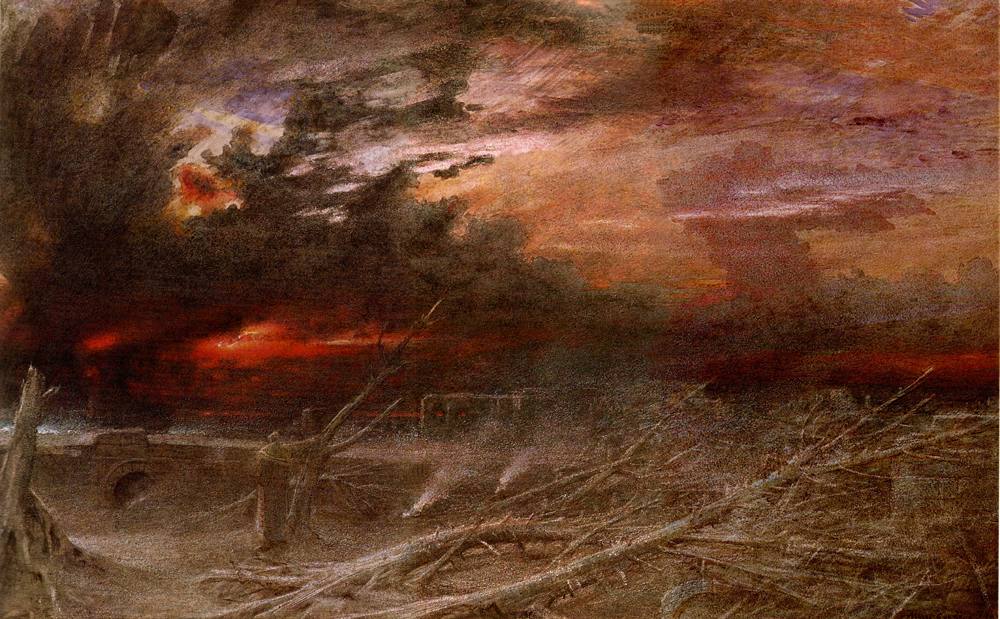
Albert Goodwin’s 1903 “Apocalypse,” Image courtesy of Wikipedia
Hello everyone!
I would first like to introduce myself as the new editor for Love Among the Ruins, taking over for Kathryn. I am in awe of everything she does and incredibly humbled that she would entrust me to carry on this project.
I developed my deep love for the Theology of the Body in the Hillsdale College class that served as the inspiration for LAR. To say that the TOB is simply an interest or even a passion, however, would be to sell it short. As I am not the first to note, TOB is a lens through which we view the entirety of human experience in right order. I’d like to take that image one step further for the purposes of this blog, and then we’ll get to the zombies.
In his 1960 work Love and Responsibility, Karol Wojtyla, soon to become John Paul II, begins by laying down a moral framework for understanding the human person. This view of the human person, which he terms the personalistic norm, serves as the foundation not only for his teachings on marital and sexual ethics, but also as an important philosophical component of the Theology of the Body.
The personalistic norm is essentially this: the person is a good towards which the only proper and adequate attitude is love.
In that same year, JPII also wrote his most famous play The Jeweler’s Shop. In this short three-act play through which he explores love as “one of the greatest dramas of human existence,” one of the characters states that “love outdistances its object, or approaches it so closely that it is almost lost from view.”
The Theology of the Body, then, is not only a lens but a magnifying glass. It is concerned with looking at persons so closely that they are no longer objects to be used, but subjects in all the greatness of their nature. The focus of this blog is invaluable because we find it increasingly harder within our culture to work at this task.
So in honor of this day, linked below is an article that illuminates this topic and provides something to read other than another history the Christian origins of Halloween. Unless you’re like me and you forget the history of Halloween every single year so you actually need to go back and read one of those articles as well.
Here’s an excerpt from “Our Walking Dead Culture: How the Theology of the Body can save us from the Zombie Apocalypse:”
The show, however, isn’t really about the undead. It’s about the living. It’s about their quest to not merely survive, but more importantly, to retain their
humanity in a world gone mad.
Sound familiar?
True, the window dressing is different. Our walking dead smell better and have less blood on their clothing than those meandering about the post-apocalyptic
Southern landscape of The Walking Dead. But the worlds remain fundamentally the same.
As the author goes on to note, the Theology of the Body serves as both a vaccine for us in this deranged world, as well as an antidote for our real-life zombies. In other words, the TOB can help us see even the walking dead as persons created in the image and likeness of God and respond to them with love.
One final note on this task from Walker Percy in his novel Love in the Ruins. Dr. Thomas More, Percy’s self-proclaimed “bad Catholic” who works as a psychiatrist attempting to heal both the spiritual deadness of mankind as well as in himself:
“A note for physicians: if you listen carefully to what patients say, they will often tell you not only what is wrong with them but also what is wrong with you.”
The goal of Love Among the Ruins is to help us approach our culture with this advice in mind.
If you would like to engage in this project with thoughts of your own, submissions can now be sent to [email protected]
Enjoy the rest of “Our Walking Dead Culture” here, and have a very happy Eve of All Hallows!
Previous Post
October 22, 2015
Happy Feast of JPII and New Editor for LAR
Next Post

November 12, 2015 Vocation in the Service of Beauty
Browse Our Archives
Select a Category Uncategorized
Select a Month May 2016 April 2016 March 2016 February 2016 January 2016 December 2015 November 2015 October 2015 July 2015 June 2015 May 2015 April 2015 March 2015 February 2015 January 2015
TAKE THE
Religious Wisdom Quiz
What does "El Shaddai" mean?
Select your answer to see how you score.
God Almighty Prince of Peace God is Judge Provider
Related posts from Love Among the Ruins
That Hideous Strength: When Marriage Saved the Universe

What if You Could Stop the Fall of...
Finding Redemption in the Blackness: Good Friday with...
TRENDING AT PATHEOS Catholic

The Parable Of The Sower And The Word...
One of Christ’s most famous parables is that of the sower who...

Rejecting Doom: Christian Hope And Human Action
Christianity is a religion of hope. We are to have hope and...

Why I Choose the Eucharist Over the Sermon
Choose the Eucharist, Not the Sermon What are we supposed to get...

5 Design Elements Found in Spiritually Rooted Homes
Putting Spirituality Into Home Decor Our homes are more than our living...

Credo: A Story of God Told with the...
About 10 years ago, I began to imagine a personal "Credo" that...

The Anatomy of Divine Revelation in Catholic Thought
The claim that God has made Himself known to human beings is...
view all Catholic blogs
Ad-Free & Subscriber Log-In Subscription Support
- About Us
- 2026 Calendar
- Videos
- Podcasts
- Library of World Religions
- Faith In Media Tracker
- Advertise With Us
- Write for Us
- Privacy Policy
- Terms of Service
- Do Not Sell My Data
- Contact Us
- Radiant Digital
- Manage Newsletter Subscriptions
- Unsubscribe From Notifications
- Sitemap
Copyright 2008-2026, Patheos. All rights reserved.
Subscription Support Ad-Free & Subscriber Log-In
Follow Patheos