
BuddhistCatholicContemplativeEvangelicalGeneral ChristianHinduJewishLatter-day SaintMuslimNew VisionsProgressive Christian
Beliefs
- Buddhist
- Catholic
- Contemplative
- Evangelical
- General Christian
- Hindu
- Jewish
- Latter-day Saint
- More Voices
- Muslim
- New Visions
- Pagan
- Progressive Christian
Topics
- Religion News
- Food and Religion
- Sports and Religion
- Religious Art
- Religious Music and Entertainment
- Religious Events
- History and Religion
- Style and Religion
- Politics and Religion
- Women in Religion
- Recreation Outdoors and Religion
- Business Finance and Religion
- Careers Workplace and Religion
- Education and Religion
- Family Parenting and Religion
- Health Fitness and Religion
- Home and Religion
- Relationships and Religion
- Technology and Religion
- Travel and Religion
Columnists
- Buddhist Columnists
- Business Finance and Religion Columnists
- Careers Workplace and Religion Columnists
- Catholic Columnists
- Contemplative Columnists
- Education and Religion Columnists
- Evangelists Columnists
- Family Parenting and Religion Columnists
- General Christian Columnists
- Health Fitness and Religion Columnists
- Hindu Columnists
- History and Religion Columnists
- Home and Religion Columnists
- Jewish Columnists
- More Voices Columnists
- Latter Day Columnists
- Muslim Columnists
- New Visions Columnists
- Nonreligious Columnists
- Pagan Columnists
- Politics and Religion Columnists
- Progressive Columnists
- Recreation Outdoors and Religion Columnists
- Relationships and Religion Columnists
- Religion News Columnists
- Religious Art Columnists
- Religious Events Columnists
- Religious Music and Entertainment Columnists
- Sports and Religion Columnists
- Style and Religion Columnists
- Technology and Religion Columnists
- Travel and Religion Columnists
- Women in Religion Columnists
Resource Library
- 2026 Calendar
- Library of World Religions
- The 100 Most Holy Places on Earth
- Patheos Answers
- Podcasts
- Videos
- Faith Leaders Database
- Anglican Episcopalian
- Bahai
- Baptist
- Buddhism
- Christianity
- Confucianism
- Eastern Orthodoxy
- Hinduism
- Holiness and Pentecostal
- ISKCON
- Islam
- Judaism
- Lutheran
- Methodist
- The Church of Jesus Christ of Latter-day Saints
- New Age
- Paganism
- Presbytarian and Reformed
- Protestantism
- Religion Behind the Scenes
- Roman Catholic
- Scientology
- Shia Islam
- Sikhism
- Sufism
- Sunni Islam
- Taoism
- Zen
- See all religions
Research Tools
 Ad-Free & Subscriber Log-In Subscription Support
Ad-Free & Subscriber Log-In Subscription Support
Follow Patheos 

- Trending:
- Forgiveness
- |
- Marriage
- |
- Consciousness
- |
- Death Penalty
- |
- Election
- |
- Halloween
 Love Among the Ruins
- Home
- Catholic
- Divine Reality in “Final Fantasy”
Divine Reality in “Final Fantasy”
Last updated on: June 26, 2015 at 2:19 pm by Rob L'Arrivee
Divine Reality in “Final Fantasy” 2015-06-26T14:19:42-04:00 Rob L'Arrivee
Patheos Explore the world's faith through different perspectives on religion and spirituality! Patheos has the views of the prevalent religions and spiritualities of the world.
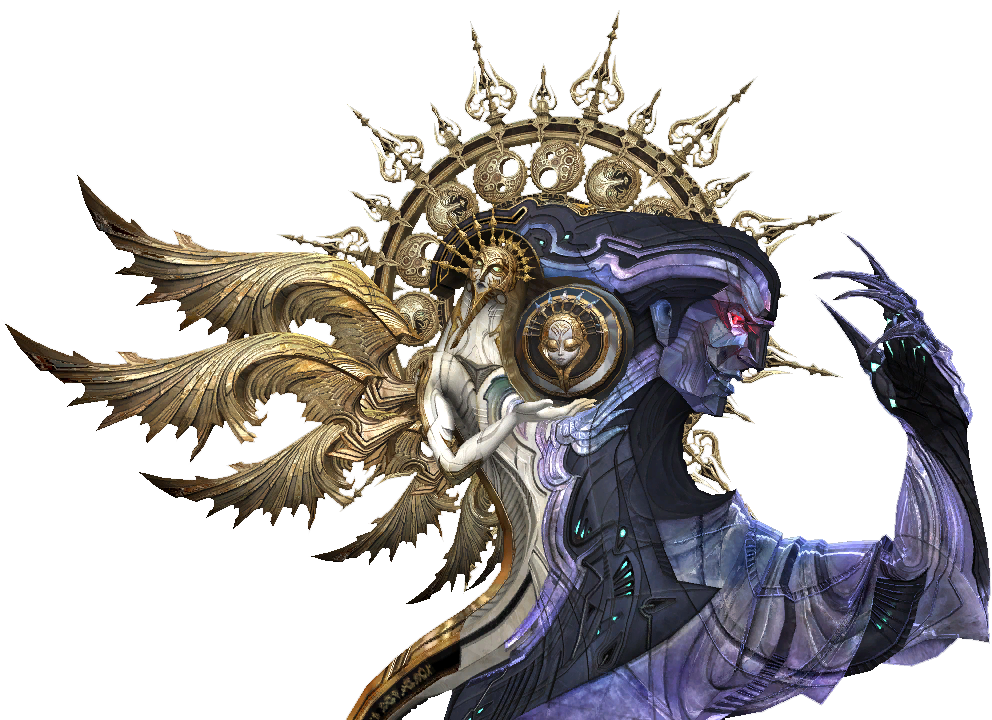
Image courtesy of Wikimedia Commons.
The first video game I purchased for Nintendo was Final Fantasy I in 1989. I immediately fell in love with its colorful maps and the exotic bestiary I fought on my quest to save the world. By today’s standards the graphics are poor, but at the time their simplicity fueled my imagination. I gleefully watched my 8 bit heroes attack motionless red skeletons in strange realms. To this day chills run down my spine when I recall battling the fallen knight Garland, whose unrequited love for a princess betrayed his soul.

Much later in FF XIII the heroes set out to discover their divinely appointed “focus” manifest in tattoos. Over the course of their adventure, each character experiences deep loss and the fear of abandonment. The main character Lightning fights to save her sister, Serah, who is frozen in a crystal shell. Serah’s fiancé, Snow, leads group of freedom fighters to save his beloved from her crystal sleep. Snow’s recklessness, however, causes the death of Hope’s mother, who joins the heroes to exact revenge. Sazh, a single father coping with the death of his wife, scrambles to rescue his son Dajh from the government. Vanille and Fang, two mysterious orphans, swear to protect one another but are separated at the beginning of the game. As you can see, there is plenty of lost love and abandonment to go around. Eventually they rally together to fight the final baddie who threatens to destroy the world (Cocoon).
While not directly about the marital aspect of the Theology of the Body, the game delves into the effects of the feeling of pain and abandonment that result from the failure to experience love and the created order as a gift from God.
The end boss is aptly named Orphan. He desires to destroy Cocoon with its millions of citizens in order to rouse God, his Father and Maker of the universe, from his slumber. Orphan believes that by shattering the world his Father will wake up and return to him. Orphan is portrayed [see above] as a little white circle flanked by monstrous parents (who are extensions of himself). A giant father figure on the right brandishes a menacing claw, while on our left a serpentine woman with six feathers caresses her delicate child.
When I first encountered Orphan, I thought, “Wow, this looks like a religious painting.” And lo and behold the Wiki article on FF XIII says that Orphan resembles the Holy Family.[1]
The mother figure, Lindzei, alludes to familiar depictions of the Virgin Mary, but also the six-winged angel. The Bible also associates the serph with serpents, and so we see Lindzei’s six-winged tale curl down one side of Orphan’s body.
The abominable father is Barthandelus. Throughout the game Barthandelus looks a lot like a Pope. He rules Cocoon and functions as an intermediary between its citizens and the gods. Little do the people of Cocoon know that he, too, is a divinity plotting to betray them.

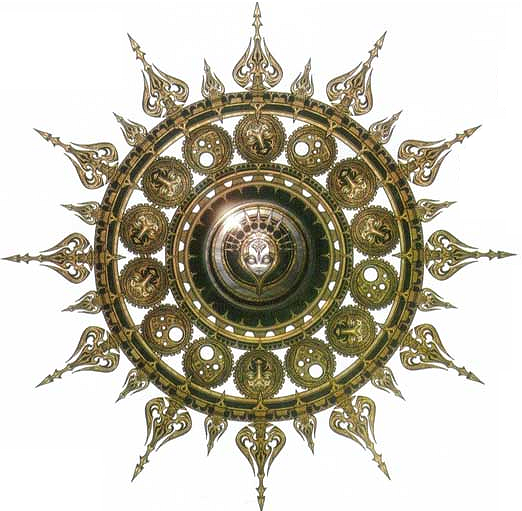
As for the Orphan child, he exhibits elements of the wheels of fire called Thrones in the Book of Ezekiel. In Hebrew these wheels are called the Ophanim, which puns somewhat on Orphan. In Jewish mystical texts, the Ophanim are responsible for maintaining the laws of the universe, which goes nicely with Orphan’s task of maintaining Cocoon. If Orphan dies, Cocoon will literally fall from the sky.
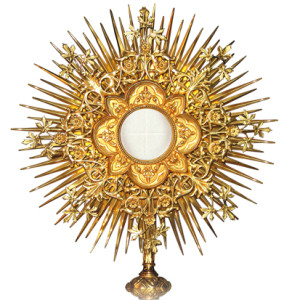
Orphan takes on another form which looks uncannily like a monstrance. Indeed, Orphan is rife with inverted Christological motifs.
When Orphan is first revealed he calls himself the Abandoned One. While fighting the heroes, Orphan casts a devastating spell called Merciless Judgment through his body which is a menacing knife. The blade divides without mercy, yet deep down Orphan aches for unity. Orphan’s rage at the pain of division and abandonment drives his merciless attack upon the world. His heart is gripped by an inescapable contradiction—his longing for wholeness is the very thing that drives him to rip everything apart.
Like Orphan, Jesus is the child of God, who experiences abandonment on the Cross. But whereas Jesus sacrifices himself in order to redeem all of creation, Orphan wants to sacrifice the whole for his own salvation. At one point Orphan asks the heroes if they have the “will to guide the world unto oblivion. Can you bear the sin of our salvation?” In contrast, Christ takes upon himself alienation from God in order to heal creation. Orphan perverts the mercy of Christ into a frantic desire to break the universe. As such, Orphan divides, Christ unites, Orphan wants vengeance, Christ preaches mercy, Orphan resents, Christ loves.
For Orphan—and us—the agony at separation from God makes us lose all hope in finding happiness. We thus turn inward to nurse a horrendous resentment against the world and ourselves. Orphan, in fact, creates a loving mother and father to heal his pain. As the TOB states, “The role of love, which is ‘poured out into (the) hearts’ (Rom 5:5) of the spouses as the fundamental spiritual power of their conjugal pact, consists—as we said—in protecting both the value of the true communion of the spouses and the value of truly responsible fatherhood and motherhood.”[2] When we fail to see that we are gifts born from love, we may feel abandoned, and seek to vent our rage. But this rage cannot satisfy our deepest longing for wholeness in true communion. Orphan only mocks and giggles while he tries to kill himself and the world just to have God come back to emptiness. Take that dad! Watch it all burn….and stare into the void. Indeed, he is not the sacrament of love and mercy that beckons us to taste and see.
Orphan attempts to summon the savage beast Ragnarok who is full of rage and destruction. Ragnarok is actually hidden inside Fang’s body. To unleash this rage Orphan tortures Vanille in front of Fang. He sees her body as weapon of nihilism, denying the fact that “creation constitutes the fundamental and original gift.”[3]
However, Orphan underestimates the characters’ love for one another. As Orphan dies and Cocoon falls from the sky, Fang and Vanille agree to transform into a crystal pillar in order to hold the world up. Vanille says to Fang before they forever lock themselves in a crystal sleep, “Wishes can come true. But not if you just wait for miracles. Miracles are things we make for ourselves, here and now.” In becoming the pillar of the world, their continental love literally supports Cocoon and its entire people.
While this all sounds nice, the ending comes with some uneasiness. FF XIII cuts God out of the picture of what can truly satisfy our deepest longings. We come away with the sense that human centered love is sufficient for wholeness. No transcendent good is needed, no loving Father in heaven. But, can we truly love without the divine penetrating our hearts? Nevertheless, Orphan’s pain and Vanille and Fang’s sacrifice point to something beyond, and the need for the “supernatural conferring of the fruits of redemption accomplished by Christ—therefore, not only the fruits of redemption are a gift, but above all, Christ himself is a gift. He gives himself to the Church as to his spouse.”[4] To assuage sense of loss and foster true sacrifice for another, we must try to see creation as a gift, and give the gift of ourselves as well.
***

Robert L’Arrivee, PhD, has studied early Christian studies and political science at the University of Notre Dame. He focuses on medieval Islamic political philosophy and is teaching at Colgate University this Fall.
Footnotes:
[1] http://finalfantasy.wikia.com/wiki/Orphan.
[2] TOB, 123.4.
[3]TOB, 13.4.
[4]TOB, 94.5.
Previous Post

June 15, 2015
What Wallace Fought For: Thoughts on "Braveheart" for Father's Day
Next Post
July 2, 2015 Not Your Average Love Songs: "Heaven's Knife" & "Like the Dawn"
Browse Our Archives
Select a Category Uncategorized
Select a Month May 2016 April 2016 March 2016 February 2016 January 2016 December 2015 November 2015 October 2015 July 2015 June 2015 May 2015 April 2015 March 2015 February 2015 January 2015
TAKE THE
Religious Wisdom Quiz
In which Psalm do we find "Your word is a lamp to my feet..."?
Select your answer to see how you score.
Psalm 23 Psalm 119 Psalm 90 Psalm 27
Related posts from Love Among the Ruins

That Hideous Strength: When Marriage Saved the Universe

What if You Could Stop the Fall of...
Finding Redemption in the Blackness: Good Friday with...
TRENDING AT PATHEOS Catholic

Creation, Preservation, and Teleology in Catholic Theology
As I write this, it is very early Monday morning. Like millions...

The Parable Of The Sower And The Word...
One of Christ’s most famous parables is that of the sower who...

Rejecting Doom: Christian Hope And Human Action
Christianity is a religion of hope. We are to have hope and...

Why I Choose the Eucharist Over the Sermon
Choose the Eucharist, Not the Sermon What are we supposed to get...

5 Design Elements Found in Spiritually Rooted Homes
Putting Spirituality Into Home Decor Our homes are more than our living...

Credo: A Story of God Told with the...
About 10 years ago, I began to imagine a personal "Credo" that...
view all Catholic blogs
Ad-Free & Subscriber Log-In Subscription Support
- About Us
- 2026 Calendar
- Videos
- Podcasts
- Library of World Religions
- Faith In Media Tracker
- Advertise With Us
- Write for Us
- Privacy Policy
- Terms of Service
- Do Not Sell My Data
- Contact Us
- Radiant Digital
- Manage Newsletter Subscriptions
- Unsubscribe From Notifications
- Sitemap
Copyright 2008-2026, Patheos. All rights reserved.
Subscription Support Ad-Free & Subscriber Log-In
Follow Patheos