
BuddhistCatholicContemplativeEvangelicalGeneral ChristianHinduJewishLatter-day SaintMuslimNew VisionsProgressive Christian
Beliefs
- Buddhist
- Catholic
- Contemplative
- Evangelical
- General Christian
- Hindu
- Jewish
- Latter-day Saint
- More Voices
- Muslim
- New Visions
- Pagan
- Progressive Christian
Topics
- Religion News
- Food and Religion
- Sports and Religion
- Religious Art
- Religious Music and Entertainment
- Religious Events
- History and Religion
- Style and Religion
- Politics and Religion
- Women in Religion
- Recreation Outdoors and Religion
- Business Finance and Religion
- Careers Workplace and Religion
- Education and Religion
- Family Parenting and Religion
- Health Fitness and Religion
- Home and Religion
- Relationships and Religion
- Technology and Religion
- Travel and Religion
Columnists
- Buddhist Columnists
- Business Finance and Religion Columnists
- Careers Workplace and Religion Columnists
- Catholic Columnists
- Contemplative Columnists
- Education and Religion Columnists
- Evangelists Columnists
- Family Parenting and Religion Columnists
- General Christian Columnists
- Health Fitness and Religion Columnists
- Hindu Columnists
- History and Religion Columnists
- Home and Religion Columnists
- Jewish Columnists
- More Voices Columnists
- Latter Day Columnists
- Muslim Columnists
- New Visions Columnists
- Nonreligious Columnists
- Pagan Columnists
- Politics and Religion Columnists
- Progressive Columnists
- Recreation Outdoors and Religion Columnists
- Relationships and Religion Columnists
- Religion News Columnists
- Religious Art Columnists
- Religious Events Columnists
- Religious Music and Entertainment Columnists
- Sports and Religion Columnists
- Style and Religion Columnists
- Technology and Religion Columnists
- Travel and Religion Columnists
- Women in Religion Columnists
Resource Library
- 2026 Calendar
- Library of World Religions
- The 100 Most Holy Places on Earth
- Patheos Answers
- Podcasts
- Videos
- Faith Leaders Database
- Anglican Episcopalian
- Bahai
- Baptist
- Buddhism
- Christianity
- Confucianism
- Eastern Orthodoxy
- Hinduism
- Holiness and Pentecostal
- ISKCON
- Islam
- Judaism
- Lutheran
- Methodist
- The Church of Jesus Christ of Latter-day Saints
- New Age
- Paganism
- Presbytarian and Reformed
- Protestantism
- Religion Behind the Scenes
- Roman Catholic
- Scientology
- Shia Islam
- Sikhism
- Sufism
- Sunni Islam
- Taoism
- Zen
- See all religions
Research Tools
 Ad-Free & Subscriber Log-In Subscription Support
Ad-Free & Subscriber Log-In Subscription Support
Follow Patheos 

- Trending:
- Forgiveness
- |
- Marriage
- |
- Consciousness
- |
- Death Penalty
- |
- Election
- |
- Halloween
 Love Among the Ruins
- Home
- Catholic
- Perpetual Solitude in “Frankenstein”
Perpetual Solitude in “Frankenstein”
Last updated on: May 12, 2015 at 2:38 pm by Sarah Rinaldi
Perpetual Solitude in “Frankenstein” 2015-05-12T14:38:39-04:00 Sarah Rinaldi
Patheos Explore the world's faith through different perspectives on religion and spirituality! Patheos has the views of the prevalent religions and spiritualities of the world.
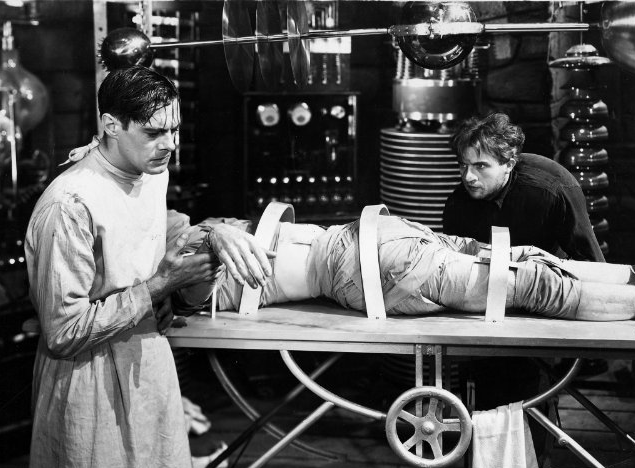
Image courtesy of IMDB.
Mary Shelley’s Frankenstein offers a warning to its readers by presenting a perversion of the creation story in Genesis. By the end of the novel, Victor Frankenstein’s egotistical aspiration to cause life has brought about destruction, solitude, death, and ultimately a permanent exclusion from human community, for both himself and his creature. This story and its consequences align precisely with and can be illuminated by John Paul II’s diagnosis of what he calls the “civilization of death” in his Letter to Families.
Breaking down the creation narrative in Frankenstein we discover distinct parallels between the fabrication of the creature and the two Genesis accounts as outlined by John Paul II in the Theology of the Body. In Genesis, the first (Elohist account) describes man’s creation in metaphysical terms: man is made in the image of God, but the particulars of his creation are not outlined. Likewise, Victor provides a brief overview of his creation by explaining that he labored to construct and give the creature the spark of life but leaves out the details. The second (Yahwist) scriptural account of creation complements the first with greater particularity, describing the creation of man and woman: how Adam was made first from the dust of the earth and Eve from his rib. This attentiveness to a process is echoed by the second account found in Frankenstein. The details are reported in Victor’s journal: As Adam was made from the dust of the earth, the creature was constructed from scraps Victor collected while graverobbing. What is the significance of these double accounts? John Paul II reads the Yahwist account as a “record of man’s self-understanding;” we might see something similar in Victor’s journal concerning the creature: he comes to a deeper self-understanding as he learns of his “accursed origin” through “the minutest description of [his] odious and loathsome person” (TOB, 137).
But in Frankenstein, the most important aspect of the creation story is missing: love. John Paul says that the “‘radical gift” of selfless love is “the divine motive for creation” (TOB, 180). God did not create man for Himself. Yet when Victor creates, he is only motivated by his own self-interest. He hopes that “a new species would bless [him] as its creator and source [and that] many happy and excellent natures would owe their being to [him].” Victor’s intention is to receive from rather than give to his creation.
Victor’s selfish motives originate in his pride which attempts to break through the boundary between life and death. Conversely, John Paul II asserts that in choosing whether or not to eat the fruit of the tree of the knowledge of good and evil, man decides between immortality and death (TOB, 154-155). Victor, when contemplating creating another being, says that “life and death appear to [him] ideal bounds, which [he] should first break through, and pour a torrent of light into our dark world.” Victor is precisely trying to usurp God’s power and Word by breaking through the “ideal bounds” of life and death. He imagines himself almost as a Christ-like figure, shedding light on a world seemingly haunted by death. But unlike Christ who gave of Himself through a true gift of spousal love, Victor, again, is only motivated by his own self-interest.
John Paul II’s exploration of what he calls the “original solitude” of prelapsarian man illuminates the creature’s predicament in Frankenstein. There are two aspects to man’s solitude in Genesis: 1) man is alone in his very nature and 2) man is alone without Eve (TOB, 147). Adam names the animals around him and realizes he is different from the rest of the visible world. Similarly, the creature looks at the cottagers, beholds their “perfect forms,”and upon examining himself, sees himself as, “the monster that I am.” John Paul emphasizes the role of the body in this discovery; he says that “the body…makes [man] aware of being ‘alone’”(TOB, 152). Man recognizes that he is a body among bodies, but his body sets him apart in creation. Victor’s creature has the same realization. And just as Adam recognizes that he does not have a suitable helper, so too the creature demands a companion. He even goes as far as to demand a female “of the same species…[who has] the same defects.” In his solitude, he pines for his own Eve who would be like him, down to the details of his physical form.
The creation account in Frankenstein renders a deeper solitude than in Genesis. John Paul II points out that from the beginning, man is “in search of his own being…in search of his own identity” (TOB, 149). Man is on a quest to understand who he is, especially in light of his differences from the rest of creation. This search is conducted “from the first moment of his existence before God” (Ibid.). The fact that “man finds himself alone before God” deepens his self-knowledge, and he comes recognize himself as a human being made in the Creator’s image (TOB, 150). The creature, just like man, is in search of his identity. But in the case of Frankenstein, the creature is abandoned by his creator and is thus deprived of that deeper self-discovery. The creator-creature relationship is denied, and with it, deeper self-knowledge.
These deviations from Genesis reveal the root of the destruction that pervades the novel. By the end, Victor and his creature have been excluded from the communion of persons because they lack an understanding of what it means to live “for someone.” John Paul II describes the communion of persons as “living in a reciprocal ‘for’ in a relationship of reciprocal gift…[which] is precisely the fulfillment of ‘man’s original solitude”(TOB, 182). Victor, in his attempt to become like God, has isolated himself completely from his family and friends. As he immerses himself in his studies, he is “alone…totally unfit for the company of strangers” and spends large portions of time in solitude. The creature, deprived of a female companion, is denied the fulfillment of that solitude. He then leads a life of destruction instead of living “to serve the truth in love” (LF, 20). He is unable to live “for someone” because his creator has not shown him an example of this self-gift in the way that God provided an example for man. Victor and his creature fall into a perpetual state of solitude and destruction because the creator has stepped outside of the boundaries of God’s order; he is surrounded by death, the very thing he sought to avoid.
The plot of Frankenstein paints a dark and grotesque picture, warning its readers to steer clear of those choices which lead us away from human flourishing. John Paul II explains that the mentality undergirding the civilization of death results in “the loss of the truth about one’s own self […] and consequently of a loss of love itself” (LF, 20). Victor only creates for his own self-interest, and as a result, he and his creature have lost an understanding of themselves. They are no longer able to participate in the communion of persons; and thus, what Victor hoped would one day bless him, now has led to his own downfall. Ultimately, generating life outside of God’s order leads to a society without love, truth, and goodness. Frankenstein clearly illustrates this, and in so doing, poses this question to the reader: what values ought we to cultivate in our own lives and, more broadly, our society today? Those that lead to death? Or life?
***

Sarah Rinaldi, a swimmer and Augustine-loving historiographer, is honing her skills at Hillsdale College in pursuit of becoming a classical educator.
Previous Post

May 3, 2015
Fr. Barron's New Book Plumbs Pop Culture in Search of the Divine
Next Post

May 25, 2015 Love, Pain, and Polar Bears: Conjugal Union in "Mess Is Mine"
Browse Our Archives
Select a Category Uncategorized
Select a Month May 2016 April 2016 March 2016 February 2016 January 2016 December 2015 November 2015 October 2015 July 2015 June 2015 May 2015 April 2015 March 2015 February 2015 January 2015
TAKE THE
Religious Wisdom Quiz
What does "Moses" mean?
Select your answer to see how you score.
Born Amid Trouble Drawn Out (of water) Gifted Rescued
Related posts from Love Among the Ruins

That Hideous Strength: When Marriage Saved the Universe
What if You Could Stop the Fall of...
Finding Redemption in the Blackness: Good Friday with...
TRENDING AT PATHEOS Catholic

The Parable Of The Sower And The Word...
One of Christ’s most famous parables is that of the sower who...

Rejecting Doom: Christian Hope And Human Action
Christianity is a religion of hope. We are to have hope and...

Why I Choose the Eucharist Over the Sermon
Choose the Eucharist, Not the Sermon What are we supposed to get...

5 Design Elements Found in Spiritually Rooted Homes
Putting Spirituality Into Home Decor Our homes are more than our living...

Credo: A Story of God Told with the...
About 10 years ago, I began to imagine a personal "Credo" that...

The Anatomy of Divine Revelation in Catholic Thought
The claim that God has made Himself known to human beings is...
view all Catholic blogs
Ad-Free & Subscriber Log-In Subscription Support
- About Us
- 2026 Calendar
- Videos
- Podcasts
- Library of World Religions
- Faith In Media Tracker
- Advertise With Us
- Write for Us
- Privacy Policy
- Terms of Service
- Do Not Sell My Data
- Contact Us
- Radiant Digital
- Manage Newsletter Subscriptions
- Unsubscribe From Notifications
- Sitemap
Copyright 2008-2026, Patheos. All rights reserved.
Subscription Support Ad-Free & Subscriber Log-In
Follow Patheos