
BuddhistCatholicContemplativeEvangelicalGeneral ChristianHinduJewishLatter-day SaintMuslimNew VisionsProgressive Christian
Beliefs
- Buddhist
- Catholic
- Contemplative
- Evangelical
- General Christian
- Hindu
- Jewish
- Latter-day Saint
- More Voices
- Muslim
- New Visions
- Pagan
- Progressive Christian
Topics
- Religion News
- Food and Religion
- Sports and Religion
- Religious Art
- Religious Music and Entertainment
- Religious Events
- History and Religion
- Style and Religion
- Politics and Religion
- Women in Religion
- Recreation Outdoors and Religion
- Business Finance and Religion
- Careers Workplace and Religion
- Education and Religion
- Family Parenting and Religion
- Health Fitness and Religion
- Home and Religion
- Relationships and Religion
- Technology and Religion
- Travel and Religion
Columnists
- Buddhist Columnists
- Business Finance and Religion Columnists
- Careers Workplace and Religion Columnists
- Catholic Columnists
- Contemplative Columnists
- Education and Religion Columnists
- Evangelists Columnists
- Family Parenting and Religion Columnists
- General Christian Columnists
- Health Fitness and Religion Columnists
- Hindu Columnists
- History and Religion Columnists
- Home and Religion Columnists
- Jewish Columnists
- More Voices Columnists
- Latter Day Columnists
- Muslim Columnists
- New Visions Columnists
- Nonreligious Columnists
- Pagan Columnists
- Politics and Religion Columnists
- Progressive Columnists
- Recreation Outdoors and Religion Columnists
- Relationships and Religion Columnists
- Religion News Columnists
- Religious Art Columnists
- Religious Events Columnists
- Religious Music and Entertainment Columnists
- Sports and Religion Columnists
- Style and Religion Columnists
- Technology and Religion Columnists
- Travel and Religion Columnists
- Women in Religion Columnists
Resource Library
- 2026 Calendar
- Library of World Religions
- The 100 Most Holy Places on Earth
- Patheos Answers
- Podcasts
- Videos
- Faith Leaders Database
- Anglican Episcopalian
- Bahai
- Baptist
- Buddhism
- Christianity
- Confucianism
- Eastern Orthodoxy
- Hinduism
- Holiness and Pentecostal
- ISKCON
- Islam
- Judaism
- Lutheran
- Methodist
- The Church of Jesus Christ of Latter-day Saints
- New Age
- Paganism
- Presbytarian and Reformed
- Protestantism
- Religion Behind the Scenes
- Roman Catholic
- Scientology
- Shia Islam
- Sikhism
- Sufism
- Sunni Islam
- Taoism
- Zen
- See all religions
Research Tools
 Ad-Free & Subscriber Log-In Subscription Support
Ad-Free & Subscriber Log-In Subscription Support
Follow Patheos 

- Trending:
- Forgiveness
- |
- Marriage
- |
- Consciousness
- |
- Death Penalty
- |
- Election
- |
- Halloween
 Love Among the Ruins
- Home
- Catholic
- Marriage + Change = …Divorce? A Look at “The Vow”
Marriage + Change = …Divorce? A Look at “The Vow”
Last updated on: April 23, 2015 at 4:30 pm by Bridget Surmont
Marriage + Change = …Divorce? A Look at “The Vow” 2015-04-23T16:30:38-04:00 Bridget Surmont
Patheos Explore the world's faith through different perspectives on religion and spirituality! Patheos has the views of the prevalent religions and spiritualities of the world.
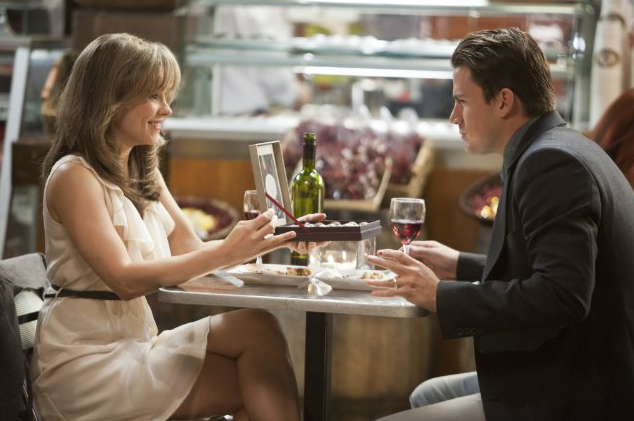
Image courtesy of IMDB.
The Vow (2012) follows Leo (Channing Tatum) and Paige (Rachel McAdams), a newlywed couple who are involved in a car accident that leaves Paige in a coma. When she wakes up, Paige has no memory of the last five years of her life—during which she met, fell in love with, and married Leo.
Essentially, Paige becomes the person she was five years ago, before she knew Leo. Here is an extreme example of the “my spouse changed” argument for divorce, which leads us to an important question: Who are we? Initially, Leo (like many of us) believes that Paige’s memory loss has transformed her into a different person. Leo believes that people are their thoughts, while their bodies are merely machines (aka a dualistic view). He expresses this view when he states: “Each one of us is the sum total of every moment that we’ve ever experienced… [and] these moments of impact define who we are.” This dualistic view of the body is opposed to the ideas put forth by John Paul II in his Letter to Families where he affirms, “[M]an is a person in the unity of his body and spirit. The body can never be reduced to mere matter: it is a spiritualized body, just as man’s spirit is so closely united to the body that he can be described as an embodied spirit.” Leo quickly realizes that, even though his wife has changed, he still is deeply in love with her. This is in line with John Paul II’s Theology of the Body, which holds that one marries the person, not their qualities. The Theology of the Body maintains that attraction must not be based merely on qualities. Indeed, even if one’s qualities fade, the TOB reaffirms that the person does not experience a fundamental change to their identity.
Throughout the film, Leo shows he loves Paige in her entirety. After the accident, Paige retreats to the life she remembers living five years ago: She chooses to go back to law school, abandons her career as an artist, and wishes to move back in with her parents. Additionally, she becomes short-tempered and acts differently towards those she cannot remember. Despite these changes, Leo repeatedly places Paige above his other obligations. When Paige does not return home after going out, Leo correctly believes she has forgotten her way around the unfamiliar city and misses an important work meeting in order to search for her. When Paige wants to live closer to her parents, Leo follows her. Many times Leo plans activities to try to help Paige remember the past. Through his actions, Leo proves that his love is not “limited to partial values, to something which is inherent to the person but it not the person as a whole” (Love and Responsibility). Since Leo loves Paige for her whole person, his love persists even when the accident alters her memory and causes her to behave differently.
Leo loves Paige completely and is willing to continue fighting for her love; but he ultimately chooses to give up his happiness for her own since it seems that she will be happier without him. Completely exhausted, Leo asks Paige, “How do you look at the girl you love and tell yourself it’s time to walk away?” Leo’s love toward Paige appears to be goodwill, which, according to Love and Responsibility, “is the same as selflessness in love: not ‘I long for you as a good’ but ‘I long for your good’…The person of goodwill longs for this with no selfish ulterior motive, no personal consideration.” Goodwill is opposed to utilitarianism, which merely seeks one’s own pleasure. By placing Paige’s happiness even higher than his own, Leo verifies that his love to Paige is true rather than guided by a utilitarian outlook. Leo’s love for Paige is so great that he is willing to leave her. If this is all in accord with the ideas in the Theology of the Body, does that mean that divorce is ok? Here’s where we need to clarify an important point:
1. Separation is ok.
2. Divorce is not.
1. Separation “does not negate the personalistic norm [as] neither of the persons…is put in the position of an object of use for the other” (L&R). When separating, the couple agrees to live apart though they are still bound by their marriage. John Paul II states: “One, or both of [the spouses], may cease to feel that there is any subjective justification for this union, and gradually fall into a state of mind which is…incompatible with it. Such a condition warrants separation ‘from bed and table’, but cannot annul the fact that they are objectively united, and united in wedlock (L&R). John Paul II’s statement certainly includes the situation presented in The Vow, as Paige does not remember Leo and she no longer feels bound by their marriage.
2. Divorce “claims to break the contract, to which the spouses freely consented, to live with each other till death” (Catechism of the Catholic Church, 2384).
Divorce is opposed to the idea of the indissolubility of marriage, and even when a couple gets a divorce the church holds that the spouses remain united as husband and wife. Divorce is so common today, that it is simply overlooked in society. In addition to promoting the practice of divorce, The Vow errs from the Theology of the Body on another important point. When Leo and Paige agree to divorce Paige says, “Leo, I hope one day I can love the way that you love me.” While it may seem trivial, with this statement Paige clearly implies that she will search for love outside of their marriage. The Vow does not support the indissolubility of marriage, as it is implied that Leo and Paige are both able to date (and ultimately remarry) following their divorce. Indeed, by claiming to dissolve the marriage, divorce suggests that the individuals are free to remarry—which actually “adds to the gravity of the rupture,” as it leads to utilitarianism and adultery (CCC, 2384). Remarriage corresponds with a utilitarian love, in which the previous spouse is “degraded to the status of an object for use,” and the new spouse, in marrying someone who is actually still married, becomes an adulterer (L&R). Therefore, by suggesting that Leo and Paige are free to enter into a committed relationship following their divorce, The Vow supports ideas which are contrary to a correct understanding of the indissolubility of marriage.
The film shows Leo and Paige living their separate lives after the divorce. While these images flash on the screen, Leo thinks, “That’s the thing about moments like these. You can’t, no matter how hard you try, control how they’re [going to] affect you. You just [have to]… wait.” Right at this moment, Paige finds her wedding vows while searching through a box in her art studio. As she reads them she inhales quickly and looks off into the distance, as if she is searching for something. Paige realizes that there is something important about a vow, and she seems to reconsider her decisions about Leo. It seems she finally grasps the finality of such a promise. The next scene shows Paige waiting outside of a coffee shop that she and Leo used to go to together. It appears that Paige has sought Leo out. As Leo and Paige talk, it is revealed that they have been divorced for over six months, during which time they have not been in contact. Paige admits that she has been talking to her friends about Leo and asks him if he is indeed still single. Paige asks Leo on a date and the film ends with the two walking hand in hand down a snow-covered street. As the image fades out, these words appear on the screen: “The couple who inspired this film are happily married today and have two children. She never regained her memory.”
The film ultimately concludes that Leo and Paige have a unique love that cannot be broken. But in highlighting the role of fate rather than the power of the couple’s wedding vows, it fails to support the idea of the indissolubility of marriage as a general rule that applies to all cases. Still, The Vow ends on a happy note in that it suggests that true love can overcome any obstacle.
***

Bridget Surmont is a Senior at Hillsdale College. She will graduate this May with a major in Psychology and a minor in Early Childhood Education.
Previous Post

April 18, 2015
Good News About Sex & Marriage Found in "Kristin Lavransdatter"

Browse Our Archives
Select a Category Uncategorized
Select a Month May 2016 April 2016 March 2016 February 2016 January 2016 December 2015 November 2015 October 2015 July 2015 June 2015 May 2015 April 2015 March 2015 February 2015 January 2015
TAKE THE
Religious Wisdom Quiz
How many wise men visited baby Jesus?
Select your answer to see how you score.
Four The Bible doesn’t say Two Three
Related posts from Love Among the Ruins
That Hideous Strength: When Marriage Saved the Universe

What if You Could Stop the Fall of...
Finding Redemption in the Blackness: Good Friday with...
TRENDING AT PATHEOS Catholic

Creation, Preservation, and Teleology in Catholic Theology
As I write this, it is very early Monday morning. Like millions...

The Parable Of The Sower And The Word...
One of Christ’s most famous parables is that of the sower who...

Rejecting Doom: Christian Hope And Human Action
Christianity is a religion of hope. We are to have hope and...

Why I Choose the Eucharist Over the Sermon
Choose the Eucharist, Not the Sermon What are we supposed to get...

5 Design Elements Found in Spiritually Rooted Homes
Putting Spirituality Into Home Decor Our homes are more than our living...

Credo: A Story of God Told with the...
About 10 years ago, I began to imagine a personal "Credo" that...
view all Catholic blogs
Ad-Free & Subscriber Log-In Subscription Support
- About Us
- 2026 Calendar
- Videos
- Podcasts
- Library of World Religions
- Faith In Media Tracker
- Advertise With Us
- Write for Us
- Privacy Policy
- Terms of Service
- Do Not Sell My Data
- Contact Us
- Radiant Digital
- Manage Newsletter Subscriptions
- Unsubscribe From Notifications
- Sitemap
Copyright 2008-2026, Patheos. All rights reserved.
Subscription Support Ad-Free & Subscriber Log-In
Follow Patheos