
BuddhistCatholicContemplativeEvangelicalGeneral ChristianHinduJewishLatter-day SaintMuslimNew VisionsProgressive Christian
Beliefs
- Buddhist
- Catholic
- Contemplative
- Evangelical
- General Christian
- Hindu
- Jewish
- Latter-day Saint
- More Voices
- Muslim
- New Visions
- Pagan
- Progressive Christian
Topics
- Religion News
- Food and Religion
- Sports and Religion
- Religious Art
- Religious Music and Entertainment
- Religious Events
- History and Religion
- Style and Religion
- Politics and Religion
- Women in Religion
- Recreation Outdoors and Religion
- Business Finance and Religion
- Careers Workplace and Religion
- Education and Religion
- Family Parenting and Religion
- Health Fitness and Religion
- Home and Religion
- Relationships and Religion
- Technology and Religion
- Travel and Religion
Columnists
- Buddhist Columnists
- Business Finance and Religion Columnists
- Careers Workplace and Religion Columnists
- Catholic Columnists
- Contemplative Columnists
- Education and Religion Columnists
- Evangelists Columnists
- Family Parenting and Religion Columnists
- General Christian Columnists
- Health Fitness and Religion Columnists
- Hindu Columnists
- History and Religion Columnists
- Home and Religion Columnists
- Jewish Columnists
- More Voices Columnists
- Latter Day Columnists
- Muslim Columnists
- New Visions Columnists
- Nonreligious Columnists
- Pagan Columnists
- Politics and Religion Columnists
- Progressive Columnists
- Recreation Outdoors and Religion Columnists
- Relationships and Religion Columnists
- Religion News Columnists
- Religious Art Columnists
- Religious Events Columnists
- Religious Music and Entertainment Columnists
- Sports and Religion Columnists
- Style and Religion Columnists
- Technology and Religion Columnists
- Travel and Religion Columnists
- Women in Religion Columnists
Resource Library
- 2026 Calendar
- Library of World Religions
- The 100 Most Holy Places on Earth
- Patheos Answers
- Podcasts
- Videos
- Faith Leaders Database
- Anglican Episcopalian
- Bahai
- Baptist
- Buddhism
- Christianity
- Confucianism
- Eastern Orthodoxy
- Hinduism
- Holiness and Pentecostal
- ISKCON
- Islam
- Judaism
- Lutheran
- Methodist
- The Church of Jesus Christ of Latter-day Saints
- New Age
- Paganism
- Presbytarian and Reformed
- Protestantism
- Religion Behind the Scenes
- Roman Catholic
- Scientology
- Shia Islam
- Sikhism
- Sufism
- Sunni Islam
- Taoism
- Zen
- See all religions
Research Tools
 Ad-Free & Subscriber Log-In Subscription Support
Follow Patheos 

- Trending:
- Advent
- |
- Forgiveness
- |
- Thanksgiving
- |
- Election
- |
- Seasonal Holidays
- |
- Marriage

- Home
- Hindu
- Politics and Religion
- Indian PM reveals his philosopher king side to US podcaster
Indian PM reveals his philosopher king side to US podcaster
Last updated on: April 10, 2025 at 1:59 pm by Parveen Chopra
Indian PM reveals his philosopher king side to US podcaster 2025-04-10T13:59:18-04:00 Parveen Chopra
Patheos Explore the world's faith through different perspectives on religion and spirituality! Patheos has the views of the prevalent religions and spiritualities of the world.
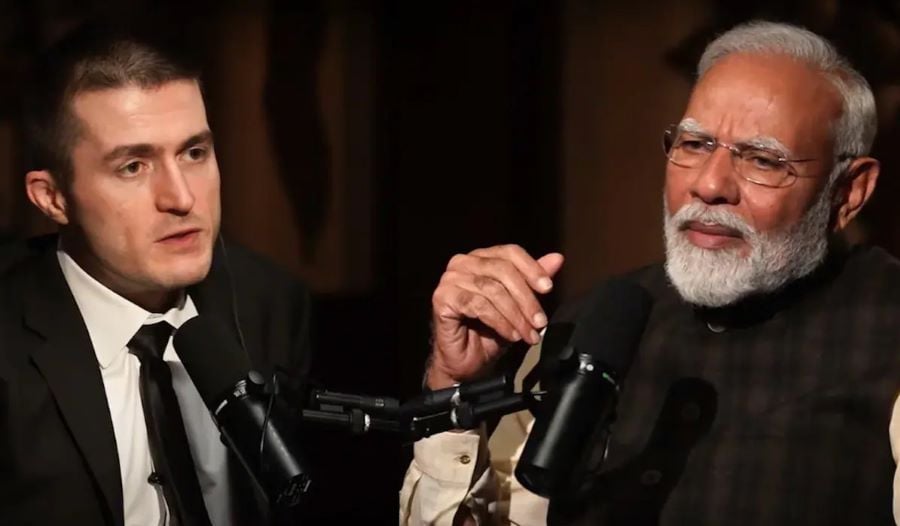
Indian Prime Minister Narendra Modi was interviewed by Lex Fridman for his podcast last month. (Photo courtesy NDTV)
President Trump has been so dominating the world stage that little else breaks out about leaders or leadership.
But this story did.
Last month, Indian Prime Minister Narendra Modi had a riveting 3-hour conversation with MIT scientist and podcaster Lex Fridman. In a world captivated by political rhetoric and media spectacles, the podcast was a rare glimpse into the inner world of a leader – his spiritual foundation, his discipline, his journey beyond the offices held. The interview became a reflection on the timeless virtues that shape a man, a leader, and a seeker – self-discipline, service, and an unshakable commitment to Dharma. Going viral, the podcast has since garnered 4.6 million views in less than a month.
Modi, serving his 3rd five-year term as Prime Minister, has variously been described as a statesman, a strategist, a nationalist, and a “tougher negotiator than me” (by President Trump). His critics see him as a polarizing figure who has suppressed the Muslim and Christian minorities. Speaking dispassionately, as ruler of the most diverse country in the world, he has kept calm at home and exercised diplomatic dexterity in a multi-polar world to raise India’s stature.
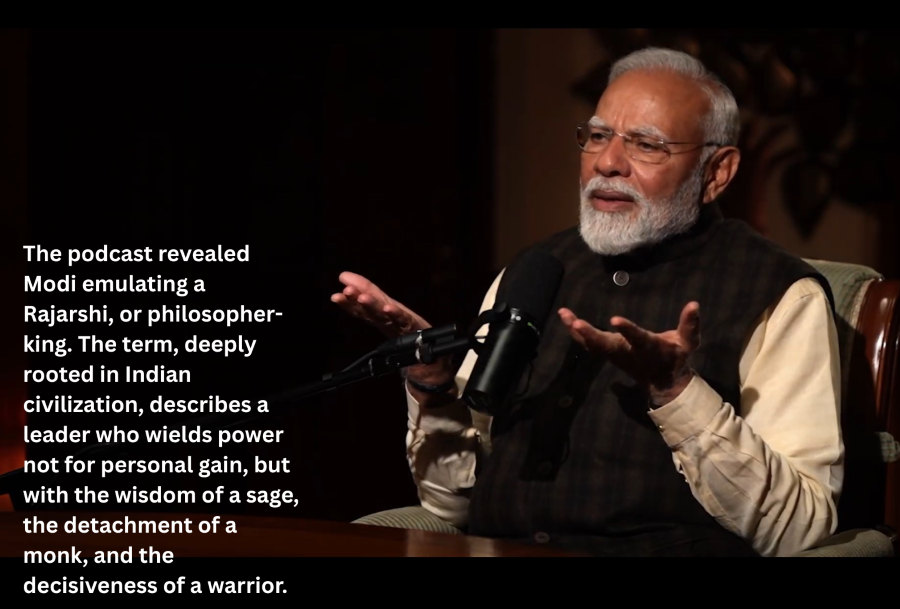
But in this podcast with Fridman, we see a different archetype emerging: the Rajarshi or the philosopher king. The term, deeply rooted in Indian civilization, describes a leader who wields power not for personal gain, but with the wisdom of a sage, the detachment of a monk, and the decisiveness of a warrior.
The discipline of fasting: A leader’s inner strength
The podcast, translated in multiple languages and released on March 16, carried a remarkable undercurrent: both men had fasted before the interview. Fridman, a scientist of Russian-Jewish descent, practices intermittent fasting for mental clarity. Modi has observed fasting as a way of life – whether the Navratri fasts he has adhered to for decades (he did not break his water fast even when it coincided with the State Dinner at White House with President Obama in September 2014), or the deeper spiritual restraint that fasting represents.
“After fasting for two days, I recommend you ease into eating slowly. I hope you reap great benefits from this fasting experience,” Modi told Fridman.
Ideally, fasting is not deprivation – it is mastery over the senses. The Bhagavad Gita, the key Indian scripture, echoes this wisdom, portraying the ideal man as one “unshaken by the dualities of pleasure and pain, praise and blame.” Modi’s life has been shaped by such tapasya – from selling tea at a railway station to enduring Himalayan winters, to the unrelenting pressures of political life. His ability to endure, to renounce, and to stay laser-focused has been his greatest asset.
The Himalayas: A test of the spirit
Perhaps the most striking segment of the discussion was PM Modi’s recollection of his two years of solitude in the Himalayas. In an age where public figures meticulously craft their image for the world, here was a leader speaking not of political ambitions, but of renunciation. (For the record, he has no kith and kin in his kitchen cabinet or entourage.)
Modi ji described waking before dawn, bathing in freezing waters, and observing monks who had renounced all possessions. Yet, despite being surrounded by silence, he felt his own restlessness. “A wise sage in the Himalayas once asked me to focus only on the dripping water from a leaf onto a bowl, ignoring all other sounds. That rhythmic melody guided me into deep focus and taught me the art of concentration.”
The Himalayas have long been the testing ground for seekers – Adi Shankaracharya walked its valleys before revitalizing Sanatana Dharma, and Swami Vivekananda found his awakening in its solitude. Modi’s time in the mountains was not that of a politician in retreat, but of a young man investigating the nature of existence.
Yet, solitude did not mean detachment from duty. When a calamity struck a village, Modi did not sit back – he stepped forward to serve. This echoes the karma yoga of the Bhagavad Gita: true spirituality is not found in renunciation alone but in action without ego.
Meditation, focus, and decision-making
Pressure, expectations, and external noise often cloud a leader’s mind. But what happens when a leader trains his mind the way a yogi trains his breath?
“The word meditation has been overused to the point that it feels like a cliché,” Modi noted. “We usually refer to it as dhyan. It simply means freeing yourself from distraction.”
Throughout the conversation with Fridman, one theme stood out – Modi’s clarity of thought and decision-making process. In today’s age of hyper-connectivity and distraction, few leaders can claim the ability to think deeply and act decisively. Modi’s method, as he described, is rooted in an old practice: detachment from praise and criticism, a mind trained to focus on action rather than outcome.
This is the essence of meditation – not just sitting cross-legged in silence, but the ability to hold stillness within, even amid the storm. It is the ability to look at problems without anxiety and solutions without attachment. The ability to act without ego as an instrument of something larger than oneself.
Not Modi, but the voice of a nation
“My strength lies not in my name, but in the backing of 1.4 billion Indians. And thousands of years of timeless culture and heritage,” Modi is heard saying in the English overdub, sounding like himself, which is made possible by AI. He continues, “So, wherever I go, I carry with me the essence of thousands of years of Vedic tradition and timeless teachings of Swami Vivekananda, and the blessings, dreams and aspirations of 1.4 billion Indians. When I shake hands with a world leader, it is not Modi, but 1.4 billion Indians doing so. So this is not my strength at all, but of India.”
The idea of India: A civilizational unity
When the conversation shifted to Hindu nationalism, Modi was neither defensive nor did he engage in rhetoric. Instead, he framed it as a question of civilizational continuity – a way of life rather than a political ideology.
“Hindu thought,” he said, “is not about exclusion – it is about harmony.”
He spoke of India not just as a modern nation-state, but as a civilization that has endured for many millennia. “India is so diverse that we say, every 20 miles, the language changes, customs change, cuisine changes, even clothing styles shift. Yet, beneath this diversity, there is a common cultural thread that binds us together.”
This echoes the teachings of Swami Vivekananda, who stood before the West not as a nationalist in the modern sense, but as a representative of Sanatana Dharma, the actual name for Hinduism. It is not an identity to wield, but a wisdom to live.
Modi ji also highlighted the role of pilgrimage traditions in preserving India’s unity. “In Kashi, people bring water from Rameshwaram and take water from Kashi back to Rameshwaram – this exchange symbolizes a spiritual and cultural bond that spans the country.”
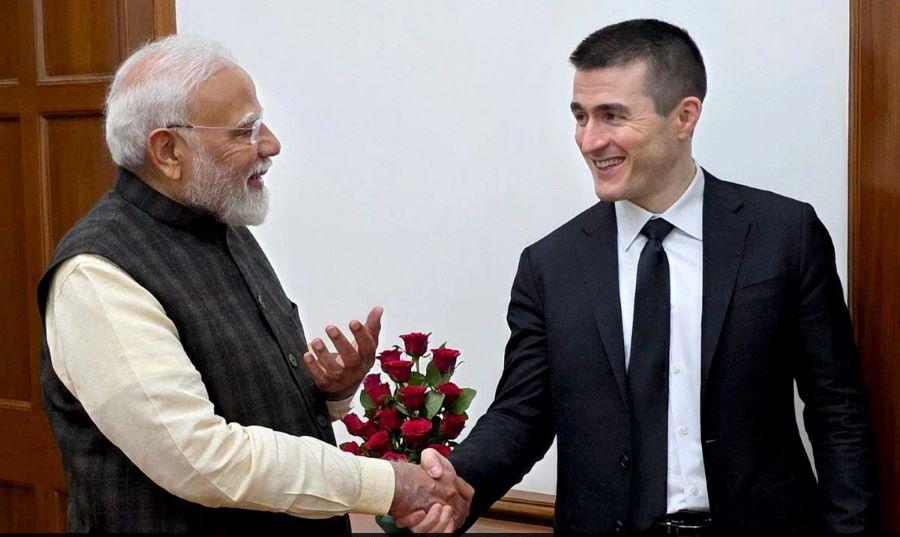
PM Modi told Fridman: “Whenever we speak of peace, the world listens to us because India is the land of Gautam Buddha and Mahatma Gandhi, and Indians aren’t hardwired to espouse strife and conflict.” (Photo courtesy X/LexFridman)
In the Tradition of Peacemaking
Fridman, who has previously hosted Trump, Benjamin Netanyahu, Elon Musk, Mark Zuckerberg, and Sam Altman, asked PM Modi about his approach to helping make peace between two warring nations, for example, Russia and Ukraine.
Modi pointed out that he comes from and represents the land of Lord Buddha and Mahatma Gandhi, whose teachings, words, actions, and behavior are completely dedicated to peace.
“That is why, culturally and historically, our background is so strong that whenever we speak of peace, the world listens to us because India is the land of Gautam Buddha and Mahatma Gandhi, and Indians aren’t hardwired to espouse strife and conflict. We espouse harmony instead. We seek neither to wage war against nature, nor to foster strife among nations. We stand for peace and wherever we can act as peacemakers, we have gladly embraced that responsibility.”
A Leader Forged in Fire
The podcast struck a chord in a world inured by political shenanigans because it was not about politics, it was about something deeper: the making of a leader through sacrifice, discipline, service, and spiritual inquiry.
Modi ji’s insights on decision-making revealed a leader who relies not just on intellect, but on instinct honed through years of experience. “If a decision goes wrong, I take full responsibility – I don’t shift blame. When you own your decisions, your team trusts you and stands by you.”
In an era where leadership is often measured by popularity and power, here was an insight into an older tradition – a leader shaped by hardship, self-mastery, and an unwavering commitment to a higher purpose.
The Rajarishi model is not about titles, but about a state of being. It is the leader who rules not by force but by wisdom, who walks the corridors of power yet remains inwardly untouched by it.
‘One of the Most Fascinating Leaders’: Lex Fridman
After the release of the podcast, Fridman said on social media that his conversation with Modi was one of the most powerful of his life. “PM Modi is one of the most fascinating human beings I have ever studied,” he tweeted.
In response, Modi shared his own reflections on the exchange:
“It was indeed a fascinating conversation with @lexfridman, covering diverse topics, including reminiscing about my childhood, the years in the Himalayas, and the journey in public life.”
A Must-listen Podcast Making Global Waves
The podcast of this episode has generated massive interest across social media platforms, drawing listeners from India and around the world. With Fridman’s global reach and Modi’s towering presence on the world stage, this conversation provides an unparalleled insight into the mind of a leader who has made India count in the comity of nations.
The Modi interview has been translated into many languages, and is available on Apple Podcasts and Spotify and on YouTube.
Buddhism
Politics and Religion
Previous Post
March 3, 2025
Global Leaders Urge Meditation for Peace and Well-Being
Next Post

May 7, 2025 Massacre of Hindus in Kashmir takes India, Pak to war brink
Recent Comments
"Pilgrims on journey realize that life is a precious gift to be celebrated with constructive ..."
‘Ramayana’ Gives India’s Epic a Hollywood-Scale ..."
"Thank you for you comment"
Indian Hindu pilot’s valor in line ..."
"Well done. Hats off to Captain Courageous. From womb to tomb and from cradle to ..."
Indian Hindu pilot’s valor in line ..."
"Ancient people in ancient times had their own views on war, just war, or an ..."
Christian Just War View Mirrors Eastern ..."
Browse Our Archives
Select a Category Politics and religion Seasonal Holidays Uncategorized
Select a Month November 2026 October 2026 September 2026 April 2026 December 2025 October 2025 September 2025 May 2025 April 2025 March 2025 February 2025 January 2025 December 2024 November 2024 October 2024 September 2024
Follow Us!
TAKE THE
Religious Wisdom Quiz
What Christian group follows the Augsburg Confession?
Select your answer to see how you score.
Methodists Lutherans Pentecostals Presbyterians
Related posts from Lotus Pond
Indian Hindu pilot’s valor in line of duty...
Christian Just War View Mirrors Eastern Traditions

Why would the Vice President want his Hindu...
Massacre of Hindus in Kashmir takes India, Pak...
TRENDING AT PATHEOS Hindu
‘Ramayana’ Gives India’s Epic a Hollywood-Scale Makeover
For centuries, the Ramayana has been far more than an ancient...

Does One of Us Have to Change Religions...
Twenty Years of Listening to Interfaith Couples A couple can spend years...

10% or 38%? Counting Hindu - American Interfaith...
Are 10% or 38% of American Hindus Marrying Outside Faith? What two...

Indian Hindu pilot’s valor in line of duty...
There is a hoary maritime tradition that the captain of the...

Movie on Neem Karoli Baba’s life is a...
Neem Karoli Baba’s life (1900-1973) is associated with miracles he made in...

20 Questions to Ask Before an Interfaith Marriage,...
Four questions every interfaith couple should discuss before marriage: Conversion. Will either...
view all Hindu blogs
What Are Your Thoughts?leave a comment
Ad-Free & Subscriber Log-In Subscription Support
- About Us
- 2026 Calendar
- Videos
- Podcasts
- Library of World Religions
- Faith In Media Tracker
- Advertise With Us
- Write for Us
- Privacy Policy
- Terms of Service
- Do Not Sell My Data
- Contact Us
- Radiant Digital
- Manage Newsletter Subscriptions
- Unsubscribe From Notifications
- Sitemap
Copyright 2008-2026, Patheos, part of the Radiant Digital network of media brands. All rights reserved.
Subscription Support Ad-Free & Subscriber Log-In
Follow Patheos