
BuddhistCatholicContemplativeEvangelicalGeneral ChristianHinduJewishLatter-day SaintMuslimNew VisionsProgressive Christian
Beliefs
- Buddhist
- Catholic
- Contemplative
- Evangelical
- General Christian
- Hindu
- Jewish
- Latter-day Saint
- More Voices
- Muslim
- New Visions
- Pagan
- Progressive Christian
Topics
- Religion News
- Food and Religion
- Sports and Religion
- Religious Art
- Religious Music and Entertainment
- Religious Events
- History and Religion
- Style and Religion
- Politics and Religion
- Women in Religion
- Recreation Outdoors and Religion
- Business Finance and Religion
- Careers Workplace and Religion
- Education and Religion
- Family Parenting and Religion
- Health Fitness and Religion
- Home and Religion
- Relationships and Religion
- Technology and Religion
- Travel and Religion
Columnists
- Buddhist Columnists
- Business Finance and Religion Columnists
- Careers Workplace and Religion Columnists
- Catholic Columnists
- Contemplative Columnists
- Education and Religion Columnists
- Evangelists Columnists
- Family Parenting and Religion Columnists
- General Christian Columnists
- Health Fitness and Religion Columnists
- Hindu Columnists
- History and Religion Columnists
- Home and Religion Columnists
- Jewish Columnists
- More Voices Columnists
- Latter Day Columnists
- Muslim Columnists
- New Visions Columnists
- Nonreligious Columnists
- Pagan Columnists
- Politics and Religion Columnists
- Progressive Columnists
- Recreation Outdoors and Religion Columnists
- Relationships and Religion Columnists
- Religion News Columnists
- Religious Art Columnists
- Religious Events Columnists
- Religious Music and Entertainment Columnists
- Sports and Religion Columnists
- Style and Religion Columnists
- Technology and Religion Columnists
- Travel and Religion Columnists
- Women in Religion Columnists
Resource Library
- 2026 Calendar
- Library of World Religions
- The 100 Most Holy Places on Earth
- Patheos Answers
- Podcasts
- Videos
- Faith Leaders Database
- Anglican Episcopalian
- Bahai
- Baptist
- Buddhism
- Christianity
- Confucianism
- Eastern Orthodoxy
- Hinduism
- Holiness and Pentecostal
- ISKCON
- Islam
- Judaism
- Lutheran
- Methodist
- The Church of Jesus Christ of Latter-day Saints
- New Age
- Paganism
- Presbytarian and Reformed
- Protestantism
- Religion Behind the Scenes
- Roman Catholic
- Scientology
- Shia Islam
- Sikhism
- Sufism
- Sunni Islam
- Taoism
- Zen
- See all religions
Research Tools
 Ad-Free & Subscriber Log-In Subscription Support
Ad-Free & Subscriber Log-In Subscription Support
Follow Patheos 

- Trending:
- Forgiveness
- |
- Marriage
- |
- Consciousness
- |
- Death Penalty
- |
- Election
- |
- Halloween

- Home
- Hindu
- Religious Events
- On Diwali, seeking light on its spirit and Hinduism
On Diwali, seeking light on its spirit and Hinduism
Last updated on: November 4, 2024 at 2:39 pm by Parveen Chopra
On Diwali, seeking light on its spirit and Hinduism 2024-11-04T14:39:46-05:00 Parveen Chopra
Patheos Explore the world's faith through different perspectives on religion and spirituality! Patheos has the views of the prevalent religions and spiritualities of the world.
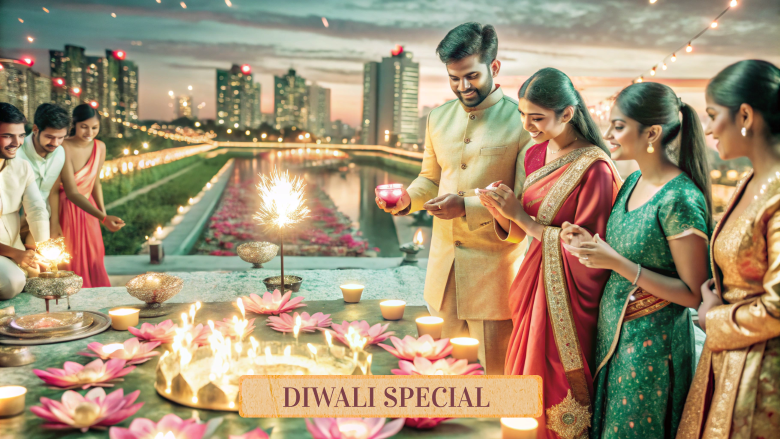
Diwali is a pan-Indian festival celebrated by Sikhs, Jains, and Buddhists apart from Hindus. The diaspora also celebrate it with gusto. (Illustration: Vedant Chopra for Lotus Pond)
The White House celebrated Diwali on October 28, as in previous years. Pennsylvania announced Diwali as a public holiday. New York City schools have declared November 1 as a holiday to mark the Indian festival for the first time.
I also notice an ever-increasing number of Diwali melas (fairs) and public functions organized by the growing and successful Indian community in America. The festivities have a cultural tinge and assertion of Hindu and Indian identity.
Chhavi Arya Bhargava, a Virginia-based entrepreneur and author of A Kids Book About Diwali, ascribes the success of her new book to “Diwali building bridges across communities at a time when people are eager to connect with and understand cultural celebrations, especially as inclusivity becomes a stronger societal focus.”
Diwali is a pan-Indian festival. It is, for us, Christmas and New Year rolled into one. In addition to Hindus, it is celebrated by Jains, Buddhists, and Sikhs. Each faith has its own back story about why the festival is auspicious to them. Hindus mainly celebrate, by lighting lamps, the epic story of a triumphant Lord Rama returning to his kingdom, Ayodhya, after defeating the Demon Ravana who had abducted his wife, Sita. Deepavali, meaning a string of lights, is the original name of the festival.
Amid the festivities in America, my sense is that the deeper spirit of the Festival of Lights has taken a back seat. Invited dignitaries join in and speak in generalities about Diwali symbolizing the victory of light over darkness and good over evil.
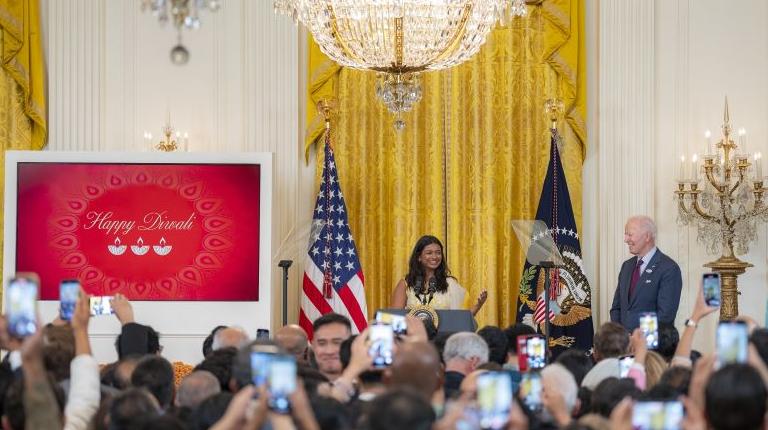
President Joe Biden celebrated Diwali at the White House on October 28, 2024. (Official White House Photo)
The ‘cultural Hindu’ question
‘Is being a cultural Hindu becoming the new normal?’
I posed this question to some prominent Hindus in the US and India. Their comments published on ALotusInTheMud.com in the run-up to Diwali give not a whiff of despair. They argue that the new trend is not a dilution of religion. The diaspora is, in fact, seeking a connection with the roots of their faith.
Ashok Vyas, a TV anchor and Hindu priest on Long Island, commented, “In Hinduism, philosophy and cultural traditions go hand in hand. The presence of various deities provides the devotee with a personal bond. Appreciating and sharing love and gratitude for the deities has given us multiple festivals. We Hindus are free to design how we celebrate and worship.”
Hari Kumar, an Indian filmmaker and author of occult books, clarified that Hinduism is not a monolithic religion but an umbrella term for a wide array of philosophies, traditions, and belief systems. “Its flexibility is reflected in the rise of cultural Hinduism, particularly among the diaspora and urban populations. Not new, it’s more visible today because of social media and the rise of shared Hindu pride.” He also finds festivals like Diwali and Navratri evolving into community-centric events focusing more on social bonding and heritage than on strict religious rituals.
Rajesh Sengamedu, an Advaita Vedanta follower and sustainability professional in the Bay Area, termed the festivities the visible, outer layer of Hinduism. The deeper layers relate to rituals before we delve deeper into understanding the philosophical layer of Vedanta and ‘All is One’. But he does see a movement toward “learning more about our history of temples and the subtle communication about our outlook toward life.”
For Dhawal Tank, who volunteered at the building project of Akshardham in Robbinsville, NJ, “Cultural Hindus are one spiritual experience away from having a spark ignited in them to seek deeper. People find this spark through meditation, yoga, and reading the Bhagavad Gita or the Puranas.”
Freedom and democratic ideals in Hinduism
Mamta Mishra, who worked for a charity in Toronto, takes pride in her faith that leaves you free to be a religious and/or a cultural Hindu, even an atheist. “As a Hindu, I don’t have a boss or book I need to be afraid of. This is freedom and democracy at its best.”
Narayani Ganesh, who was editor of the spiritual section Speaking Tree in The Times of India for a long time, said that Sanatana Dharma, now known as Hinduism, is shorn of ‘isms’. “A Hindu could be a believer, one who practices rituals, one who does not practice rituals, a temple-goer or not, a vegetarian or not”, and still be in good standing as a Hindu.
Shobit Arya, founder of Wisdom Tree publishing house in New Delhi, elaborates, “One may look down upon idol worship or form an eternal loving bond with God by feeding those little idols in their alcove-altar during puja, one may believe in many gods or one or none, Hinduism allows you to just be. At its very core is enshrined Ekam Sat Vipra Bahudha Vadanti (truth is one, the wise speak of it in many ways).”
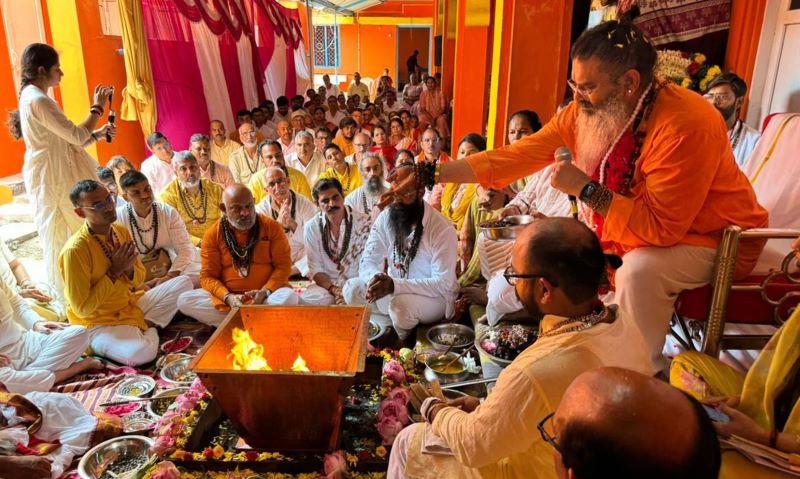
Gurudev Aaryam insists that “You cannot be spiritual without being religious. If spirituality is a flower, the seed of every spiritual flower is filled with religiosity.” Some others consider rites and rituals as secondary. (Photo courtesy Aaryam.org)
Rising above rituals
R.P. Jain, head of the Motilal Banarsidass publisher of Indology books, highlighted the spiritual aspect of Indic religions—Hinduism, Jainism, and Buddhism—and stated that their aim is “inner purification and transformation, not external rituals. Rituals, while prevalent, don’t define true spirituality.”
Navni Chawla, my India-based assistant editor at Lotus, called rites and rituals secondary to the true essence of dharma: living with integrity, truth, and compassion. “Living in dharma is maintaining purity of thought, intention, and action –– not just towards oneself but all beings.”
A Lotus reader offered this insight, which resonated with me. I paraphrase: Hinduism makes you seekers, not believers. It encourages you to seek the Truth, not believe in something handed down for generations. The scriptures and traditions aid in that search.
Professor P.K. Arya who has transitioned as Gurudev Aaryam, differed, though: “You cannot be spiritual without being religious. Because if spirituality is a flower, the seed of every spiritual flower is filled with religiosity.”
He also disliked the ‘cultural Hindu’ trend because the entertainment aspect of Hinduism is dominating rituals and spirituality. “This is because complexity has been created in simple rituals. Some acharyas and priests are responsible for this.”
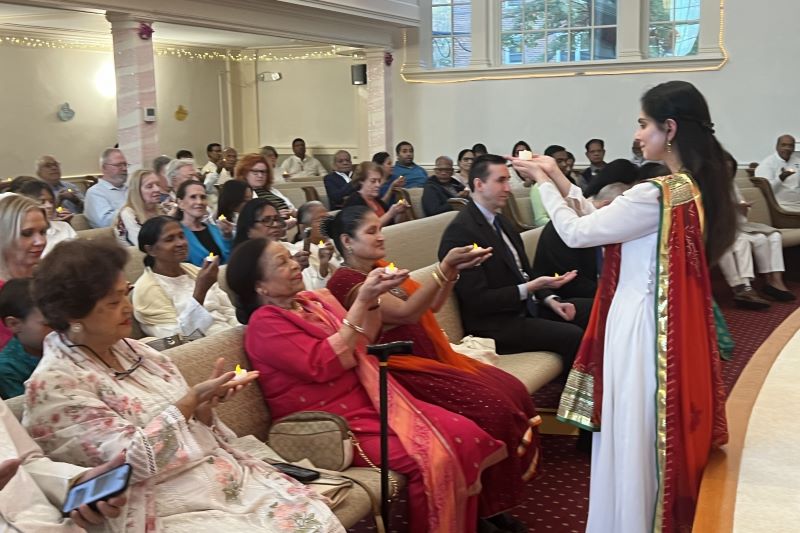
‘Light ceremony’ at the Diwali function hosted by Brahma Kumaris’ US headquarters in Great Neck, NY. Hinduism makes you seekers, not believers (Photo: Parveen Chopra)
We are the light
While all the emailed comments I received helped fill in contours of my understanding of Hinduism, it was enlightening to listen in person to Sister Kala Iyengar expound on the esoteric meaning of Diwali. She is a prominent leader in New York of the Brahma Kumaris, a spiritual offshoot of Hinduism. At their Diwali celebration on October 27 at Global Harmony House in Great Neck, NY, she said lighting lamps reminds us that we are the light. “The light that is giving life to the body. That light is also called life force, spirit, or soul. Everything happens there. Everything has to change there for anything to change outside.”
She said Diwali is about bringing attention back to the essence, “That we are all living lights, and that light is joyful by nature. And all the virtues such as peace, love, hope, power, wisdom, benevolence, and courage are the energy of this light.”
To keep this light alive, Sister Kala emphasizes the importance of integrating spirituality into daily life. Meditation is one practical way to achieve that. She concluded by conducting a guided meditation for the multicultural audience to practice what she preached.
Founder and Editor of ALotusInTheMud.com, Parveen Chopra is a seasoned media professional specializing in wellness, personal growth, and spirituality. More about him here.
Religious Events
History and Religion
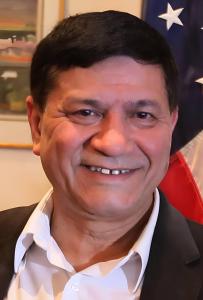
About Parveen Chopra
Founder and Editor of ALotusInTheMud.com, Parveen Chopra is a seasoned media professional specializing in wellness, personal growth, and spirituality. Before moving to the US, he founded Life Positive, India’s first and only body-mind-spirit magazine, from New Delhi in 1996. Born in a liberal Hindu family, his interest in spirituality was ignited by learning and teaching Transcendental Meditation (TM). Soon, he tasted a smorgasbord of spiritual and self-development programs, books, and gurus. Based on Long Island in New York, he earlier edited The South Asian Times weekly paper and One World Under God, an interfaith journal. He has written articles for Yoga Journal on Indian systems of Ayurveda and Vaastu Shastra and is now frequently contributing to Newsday’s ‘Asking the Clergy’ column. Find out more about Parveen Chopra and his current work at ALotusInTheMud.com, a web magazine published by the not-for-profit American Center for Wellness and Spirituality Inc. You can read more about the author here.
Previous Post
October 24, 2024
How Kamala’s Indian heritage may infuse her worldview
Next Post
November 13, 2024 Guru Nanak's message of oneness is for all humanity
Recent Comments
"Thank you for you comment"
Indian Hindu pilot’s valor in line ..."
"Well done. Hats off to Captain Courageous. From womb to tomb and from cradle to ..."
Indian Hindu pilot’s valor in line ..."
"Ancient people in ancient times had their own views on war, just war, or an ..."
Christian Just War View Mirrors Eastern ..."
"What mountain are you speaking of and what other path are there if you say ..."
Why would the Vice President want ..."
Browse Our Archives
Select a Category Politics and religion Seasonal Holidays Uncategorized
Select a Month October 2026 September 2026 April 2026 December 2025 October 2025 September 2025 May 2025 April 2025 March 2025 February 2025 January 2025 December 2024 November 2024 October 2024 September 2024
Follow Us!
TAKE THE
Religious Wisdom Quiz
I am the first to fall asleep in death for following Jesus. I saw heaven opened as stones struck me. Who am I?
Select your answer to see how you score.
Peter Stephen James John
Related posts from Lotus Pond

Indian Hindu pilot’s valor in line of duty...
Movie on Neem Karoli Baba’s life is a...
From Wall Street to Maha Kumbh: Yakub Mathew’s...

Why would the Vice President want his Hindu...
TRENDING AT PATHEOS Hindu

Indian Hindu pilot’s valor in line of duty...
There is a hoary maritime tradition that the captain of the...

Movie on Neem Karoli Baba’s life is a...
Neem Karoli Baba’s life (1900-1973) is associated with miracles he made in...

20 Questions to Ask Before an Interfaith Marriage,...
Four questions every interfaith couple should discuss before marriage: Conversion. Will either...

Avadhānam: The Art of Concentration and Intellectual Mastery
What is Avadhānam? In the summer of 2015, during a three-day Sanskrit...

Jesus in the Dharma: Where Christ Fits in...
Where Does Jesus Fit in Hinduism? That’s a question I get often...

Hormuz: A Shared Hindu and Zoroastrian Heritage
Every evening, somewhere in the world, a newsreader utters the words: "The...
view all Hindu blogs
What Are Your Thoughts?leave a comment
Ad-Free & Subscriber Log-In Subscription Support
- About Us
- 2026 Calendar
- Videos
- Podcasts
- Library of World Religions
- Faith In Media Tracker
- Advertise With Us
- Write for Us
- Privacy Policy
- Terms of Service
- Do Not Sell My Data
- Contact Us
- Radiant Digital
- Manage Newsletter Subscriptions
- Unsubscribe From Notifications
- Sitemap
Copyright 2008-2026, Patheos. All rights reserved.
Subscription Support Ad-Free & Subscriber Log-In
Follow Patheos