
BuddhistCatholicContemplativeEvangelicalGeneral ChristianHinduJewishLatter-day SaintMuslimNew VisionsProgressive Christian
Beliefs
- Buddhist
- Catholic
- Contemplative
- Evangelical
- General Christian
- Hindu
- Jewish
- Latter-day Saint
- More Voices
- Muslim
- New Visions
- Pagan
- Progressive Christian
Topics
- Religion News
- Food and Religion
- Sports and Religion
- Religious Art
- Religious Music and Entertainment
- Religious Events
- History and Religion
- Style and Religion
- Politics and Religion
- Women in Religion
- Recreation Outdoors and Religion
- Business Finance and Religion
- Careers Workplace and Religion
- Education and Religion
- Family Parenting and Religion
- Health Fitness and Religion
- Home and Religion
- Relationships and Religion
- Technology and Religion
- Travel and Religion
Columnists
- Buddhist Columnists
- Business Finance and Religion Columnists
- Careers Workplace and Religion Columnists
- Catholic Columnists
- Contemplative Columnists
- Education and Religion Columnists
- Evangelists Columnists
- Family Parenting and Religion Columnists
- General Christian Columnists
- Health Fitness and Religion Columnists
- Hindu Columnists
- History and Religion Columnists
- Home and Religion Columnists
- Jewish Columnists
- More Voices Columnists
- Latter Day Columnists
- Muslim Columnists
- New Visions Columnists
- Nonreligious Columnists
- Pagan Columnists
- Politics and Religion Columnists
- Progressive Columnists
- Recreation Outdoors and Religion Columnists
- Relationships and Religion Columnists
- Religion News Columnists
- Religious Art Columnists
- Religious Events Columnists
- Religious Music and Entertainment Columnists
- Sports and Religion Columnists
- Style and Religion Columnists
- Technology and Religion Columnists
- Travel and Religion Columnists
- Women in Religion Columnists
Resource Library
- 2026 Calendar
- Library of World Religions
- The 100 Most Holy Places on Earth
- Patheos Answers
- Podcasts
- Videos
- Faith Leaders Database
- Anglican Episcopalian
- Bahai
- Baptist
- Buddhism
- Christianity
- Confucianism
- Eastern Orthodoxy
- Hinduism
- Holiness and Pentecostal
- ISKCON
- Islam
- Judaism
- Lutheran
- Methodist
- The Church of Jesus Christ of Latter-day Saints
- New Age
- Paganism
- Presbytarian and Reformed
- Protestantism
- Religion Behind the Scenes
- Roman Catholic
- Scientology
- Shia Islam
- Sikhism
- Sufism
- Sunni Islam
- Taoism
- Zen
- See all religions
Research Tools
 Ad-Free & Subscriber Log-In Subscription Support
Follow Patheos 

- Trending:
- Advent
- |
- Forgiveness
- |
- Thanksgiving
- |
- Election
- |
- Seasonal Holidays
- |
- Marriage

- Home
- Catholic
- Nick Cave and a Rocker’s ‘Faith, Hope and Carnage’
Nick Cave and a Rocker’s ‘Faith, Hope and Carnage’
Last updated on: January 30, 2025 at 11:34 am by Jack Hartjes
Nick Cave and a Rocker’s ‘Faith, Hope and Carnage’ 2025-01-30T11:34:09-06:00 Jack Hartjes
Patheos Explore the world's faith through different perspectives on religion and spirituality! Patheos has the views of the prevalent religions and spiritualities of the world.
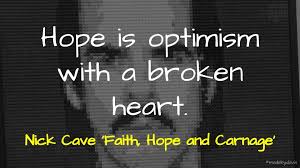
Nick Cave offers his soul along with insights into life in a series of interviews with journalist Sean O’Hagan. (Image credit: Nick Cave Archives)
Nick Cave wants to die “inside this life … not halfway out the door in the hope of something better.” Thus an almost Christian rock star ends his long conversation with journalist Seán O’Hagan and with anyone lucky enough to have fall into his or her hands a book like Faith, Hope and Carnage. That book is the product of a series of phone interviews, lasting through most of the pandemic years.
Cave’s ups and downs, tragedies and growth through tragedy speak out of the pages of the book. But this is not a story of Cave’s life. Themes of love and loss, tradition and defiance, death and grief, despair and hope circle around Cave’s work and music. They make a kind of spirituality of artistic creation. Mysticism of belief and rational skepticism face each other over Nick’s devotion to Jesus and return to Christian practice. It doesn’t quite equate, in Cave’s mind, to being a Christian. Still, Cave says, religion “is a necessary part of what I do…. [T]here is some divine element going on within my songs.” (Wikipedia)
Changes and what doesn’t change
Nick Cave is a rock musician who early in his career was a heavy influence on varieties of punk. His band The Birthday Party earned distinction as, in some eyes and ears, “the most violent live band in the world” (Wikipedia).
Birthday Party modulated into Nick Cave and the Bad Seeds. And Bad Seeds gradually tempered that violence. Nick Cave remembers a youth in Australia, when, “My heroes [were] the chaos makers in Australian culture. It’s a sacred duty to offend” (interview with Krishnam Guru-Murthy). Cave never stopped being that guy. He just found other ways to channel the chaos and offense of an original mind.
The result in albums like The Boatman and Ghosteen is spare beauty of instrumental accompaniment and a mostly soft, baritone voice speaking in melody. Cave’s lyrics are as much images to follow as signs to corral into a thought or two.
Nick Cave on his own faith, hope and carnage, 1: Faith
Conversation is important to Nick Cave. That shows in the conversations he holds with various notable personalities that he calls “In Conversation.” Conversation features also in his blog “Red Hand Files.” There he invites questions from anyone about anything. He appears on Youtube interviews with the likes of the Archbishop of Canterbury and with journalists like Krishnan Guru-Murthy of UK’s Chanel 4 News.
Probably Nick Cave’s deepest venture into conversation is the long series of interviews with Seán O’hagan in Faith, Hope and Carnage. Conversation that is honest can change a person, and Cave says some of his ideas changed in the course of that book. Guru-Murthy in his interview pressed for an example. Cave spoke of his shift in relation to Christianity from the first interviews to the last. Here, with some paraphrasing, are some of Cave’s earlier thoughts on Christianity:
Since the pandemic (and, I think, since the death of his son Arthur), Cave says, he “felt the desire to apply myself to the practice of belief and to spiritual acceptance.” His relationship with God, he says, became “a little less fraught…. And to me the benefits are self-evident. I’d certainly be happier for it.”
By this time Cave has started going to church regularly, “practicing Christianity.” Some beliefs can be “true enough.” True enough to be of use, seems to be what he means by this “beautiful, humane expression.” He refers to his own experience with Narcotics Anonymous. There hopeless and not particularly spiritual drug addicts are asked to believe in something, to “hand their will and their lives over to something that may very well not exist. And in a great many instances, they get better…. They find that believing in something that is ‘true enough’ works throughout all aspects of life.”
Two years later
In conversation with Guru-Murthy, Cave abandons that utilitarian approach. Two years after Cave’s and O’Hagan’s original conversations, in a kind of postscript to Faith, Hope and Carnage, Cave speaks from some way farther into the territory of belief:
Religion “involves taking my belief – and my unbelief — into a sacred space and dealing with it there, rather than it being something that just lives inside my head. What I like about church is that it stands against the gods of reason and rationality. It’s a deeply strange place, and Christianity is a deeply strange religion.” Religion offers “a deep and true emotional relationship to the mystery of things” (p. 284).
Close to Christian mysticism are these thoughts:
“My rational self has all the weaponry, all the big guns – reason, science, common sense, normality – and all that far outweighs the side of me that only has suspicions and hints and signs of something else, something mysterious and quietly spoken” (p. 218-19).
Probably Cave never lost the early insight that faith and doubt can coexist, and “God … provides us with the space to doubt” (p. 72). Even the early thought that Christianity is “true enough” (I rather liked it) might acquire a more than utilitarian sense. Something like:
Christianity offers the believer a perspective “good enough” to have confidence that, however dimly, reality is in view.
On the reality of being human, at least, Nick Cave and Christian theology are more realistic than popular psychologies. People imagine that negative feelings like regret, shame, and guilt are unhealthy. Avoid them at all cost! But regret, Cave says, helps better our lives. More profoundly: The need for forgiveness is “at the very center of our lives” (p. 251). Living without regrets is denying oneself the “obvious benefits of self-forgiveness” (p. 269).
Cave’s own faith, hope and carnage, 2: Hope
The full quote at the end of Faith, Hope and Carnage, part of which began this essay, reads:
It doesn’t seem at this point in time particularly important to know what happens after we die. There is too much life to deal with. And when I die, well, I want to die inside this life. This strange, beautiful life. Not halfway out the door in the hope of something better. Is there something else? I don’t know. There are intuitions for sure, but there are some things that, for our own sanity, probably should remain beyond our understanding. It gives us somewhere to go. (p. 288)
Christian hope doesn’t hesitate, as Cave does, to speak about the next life. But the thrust of Cave’s statement comes from a very Christian theme. God created the world and called it good. Cave’s hope is for this good (“strange and beautiful” in Cave’s terms) world. With Cave I would ask, How do we affirm the goodness of this life when we’re “halfway out the door” to something else?
Cave wants to hold on to created goodness to the end. If that’s Christian (it is) and if dying is part of living, then it’s entirely Christian to die with both feet plus mind, heart, and soul “inside this life.”
From the sublime to the everyday
Creation, the first (chronologically) of Christian beliefs, supports “dying inside this life.” But Cave’s thought is not foreign to Christianity’s last hope, either. The Christian dimly seen image of the “next life” isn’t so removed from this one, as Cave and a lot of believers might think. Jesus is coming again! … To this world! … At the end of the present age, when God will reign over a renewed creation! … New heavens and a new earth, earth’s promise of beauty fulfilled, her peoples freed, her powers redeemed, her tragedy vanished away!
That hope animates all the hopes that get a partial fulfillment in what Cave says comes upon us as a sacred duty – to make a small piece of the world a better place.
“So,” Seán O’Hagan says at the end of this long interruption of Cave at work, “the important thing for you is how you live your life?”
And Nick Cave, with an exquisite touch, comes down from the heights and into the moment: “The important thing for me right now is to write a song.”
Cave’s own faith, hope and carnage, 3: Carnage
In a chapter called “A Series of Ordinary Carnages,” Nick Cave dwells awhile on the violence of his early performances (p.173-74). The “wanton power” of the music, and the frenzy of the crowd. Walking on the hands of the audience. The sexual energy and confronting imagery. The knee drop, “a beautiful, sacred act – to fall on your knees and howl your heart into a microphone.” He hadn’t done a full knee drop for a while, but, “I would hate to be too old to do that.”
The raw carnage in Cave’s early music and the later measured violence interpret Caves’ own changing experiences. Carnage wears many faces. For Cave it includes:
- A rebellious youth (a sorrow to his mother, who stood by him nevertheless),
- A youthful confrontational attitude toward the world, including his own audience,
- 20 years addicted to heroin (during which he continued working),
- The loss of two sons, especially that of Arthur, the son of his second and current marriage.
- Pandemic, a second major change for Cave, as for all of us. Time for reflection, including the soul-searching that went into Faith, Hope and Carnage. Covid also took away the chance to take on tour the album, Ghosteen. That recording spoke from the heart about grief and Arthur’s death.
Carnage and artistic work for Cave
An important theme in Faith, Hope and Carnage is the demanding process by which Nick Cave creates his music – another kind of carnage. Cave doesn’t have the luxury of spontaneous inspiration while walking in the woods on a fall day. He sits at his desk from 9 to 5, letting one word or image call up another until there’s a string that might or might not fit with another string. (I’m putting his descriptions into my own words.) The result might or might not be meaningful enough to fit into the first draft of a song. What the song itself means might or might not become clear or worthwhile – most likely not until after practicing or even performing it.
O’Hagan asks if the process gets easier with experience, and the answer is that it does not. Each new song begins an unraveling of the old Nick Cave. I mentioned the “coming” of words and images, which sounds like inspiration. But Cave says in a Red Hand Files post, “I have found that the muscle of the imagination is strengthened by resistance, discipline, and order.” it’s 99 percent hard work. (Impressive to an amateur creator like me, whose slow, painful writing process consists largely of false starts, wrong turns, and almost any excuse for a distraction.)
Cave thinks of carnage, destruction, and chaos as the seeds of something new. That seems to be true for the author himself, and – in a small way, but maybe more than that – it could be true for the many end users of Cave’s creations. As one who’s often said he likes all kinds of music, except rock and country, I feel a surprising urge to become part of that large audience.
Previous Post
July 28, 2024
Social Democracy Saves Capitalism: 'Tyranny, Inc.,' Part 2
Next Post

January 26, 2025 Extreme Wealth Deplored by ‘Patriotic Millionaires’ Group
Recent Comments
"A lot of cemeteries require the vault for fear that the weight of the earth ..."
A Catholic Burial, Bodily Resurrection, and ..."
"The most devout Catholic I have ever known - Mass every day, big financial supporter ..."
A Catholic Burial, Bodily Resurrection, and ..."
"I really enjoyed this article, thanks!"
Easter Triduum at Saint Raphael’s: Three ..."
""Higgs Boson Blues" is my favorite of his."
Nick Cave and a Rocker’s ‘Faith, ..."
Browse Our Archives
Select a Category Advent Christmas Amazon Synod Angels Being Consumed Bible Catholic Modern Creed Ecology Economics Elizabeth Johnson Eucharist Fragments and Filaments Gender and Sex Gospel of Mark Herzog Historical Jesus Liturgy Luke Opening Scriptures on Way to Emmaus Ordinary radicals Parables Pro-Life Reincarnation Rosary Sacraments science Social Justice Souls Stories of Jesus The Creed Torture and Eucharist Tracy Uncategorized War and Peace
Select a Month November 2026 October 2026 June 2025 April 2025 March 2025 February 2025 January 2025 November 2024 July 2024 March 2024 December 2023 October 2023 September 2023 August 2023 May 2023 April 2023 March 2023 February 2023 January 2023 December 2022 November 2022 October 2022 September 2022 August 2022 July 2022 June 2022 April 2022 March 2022 February 2022 January 2022 December 2021 November 2021 October 2021 August 2021 July 2021 June 2021 April 2021 March 2021 February 2021 December 2020 November 2020 October 2020 August 2020 July 2020 June 2020 May 2020 April 2020 March 2020 February 2020 January 2020 December 2019 November 2019 October 2019 September 2019 August 2019 July 2019 June 2019 May 2019 April 2019 March 2019 February 2019 January 2019 December 2018 November 2018 October 2018 September 2018 August 2018 July 2018 June 2018 May 2018
Follow Us!
TAKE THE
Religious Wisdom Quiz
Who saw a vision of a flying scroll with curses written on it?
Select your answer to see how you score.
Zechariah Ezekiel Daniel Micah
Related posts from Lost in a One-Acre Wood
Credo: A Story of God Told with the...

With Carbon Dioxide, 0.014 is a big number
Crucifixion as Breakthrough, Horsley’s Nerviest Claim
Jesus’ Politics of Resistance and Renewal
TRENDING AT PATHEOS Catholic

The Kingdom Of God In Ordinary Life And...
The kingdom of God is all around us; it is in us...

How Discretion Guides Us Away From Extremes
Prudence is an important virtue for all of us. While we should...

If Baptism Washes Away Sin, Why Do Catholics...
The seven sacraments stand as the foundation of Catholic ecclesial life. The...

The Power of Setting a Good Example
Remember last August when the Chicago White Sox hosted a "Pope Hat...

A Catholic Critique of Biblical Unitarianism
If the statistics are to be believed, Unitarianism is rising worldwide. Although...

How Grandma Tourism Helps Grandparents Live Their Vocation
Grandma, The New Travel Influencer What started as a nostalgia-inspired social media...
view all Catholic blogs
What Are Your Thoughts?leave a comment
Ad-Free & Subscriber Log-In Subscription Support
- About Us
- 2026 Calendar
- Videos
- Podcasts
- Library of World Religions
- Faith In Media Tracker
- Advertise With Us
- Write for Us
- Privacy Policy
- Terms of Service
- Do Not Sell My Data
- Contact Us
- Radiant Digital
- Manage Newsletter Subscriptions
- Unsubscribe From Notifications
- Sitemap
Copyright 2008-2026, Patheos, part of the Radiant Digital network of media brands. All rights reserved.
Subscription Support Ad-Free & Subscriber Log-In
Follow Patheos