
BuddhistCatholicContemplativeEvangelicalGeneral ChristianHinduJewishLatter-day SaintMuslimNew VisionsProgressive Christian
Beliefs
- Buddhist
- Catholic
- Contemplative
- Evangelical
- General Christian
- Hindu
- Jewish
- Latter-day Saint
- More Voices
- Muslim
- New Visions
- Pagan
- Progressive Christian
Topics
- Religion News
- Food and Religion
- Sports and Religion
- Religious Art
- Religious Music and Entertainment
- Religious Events
- History and Religion
- Style and Religion
- Politics and Religion
- Women in Religion
- Recreation Outdoors and Religion
- Business Finance and Religion
- Careers Workplace and Religion
- Education and Religion
- Family Parenting and Religion
- Health Fitness and Religion
- Home and Religion
- Relationships and Religion
- Technology and Religion
- Travel and Religion
Columnists
- Buddhist Columnists
- Business Finance and Religion Columnists
- Careers Workplace and Religion Columnists
- Catholic Columnists
- Contemplative Columnists
- Education and Religion Columnists
- Evangelists Columnists
- Family Parenting and Religion Columnists
- General Christian Columnists
- Health Fitness and Religion Columnists
- Hindu Columnists
- History and Religion Columnists
- Home and Religion Columnists
- Jewish Columnists
- More Voices Columnists
- Latter Day Columnists
- Muslim Columnists
- New Visions Columnists
- Nonreligious Columnists
- Pagan Columnists
- Politics and Religion Columnists
- Progressive Columnists
- Recreation Outdoors and Religion Columnists
- Relationships and Religion Columnists
- Religion News Columnists
- Religious Art Columnists
- Religious Events Columnists
- Religious Music and Entertainment Columnists
- Sports and Religion Columnists
- Style and Religion Columnists
- Technology and Religion Columnists
- Travel and Religion Columnists
- Women in Religion Columnists
Resource Library
- 2026 Calendar
- Library of World Religions
- The 100 Most Holy Places on Earth
- Patheos Answers
- Podcasts
- Videos
- Faith Leaders Database
- Anglican Episcopalian
- Bahai
- Baptist
- Buddhism
- Christianity
- Confucianism
- Eastern Orthodoxy
- Hinduism
- Holiness and Pentecostal
- ISKCON
- Islam
- Judaism
- Lutheran
- Methodist
- The Church of Jesus Christ of Latter-day Saints
- New Age
- Paganism
- Presbytarian and Reformed
- Protestantism
- Religion Behind the Scenes
- Roman Catholic
- Scientology
- Shia Islam
- Sikhism
- Sufism
- Sunni Islam
- Taoism
- Zen
- See all religions
Research Tools
 Ad-Free & Subscriber Log-In Subscription Support
Follow Patheos 

- Trending:
- Advent
- |
- Forgiveness
- |
- Thanksgiving
- |
- Election
- |
- Seasonal Holidays
- |
- Marriage

- Home
- Catholic
- Economic Coercion and ‘Tyranny, Inc.’ by Sohrab Ahmari
Economic Coercion and ‘Tyranny, Inc.’ by Sohrab Ahmari
Last updated on: July 27, 2024 at 8:22 am by Jack Hartjes
Economic Coercion and ‘Tyranny, Inc.’ by Sohrab Ahmari 2024-07-27T08:22:41-06:00 Jack Hartjes
Patheos Explore the world's faith through different perspectives on religion and spirituality! Patheos has the views of the prevalent religions and spiritualities of the world.
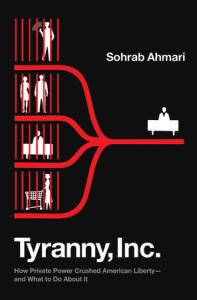
Sohrab Ahmari published Tyranny, Inc. in 2023. (Image credit: Random House)
Sohrab Ahmari shows how coercion operates in the American economy, especially in its most recent “neoliberal” phase. Neoliberalism is the economic theory that exalts market freedom and claims that market coercion does not exist as long as government stays out of the way of freely signed contracts between labor and employer and free exchange of money for goods and services.
Rejecting that idealistic picture, Ahmari looks realistically at a market rife with coercion resulting from inequalities of power. In my opinion he is no less realistic in pointing to a workable solution. Workable because, partially and imperfectly, the solution has already existed. New Deal policies, especially in the years between the Second World War and the 1970’s led to widely— with important exceptions – shared prosperity. Solutions also existed in most of Western Europe with the rise of social democracy and the centrist Christian Democratic parties.
I remember that era as a time when a union worker or a small-business entrepreneur could support a large family on one income. It was a problematic prosperity for it excluded whole groups of people based on race or national origin. Still that 40-year period stands out as a time, unique in modern history, when on average rich, poor, and middle class shared equally in the country’s rising wealth.
Out of the pains of the Great Depression grew a “socially managed capitalism” that learned how to deal with markets as they actually functioned, as neoliberal “market utopians” did not. (p. 147) Power is inevitable in market relations. New Deal policies aimed to make power a commodity shared by management and labor, producers and consumers. That market consensus didn’t last. Since 1980 inequality in the U.S, has skyrocketed. Something like the return of a New Deal consensus is Ahmari’s hope in Tyranny, Inc.
Sohrab Ahmari, an unusual conservative
An Iranian-born American journalist and author of nonfiction books, Sohrab Ahmari’s life has taken a number of turns politically and religiously. (I rely on the Ahmari’s article “My journey from Tehran to Rome” in Catholic Herald for much of the following.) He is a recent convert to Catholicism.
Ahmari’s religious journey began at age 12. As he noted the hypocrisy of religious believers in his Islamic family and community, he decided God does not exist. After emigrating to the U.S. with his family at age 13, he had both positive and negative contacts with Christianity. Subsequently he learned to respect Christianity for its benevolent effect on society. His final acceptance of Catholicism is a long story that also includes a series of political turns.
Politically, Ahmari’s moves started with the nihilism of Nietzsche, Camus, and Sartre, whom he read in his late teens along with other existentialist philosophers and novelists. It was “an intoxicating business,” in his later words. From there he moved to Marxism in its “more romantic” Trotskyist variety. He hawked pamphlets and joined labor picket lines along with doing “my share of hooking up, hard drinking and drugs.”
After graduating college he entered the program “Teach for America.” A committed leftist at the time, he had been sure that only redistributive justice could close the achievement gap between rich and poor students. His experience in that poor Texas learning environment taught him otherwise. He observed “even in the direst classrooms” great teachers (of whom, he says, “I wasn’t one”). They set high expectations and emphasized “hard work, honesty, and tough discipline.” Their students made “tremendous gains.”
Leaving Nihilism, entering American conservatism by way of Rome
That experience convinced Ahmari of the wisdom in old moralistic notions and that “there were permanent things about what makes all people tick.” People are not without inner resources independent of circumstance. They are not “infinitely malleable to the whims of the state.” It was the Judeo-Christian tradition, Ahmari believed, that fostered a sense of inner dignity; and that garnered his respect.
Respect did not mean commitment. Christianity was “a civilizing force” rather than a matter for belief – “Until one day I stopped denying.” Ahmari didn’t turn directly to Catholicism, but I suspect that Rome was in the playbook for much of the way. For this I’m judging from later writing where one finds a firm authoritarian streak. In Ahmari’s words:
[W]ith Catholicism there was the added assurance that came with two millennia of continuous authority. The Church’s hierarchical character, which so repelled my Evangelical friends, was one of its attractions for me. It meant that, having seen off a thousand heresies, Rome would be less likely to permit the Christian idea to be distorted by the passing fads of the day.
Ahmari became a contributing editor to the American Conservative and wrote regularly for various right-wing publications, secular and Catholic. In a more liberal Catholic magazine, Economist Anthony Annett calls Sohrab Ahmari “a man of the Right” who “has made a name for himself as a culture-war brawler.” (Commonweal, December 2023)
Why Tyranny, Inc. and its focus on economic coercion?
From a conservative today full-throated praise for a New-Deal-type activist government is unexpected. Still, it makes more sense than most of today’s conservative movement. Ahmari’s claim is that the activist government of the New Deal and postwar years was not leftist but a consensus of left and right. Republican and Democratic administrations pursued it. Ahmari, the conservative, sees what many leftists today see — “capitalism’s pitiless destruction of older social forms.” (From “Tehran to Rome”) I see community, neighborhood, church, and marriage among these threatened community forms. Tyranny, Inc. lays bare capitalism’s destructive potential along with its power of coercion.
Ahmari begins with a deceptive hook. A story of an especially egregious example of coercion occurs, purportedly, in the People’s Republic of China. There a meatpacker, Zhang, works at a massive slaughterhouse. A “digital panopticon” surveils his and 2000-some other employees’ every movement. Pay is docked for missing production quotas, “wasting the people’s time.” Workers had to forgo lunch and even bathroom breaks. During the pandemic, as “essential workers,” employees had to put in extra hours without safeguards against the virus. On an April day Zhang led a walkout. He was fired that very day for “immoral, unacceptable, and arguably illegal” behavior. The vast majority of employees had continued to do “heroic work,” a company spokesman later said. (p. xiv)
Ahmari’s reporting switches to Russia and then Iran with other shocking accounts of management suppression of free speech and violation of privacy. But he has tricked the unwary reader. In fact, none of these stories took place in foreign countries. All happened in progressive, freedom-loving U.S.A. Ahmari concludes:
… coercion is far more widespread in supposedly noncoercive societies than we would like to think—provided we pay attention to private power and admit the possibility of private coercion. (P. xvii)
Private vs. public coercion and blind neoliberal economists
Acccording to neoliberal theory the free market can’t be coercive because both sides of an employer-employee relation enter into a contract freely. Neither forces the other to sign on the dotted line. Job applicants are free to choose another employer; employers are free to look elsewhere for workers. It’s the same in the seller-buyer transaction. The seller freely determines a price; the buyer can either accept the price or go to another seller or (presumably) go without. In a world of perfect competition the market will ultimately provide adequate jobs at adequate wages and sufficient goods at affordable prices.
And that, supposedly, will happen provided only that government keeps its proper distance. Government’s role is to ensure the freedom, honesty, and inviolability of economic relations. Anything beyond that, any regulating authority for the purpose of ensuring some preferred social end, is tyranny. Only governments coerce. In free markets there is no coercion.
This utopian scheme runs up against a simple reality: all power is not equal. Part 1 of Tyranny, Inc. details the dystopian effects of the last near half century of a market increasingly free from the steadying effects of government oversight. It turns out that where government coercion is absent private coercion runs rampant.
Ahmari tells stories that illustrate legal uses of power resulting in economic coercion:
- · Schedules announced with little warning (“Just-in-time staffing) makes home life a nightmare.
- · Poverty wages make employees dependent on welfare and unable to prepare for emergencies.
- · Non-disclosure, non-disparagement agreements prevent employees from speaking out, even in cases of sexual abuse and harassment.
- · Compulsory attendance at anti-union rallies and political events favoring a company’s positions also limit an employee’s free speech right.
- · Contracts require all disputes with the company to be brought to prohibitively expensive arbitration procedures rather than law courts.
- · Increasing privatization of emergency services like ambulances and fire protection (formerly among society’s “common goods”) results in large, unexpected bills.
- · An increasing and now bloated financial sector “loots” the real economy. (The downfall of Sears and lots of news outlets are examples.)
- · Billionaires use bankruptcy to avoid paying just recompense for damage they and their companies have caused.
Arbitration: Another story with a hook
In the 1970’s I worked in the progressive office of the American Bar Association. There I learned about arbitration, an alternative to law courts for settling disputes. It seemed like a good idea, cheaper and faster than a law court. Two parties in a dispute would each propose a settlement, and an impartial judge would pick one or the other. Neither party could gain by presenting an unreasonable proposal. I suspect a lot of small claims between relatively equal parties got settled equitably that way.
Arbitration wears a different hue when it’s enforced by a contract between an employee and a large company and requires the employee to use arbitration to settle disputes. Ahmari cites the case of a certain Heller, an Uber driver. An e-mail arrived while on the job informing him he could no longer work or even get directions to finish a delivery unless he signed an agreement to a new contract with reduced pay. Other drivers, too, found their pay cut 20 to 50 percent. More pay cuts followed, but Heller and a few other drivers had launched a protest.
Heller’s father, a criminal lawyer, gave him a lively sense of right and wrong, He skipped the chance to sue as an individual, with a likely hefty payout. Instead he pursued a class-action lawsuit. Problem was, the contract he signed had a provision mandating private mediation for settling disputes. The contract directed all arbitration to the International Chamber of Commerce in Amsterdam. Heller would have to pay $14,500 up front plus travel expenses.
Heller challenged the legality of the contract in court, but that court upheld Uber’s position. An appeals court, however, disagreed. In 2020 the Supreme Court ruled the arbitration clause unconstitutional. An 8-1 majority said the clause rendered an employee’s contractual rights “illusory.”
Now the hook
A satisfying ending to the story. But for a second time Ahmari has tricked us. This case occurred not in the U.S. but in Canada, and the favorable ruling was issued by the Canadian Supreme Court. In the United States another case involved forced arbitration over non-payment of overtime wages. It was a clear violation of the Fair Labor Standards Act. The contract required arbitration but also raised expensive barriers to an individual pursuing justice and barred workers from adjudicating cases collectively. The cost for one individual would amount to $200,000 to recover under $2000.
The eventual ruling from the U.S. Supreme Court was written by Justice Neil Gorsuch of beer and Trumpian fame. The decision stated that the parties had freely “contracted for arbitration … indicating their intention to use individualized rather than class or collective action.” The court insisted it couldn’t challenge what parties freely agreed to. Ahmari calls it “one of the cruelest decisions ever issued by the high court.” (p. 50)
Looking ahead
In Part 2 of Tyranny, Inc. Ahmari proposes another way for an economy to run. It would not eliminate coercion but equalize the power of contending parties. The next post will look at what Ahmari calls the “glorious years” of the American economy. These were the years from the New Deal to the 1970’s, before the rise of economic neoliberalism. During that period employees gained, and employers accepted, a more equal stature in contentions over contracts. It was a time of rising and shared prosperity.
Previous Post

March 20, 2024
Easter Triduum at Saint Raphael’s: Three Days with Jesus
Next Post

July 28, 2024 Social Democracy Saves Capitalism: 'Tyranny, Inc.,' Part 2
Recent Comments
"A lot of cemeteries require the vault for fear that the weight of the earth ..."
A Catholic Burial, Bodily Resurrection, and ..."
"The most devout Catholic I have ever known - Mass every day, big financial supporter ..."
A Catholic Burial, Bodily Resurrection, and ..."
"I really enjoyed this article, thanks!"
Easter Triduum at Saint Raphael’s: Three ..."
""Higgs Boson Blues" is my favorite of his."
Nick Cave and a Rocker’s ‘Faith, ..."
Browse Our Archives
Select a Category Advent Christmas Amazon Synod Angels Being Consumed Bible Catholic Modern Creed Ecology Economics Elizabeth Johnson Eucharist Fragments and Filaments Gender and Sex Gospel of Mark Herzog Historical Jesus Liturgy Luke Opening Scriptures on Way to Emmaus Ordinary radicals Parables Pro-Life Reincarnation Rosary Sacraments science Social Justice Souls Stories of Jesus The Creed Torture and Eucharist Tracy Uncategorized War and Peace
Select a Month November 2026 October 2026 June 2025 April 2025 March 2025 February 2025 January 2025 November 2024 July 2024 March 2024 December 2023 October 2023 September 2023 August 2023 May 2023 April 2023 March 2023 February 2023 January 2023 December 2022 November 2022 October 2022 September 2022 August 2022 July 2022 June 2022 April 2022 March 2022 February 2022 January 2022 December 2021 November 2021 October 2021 August 2021 July 2021 June 2021 April 2021 March 2021 February 2021 December 2020 November 2020 October 2020 August 2020 July 2020 June 2020 May 2020 April 2020 March 2020 February 2020 January 2020 December 2019 November 2019 October 2019 September 2019 August 2019 July 2019 June 2019 May 2019 April 2019 March 2019 February 2019 January 2019 December 2018 November 2018 October 2018 September 2018 August 2018 July 2018 June 2018 May 2018
Follow Us!
TAKE THE
Religious Wisdom Quiz
What does "Nebuchadnezzar" mean in Akkadian?
Select your answer to see how you score.
Chosen by the gods King of Babylon O Nabu, protect my heir The Lord reigns
Related posts from Lost in a One-Acre Wood
Social Democracy Saves Capitalism: 'Tyranny, Inc.,' Part 2
A Rich Man Follows All the Old Rules....

The Temple, Jesus, and the Little Traditions of...

Pope at Economy of Francesco: A Rich Heritage...
TRENDING AT PATHEOS Catholic

The Kingdom Of God In Ordinary Life And...
The kingdom of God is all around us; it is in us...

How Discretion Guides Us Away From Extremes
Prudence is an important virtue for all of us. While we should...

If Baptism Washes Away Sin, Why Do Catholics...
The seven sacraments stand as the foundation of Catholic ecclesial life. The...

The Power of Setting a Good Example
Remember last August when the Chicago White Sox hosted a "Pope Hat...

A Catholic Critique of Biblical Unitarianism
If the statistics are to be believed, Unitarianism is rising worldwide. Although...

How Grandma Tourism Helps Grandparents Live Their Vocation
Grandma, The New Travel Influencer What started as a nostalgia-inspired social media...
view all Catholic blogs
What Are Your Thoughts?leave a comment
Ad-Free & Subscriber Log-In Subscription Support
- About Us
- 2026 Calendar
- Videos
- Podcasts
- Library of World Religions
- Faith In Media Tracker
- Advertise With Us
- Write for Us
- Privacy Policy
- Terms of Service
- Do Not Sell My Data
- Contact Us
- Radiant Digital
- Manage Newsletter Subscriptions
- Unsubscribe From Notifications
- Sitemap
Copyright 2008-2026, Patheos, part of the Radiant Digital network of media brands. All rights reserved.
Subscription Support Ad-Free & Subscriber Log-In
Follow Patheos