
BuddhistCatholicContemplativeEvangelicalGeneral ChristianHinduJewishLatter-day SaintMuslimNew VisionsProgressive Christian
Beliefs
- Buddhist
- Catholic
- Contemplative
- Evangelical
- General Christian
- Hindu
- Jewish
- Latter-day Saint
- More Voices
- Muslim
- New Visions
- Pagan
- Progressive Christian
Topics
- Religion News
- Food and Religion
- Sports and Religion
- Religious Art
- Religious Music and Entertainment
- Religious Events
- History and Religion
- Style and Religion
- Politics and Religion
- Women in Religion
- Recreation Outdoors and Religion
- Business Finance and Religion
- Careers Workplace and Religion
- Education and Religion
- Family Parenting and Religion
- Health Fitness and Religion
- Home and Religion
- Relationships and Religion
- Technology and Religion
- Travel and Religion
Columnists
- Buddhist Columnists
- Business Finance and Religion Columnists
- Careers Workplace and Religion Columnists
- Catholic Columnists
- Contemplative Columnists
- Education and Religion Columnists
- Evangelists Columnists
- Family Parenting and Religion Columnists
- General Christian Columnists
- Health Fitness and Religion Columnists
- Hindu Columnists
- History and Religion Columnists
- Home and Religion Columnists
- Jewish Columnists
- More Voices Columnists
- Latter Day Columnists
- Muslim Columnists
- New Visions Columnists
- Nonreligious Columnists
- Pagan Columnists
- Politics and Religion Columnists
- Progressive Columnists
- Recreation Outdoors and Religion Columnists
- Relationships and Religion Columnists
- Religion News Columnists
- Religious Art Columnists
- Religious Events Columnists
- Religious Music and Entertainment Columnists
- Sports and Religion Columnists
- Style and Religion Columnists
- Technology and Religion Columnists
- Travel and Religion Columnists
- Women in Religion Columnists
Resource Library
- 2026 Calendar
- Library of World Religions
- The 100 Most Holy Places on Earth
- Patheos Answers
- Podcasts
- Videos
- Faith Leaders Database
- Anglican Episcopalian
- Bahai
- Baptist
- Buddhism
- Christianity
- Confucianism
- Eastern Orthodoxy
- Hinduism
- Holiness and Pentecostal
- ISKCON
- Islam
- Judaism
- Lutheran
- Methodist
- The Church of Jesus Christ of Latter-day Saints
- New Age
- Paganism
- Presbytarian and Reformed
- Protestantism
- Religion Behind the Scenes
- Roman Catholic
- Scientology
- Shia Islam
- Sikhism
- Sufism
- Sunni Islam
- Taoism
- Zen
- See all religions
Research Tools
 Ad-Free & Subscriber Log-In Subscription Support
Ad-Free & Subscriber Log-In Subscription Support
Follow Patheos 

- Trending:
- Forgiveness
- |
- Marriage
- |
- Consciousness
- |
- Death Penalty
- |
- Election
- |
- Halloween

- Home
- Catholic
- Religious Events
- Easter Triduum at Saint Raphael’s: Three Days with Jesus
Easter Triduum at Saint Raphael’s: Three Days with Jesus
Last updated on: January 30, 2025 at 11:15 am by Jack Hartjes
Easter Triduum at Saint Raphael’s: Three Days with Jesus 2025-01-30T11:15:28-06:00 Jack Hartjes
Patheos Explore the world's faith through different perspectives on religion and spirituality! Patheos has the views of the prevalent religions and spiritualities of the world.
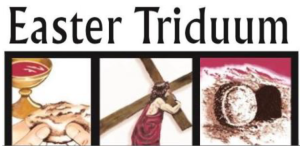
The Easter Triduum is a short season with one Liturgy spread over three days: Holy Thursday, Good Friday, and the Easter Vigil.
Tomorrow the 40 days of Lent will end. These six weeks call to our minds Jesus’ 40 days in the desert and the Israelites’ 40 years of wandering to the Promised Land. Tomorrow also begins the Church’s shortest season, the Easter Triduum, and her longest Mass. Three days, Holy Thursday night through Good Friday to Saturday night’s Easter Vigil. We go to church three times, but it’s all one Liturgy.
The Easter Triduum is the summit of the Church’s year, the purpose for which Christmas happened. Three parishioners of St. Raphael’s Parish, Springfield, Minnesota, got together to talk and write for the local newspaper about our favorite times in church. This is the result.
Holy Thursday
This night we celebrate the Mass of the Lord’s Supper. Jesus and his apostles celebrated the Passover, when God freed the Israelites from slavery in Egypt. Jesus took the traditional unleavened “bread of affliction” and called it himself, his body. A cup of wine becomes his blood. That mystery is present at every Mass as we obey Jesus’ command to “do this in memory of me.”
We haven’t sung the Gloria since Ash Wednesday. But on Holy Thursday it rings out, bells accompanying, prepping us for our first Bible reading, the happy story of that first Passover meal. The mood turns, though, when we respond: “Our blessing cup is a communion with the blood of Christ.” Next St. Paul gives us the Last Supper story, which he “received from the Lord” and also “handed on,” the first to do so in writing.
In the Gospel, instead of hearing about bread and wine, body and blood, we get a lesson on putting this mystery into practice. Jesus took towel and water basin and washed his disciples’ feet. Again we obey Jesus’ command to do for others “as I have done for you.” In the church service it’s a symbolic washing of 12 volunteers’ feet, but it becomes real outside of church in Christian service to a world of affliction.
The Holy Thursday service continues like any Mass, but it stops without a real ending. After Communion there’s no final blessing. No “Thanks be to God” at the end. Everybody kneels as the Blessed Sacrament is carried to the Altar of Repose. We remember Jesus’ agony in the Garden of Gethsemane and betrayal into the hands of Roman soldiers. We remain kneeling for a while at Jesus’ request. “Stay here and keep watch with me.” Those who wish continue a silent watch for as long as they want. The Easter Triduum Liturgy continues tomorrow.
Good Friday
Good Friday continues the service begun the previous evening. By tradition it occurs during the three hours when Jesus was hanging on the cross. It is a Communion service, not a Mass, the only day in the year on which Catholics do not celebrate a Mass.
We enter a silent church and see a bare altar. Purple cloths cover statues and crucifixes. The Tabernacle Light is extinguished. It is a time of mourning and prayer, which the priest begins by prostrating himself before the altar, a reminder of Jesus in Gethsemane. Then the service goes straight to the Liturgy of the Word. As Holy Thursday had no real ending, this service has no real beginning.
The first Word of the Lord is the prophet Isaiah’s moving description of the Suffering Servant of the Lord. “By his stripes we are healed.” We respond with Jesus’ dying words, “Father, into your hands I commend my spirit.” We hear from St. Paul again, now telling us that “we do not have a high priest who is unable to sympathize with our weaknesses. So let us confidently approach the throne of grace.” Then for the second time this week we hear the story of Jesus’ passion and death. (The first time was on Palm Sunday.) We all participate by reciting lines spoken by more than one person. It feels like being there. One is deeply aware of one’s own participation in the sin that caused Jesus to suffer.
The Prayers of the Faithful that follow are more elaborate than usual. Traditionally, each prayer includes a call to kneel and then stand — for those who are able. Every Catholic parish in the world offers the same prayers. This list of 10 prayers includes prayers for the pope, for the unity of Christians, for the Jewish people, for people who do not believe in God, and for those in public office.
There follows a uniquely Catholic and touching rite called the Veneration of the Cross, “on which hung the salvation of the world.” A touch, a kiss, a bow, or a genuflection are gestures by which we acknowledge the saving use to which the Lord puts mere wood and nails.
At the Communion Rite consecrated hosts are brought from the side altar on which the Blessed Sacrament has reposed since the previous night. There is no new consecration since this is not a Mass. Once again the faithful depart in silence without getting a real ending. The story can’t end like this. Neither can the Easter Triduum Liturgy.
Easter Vigil
“Holy Saturday” has no church services. From Friday evening through Saturday Jesus’ body remained in the tomb. Today all is quiet until the dark of night when the solemn and glorious finale of the Easter Triduum begins. This service has four parts centered on four elements: light, word, water, and the Eucharist. We’ll be in church until almost 10 o’clock!
The service of light begins with a fire, from which is lit the large Easter candle. It will burn at every Mass of the 50-day Easter Season. This Christ light also shines for baptisms and funerals.
Once lit and blessed (“Christ yesterday and today, the beginning and the end, the Alpha and the Omega”), the Easter candle makes its way through the assembly, each of us holding our own candle to be lit from the Easter Candle. With only fire from the Christ Candle lighting the church, the long, ancient Easter Proclamation is sung. “Exult, heavenly powers. Let the earth be glad. This is the night when once you led our forebears, Israel’s children, from slavery in Egypt. This is the night when Christ broke the prison bars of death.” This night frees us from all our imprisonments and slaveries.
The Liturgy of the Word includes at least three out of a possible seven readings from the Old Testament. At St. Raphael’s we will hear (1) the story of creation, with which the Bible and salvation history begins; (2) the story of crossing the sea on dry land and the dramatic new beginning of God’s holy people; (3) God’s call in Isaiah’s words to “come to the water, all you thirsty ones. Receive grain and eat without paying and without cost.”
Then come the Gloria, again with bells ringing; another reading from St. Paul – “Baptized into Jesus’ death and burial, we believe that we shall also live with him”; the Alleluia, sung for the first time since Ash Wednesday; and a Gospel story about the women who went to Jesus’ tomb and found the stone that covered the entrance rolled away. From the tomb we hear the message of two men, perhaps angels: “Jesus has been raised!”
We reaffirm our belief in this astounding good news and renounce Satan and all his works as we recite our baptismal promises, first spoken for most of us by our parents and godparents. Our Baptism renewal continues. We get sprinkled with holy water as the choir sings about “living streams of water.”
The liturgy continues with the familiar Mass rites: the Eucharistic Prayer, consecrating and lifting up the Bread of Life and the Cup of Blessing and offering to God all glory and honor through Jesus, with Jesus, and in Jesus … Amen; the Communion Rite with the Our Father, Sign of Peace, Lamb of God, and “O Lord, I am not worthy,” preparing us for Holy Communion in the “Body of Christ,” uniting us with Jesus and all who belong to Jesus; and, finally, a real ending and the sending forth from this three-day Mass, with a prayer and a blessing and “Go in peace…. Thanks be to God. ALLELUIA! ALLELUIA!”
Image credit: Our Savior Parish, P.N.C.C.
Religious Events
Previous Post
December 4, 2023
Francis, the Writing Pope: A Walk through Some Major Works
Next Post

July 27, 2024 Economic Coercion and 'Tyranny, Inc.' by Sohrab Ahmari
Recent Comments
"A lot of cemeteries require the vault for fear that the weight of the earth ..."
A Catholic Burial, Bodily Resurrection, and ..."
"The most devout Catholic I have ever known - Mass every day, big financial supporter ..."
A Catholic Burial, Bodily Resurrection, and ..."
"I really enjoyed this article, thanks!"
Easter Triduum at Saint Raphael’s: Three ..."
""Higgs Boson Blues" is my favorite of his."
Nick Cave and a Rocker’s ‘Faith, ..."
Browse Our Archives
Select a Category Advent Christmas Amazon Synod Angels Being Consumed Bible Catholic Modern Creed Ecology Economics Elizabeth Johnson Eucharist Fragments and Filaments Gender and Sex Gospel of Mark Herzog Historical Jesus Liturgy Luke Opening Scriptures on Way to Emmaus Ordinary radicals Parables Pro-Life Reincarnation Rosary Sacraments science Social Justice Souls Stories of Jesus The Creed Torture and Eucharist Tracy Uncategorized War and Peace
Select a Month October 2026 June 2025 April 2025 March 2025 February 2025 January 2025 November 2024 July 2024 March 2024 December 2023 October 2023 September 2023 August 2023 May 2023 April 2023 March 2023 February 2023 January 2023 December 2022 November 2022 October 2022 September 2022 August 2022 July 2022 June 2022 April 2022 March 2022 February 2022 January 2022 December 2021 November 2021 October 2021 August 2021 July 2021 June 2021 April 2021 March 2021 February 2021 December 2020 November 2020 October 2020 August 2020 July 2020 June 2020 May 2020 April 2020 March 2020 February 2020 January 2020 December 2019 November 2019 October 2019 September 2019 August 2019 July 2019 June 2019 May 2019 April 2019 March 2019 February 2019 January 2019 December 2018 November 2018 October 2018 September 2018 August 2018 July 2018 June 2018 May 2018
Follow Us!
TAKE THE
Religious Wisdom Quiz
Which Psalm is famous as the "Shepherd's Psalm"?
Select your answer to see how you score.
Psalm 1 Psalm 23 Psalm 119 Psalm 51
Related posts from Lost in a One-Acre Wood

Credo: A Story of God Told with the...

With Carbon Dioxide, 0.014 is a big number
Crucifixion as Breakthrough, Horsley’s Nerviest Claim
Jesus’ Politics of Resistance and Renewal
TRENDING AT PATHEOS Catholic

Rejecting Doom: Christian Hope And Human Action
Christianity is a religion of hope. We are to have hope and...

It’s What Comes From Within Which Matters
One of the most difficult things for us to understand is why...

Why I Choose the Eucharist Over the Sermon
Choose the Eucharist, Not the Sermon What are we supposed to get...

5 Design Elements Found in Spiritually Rooted Homes
Putting Spirituality Into Home Decor Our homes are more than our living...

Credo: A Story of God Told with the...
About 10 years ago, I began to imagine a personal "Credo" that...

The Anatomy of Divine Revelation in Catholic Thought
The claim that God has made Himself known to human beings is...
view all Catholic blogs
What Are Your Thoughts?leave a comment
Ad-Free & Subscriber Log-In Subscription Support
- About Us
- 2026 Calendar
- Videos
- Podcasts
- Library of World Religions
- Faith In Media Tracker
- Advertise With Us
- Write for Us
- Privacy Policy
- Terms of Service
- Do Not Sell My Data
- Contact Us
- Radiant Digital
- Manage Newsletter Subscriptions
- Unsubscribe From Notifications
- Sitemap
Copyright 2008-2026, Patheos. All rights reserved.
Subscription Support Ad-Free & Subscriber Log-In
Follow Patheos