
BuddhistCatholicContemplativeEvangelicalGeneral ChristianHinduJewishLatter-day SaintMuslimNew VisionsProgressive Christian
Beliefs
- Buddhist
- Catholic
- Contemplative
- Evangelical
- General Christian
- Hindu
- Jewish
- Latter-day Saint
- More Voices
- Muslim
- New Visions
- Pagan
- Progressive Christian
Topics
- Religion News
- Food and Religion
- Sports and Religion
- Religious Art
- Religious Music and Entertainment
- Religious Events
- History and Religion
- Style and Religion
- Politics and Religion
- Women in Religion
- Recreation Outdoors and Religion
- Business Finance and Religion
- Careers Workplace and Religion
- Education and Religion
- Family Parenting and Religion
- Health Fitness and Religion
- Home and Religion
- Relationships and Religion
- Technology and Religion
- Travel and Religion
Columnists
- Buddhist Columnists
- Business Finance and Religion Columnists
- Careers Workplace and Religion Columnists
- Catholic Columnists
- Contemplative Columnists
- Education and Religion Columnists
- Evangelists Columnists
- Family Parenting and Religion Columnists
- General Christian Columnists
- Health Fitness and Religion Columnists
- Hindu Columnists
- History and Religion Columnists
- Home and Religion Columnists
- Jewish Columnists
- More Voices Columnists
- Latter Day Columnists
- Muslim Columnists
- New Visions Columnists
- Nonreligious Columnists
- Pagan Columnists
- Politics and Religion Columnists
- Progressive Columnists
- Recreation Outdoors and Religion Columnists
- Relationships and Religion Columnists
- Religion News Columnists
- Religious Art Columnists
- Religious Events Columnists
- Religious Music and Entertainment Columnists
- Sports and Religion Columnists
- Style and Religion Columnists
- Technology and Religion Columnists
- Travel and Religion Columnists
- Women in Religion Columnists
Resource Library
- 2026 Calendar
- Library of World Religions
- The 100 Most Holy Places on Earth
- Patheos Answers
- Podcasts
- Videos
- Faith Leaders Database
- Anglican Episcopalian
- Bahai
- Baptist
- Buddhism
- Christianity
- Confucianism
- Eastern Orthodoxy
- Hinduism
- Holiness and Pentecostal
- ISKCON
- Islam
- Judaism
- Lutheran
- Methodist
- The Church of Jesus Christ of Latter-day Saints
- New Age
- Paganism
- Presbytarian and Reformed
- Protestantism
- Religion Behind the Scenes
- Roman Catholic
- Scientology
- Shia Islam
- Sikhism
- Sufism
- Sunni Islam
- Taoism
- Zen
- See all religions
Research Tools
 Ad-Free & Subscriber Log-In Subscription Support
Follow Patheos 

- Trending:
- Advent
- |
- Forgiveness
- |
- Thanksgiving
- |
- Election
- |
- Seasonal Holidays
- |
- Marriage

- Home
- Catholic
- An Intertextual Reading Places Imperial Texts alongside the New Testament
An Intertextual Reading Places Imperial Texts alongside the New Testament
Last updated on: October 10, 2023 at 7:22 am by Jack Hartjes
An Intertextual Reading Places Imperial Texts alongside the New Testament 2023-10-10T07:22:58-06:00 Jack Hartjes
Patheos Explore the world's faith through different perspectives on religion and spirituality! Patheos has the views of the prevalent religions and spiritualities of the world.
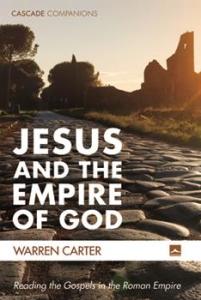
Warren Carter reads the Gospels in communication with texts from the Roman Empire. (Image credit: Amazon)
It’s common to read the New Testament for spiritual enlightenment and moral persuasion. One can also lower one’s sights and wonder about the political arena in which Jesus lived, worked, and suffered. That’s not as common, and when we do think that way, we tend to keep the two, Jesus and politics, apart from each other: “Render to Caesar Caesar’s due, and to God” … something else. Warren Carter rejects that separation and thinks a lot about politics in the New Testament. In Jesus and the Empire of God, Carter brings the first-century Palestinian world into his search for the meaning of the Scriptures. This background, especially the texts that described and made sense of the Roman imperial world, becomes foreground along with the New Testament texts. Carter calls his reading intertextual.
An intertextual reading
Intertextuality, for Carter, does not mean any obvious interdependence of texts one way or the other. Carter says,
[T]exts from quite different communities and traditions participate in various ways in common cultural contexts and interact with various other texts. (p.4)
Carter deals with texts only; that is, he works uncritically, not questioning the historicity of claims the texts make. In one of the discussion questions that follow a chapter on miracles, Carter asks,
Do you think healings such as miracles occur? (p. 122)
But he doesn’t answer, leaving such speculation to us. Carter is much more interested in the function and intertextuality of miracle stories in imperial and scriptural texts.
There are examples among the many imperial texts Carter cites that are surprisingly similar to New Testament stories. One could easily imagine some copying by a New Testament author. But Carter keeps away from any such historical connections, explaining,
I, as the author of this book, am responsible for creating this intertextuality or network between Gospel texts and Roman imperial texts.
And,
Cultural intertextuality is reader-centric, not author-centric. (p. 3)
Carter apparently declares here at the outset that he is dealing with meaning for the text’s reader, a meaning that is beyond an author’s control. Carter does not claim to reach back to the historical Jesus. Not even to the historical Church, which wrote about Jesus.
History
Still, there is a lot of history in this book, and the New Testament authors lived in that history:
I am interested in thinking about the New Testament writings as participants in networks of texts from the Roman Empire in the first and second centuries CE. (p. 4)
There are “interactions” among these texts, Carter claims. I don’t think these interactions could be just in our minds. They must be truly historical interactions, even if unconsciously, in the minds of New Testament authors and original readers. I don’t know if Carter agrees, but consider:
The New Testament writings participate in this system of imperial domination…. In places they appear to submit to and cooperate with imperial rule. But they also dissent from Rome’s societal vision, practices, and structures….
They imagine and advocate
… alternative commitments and ways of being human shaped by God’s purposes and Jesus’ teaching. (p. 18)
A sacred writer may not be able to name all of Carter’s 15 or so characteristics of an oppressive imperial system, but he knows when he’s going against the grain, even when all he wants to do is follow Jesus. I suspect Jesus himself sometimes deliberately aimed his teaching at an overbearing culture of empire.
Multitudes of texts and stories
For a history buff, Carter supplies a satisfying array of texts from the Roman and Greek classic era. In every case he finds mimicry, cooptation, and also dissent in the New Testament. Chapters present imperial texts and comparable New Testament texts in these areas:
- Origins – Chapter 3
- Portents of greatness – Chapter 4
- Teachings about social structures and practices – Chapter 5
- Miracles, signs, and wonders – Chapter 6
The imperial stories always glorify what already is or has been, namely, the Roman Empire, an emperor, or some other important figure. The New Testament stories, like the ancient biographies that Carter says they are, also glorify. But they glorify what is to come – the “Empire of God” and the coming victorious “Son of Man.”
Carter finds more similarities and differences between imperial literature and the New Testament in chapters dealing with the end of Jesus’ career on earth:
- Chapter 7, Jesus’ entry into Jerusalem
- Chapter 8, Jesus’ death
- Chapter 9, Jesus’ resurrection, ascension, and return
Probably the New Testament’s most obvious dissent from imperial ways of thinking is in the stories of Jesus’ death. In the Roman Empire an honorable death is a convincing mark of a person’s greatness. Jesus’ death is anything but honorable in the eyes of the world. Yet Christians found a way to exhibit the cross as a badge of honor. Jesus’ death “becomes a symbol of faithfulness to God’s purpose.” (p. 37)
Empire then and today
Carter sometimes startles the reader with original translations, for instance:
Repent, for the empire of the heavens has come near. (p. 81, Matthew)
The Greek term basileia becomes “kingdom” in most New Testament translation. But that term “names various empires: Babylon, Media, Persia, Macedonia, the Seleucids, and the contemporary Roman Empire” (p. 94). It was not just any kingdom that God and subject peoples of the first-century Mediterranean dealt with but worldwide power. Today, when we think of wide-ranging worldly power, we don’t think kingdom but empire. Imperial nations still treat other nations as colonies. The worldwide dominance of multinational corporations forms another kind of empire. Carter is clear and insistent about one of the purposes of his intertextual reading:
I suggest that engaging the Gospels’ intertextuality with the imperial-cultural texts of the Roman Empire foregrounds matters of societal visions, practices, structures, and personnel, both ancient and contemporary. Such intertextualities provoke us to think about the impact of the use of power and privilege in our world. (p. 6)
Lightning, eagles and vultures
Carter’s intertextual reading extends to “texts” other than literary forms. He explains:
I use “text” to refer to non-written “texts” such as monuments, buildings, statues, and coins that make statements about imperial power. (p. 4)
Carter’s use of one such non-literary “text” helped me make sense of a difficult New Testament passage. Again he brings empire into the foreground, where otherwise it wasn’t even in the background, at least not for me.
Just as lightning comes from the east and is seen as far as the west, so will the coming of the Son of Man be. Wherever the corpse is there the eagles will be gathered. (Matthew 24:27-28)
Carter’s intertextual reading sees in the lightning of that first sentence more than a highly visible display. It’s a sign of the authority of the Roman Empire and its high God, Zeus. First, the Son of Man rivals that authority. Then, in the second sentence, he subverts it. The eagles there are not just birds but standards that Roman armies carried into battle. Usually one reads “vultures” instead of “eagles.” Most often it’s vultures that gather around dead bodies. But “eagle” is the ordinary meaning of the Greek aetos, and now they aren’t gathering, but they are gathered. They’re lying in the dust with the dead and dying soldiers of Rome. (p. 187)
I like this intertextual reading better than the thought that Jesus, or Matthew, would make vultures a sign of God’s Kingdom or compare the Kingdom itself to a corpse. I suspect that here Carter is not just gathering disparate texts together but actually getting into Matthew’s mind. If so, then God’s empire, as Matthew sees it, is not just highly visible – light lightning and vultures soaring – but also highly disruptive of worldly empire.
For Matthew the end of this age of the world would entail the end of the Roman Empire. For us, then, the Christian hope for God’s Empire must take deliberate aim at the empires of today’s world.
More than spiritual documents
Carter contends with a common way of reading the Gospels:
As spiritual texts they are often understood by contemporary readers as concerning an individual’s spiritual and individual relationship with God. Often this approach isolates Gospels from everyday matters and practices, from societal structures and political practices. [An intertextual reading] alerts us to the Gospels as documents of political import. These intertextualities expand our horizons and disrupt spiritualizing reading strategies. They frame the Gospels as concerned with power structures, societal practices, leadership, social relationships, beneficiaries and casualties, who has access to and who is excluded from good resources of food, healthcare, housing, safety, and justice. The Gospels envision a different world and different priorities. (p. 195-96)
I found in Carter’s intertextual reading a confirmation of the direction I have taken in many posts. The Gospels show at least as much concern for life in this world as in the next. As I have claimed, for example, in a series of posts on the Gospel of Mark, there is a spirituality in the Gospels that is quite worldly.
Previous Post

September 15, 2023
Warren Carter Writes about the Bible in a World of Empire
Next Post
October 14, 2023 On Climate Change Pope Francis is Factual and Compelling
Recent Comments
"A lot of cemeteries require the vault for fear that the weight of the earth ..."
A Catholic Burial, Bodily Resurrection, and ..."
"The most devout Catholic I have ever known - Mass every day, big financial supporter ..."
A Catholic Burial, Bodily Resurrection, and ..."
"I really enjoyed this article, thanks!"
Easter Triduum at Saint Raphael’s: Three ..."
""Higgs Boson Blues" is my favorite of his."
Nick Cave and a Rocker’s ‘Faith, ..."
Browse Our Archives
Select a Category Advent Christmas Amazon Synod Angels Being Consumed Bible Catholic Modern Creed Ecology Economics Elizabeth Johnson Eucharist Fragments and Filaments Gender and Sex Gospel of Mark Herzog Historical Jesus Liturgy Luke Opening Scriptures on Way to Emmaus Ordinary radicals Parables Pro-Life Reincarnation Rosary Sacraments science Social Justice Souls Stories of Jesus The Creed Torture and Eucharist Tracy Uncategorized War and Peace
Select a Month November 2026 October 2026 June 2025 April 2025 March 2025 February 2025 January 2025 November 2024 July 2024 March 2024 December 2023 October 2023 September 2023 August 2023 May 2023 April 2023 March 2023 February 2023 January 2023 December 2022 November 2022 October 2022 September 2022 August 2022 July 2022 June 2022 April 2022 March 2022 February 2022 January 2022 December 2021 November 2021 October 2021 August 2021 July 2021 June 2021 April 2021 March 2021 February 2021 December 2020 November 2020 October 2020 August 2020 July 2020 June 2020 May 2020 April 2020 March 2020 February 2020 January 2020 December 2019 November 2019 October 2019 September 2019 August 2019 July 2019 June 2019 May 2019 April 2019 March 2019 February 2019 January 2019 December 2018 November 2018 October 2018 September 2018 August 2018 July 2018 June 2018 May 2018
Follow Us!
TAKE THE
Religious Wisdom Quiz
What does "Nebuchadnezzar" mean in Akkadian?
Select your answer to see how you score.
Chosen by the gods King of Babylon O Nabu, protect my heir The Lord reigns
Related posts from Lost in a One-Acre Wood
Credo: A Story of God Told with the...

With Carbon Dioxide, 0.014 is a big number
Crucifixion as Breakthrough, Horsley’s Nerviest Claim

Jesus’ Politics of Resistance and Renewal
TRENDING AT PATHEOS Catholic

The Kingdom Of God In Ordinary Life And...
The kingdom of God is all around us; it is in us...

How Discretion Guides Us Away From Extremes
Prudence is an important virtue for all of us. While we should...

If Baptism Washes Away Sin, Why Do Catholics...
The seven sacraments stand as the foundation of Catholic ecclesial life. The...

The Power of Setting a Good Example
Remember last August when the Chicago White Sox hosted a "Pope Hat...

A Catholic Critique of Biblical Unitarianism
If the statistics are to be believed, Unitarianism is rising worldwide. Although...

How Grandma Tourism Helps Grandparents Live Their Vocation
Grandma, The New Travel Influencer What started as a nostalgia-inspired social media...
view all Catholic blogs
What Are Your Thoughts?leave a comment
Ad-Free & Subscriber Log-In Subscription Support
- About Us
- 2026 Calendar
- Videos
- Podcasts
- Library of World Religions
- Faith In Media Tracker
- Advertise With Us
- Write for Us
- Privacy Policy
- Terms of Service
- Do Not Sell My Data
- Contact Us
- Radiant Digital
- Manage Newsletter Subscriptions
- Unsubscribe From Notifications
- Sitemap
Copyright 2008-2026, Patheos, part of the Radiant Digital network of media brands. All rights reserved.
Subscription Support Ad-Free & Subscriber Log-In
Follow Patheos