
BuddhistCatholicContemplativeEvangelicalGeneral ChristianHinduJewishLatter-day SaintMuslimNew VisionsProgressive Christian
Beliefs
- Buddhist
- Catholic
- Contemplative
- Evangelical
- General Christian
- Hindu
- Jewish
- Latter-day Saint
- More Voices
- Muslim
- New Visions
- Pagan
- Progressive Christian
Topics
- Religion News
- Food and Religion
- Sports and Religion
- Religious Art
- Religious Music and Entertainment
- Religious Events
- History and Religion
- Style and Religion
- Politics and Religion
- Women in Religion
- Recreation Outdoors and Religion
- Business Finance and Religion
- Careers Workplace and Religion
- Education and Religion
- Family Parenting and Religion
- Health Fitness and Religion
- Home and Religion
- Relationships and Religion
- Technology and Religion
- Travel and Religion
Columnists
- Buddhist Columnists
- Business Finance and Religion Columnists
- Careers Workplace and Religion Columnists
- Catholic Columnists
- Contemplative Columnists
- Education and Religion Columnists
- Evangelists Columnists
- Family Parenting and Religion Columnists
- General Christian Columnists
- Health Fitness and Religion Columnists
- Hindu Columnists
- History and Religion Columnists
- Home and Religion Columnists
- Jewish Columnists
- More Voices Columnists
- Latter Day Columnists
- Muslim Columnists
- New Visions Columnists
- Nonreligious Columnists
- Pagan Columnists
- Politics and Religion Columnists
- Progressive Columnists
- Recreation Outdoors and Religion Columnists
- Relationships and Religion Columnists
- Religion News Columnists
- Religious Art Columnists
- Religious Events Columnists
- Religious Music and Entertainment Columnists
- Sports and Religion Columnists
- Style and Religion Columnists
- Technology and Religion Columnists
- Travel and Religion Columnists
- Women in Religion Columnists
Resource Library
- 2026 Calendar
- Library of World Religions
- The 100 Most Holy Places on Earth
- Patheos Answers
- Podcasts
- Videos
- Faith Leaders Database
- Anglican Episcopalian
- Bahai
- Baptist
- Buddhism
- Christianity
- Confucianism
- Eastern Orthodoxy
- Hinduism
- Holiness and Pentecostal
- ISKCON
- Islam
- Judaism
- Lutheran
- Methodist
- The Church of Jesus Christ of Latter-day Saints
- New Age
- Paganism
- Presbytarian and Reformed
- Protestantism
- Religion Behind the Scenes
- Roman Catholic
- Scientology
- Shia Islam
- Sikhism
- Sufism
- Sunni Islam
- Taoism
- Zen
- See all religions
Research Tools
 Ad-Free & Subscriber Log-In Subscription Support
Ad-Free & Subscriber Log-In Subscription Support
Follow Patheos 

- Trending:
- Forgiveness
- |
- Marriage
- |
- Consciousness
- |
- Death Penalty
- |
- Election
- |
- Halloween

- Home
- Catholic
- Norman Wirzba Roots Humanity in a Sacred World
Norman Wirzba Roots Humanity in a Sacred World
Last updated on: April 21, 2023 at 8:24 am by Jack Hartjes
Norman Wirzba Roots Humanity in a Sacred World 2023-04-21T08:24:57-06:00 Jack Hartjes
Patheos Explore the world's faith through different perspectives on religion and spirituality! Patheos has the views of the prevalent religions and spiritualities of the world.
On Wirzba, This Sacred Life: Humanity’s Place in a Wounded World
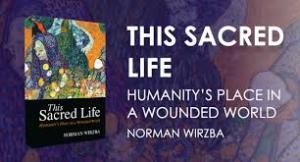
Norman Wirzba analyzes wounds and prescribes remedies for the threatening age of the Anthropocene. (Image credit: Cambridge University Press)
What is humanity’s purpose in this world? Or are we the end for which every other thing exists. Can we find purpose in the universe, given that science isn’t geared for anything like purpose? Or is competition for limited resources the rule for all life forms and for individuals within our species as well? Would the right answer to questions like these help turn around a world bent on self-destruction? Maybe it’s only a hope that says, Yes; but Norman Wirzba shares that hope. In This Sacred Life, he appeals to traditional beliefs and religions, especially Christianity, to clarify his hope as a call to recognize the sacred.
Wirzba approaches the sacred in three steps.
Wirzba writes with an eye on the harm Earth’s human inhabitants visit on the planet. Scientists think human actions are now the major force changing Earth’s natural systems. They think in terms of a new era of planetary history, the Anthropocene. The dangers of the Anthropocene are the leading idea in Wirzba’s Part I, “Assessing our Situation.”
Part II, “Turning to Fundamentals,” introduces two metaphors for healthful existence on the planet. To thrive spiritually and even materially, we must be “rooted” to place and community. And the world in which we find our roots is a “meshwork.” Wirzba borrows the unusual term from British anthropologist Tim Ingols. I think of being enmeshed. Wirzba says, “[T]he borders between organic and inorganic [and between the world and us] are constantly being blurred.” (p. 84)
Part III is “This Sacred Life.” I’m used to thinking some things are sacred and others not. Like the set of fancy dishes inherited from Grandma. They stay on the shelf, set apart from ordinary tableware, saved for special occasions. Or like the people the God of the Old Testament sets apart from all other peoples. But if all life is sacred and life stretches into and opens to penetration by its environment, that raises a question. Where, if ever, does the sacred end and the secular begin? What is the sacred set apart from?
Wirzba thinks differently about the sacred. The sacred is the “gratuitous and gracious presence” that people in just about any culture seem to encounter in their “engagement with places and fellow creatures.” (p. 143) Wirzba further clarifies with the Christian concept of creation. God gives himself in the gift of the created world. If everything is gift, including the creatures that we are, then everything is sacred.
Combining the two concepts of the sacred
Living as creatures in response to the gift of creation, Wirzba thinks is the way the world can return to wholeness and health. But it’s obvious that the human race has not done that. We have lived, instead, as “masters of the universe.” As if the universe has no meaning apart from what it means for us. As if the world is infinitely pliable to our demands. The latter is scientific nonsense, of course; but science encourages the former myth by setting aside the question of meaning.
But let’s go back to Wirzba’s idea of creation as gift. For there to be a gift there has to be a receiver, one who recognizes the gift as a gift. That closely connects the human race to creation’s giftedness while allowing the gift to be entirely God’s action. In our best – graced – moments, we have allowed the gift to be gift. We have accepted even ourselves and our virtues as gift. Without that acceptance, God’s giving fails to reach its natural end.
As gift, the world is indeed sacred. But as gift refused or ignored or spat upon, the world loses that sacred character. Adam’s fall from grace brings with it a fallen world. The world as fallen is the secular world out of which God draws a sacred world, like constituting a holy people out of slaves in Egypt. On that future day when humans live the creaturely life that God planned, then all the world will be sacred. Only the memory of the sacred’s counterpoint, the secular, will remain.
The Anthropocene and hope for the world
One of the debates that Wirzba has with himself concerns the proper name for the age we seem to be entering. Perhaps instead of Anthropocene we should call it Capitalocene. After all, it’s only since the heedless material progress that capitalism engenders that humanity has acquired the choice of destroying its world or not. An economic system and ideology has made us the major factor determining the future of planet Earth.
Wirzba admits that reality but sees it in the context of what humans have done to their world since at least the rise of agriculture. The only difference between then and today, as Wirzba sees it, is that now Earth has had about all it can take. Commentator Jonathan Tran, in a Syndicate symposium, holds an opposing view. He sees the expansion of human power beyond what nature can cope with as a qualitative difference. It’s not the human as such but the capitalist that ushers in a new age of the world.
Personally, between “Capitalocene” and “Anthropocene” I much prefer the latter, at least for the sound of it. There’s no harm in the more general term, Anthropocene, if we recognize it didn’t have to turn out as it has. We’ve made choices along the way, and we could reverse ourselves.
We have a generation or two to accomplish that prodigious feat. And what if we do? It could mean returning Earth and its natural process to their natural role as chief drivers of planetary change. And will that entail the end of the Anthropocene? We might relinquish mastery for servanthood, God’s original plan for us. Anthropocene could be Earth’s shortest era by millennia. Or maybe we shouldn’t proclaim any new age just yet. There is still hope for the world.
Previous Post

April 13, 2023
“Drink the Cup” – Liturgy Teaches Us Eucharistic Vocabulary
Next Post
May 17, 2023 Credo: A Story of God. I tell it Again with the Creed of Christians
Recent Comments
"A lot of cemeteries require the vault for fear that the weight of the earth ..."
A Catholic Burial, Bodily Resurrection, and ..."
"The most devout Catholic I have ever known - Mass every day, big financial supporter ..."
A Catholic Burial, Bodily Resurrection, and ..."
"I really enjoyed this article, thanks!"
Easter Triduum at Saint Raphael’s: Three ..."
""Higgs Boson Blues" is my favorite of his."
Nick Cave and a Rocker’s ‘Faith, ..."
Browse Our Archives
Select a Category Advent Christmas Amazon Synod Angels Being Consumed Bible Catholic Modern Creed Ecology Economics Elizabeth Johnson Eucharist Fragments and Filaments Gender and Sex Gospel of Mark Herzog Historical Jesus Liturgy Luke Opening Scriptures on Way to Emmaus Ordinary radicals Parables Pro-Life Reincarnation Rosary Sacraments science Social Justice Souls Stories of Jesus The Creed Torture and Eucharist Tracy Uncategorized War and Peace
Select a Month October 2026 June 2025 April 2025 March 2025 February 2025 January 2025 November 2024 July 2024 March 2024 December 2023 October 2023 September 2023 August 2023 May 2023 April 2023 March 2023 February 2023 January 2023 December 2022 November 2022 October 2022 September 2022 August 2022 July 2022 June 2022 April 2022 March 2022 February 2022 January 2022 December 2021 November 2021 October 2021 August 2021 July 2021 June 2021 April 2021 March 2021 February 2021 December 2020 November 2020 October 2020 August 2020 July 2020 June 2020 May 2020 April 2020 March 2020 February 2020 January 2020 December 2019 November 2019 October 2019 September 2019 August 2019 July 2019 June 2019 May 2019 April 2019 March 2019 February 2019 January 2019 December 2018 November 2018 October 2018 September 2018 August 2018 July 2018 June 2018 May 2018
Follow Us!
TAKE THE
Religious Wisdom Quiz
What did Moses break upon seeing the people worshiping an idol?
Select your answer to see how you score.
Aaron's staff Stone tablets The Ark The altar
Related posts from Lost in a One-Acre Wood

Global Warming, Glaciers, and Nearly Silent Catholic Wisdom
Faith Leaders on Climate Change: “Future Generations Will...
BirthStrike Movement to Dissolve Next Week
Corona, Global Warming, Sacrifice, and Hope
TRENDING AT PATHEOS Catholic

Creation, Preservation, and Teleology in Catholic Theology
As I write this, it is very early Monday morning. Like millions...

The Parable Of The Sower And The Word...
One of Christ’s most famous parables is that of the sower who...

Rejecting Doom: Christian Hope And Human Action
Christianity is a religion of hope. We are to have hope and...

Why I Choose the Eucharist Over the Sermon
Choose the Eucharist, Not the Sermon What are we supposed to get...

5 Design Elements Found in Spiritually Rooted Homes
Putting Spirituality Into Home Decor Our homes are more than our living...

Credo: A Story of God Told with the...
About 10 years ago, I began to imagine a personal "Credo" that...
view all Catholic blogs
What Are Your Thoughts?leave a comment
Ad-Free & Subscriber Log-In Subscription Support
- About Us
- 2026 Calendar
- Videos
- Podcasts
- Library of World Religions
- Faith In Media Tracker
- Advertise With Us
- Write for Us
- Privacy Policy
- Terms of Service
- Do Not Sell My Data
- Contact Us
- Radiant Digital
- Manage Newsletter Subscriptions
- Unsubscribe From Notifications
- Sitemap
Copyright 2008-2026, Patheos. All rights reserved.
Subscription Support Ad-Free & Subscriber Log-In
Follow Patheos