
BuddhistCatholicContemplativeEvangelicalGeneral ChristianHinduJewishLatter-day SaintMuslimNew VisionsProgressive Christian
Beliefs
- Buddhist
- Catholic
- Contemplative
- Evangelical
- General Christian
- Hindu
- Jewish
- Latter-day Saint
- More Voices
- Muslim
- New Visions
- Pagan
- Progressive Christian
Topics
- Religion News
- Food and Religion
- Sports and Religion
- Religious Art
- Religious Music and Entertainment
- Religious Events
- History and Religion
- Style and Religion
- Politics and Religion
- Women in Religion
- Recreation Outdoors and Religion
- Business Finance and Religion
- Careers Workplace and Religion
- Education and Religion
- Family Parenting and Religion
- Health Fitness and Religion
- Home and Religion
- Relationships and Religion
- Technology and Religion
- Travel and Religion
Columnists
- Buddhist Columnists
- Business Finance and Religion Columnists
- Careers Workplace and Religion Columnists
- Catholic Columnists
- Contemplative Columnists
- Education and Religion Columnists
- Evangelists Columnists
- Family Parenting and Religion Columnists
- General Christian Columnists
- Health Fitness and Religion Columnists
- Hindu Columnists
- History and Religion Columnists
- Home and Religion Columnists
- Jewish Columnists
- More Voices Columnists
- Latter Day Columnists
- Muslim Columnists
- New Visions Columnists
- Nonreligious Columnists
- Pagan Columnists
- Politics and Religion Columnists
- Progressive Columnists
- Recreation Outdoors and Religion Columnists
- Relationships and Religion Columnists
- Religion News Columnists
- Religious Art Columnists
- Religious Events Columnists
- Religious Music and Entertainment Columnists
- Sports and Religion Columnists
- Style and Religion Columnists
- Technology and Religion Columnists
- Travel and Religion Columnists
- Women in Religion Columnists
Resource Library
- 2026 Calendar
- Library of World Religions
- The 100 Most Holy Places on Earth
- Patheos Answers
- Podcasts
- Videos
- Faith Leaders Database
- Anglican Episcopalian
- Bahai
- Baptist
- Buddhism
- Christianity
- Confucianism
- Eastern Orthodoxy
- Hinduism
- Holiness and Pentecostal
- ISKCON
- Islam
- Judaism
- Lutheran
- Methodist
- The Church of Jesus Christ of Latter-day Saints
- New Age
- Paganism
- Presbytarian and Reformed
- Protestantism
- Religion Behind the Scenes
- Roman Catholic
- Scientology
- Shia Islam
- Sikhism
- Sufism
- Sunni Islam
- Taoism
- Zen
- See all religions
Research Tools
 Ad-Free & Subscriber Log-In Subscription Support
Ad-Free & Subscriber Log-In Subscription Support
Follow Patheos 

- Trending:
- Forgiveness
- |
- Marriage
- |
- Consciousness
- |
- Death Penalty
- |
- Election
- |
- Halloween

- Home
- Catholic
- Catholic Church Repudiates the Doctrine of Discovery
Catholic Church Repudiates the Doctrine of Discovery
Last updated on: April 15, 2023 at 5:33 am by Jack Hartjes
Catholic Church Repudiates the Doctrine of Discovery 2023-04-15T05:33:56-06:00 Jack Hartjes
Patheos Explore the world's faith through different perspectives on religion and spirituality! Patheos has the views of the prevalent religions and spiritualities of the world.
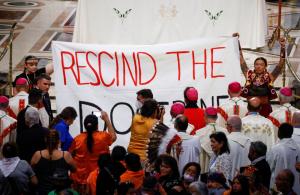
During Pope Francis’ visit to Canada last July, Indigenous people hold a banner calling on Pope Francis to “rescind the doctrine of discovery,” old papal teachings that encouraged explorers to colonize and claim the lands of any people who were not Christian,. (CNS photo/Guglielmo Mangiapane, Reuters)
On Thursday, March 30, the Church formally rejected the Doctrine of Discovery.
I learned about the Doctrine of Discovery from a folksinger in Montana. Jack Gladstone, a member of the Blackfeet tribe is Montana’s official troubadour and storyteller. In regular performances in Glacier National Park he would often describe and censure this hateful doctrine for his mostly white audiences. I have written about Jack Gladstone before.
Much earlier, in Catholic grade school, I learned about the “demarcation line” that Pope Alexander VI established in 1493. His Papal Bull “Inter Caetera” separated Spanish and Portuguese land claims in the New Worlds. Essentially it gave colonization rights in Africa to Portugal and in most of the Americas to Spain. These allotments were to change through subsequent history obviously. What didn’t change was the appearance of blessing on European hegemony from a series of Papal Bulls at the dawn of the age of colonization.
In the 1950’s the Church was not ready to teach Catholic school children about the Church’s responsibility for the results that accrued to indigenous peoples. I learned little or, in some areas, nothing about:
- Enslavement of and even attempts to exterminate indigenous peoples,
- Systematic appropriation of the wealth of indigenous lands,
- Loss of indigenous languages, cultures, and spiritualities
- Separation of children from their families and their cultures in punitive, often “Christian,” boarding schools,
- Weakened family structures and cultural norms and invasion by Western consumerism and drug culture,
- Wide-spread discrimination against indigenous peoples.
Some Legal history of the Doctrine of Discovery
The bull [“inter Caetera”] stated that any land not inhabited by Christians was available to be “discovered,” claimed, and exploited by Christian rulers…. [It stated further] that barbarous nations be overthrown and brought to the faith itself.” (Gilder Lehrman Institute of American History article, “The Doctrine of Discovery, 1493”)
In other words, if people are not Christian they have no right to land or self-government. This concept, the institute’s article says, “became the basis of all European claims in the Americas as well as the foundation for the United States’ western expansion.”
In 1823 the US Supreme Court coined the phrase “Doctrine of Discovery.” It held that “the principle of discovery gave European nations an absolute right to New World lands.” The above article comments, “In essence, American Indians had only a right of occupancy, which could be abolished.”
In 2005 a unanimous Supreme Court denied an Oneida tribe’s attempt to use an ancient right to avoid paying taxes on lost but newly acquired tribal land. Justice Ruth Bader Ginsburg referenced the “Doctrine of Discovery” in writing this decision. (American Indian Law Alliance)
Change a long time coming
In the 1990’s, when I spent many summer nights listening to Jack Gladstone, the bull “Inter Caetera” was becoming newsworthy. Catholics were petitioning Pope John Paul II to revoke the Doctrine of Discovery. They urged him to “recognize the human rights of indigenous ‘non-Christian peoples.’” (From the Gilder Lehrman Institute article) The second part of that request had already made its way into Church documents going back as far as 1537. In that year Pope Paul III wrote:
We define and declare … people who may be discovered by Christians are by no means to be deprived of their liberty or the possession of their property…. {N]or should they be in any way enslaved.” (Catholic News Agency)
Still, until last Thursday the Church had not disavowed the offending papal bulls.
Eight months earlier, Pope Francis had spoken with First Nations people, Métis, and Inuit during a visit to Canada. He heard what Canadian Indigenous had to say about the Doctrine of Discovery. Vatican News reported:
The words sorry, shame, pain and indignation resounded strongly in Pope Francis’s first public speech of his penitential pilgrimage…..
The pope implored God’s forgiveness and longed for healing and reconciliation. But, he said, begging pardon is only a first step in creating “a culture able to prevent such situations from happening.” A further step took place in the Vatican last Thursday.
Vatican rejects the Doctrine of Discovery
A Vatican statement by the dicasteries for Culture and Education and for Promoting Integral Human Development repudiated
… those concepts that fail to recognize the inherent human rights of indigenous peoples, including what has become known as the legal and political ‘doctrine of discovery.’
Rreferring to decrees of the 15th century, the statement “acknowledges that these papal bulls did not adequately reflect the equal dignity and rights of indigenous peoples.”
That was an understatement. A gilder Lehrman Institute of American History article, “The Doctrine of Discovery, 1493,” specifies what the bull “Inter Caetera” did do. It stated that
… any land not inhabited by Christians was available to be “discovered,” claimed, and exploited by Christian rulers…. [It stated further] that barbarous nations be overthrown and brought to the faith itself.”
In other words, if people are not Christian they have no right to land or self-government. This doctrine “became the basis of all European [land] claims [and] the foundation for the United States’ western expansion.”
Colonial powers justified their “immoral acts against indigenous peoples” by citing Church documents. The Vatican statement acknowledges that these actions continued “at times without opposition from ecclesiastical authorities.”
Looking forward
Thursday’s Vatican statement commits the Church to accompanying indigenous peoples and fostering efforts to promote reconciliation and healing. Dialogue with indigenous peoples is helping the Church understand “their values, cultures, as well as past and present sufferings.” That suffering is “a powerful summons to abandon the colonizing mentality and to walk with [indigenous peoples] side by side.”
History demands that the Church acknowledge her members “weakness and failings … in every generation,” the statement says.
Previous Post
March 28, 2023
“Jesus Wept.” Don’t Take the Humanity out of This Human Experience
Next Post

April 13, 2023 “Drink the Cup” – Liturgy Teaches Us Eucharistic Vocabulary
Recent Comments
"A lot of cemeteries require the vault for fear that the weight of the earth ..."
A Catholic Burial, Bodily Resurrection, and ..."
"The most devout Catholic I have ever known - Mass every day, big financial supporter ..."
A Catholic Burial, Bodily Resurrection, and ..."
"I really enjoyed this article, thanks!"
Easter Triduum at Saint Raphael’s: Three ..."
""Higgs Boson Blues" is my favorite of his."
Nick Cave and a Rocker’s ‘Faith, ..."
Browse Our Archives
Select a Category Advent Christmas Amazon Synod Angels Being Consumed Bible Catholic Modern Creed Ecology Economics Elizabeth Johnson Eucharist Fragments and Filaments Gender and Sex Gospel of Mark Herzog Historical Jesus Liturgy Luke Opening Scriptures on Way to Emmaus Ordinary radicals Parables Pro-Life Reincarnation Rosary Sacraments science Social Justice Souls Stories of Jesus The Creed Torture and Eucharist Tracy Uncategorized War and Peace
Select a Month October 2026 June 2025 April 2025 March 2025 February 2025 January 2025 November 2024 July 2024 March 2024 December 2023 October 2023 September 2023 August 2023 May 2023 April 2023 March 2023 February 2023 January 2023 December 2022 November 2022 October 2022 September 2022 August 2022 July 2022 June 2022 April 2022 March 2022 February 2022 January 2022 December 2021 November 2021 October 2021 August 2021 July 2021 June 2021 April 2021 March 2021 February 2021 December 2020 November 2020 October 2020 August 2020 July 2020 June 2020 May 2020 April 2020 March 2020 February 2020 January 2020 December 2019 November 2019 October 2019 September 2019 August 2019 July 2019 June 2019 May 2019 April 2019 March 2019 February 2019 January 2019 December 2018 November 2018 October 2018 September 2018 August 2018 July 2018 June 2018 May 2018
Follow Us!
TAKE THE
Religious Wisdom Quiz
What does "Boaz" mean in Hebrew?
Select your answer to see how you score.
God is my salvation Righteous One Strength Redeemer
Related posts from Lost in a One-Acre Wood

Axios News, Inflation, Justice, and Young Workers in...

Holy Thursday Theology and the Scientific Quest for...
‘Render to Caesar’ – or Not. The Speech...

Personal Morality: Jesus’ Village Politics Can’t be Without...
TRENDING AT PATHEOS Catholic

Creation, Preservation, and Teleology in Catholic Theology
As I write this, it is very early Monday morning. Like millions...

The Parable Of The Sower And The Word...
One of Christ’s most famous parables is that of the sower who...

Rejecting Doom: Christian Hope And Human Action
Christianity is a religion of hope. We are to have hope and...

Why I Choose the Eucharist Over the Sermon
Choose the Eucharist, Not the Sermon What are we supposed to get...

5 Design Elements Found in Spiritually Rooted Homes
Putting Spirituality Into Home Decor Our homes are more than our living...

Credo: A Story of God Told with the...
About 10 years ago, I began to imagine a personal "Credo" that...
view all Catholic blogs
What Are Your Thoughts?leave a comment
Ad-Free & Subscriber Log-In Subscription Support
- About Us
- 2026 Calendar
- Videos
- Podcasts
- Library of World Religions
- Faith In Media Tracker
- Advertise With Us
- Write for Us
- Privacy Policy
- Terms of Service
- Do Not Sell My Data
- Contact Us
- Radiant Digital
- Manage Newsletter Subscriptions
- Unsubscribe From Notifications
- Sitemap
Copyright 2008-2026, Patheos. All rights reserved.
Subscription Support Ad-Free & Subscriber Log-In
Follow Patheos