
BuddhistCatholicContemplativeEvangelicalGeneral ChristianHinduJewishLatter-day SaintMuslimNew VisionsProgressive Christian
Beliefs
- Buddhist
- Catholic
- Contemplative
- Evangelical
- General Christian
- Hindu
- Jewish
- Latter-day Saint
- More Voices
- Muslim
- New Visions
- Pagan
- Progressive Christian
Topics
- Religion News
- Food and Religion
- Sports and Religion
- Religious Art
- Religious Music and Entertainment
- Religious Events
- History and Religion
- Style and Religion
- Politics and Religion
- Women in Religion
- Recreation Outdoors and Religion
- Business Finance and Religion
- Careers Workplace and Religion
- Education and Religion
- Family Parenting and Religion
- Health Fitness and Religion
- Home and Religion
- Relationships and Religion
- Technology and Religion
- Travel and Religion
Columnists
- Buddhist Columnists
- Business Finance and Religion Columnists
- Careers Workplace and Religion Columnists
- Catholic Columnists
- Contemplative Columnists
- Education and Religion Columnists
- Evangelists Columnists
- Family Parenting and Religion Columnists
- General Christian Columnists
- Health Fitness and Religion Columnists
- Hindu Columnists
- History and Religion Columnists
- Home and Religion Columnists
- Jewish Columnists
- More Voices Columnists
- Latter Day Columnists
- Muslim Columnists
- New Visions Columnists
- Nonreligious Columnists
- Pagan Columnists
- Politics and Religion Columnists
- Progressive Columnists
- Recreation Outdoors and Religion Columnists
- Relationships and Religion Columnists
- Religion News Columnists
- Religious Art Columnists
- Religious Events Columnists
- Religious Music and Entertainment Columnists
- Sports and Religion Columnists
- Style and Religion Columnists
- Technology and Religion Columnists
- Travel and Religion Columnists
- Women in Religion Columnists
Resource Library
- 2026 Calendar
- Library of World Religions
- The 100 Most Holy Places on Earth
- Patheos Answers
- Podcasts
- Videos
- Faith Leaders Database
- Anglican Episcopalian
- Bahai
- Baptist
- Buddhism
- Christianity
- Confucianism
- Eastern Orthodoxy
- Hinduism
- Holiness and Pentecostal
- ISKCON
- Islam
- Judaism
- Lutheran
- Methodist
- The Church of Jesus Christ of Latter-day Saints
- New Age
- Paganism
- Presbytarian and Reformed
- Protestantism
- Religion Behind the Scenes
- Roman Catholic
- Scientology
- Shia Islam
- Sikhism
- Sufism
- Sunni Islam
- Taoism
- Zen
- See all religions
Research Tools
 Ad-Free & Subscriber Log-In Subscription Support
Ad-Free & Subscriber Log-In Subscription Support
Follow Patheos 

- Trending:
- Forgiveness
- |
- Marriage
- |
- Consciousness
- |
- Death Penalty
- |
- Election
- |
- Halloween

- Home
- Catholic
- History and Religion
- “Jesus Wept.” Don’t Take the Humanity out of This Human Experience
“Jesus Wept.” Don’t Take the Humanity out of This Human Experience
Last updated on: December 4, 2023 at 10:19 pm by Jack Hartjes
“Jesus Wept.” Don’t Take the Humanity out of This Human Experience 2023-12-04T22:19:49-06:00 Jack Hartjes
Patheos Explore the world's faith through different perspectives on religion and spirituality! Patheos has the views of the prevalent religions and spiritualities of the world.
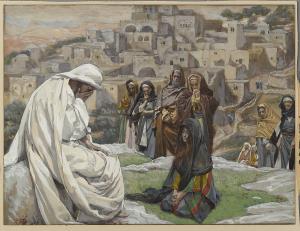
Jesus humanity includes the experience of human emotion, as when he cries at the death of his friend Lazarus in John’s Gospel. (Image: Wikipedia)
When I was a child, Lent for me was a time to meditate on Jesus’ suffering. I was pretty good at it. I could imagine mountains of suffering far beyond what the Bible describes. And I could imagine loving Jesus all the more because of his extreme suffering for me. When it came to bearing up under his cross of suffering, Jesus rocked – in my imagination. What occasions this memory of my childhood? Two words from The Gospel for the Fifth Sunday of Lent: “Jesus wept.” I happened across a meditation on these tears, and it echoed my childhood imaginations. The source I won’t reference. After all, it’s a rather common thought and, I think, a mistake.
“Jesus wept.” But did Jesus suffer more than you or I or anyone else ever could, when he cried at his friend Lazarus’s death — or on the cross for that matter? That seems theologically unnecessary. More importantly, one must ask, “What kind of comfort would that be?” When you go to a suffering friend, you don’t (or shouldn’t) say, “I’ve suffered worse.” There’s no comfort in that. How can it be consoling if it’s Jesus who endures worse?
Jesus wept, like us
I’m thinking of a mother in Chile or Argentina during their dictatorship years. She has endured the kidnapping, raping, torturing, and killing of her child by her own government. Or the sorrows of the mothers in Ukraine and in many other countries witnessing similar acts against their children. Or the mother who has to watch her children die from hunger and can’t do anything about it.
“Jesus wept” in the depths of his heart. Jesus experienced anguish at the cruelty of this world. But did Jesus experience an agony greater than what these mothers knew? Did Jesus suffer more on the cross in three hours than the many others who suffered the same punishment for their supposed crimes against Rome? Crucifixions often lasted for days instead of just hours. That Jesus suffered more than any other human being seems theologically unnecessary and factually simply untrue.
Suffering is part of a human life, and Jesus suffered. It’s certainly worthwhile to meditate on this way that Jesus is so like all of us, so human. That value is mostly lost, I think, when we make Jesus’ suffering, in quality or quality, very much unlike ours.
Jesus, divine and human
Jesus is both fully divine and fully human. We look at Jesus’ miracles reported in the Gospels and think of Jesus’ divine nature. How does that square with Jesus’ humanity? A Benedictine monk, whom I remember now only as Father Tom, explained: There were times when divinity so overwhelmed Jesus that it shone visibly in a miracle, or in understanding of people’s hearts, or knowledge of the future.
I don’t know what to make of my friend the old monk’s theory. But, even if true, this sporadic, unpredictable, unexplainable, divine incursion happens to others as well, and not just in the Christian tradition. It doesn’t necessarily mean Jesus wasn’t human. But if Jesus walked around with awareness of his divinity a regular feature of his consciousness, that would make him something other than human. Actually, I doubt that the thought “I am divine” ever crossed Jesus’ mind.
On the same occasion when John’s Gospel says “Jesus wept,” Jesus also shows forth his divinity. He predicts that Lazarus will rise again, and he makes the astounding claim: “I AM the Resurrection.” It’s one of many “I AM” statements in John’s Gospel. These are echoes of the name that, out of the burning bush, God gave himself. (Exodus 3:14) John gives us historical details that the other Gospels don’t, but most likely Jesus’ manner of speech, including this “I AM,” isn’t one of them. Jesus’ words in John’s Gospel often are too different from what we know of Jesus from the other three Gospels. Often they’re so divine-like, they seems to obliterate, rather than occasionally overshadow, Jesus’ humanity.
A death like ours?
Jesus talks most like a God in John’s Gospel, but it’s in the other three Gospels that Jesus predicts his death and resurrection after three days. He does this three times in the Gospel of Mark. Did Jesus walk to his death aware that he would rise in three days? That seems to say, as I heard in a homily recently, that Jesus’ experience of death was different from ours.
In the Gospels we do not find literal transcriptions of Jesus words and deeds – no more in the first three than in the fourth. Mark and, following him, Matthew and Luke sometimes put their own community’s faith in Jesus’ divinity into Jesus’ words and deeds. Some of the Bible’s miracle stories may be legends. But not all; Jesus’ reputation during his lifetime as miracle worker must have had some basis in fact. (See this post.) Still, this was God working through Jesus. We should not think of Jesus as a man with super-human powers.
The same is true for Jesus’ thoughts and feelings about death. Jesus no doubt could predict his own death. Others have done the same. But Raymond Brown is one Catholic scholar who doubts that the predictions of resurrection are Jesus’ own words. In his An Introduction to New Testament Christology he says:
A Jesus who walked through the world with unlimited knowledge, knowing exactly what the morrow would bring, knowing with certainty that three days after his death his Father would raise him up, would be a Jesus who could arouse our admiration, but a Jesus still far from … a humankind that can only hope in the future and believe in God’s goodness, far from a humankind that must face the supreme uncertainty of death with faith but without knowledge of what is beyond. (p. 151)”
Conclusion
It’s hard to keep both ends of the Church’s teaching about Jesus – his divinity and his humanity – equally in mind. The one that’s most likely to be shortchanged is the humanity. That may happen as we meditate on the risen Jesus or on his amazing deeds of healing, exorcising, and declaring sins forgiven. It may happen in this time of Lent as we read that “Jesus wept” and come face to face with Jesus’ agony. But neither Superman nor Rock Star of Suffering is an appropriate image for the one who saves us. Salvation is only through the One who became like us in all things but sin.
History and Religion
Education and Religion
Previous Post
March 14, 2023
Holy Thursday Theology and the Scientific Quest for Jesus in History
Next Post
April 3, 2023 Catholic Church Repudiates the Doctrine of Discovery
Recent Comments
"A lot of cemeteries require the vault for fear that the weight of the earth ..."
A Catholic Burial, Bodily Resurrection, and ..."
"The most devout Catholic I have ever known - Mass every day, big financial supporter ..."
A Catholic Burial, Bodily Resurrection, and ..."
"I really enjoyed this article, thanks!"
Easter Triduum at Saint Raphael’s: Three ..."
""Higgs Boson Blues" is my favorite of his."
Nick Cave and a Rocker’s ‘Faith, ..."
Browse Our Archives
Select a Category Advent Christmas Amazon Synod Angels Being Consumed Bible Catholic Modern Creed Ecology Economics Elizabeth Johnson Eucharist Fragments and Filaments Gender and Sex Gospel of Mark Herzog Historical Jesus Liturgy Luke Opening Scriptures on Way to Emmaus Ordinary radicals Parables Pro-Life Reincarnation Rosary Sacraments science Social Justice Souls Stories of Jesus The Creed Torture and Eucharist Tracy Uncategorized War and Peace
Select a Month October 2026 June 2025 April 2025 March 2025 February 2025 January 2025 November 2024 July 2024 March 2024 December 2023 October 2023 September 2023 August 2023 May 2023 April 2023 March 2023 February 2023 January 2023 December 2022 November 2022 October 2022 September 2022 August 2022 July 2022 June 2022 April 2022 March 2022 February 2022 January 2022 December 2021 November 2021 October 2021 August 2021 July 2021 June 2021 April 2021 March 2021 February 2021 December 2020 November 2020 October 2020 August 2020 July 2020 June 2020 May 2020 April 2020 March 2020 February 2020 January 2020 December 2019 November 2019 October 2019 September 2019 August 2019 July 2019 June 2019 May 2019 April 2019 March 2019 February 2019 January 2019 December 2018 November 2018 October 2018 September 2018 August 2018 July 2018 June 2018 May 2018
Follow Us!
TAKE THE
Religious Wisdom Quiz
What happened when the Philistines captured the Ark of the Covenant?
Select your answer to see how you score.
Fire rained from heaven The sun stood still The Jordan parted Dagon's idol fell
Related posts from Lost in a One-Acre Wood

Credo: A Story of God Told with the...

Richard A. Horsley Sees Jesus in the Context...

Holy Thursday Theology and the Scientific Quest for...
‘Render to Caesar’ – or Not. The Speech...
TRENDING AT PATHEOS Catholic

Creation, Preservation, and Teleology in Catholic Theology
As I write this, it is very early Monday morning. Like millions...

The Parable Of The Sower And The Word...
One of Christ’s most famous parables is that of the sower who...

Rejecting Doom: Christian Hope And Human Action
Christianity is a religion of hope. We are to have hope and...

Why I Choose the Eucharist Over the Sermon
Choose the Eucharist, Not the Sermon What are we supposed to get...

5 Design Elements Found in Spiritually Rooted Homes
Putting Spirituality Into Home Decor Our homes are more than our living...

Credo: A Story of God Told with the...
About 10 years ago, I began to imagine a personal "Credo" that...
view all Catholic blogs
What Are Your Thoughts?leave a comment
Ad-Free & Subscriber Log-In Subscription Support
- About Us
- 2026 Calendar
- Videos
- Podcasts
- Library of World Religions
- Faith In Media Tracker
- Advertise With Us
- Write for Us
- Privacy Policy
- Terms of Service
- Do Not Sell My Data
- Contact Us
- Radiant Digital
- Manage Newsletter Subscriptions
- Unsubscribe From Notifications
- Sitemap
Copyright 2008-2026, Patheos. All rights reserved.
Subscription Support Ad-Free & Subscriber Log-In
Follow Patheos