
BuddhistCatholicContemplativeEvangelicalGeneral ChristianHinduJewishLatter-day SaintMuslimNew VisionsProgressive Christian
Beliefs
- Buddhist
- Catholic
- Contemplative
- Evangelical
- General Christian
- Hindu
- Jewish
- Latter-day Saint
- More Voices
- Muslim
- New Visions
- Pagan
- Progressive Christian
Topics
- Religion News
- Food and Religion
- Sports and Religion
- Religious Art
- Religious Music and Entertainment
- Religious Events
- History and Religion
- Style and Religion
- Politics and Religion
- Women in Religion
- Recreation Outdoors and Religion
- Business Finance and Religion
- Careers Workplace and Religion
- Education and Religion
- Family Parenting and Religion
- Health Fitness and Religion
- Home and Religion
- Relationships and Religion
- Technology and Religion
- Travel and Religion
Columnists
- Buddhist Columnists
- Business Finance and Religion Columnists
- Careers Workplace and Religion Columnists
- Catholic Columnists
- Contemplative Columnists
- Education and Religion Columnists
- Evangelists Columnists
- Family Parenting and Religion Columnists
- General Christian Columnists
- Health Fitness and Religion Columnists
- Hindu Columnists
- History and Religion Columnists
- Home and Religion Columnists
- Jewish Columnists
- More Voices Columnists
- Latter Day Columnists
- Muslim Columnists
- New Visions Columnists
- Nonreligious Columnists
- Pagan Columnists
- Politics and Religion Columnists
- Progressive Columnists
- Recreation Outdoors and Religion Columnists
- Relationships and Religion Columnists
- Religion News Columnists
- Religious Art Columnists
- Religious Events Columnists
- Religious Music and Entertainment Columnists
- Sports and Religion Columnists
- Style and Religion Columnists
- Technology and Religion Columnists
- Travel and Religion Columnists
- Women in Religion Columnists
Resource Library
- 2026 Calendar
- Library of World Religions
- The 100 Most Holy Places on Earth
- Patheos Answers
- Podcasts
- Videos
- Faith Leaders Database
- Anglican Episcopalian
- Bahai
- Baptist
- Buddhism
- Christianity
- Confucianism
- Eastern Orthodoxy
- Hinduism
- Holiness and Pentecostal
- ISKCON
- Islam
- Judaism
- Lutheran
- Methodist
- The Church of Jesus Christ of Latter-day Saints
- New Age
- Paganism
- Presbytarian and Reformed
- Protestantism
- Religion Behind the Scenes
- Roman Catholic
- Scientology
- Shia Islam
- Sikhism
- Sufism
- Sunni Islam
- Taoism
- Zen
- See all religions
Research Tools
 Ad-Free & Subscriber Log-In Subscription Support
Ad-Free & Subscriber Log-In Subscription Support
Follow Patheos 

- Trending:
- Forgiveness
- |
- Marriage
- |
- Consciousness
- |
- Death Penalty
- |
- Election
- |
- Halloween

- Home
- Catholic
- ‘Render to Caesar’ – or Not. The Speech of Oppressed People
‘Render to Caesar’ – or Not. The Speech of Oppressed People
Last updated on: December 4, 2023 at 10:28 pm by Jack Hartjes
‘Render to Caesar’ – or Not. The Speech of Oppressed People 2023-12-04T22:28:58-06:00 Jack Hartjes
Patheos Explore the world's faith through different perspectives on religion and spirituality! Patheos has the views of the prevalent religions and spiritualities of the world.
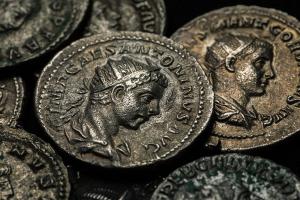
Jesus says give all these blasphemous denarii to Caesar. (Image credit: Psephizo)
One of the charges against Jesus during his trial is that he forbade payment of the tax to the empire. William R. Herzog II says it’s one of the two charges that probably were true. (The other is threatening to destroy the temple.) But the gospels give us Jesus’ famous statement that seems to endorse paying taxes: “Render to Caesar what is Caesar’s and to God what is God’s.” Ched Myers (see this earlier post) says a Judean theologian would read in Jesus’ words something different from what they seem to say. Herzog, adopting a different perspective, that of Jesus’ typical village listeners, agrees.
This is the tenth post on Herzog’s Jesus, Justice and the Reign of God. Earlier posts in the series are:
- The Historical Jesus and the Transcendent God in the Work of William Herzog
- Context Group Continues the Long History of Witnessing to Jesus
- Jesus Heals a Paralytic and Opens a Temple-Free Zone of Grace
- The Temple, Jesus, and the Little Traditions of Village Life
- A Rich Man Follows All the Old Rules. Or Does He?
- The Tradition of the Elders or the Mercy of God
- Jesus Reinterprets the Sabbath and Subverts the Social Order
- Dangerous Thoughts: Three Parables in Dissembling Villager Speak
- Personal Morality: Jesus’ Village Politics Can’t be Without It
Paying Caesar’s tax (Mark 12:13-17)
Some Pharisees and Herodians attempt to trap Jesus with a question that brings up a controversial topic: “Is it lawful to pay taxes to the Emperor?” Jesus’ answer, whether Yes or No, should get him in trouble one way or another, they think. If Yes, he will lose favor with the poor and anyone who chafes at the occupation by Roman troops. If No, his opponents will have reason to condemn him as a subversive.
Jesus’ answer, “Render to Caesar the things that are Caesar’s and to God the things that are God’s,” avoids the trap; but how exactly?
To interpreters in modern democracies these words have long seemed like a straightforward endorsement of separation of church and state. More recently scholars have doubted whether such a modern concept was even possible in Jesus’ Palestine. I don’t see how it would have endeared Jesus with the oppressed poor, who had to pay the tax, anyway.
William R. Herzog II puts Jesus controversies into their setting among first-century Palestine’s poor. He finds a hidden message that these oppressed people could find in Jesus’ “Render to Caesar … and to God….”
Dissembling
Oppressed populations worldwide develop different ways of speaking for different contexts. (See this post.) They speak one way in public and with their oppressors and another way in private and among people they trust. In private they speak the truth. In public they will say what their oppressors want to hear. They will shamelessly pretend to go along with “the flattering self-image of the elites.” (Herzog, p. 225)
But dissembling and pretending are not the whole story. For their own satisfaction or to communicate surreptitiously to like-minded friends, they will code subversive truths into innocuous-seeming sound bites. They appear to be loyal and obedient subjects who consent to the rule of the elites. Or, at least, no one can prove that they’re not. But a fellow villager, one a who has “ears to hear,” will read between the lines.
Jesus and paying the temple tax
We could assume that Jesus agrees with peasant villagers that the empire’s tax is an unjust burden. Herzog says we can do better than assume. There’s a curious incident that only Matthew’s Gospel records.
That story ends so magically and so unlike anything else in the Gospels that interpreters have regarded the whole incident as legendary. Herzog, rather, thinks that, minus the magic, it fits well into the stream of controversies into which Jesus regularly waded. Besides, “If Matthew was writing after the temple’s destruction, why would he create a story about paying the temple tax?” More likely he adopted a story from the community’s cherished Jesus tradition, Herzog says. (p. 220)
The story concerns only the temple tax, but Herzog sees broader implications.
Collectors of the temple tax came to Peter and said, ‘Does your teacher not pay the temple tax?’ He said, ‘Yes, he does.’
When he came home, Jesus spoke of it first, asking, ‘What do you think, Simon? From whom do kings of the earth take toll or tribute? From their children or from others?’ When Peter said, ‘From others,’ Jesus said to him, ‘Then the children are free.’ (Matthew 17:24-26)
The magical ending that follows has Jesus instructing Peter to cast a hook into the sea. The first fish he catches has a coin in its mouth, a shekel, enough to pay the temple tax twice. “So we do not give offense to them, take that and give it to them for you and me,” Jesus says. (Verse 27)
Herzog thinks this story fits well with Matthew’s program of presenting Jesus as a faithful Jew following Jewish practices. He also thinks that the ending doesn’t fit the actual Jesus of history. He guesses Jesus probably would not have paid the temple tax.
‘Then the children are free’
This temple tax was not a mandate of Mosaic Law but rested on “precedent and custom” and “moral suasion.” (p. 220) It was a pole tax, or head tax, exactly like the tribute to Rome that was in question in Jesus’ controversy with the Pharisees and Herodians. Paying either tax was “an acknowledgment that the body of the person being assessed was under the command and control of another.” (p. 220)
Here an economic and political issue gets involved with theology: What kind of God is Yahweh? Herzog explains:
Masked behind the [temple’s] collection of tribute is the picture of Yahweh as king, a portrait in stark contrast to the characteristic way Jesus spoke about God as ‘abba,’ or father. The kingly God, like his earthly counterparts, demanded and collected tribute, whether or not the people of the land could afford to pay it. The paternal and patronal God proclaimed by Jesus treats the people like his own kin. If God really is as Jesus proclaimed, then ‘the sons [and daughters] are free.’ (p.220; words in brackets are Herzog’s)
Would Jesus have paid the temple tax anyway, so as not to “give offense”? Here again is Herzog’s guess:
In light of Jesus’ campaign to separate the temple from the land, and in light of his claim to broker God’s forgiveness apart from the temple, it is improbable that Jesus would have paid the tribute. It was too late to consider not giving offense. (p. 221)
‘Render to Caesar what is Caesar’s and to God what is God’s’ as code
Jesus doesn’t particularly like the temple tax. Would he like the empire’s tax any better? Ched Myers parses Jesus’ famous answer thus: What belongs to God is everything; hence, what belongs to Caesar is nothing. Theologically the saying means that Jews, whom the Romans have subjugated, owe the Roman Empire nothing. While agreeing with that reasoning, I couldn’t help wondering if either Jesus’ peasant audience or his official antagonists would readily perform the same mental operation.
Herzog gets over that hurdle by noting the dissembling and coding speech that oppressed peoples use when in the presence of their oppressors. The public speech of subordinate groups always contains “a partly sanitized, ambiguous and coded version of [what the speaker really thinks].” Peasants will be on the lookout for any clue that might signal Jesus’ true intent.
In this case the clue is that Jesus goes far beyond what is necessary to answer a simple Yes/No question. He even makes a big production of it.
Taking control of the contest
This is a high-stakes encounter. The winner gains honor at the expense of the loser, and the crowd determines who won. It begins with an insincere compliment meant only to force Jesus to tell the truth. And telling this truth is treasonable. Jesus parries by showing he recognizes what his opponents are doing and refusing the compliment:
‘Teacher, we know that you are sincere and show deference to no one. You do not regard people with partiality, but teach the way of God in accordance with truth. Is it lawful to pay taxes to the emperor, or not? Should we pay them, or should we not?’ But knowing their hypocrisy, he said to them, ‘Why are you putting me to the test?’
Then Jesus takes command:
‘Bring me a denarius [the Roman coin of tribute] and let me see it.’ And they brought one.
Jesus’ opponents have to produce an object that everyone detests. The coin displays an image – blasphemy to the Jews. Jesus adds insult to injury by pretending he doesn’t know what everyone knows, forcing the officials to say it out loud:
Then he said to them, ‘Whose head is this, and whose title?’ They answered, ‘The emperor’s.’
Now the officials are firmly identified with the Roman coin in the crowd’s mind. And Jesus vanquishes his antagonists:
‘Render to Caesar what is Caesar’s and to God what is God’s.’
With his coin theatrics Jesus speaks a broader truth than the officials asked for. The only thing in the whole land that is not God’s but Caesar’s is the denarius with the picture on it. That means all the denarii in Palestine! Jesus’ crowd pleasing answer is: Don’t just pay the tax. Render to Caesar all those hated coins, those blasphemous instruments of oppression.
To whom do we belong?
The obvious question about Jesus’ “clever aphorism,” as Herzog puts it, is, What good did it do? There was no realistic chance of getting rid of all those hated coins, and poor people would still be paying the burdensome tax. Were they not “acknowledging Caesar’s claim over their bodies, after all?” Herzog answers his own question:
[It’s] one thing to pay inevitable and unavoidable tribute to Caesar as a subject, but quite another to pay the tribute as an act of resistance. (p. 232)
Lowly peasant listeners heard in Jesus’ words resistance, not accommodation or catering to Caesar. Probably Jesus’ elite challengers also guessed what was hiding behind the words, the coded message that delighted the crowd. Eventually that message led to one of the charges on which a Jewish court tried to convict Jesus – that he forbade paying the tax to Caesar. That charge, Herzog says, was pretty close to the mark.
Yet Jesus’ words themselves were not treasonous or actionable. They were simply solid Jewish theology, which any Jewish official should have known. The Jewish people belong to God alone – and him only shall they serve.
Previous Post

February 20, 2023
Personal Morality: Jesus’ Village Politics Can’t be Without It
Next Post
March 14, 2023 Holy Thursday Theology and the Scientific Quest for Jesus in History
Recent Comments
"A lot of cemeteries require the vault for fear that the weight of the earth ..."
A Catholic Burial, Bodily Resurrection, and ..."
"The most devout Catholic I have ever known - Mass every day, big financial supporter ..."
A Catholic Burial, Bodily Resurrection, and ..."
"I really enjoyed this article, thanks!"
Easter Triduum at Saint Raphael’s: Three ..."
""Higgs Boson Blues" is my favorite of his."
Nick Cave and a Rocker’s ‘Faith, ..."
Browse Our Archives
Select a Category Advent Christmas Amazon Synod Angels Being Consumed Bible Catholic Modern Creed Ecology Economics Elizabeth Johnson Eucharist Fragments and Filaments Gender and Sex Gospel of Mark Herzog Historical Jesus Liturgy Luke Opening Scriptures on Way to Emmaus Ordinary radicals Parables Pro-Life Reincarnation Rosary Sacraments science Social Justice Souls Stories of Jesus The Creed Torture and Eucharist Tracy Uncategorized War and Peace
Select a Month October 2026 June 2025 April 2025 March 2025 February 2025 January 2025 November 2024 July 2024 March 2024 December 2023 October 2023 September 2023 August 2023 May 2023 April 2023 March 2023 February 2023 January 2023 December 2022 November 2022 October 2022 September 2022 August 2022 July 2022 June 2022 April 2022 March 2022 February 2022 January 2022 December 2021 November 2021 October 2021 August 2021 July 2021 June 2021 April 2021 March 2021 February 2021 December 2020 November 2020 October 2020 August 2020 July 2020 June 2020 May 2020 April 2020 March 2020 February 2020 January 2020 December 2019 November 2019 October 2019 September 2019 August 2019 July 2019 June 2019 May 2019 April 2019 March 2019 February 2019 January 2019 December 2018 November 2018 October 2018 September 2018 August 2018 July 2018 June 2018 May 2018
Follow Us!
TAKE THE
Religious Wisdom Quiz
What happened when the Philistines captured the Ark of the Covenant?
Select your answer to see how you score.
Fire rained from heaven The sun stood still The Jordan parted Dagon's idol fell
Related posts from Lost in a One-Acre Wood

Credo: A Story of God Told with the...

Richard A. Horsley Sees Jesus in the Context...

Axios News, Inflation, Justice, and Young Workers in...
Catholic Church Repudiates the Doctrine of Discovery
TRENDING AT PATHEOS Catholic

Creation, Preservation, and Teleology in Catholic Theology
As I write this, it is very early Monday morning. Like millions...

The Parable Of The Sower And The Word...
One of Christ’s most famous parables is that of the sower who...

Rejecting Doom: Christian Hope And Human Action
Christianity is a religion of hope. We are to have hope and...

Why I Choose the Eucharist Over the Sermon
Choose the Eucharist, Not the Sermon What are we supposed to get...

5 Design Elements Found in Spiritually Rooted Homes
Putting Spirituality Into Home Decor Our homes are more than our living...

Credo: A Story of God Told with the...
About 10 years ago, I began to imagine a personal "Credo" that...
view all Catholic blogs
What Are Your Thoughts?leave a comment
Ad-Free & Subscriber Log-In Subscription Support
- About Us
- 2026 Calendar
- Videos
- Podcasts
- Library of World Religions
- Faith In Media Tracker
- Advertise With Us
- Write for Us
- Privacy Policy
- Terms of Service
- Do Not Sell My Data
- Contact Us
- Radiant Digital
- Manage Newsletter Subscriptions
- Unsubscribe From Notifications
- Sitemap
Copyright 2008-2026, Patheos. All rights reserved.
Subscription Support Ad-Free & Subscriber Log-In
Follow Patheos