
BuddhistCatholicContemplativeEvangelicalGeneral ChristianHinduJewishLatter-day SaintMuslimNew VisionsProgressive Christian
Beliefs
- Buddhist
- Catholic
- Contemplative
- Evangelical
- General Christian
- Hindu
- Jewish
- Latter-day Saint
- More Voices
- Muslim
- New Visions
- Pagan
- Progressive Christian
Topics
- Religion News
- Food and Religion
- Sports and Religion
- Religious Art
- Religious Music and Entertainment
- Religious Events
- History and Religion
- Style and Religion
- Politics and Religion
- Women in Religion
- Recreation Outdoors and Religion
- Business Finance and Religion
- Careers Workplace and Religion
- Education and Religion
- Family Parenting and Religion
- Health Fitness and Religion
- Home and Religion
- Relationships and Religion
- Technology and Religion
- Travel and Religion
Columnists
- Buddhist Columnists
- Business Finance and Religion Columnists
- Careers Workplace and Religion Columnists
- Catholic Columnists
- Contemplative Columnists
- Education and Religion Columnists
- Evangelists Columnists
- Family Parenting and Religion Columnists
- General Christian Columnists
- Health Fitness and Religion Columnists
- Hindu Columnists
- History and Religion Columnists
- Home and Religion Columnists
- Jewish Columnists
- More Voices Columnists
- Latter Day Columnists
- Muslim Columnists
- New Visions Columnists
- Nonreligious Columnists
- Pagan Columnists
- Politics and Religion Columnists
- Progressive Columnists
- Recreation Outdoors and Religion Columnists
- Relationships and Religion Columnists
- Religion News Columnists
- Religious Art Columnists
- Religious Events Columnists
- Religious Music and Entertainment Columnists
- Sports and Religion Columnists
- Style and Religion Columnists
- Technology and Religion Columnists
- Travel and Religion Columnists
- Women in Religion Columnists
Resource Library
- 2026 Calendar
- Library of World Religions
- The 100 Most Holy Places on Earth
- Patheos Answers
- Podcasts
- Videos
- Faith Leaders Database
- Anglican Episcopalian
- Bahai
- Baptist
- Buddhism
- Christianity
- Confucianism
- Eastern Orthodoxy
- Hinduism
- Holiness and Pentecostal
- ISKCON
- Islam
- Judaism
- Lutheran
- Methodist
- The Church of Jesus Christ of Latter-day Saints
- New Age
- Paganism
- Presbytarian and Reformed
- Protestantism
- Religion Behind the Scenes
- Roman Catholic
- Scientology
- Shia Islam
- Sikhism
- Sufism
- Sunni Islam
- Taoism
- Zen
- See all religions
Research Tools
 Ad-Free & Subscriber Log-In Subscription Support
Ad-Free & Subscriber Log-In Subscription Support
Follow Patheos 

- Trending:
- Forgiveness
- |
- Marriage
- |
- Consciousness
- |
- Death Penalty
- |
- Election
- |
- Halloween

- Home
- Catholic
- Jesus Reinterprets the Sabbath and Subverts the Social Order
Jesus Reinterprets the Sabbath and Subverts the Social Order
Last updated on: February 13, 2023 at 8:07 am by Jack Hartjes
Jesus Reinterprets the Sabbath and Subverts the Social Order 2023-02-13T08:07:38-06:00 Jack Hartjes
Patheos Explore the world's faith through different perspectives on religion and spirituality! Patheos has the views of the prevalent religions and spiritualities of the world.
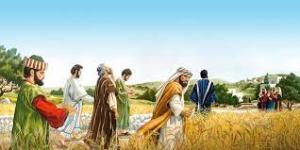
A Pharisee disapproves as Jesus’ hungry disciples shuck grain on a Sabbath morning.
Many times in the Gospels and, presumably, many times in historical reality Jesus gets in trouble with authorities over Sabbath rules. Rather, perhaps, than getting in trouble like an inattentive schoolboy, Jesus seems to jump at any chance to stir things up. That, at any rate, is the hypothesis of this post. Jesus courts controversy over the Sabbath and subverts an oppressive social order in the process.
This is the seventh post on William R. Herzog II’s Jesus, Justice and the Reign of God. Earlier posts in the series are:
- The Historical Jesus and the Transcendent God in the Work of William Herzog
- Context Group Continues the Long History of Witnessing to Jesus
- Jesus Heals a Paralytic and Opens a Temple-Free Zone of Grace
- The Temple, Jesus, and the Little Traditions of Village Life
- A Rich Man Follows All the Old Rules. Or Does He?
- The Tradition of the Elders or the Mercy of God
Incidents of Sabbath controversies that the Gospels report include shucking grain, healing a man with a withered hand, healing a bent woman, healing a man with dropsy, and an exorcism – all on the Sabbath. Whether these things actually happened in Jesus’ life is contested, but Herzog leans more than many others toward their authenticity. The first of these incidents, in which the disciples break a Sabbath rule on their way through a grain field, is the subject of this post.
Shucking grain in plain sight – a deliberate provocation? (Mark 2:23-28)
One Sabbath he was going through the grain fields; and as they made their way his disciples began to pluck heads of grain. The Pharisees said to him, “Look why are they doing what is not lawful on the Sabbath?”
And he said to them, Have you never read what David did when he and his companions were hungry and in need of food? He entered the house of God when Abiathar was high priest, and ate the bread of the Presence, which is not lawful for any but the priests to eat, and he gave some to his companions.”
Then he said to them, “The Sabbath was made for man, not man for the Sabbath. So the Son of Man is lord even of the Sabbath.
I have wondered at the disciples’ behavior in this incident, even more than at the Pharisees’. Did they forget last night that tomorrow would be the Sabbath Day? Did no one follow the normal procedure of preparing Sabbath meals in advance? Couldn’t they have gone hungry once, like law-abiding Jews? You could take this as evidence that the story never really happened and that it was the early Church illustrating a point. I concluded, however, that Jesus may have orchestrated an act of civil disobedience in plain sight of some Pharisees. If the Pharisees could see the disciples, the line of sight went both ways. The disciples knew they were being watched and did “what was unlawful on the Sabbath” anyway.
The question of historicity
Herzog also considers whether this event may have actually happened in Jesus’ life (p. 185-6). Some scholars claim that geographically the scene is impossible. Sabbath rules allowed only a half-mile walk, or 1000 steps. One interpreter wonders:
Are we to imagine [the obsessively observant Pharisees] out for a Sabbath stroll in the country, where they happen to spot the disciples just as they are plucking a few heads of grain? (This is from Arland J. Hultgren, Jesus and His Adversaries, p. 114)
Hultgren, further, claims to see a process of putting this story together in the early Church. It starts with a saying of Jesus – “The Sabbath was made for man, not man for the Sabbath.” The section on David eating the forbidden “bread of the Presence” could have arisen in early Christianity’s debates with Judaism. It would have served to justify Jesus’ daring statement and their less than rigorous Sabbath observance. Finally, someone composes the story of the episode in the grain field to give a context to Jesus’ saying.
Opposing this scenario, Herzog first clarifies the geography of Galilean village life. So as not to waste any precious land, villagers planted their fields right up to village borders. Paths led through these fields from one village to another. The Pharisees needn’t have traveled out of town at all to see the disciples approaching on some such path. If, as is entirely possible, the synagogue was just an open field where villagers met, the Pharisees needn’t even have left the synagogue.
Jesus brings up an unusual story.
The Pharisees have issued their challenge: Why are your disciples doing work on the Sabbath? Jesus must respond. He does so with a mild dig – “Have you never read” – and a story the Pharisees would not have expected. David, fleeing from murderous Saul, and his men (supposedly, but we’ll see about that later) eat some holy bread. This story has nothing at all to do with work or the Sabbath.
If the story has any relevance to Jesus’ situation, then David must have broken some rule, but what? In Jesus’ telling there was a rule breaking – David and his men ate the forbidden bread of the Presence. (Supposedly forbidden, but we’ll get to that later too.) Jesus appears to make an outrageous comparison between his hungry disciples on a Sabbath morning and Israel’s most loved king in desperate flight from Saul.
Jesus plays to the crowd
In an honor confrontation victory is a matter of winning over spectators more than getting one’s adversary to concede a theological point. (The latter was never going to happen anyway.) But stories of royal figures, or “the one percent” as we’d say today, don’t fare well among the poor. We need a closer look to see how David’s story engages the crowd of village peasants. Jesus picks up the story (from 1 Samuel 21:1-6) at a low point in a most-loved king’s career.
David is, in Herzog’s words, “a coyote figure who lives by his wits while others seek to destroy him.” (p. 188) (A Galilean villager can warm to that figure.)
David is a trickster like heroes in many popular stories. And the trickery in David’s story starts with no lesser figures than the prophet Samuel and God almighty. You see, David really is an anointed king, but Saul still has all the power. God has told Samuel to anoint a son of Jesse. God tells Samuel to let on that he’s just going to Jesse’s place to offer sacrifice. If Saul finds out the real reason, he’ll probably kill Samuel.
Some time later David is on the run from Saul. He has gotten a warning by secret sign from his best friend, who happens to be Saul’s son Jonathan. David makes his way to Nob and asks the local priest, whose name is Ahimelech, for five loaves of bread. He needs it for his men, whom he’ll be meeting shortly. To reassure the priest, who knows about Saul’s temper, he makes up a story about being on a secret mission from Saul himself.
More lies
The only bread on hand is the holy bread of the Presence. Ahimelech says David can have some as long as his men have “kept themselves from women.” David insists that they have. Conveniently, that lie is almost a truth. David doesn’t have any men so, of course, no women have touched them.
David won’t be meeting up with anyone except some Philistines in the town of Gath. There his reputation as a killer of Philistines is well known. To protect himself David, a consummate actor, pretends to be mad, foaming at the mouth in front of King Achish.
Eventually David gets his army. First his brothers and then “everyone who was in distress, and everyone who was in debt, and everyone who was discontented” gather around. (1 Samuel 22:2)
These folks, including the ones in debt, are a lot like the villagers overhearing Jesus’ argument with the Pharisees. Practically every element of this story strikes an agreeable chord with story-loving villagers in Nazareth.
Credible history?
Jesus has used a small part of one of the crowd’s often-told stories. Not so well-known or well-liked, I think, by Jesus’ big-city Pharisee adversaries. Jesus repeated David’s lie about having a posse on hand as if it’s true, and they don’t seem to have caught it. (I admit that I didn’t catch it either when I wrote about this story the first time in an earlier post.)
The Pharisees also didn’t catch Jesus in some mistakes he made. Jesus misnamed the priest of Nob. He’s Ahimelech, not Abiathar; Abiathar is Ahimelech’s son. And it wasn’t true that only priests could eat the holy bread. The men just had to keep themselves from women.
I can imagine mistakes like those creeping into the oral telling and retelling of a favorite village story. And I can see Jesus learning the story with those mistakes in it. It would be less likely to come from the pen of a Christian scribe with 1 Samuel at his fingertips. Unlike many scholars Herzog tells the story of this confrontation between Jesus and the Pharisees as if it really happened. Jesus’ mistakes, I think, add to the credibility of Herzog’s view.
A subversive story
Jesus follows the telling of his David story with a first-century Palestinian version of “Rules are made to be broken.” In Jesus’ words, “The Sabbath is made for man, not man for the Sabbath.” Since David didn’t break any Sabbath rule, Jesus is really implying, more generally: “Rules are made for people, not people for rules.”
Pharisees are among the most scrupulous of rule followers. They didn’t make the rules for the most part. That was for priests and scribes interpreting the written Torah. But Pharisees appointed themselves unofficial enforcers, or at least encouragers, of obedience to rules. This particular group may have been on a mission from Jerusalem to monitor village compliance with oral law. Villagers, of course, have their own moral code that works for poor people on the periphery of society. They exist in some tension with the center of their religion in Jerusalem.
Jesus evoked this element of tension in the villagers’ character with his story about David. Herzog, summarizing, says the Pharisees
… have forgotten that the Sabbath was God’s provision for restoring human life and renewing human community. But they have turned the Sabbath into an endless series of tasks required to maintain purity. This system turns people into the objects of their system, rather than … the subjects of God’s creative caring. (p. 189)
“So the son of man is lord even of the Sabbath.”
If God’s people are subjects, not objects, for God, then they have some authority over their own lives. That is what the concluding saying about lord of the Sabbath may point toward. But the saying is ambiguous. “Son of man” can have different meaning. The saying itself may not be from the historical Jesus. Herzog gives three meanings of “son of man” and three ways the saying fits — “remarkably well” — the controversy over the Sabbath. (p. 190)
- “Son of man” may be Jesus’ way of referring to an ordinary person. If so, then he is saying “an ordinary person can create and change the rules that govern the observance of the Sabbath.” That assumes, of course, that the person is “brokering God’s covenant mercy and love.” Perhaps that’s what the disciples were doing. This saying, then, puts disciples and village peasants on the same footing as Jerusalem officials. Villagers “can work things out in their own context.”
- “Son of man” could be a self-reference to Jesus himself in the third person. Similarly, we might say, “Yours truly.” Then “Jesus is identifying his role as God’s broker of this new way of doing things.” Probably, Jesus is doing that in any case.
- Or “son of man” may mean, in Jesus’ telling, one like me. Then “Jesus is claiming the same role for his disciples and others who follow him.”
Herzog doesn’t get any more definite than this about the historicity of Jesus’ last saying. He does favor the basic story as historical. But he doesn’t push hard on that, suggesting it’s a good candidate for further discussion. (p. 190) Regardless, the Bible story does illustrate a conflict over Jerusalem’s centralized and oppressive authority versus God’s justice. That Jesus often had such conflicts is Herzog’s argument through two books. He makes that argument well. And Jesus pushes hard for God’s justice and the needs of the village poor versus a social order that prioritizes the interests of a powerful, central elite.
Previous Post

January 20, 2023
The Tradition of the Elders or the Mercy of God
Next Post
February 3, 2023 Dangerous Thoughts: Three Parables in Dissembling Villager Speak
Recent Comments
"A lot of cemeteries require the vault for fear that the weight of the earth ..."
A Catholic Burial, Bodily Resurrection, and ..."
"The most devout Catholic I have ever known - Mass every day, big financial supporter ..."
A Catholic Burial, Bodily Resurrection, and ..."
"I really enjoyed this article, thanks!"
Easter Triduum at Saint Raphael’s: Three ..."
""Higgs Boson Blues" is my favorite of his."
Nick Cave and a Rocker’s ‘Faith, ..."
Browse Our Archives
Select a Category Advent Christmas Amazon Synod Angels Being Consumed Bible Catholic Modern Creed Ecology Economics Elizabeth Johnson Eucharist Fragments and Filaments Gender and Sex Gospel of Mark Herzog Historical Jesus Liturgy Luke Opening Scriptures on Way to Emmaus Ordinary radicals Parables Pro-Life Reincarnation Rosary Sacraments science Social Justice Souls Stories of Jesus The Creed Torture and Eucharist Tracy Uncategorized War and Peace
Select a Month October 2026 June 2025 April 2025 March 2025 February 2025 January 2025 November 2024 July 2024 March 2024 December 2023 October 2023 September 2023 August 2023 May 2023 April 2023 March 2023 February 2023 January 2023 December 2022 November 2022 October 2022 September 2022 August 2022 July 2022 June 2022 April 2022 March 2022 February 2022 January 2022 December 2021 November 2021 October 2021 August 2021 July 2021 June 2021 April 2021 March 2021 February 2021 December 2020 November 2020 October 2020 August 2020 July 2020 June 2020 May 2020 April 2020 March 2020 February 2020 January 2020 December 2019 November 2019 October 2019 September 2019 August 2019 July 2019 June 2019 May 2019 April 2019 March 2019 February 2019 January 2019 December 2018 November 2018 October 2018 September 2018 August 2018 July 2018 June 2018 May 2018
Follow Us!
TAKE THE
Religious Wisdom Quiz
What was Isaiah's most famous prophecy about the Messiah's birth?
Select your answer to see how you score.
A king will rise in Nineveh A child will lead lions A prophet like Moses A virgin will conceive
Related posts from Lost in a One-Acre Wood

Credo: A Story of God Told with the...

Richard A. Horsley Sees Jesus in the Context...

Axios News, Inflation, Justice, and Young Workers in...
Catholic Church Repudiates the Doctrine of Discovery
TRENDING AT PATHEOS Catholic

The Parable Of The Sower And The Word...
One of Christ’s most famous parables is that of the sower who...

Rejecting Doom: Christian Hope And Human Action
Christianity is a religion of hope. We are to have hope and...

Why I Choose the Eucharist Over the Sermon
Choose the Eucharist, Not the Sermon What are we supposed to get...

5 Design Elements Found in Spiritually Rooted Homes
Putting Spirituality Into Home Decor Our homes are more than our living...

Credo: A Story of God Told with the...
About 10 years ago, I began to imagine a personal "Credo" that...

The Anatomy of Divine Revelation in Catholic Thought
The claim that God has made Himself known to human beings is...
view all Catholic blogs
What Are Your Thoughts?leave a comment
Ad-Free & Subscriber Log-In Subscription Support
- About Us
- 2026 Calendar
- Videos
- Podcasts
- Library of World Religions
- Faith In Media Tracker
- Advertise With Us
- Write for Us
- Privacy Policy
- Terms of Service
- Do Not Sell My Data
- Contact Us
- Radiant Digital
- Manage Newsletter Subscriptions
- Unsubscribe From Notifications
- Sitemap
Copyright 2008-2026, Patheos. All rights reserved.
Subscription Support Ad-Free & Subscriber Log-In
Follow Patheos