
BuddhistCatholicContemplativeEvangelicalGeneral ChristianHinduJewishLatter-day SaintMuslimNew VisionsProgressive Christian
Beliefs
- Buddhist
- Catholic
- Contemplative
- Evangelical
- General Christian
- Hindu
- Jewish
- Latter-day Saint
- More Voices
- Muslim
- New Visions
- Pagan
- Progressive Christian
Topics
- Religion News
- Food and Religion
- Sports and Religion
- Religious Art
- Religious Music and Entertainment
- Religious Events
- History and Religion
- Style and Religion
- Politics and Religion
- Women in Religion
- Recreation Outdoors and Religion
- Business Finance and Religion
- Careers Workplace and Religion
- Education and Religion
- Family Parenting and Religion
- Health Fitness and Religion
- Home and Religion
- Relationships and Religion
- Technology and Religion
- Travel and Religion
Columnists
- Buddhist Columnists
- Business Finance and Religion Columnists
- Careers Workplace and Religion Columnists
- Catholic Columnists
- Contemplative Columnists
- Education and Religion Columnists
- Evangelists Columnists
- Family Parenting and Religion Columnists
- General Christian Columnists
- Health Fitness and Religion Columnists
- Hindu Columnists
- History and Religion Columnists
- Home and Religion Columnists
- Jewish Columnists
- More Voices Columnists
- Latter Day Columnists
- Muslim Columnists
- New Visions Columnists
- Nonreligious Columnists
- Pagan Columnists
- Politics and Religion Columnists
- Progressive Columnists
- Recreation Outdoors and Religion Columnists
- Relationships and Religion Columnists
- Religion News Columnists
- Religious Art Columnists
- Religious Events Columnists
- Religious Music and Entertainment Columnists
- Sports and Religion Columnists
- Style and Religion Columnists
- Technology and Religion Columnists
- Travel and Religion Columnists
- Women in Religion Columnists
Resource Library
- 2026 Calendar
- Library of World Religions
- The 100 Most Holy Places on Earth
- Patheos Answers
- Podcasts
- Videos
- Faith Leaders Database
- Anglican Episcopalian
- Bahai
- Baptist
- Buddhism
- Christianity
- Confucianism
- Eastern Orthodoxy
- Hinduism
- Holiness and Pentecostal
- ISKCON
- Islam
- Judaism
- Lutheran
- Methodist
- The Church of Jesus Christ of Latter-day Saints
- New Age
- Paganism
- Presbytarian and Reformed
- Protestantism
- Religion Behind the Scenes
- Roman Catholic
- Scientology
- Shia Islam
- Sikhism
- Sufism
- Sunni Islam
- Taoism
- Zen
- See all religions
Research Tools
 Ad-Free & Subscriber Log-In Subscription Support
Ad-Free & Subscriber Log-In Subscription Support
Follow Patheos 

- Trending:
- Forgiveness
- |
- Marriage
- |
- Consciousness
- |
- Death Penalty
- |
- Election
- |
- Halloween

- Home
- Catholic
- Jesus Heals a Paralytic and Opens a Temple-Free Zone of Grace
Jesus Heals a Paralytic and Opens a Temple-Free Zone of Grace
Last updated on: February 13, 2023 at 8:09 am by Jack Hartjes
Jesus Heals a Paralytic and Opens a Temple-Free Zone of Grace 2023-02-13T08:09:04-06:00 Jack Hartjes
Patheos Explore the world's faith through different perspectives on religion and spirituality! Patheos has the views of the prevalent religions and spiritualities of the world.
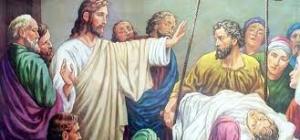
Could the crowd at Capernaum have suspected that Jesus’ first words to the paralytic would be about sins forgiven. (Image credit: Flickr/pcstratman)
The Healing of the Paralytic (Gospel of Mark 2:1-12) is Jesus’ challenge to the oppressive ways of the temple and its officials.
This is the third in a series on William R. Herzog II’s Jesus, Justice, and the Reign of God. It considers the first half of Chapter 6, “Something Greater than the Temple is Here.” (Pages 111-132) Previous posts in this series are:
- The Historical Jesus and the Transcendent God in the Work of William Herzog
- Context Groups Continues the Long History of Witnessing to Jesus
In the ancient Mediterranean world temples were as much political and economic as religious institutions. The temple in Jerusalem was no exception to that rule, and it was as powerful as the political and economic elite could make it. The temple held a prominent place among institutions that oppressed the poor in Palestine. For Jesus the temple was an obstacle to God’s reign.
A previous series of posts (concluding here) showed how Jesus’ teaching in parables exposed the ways oppression operated in first-century Palestine. In the current series it’s Jesus in action that exposes and opposes oppression. In the healing of the paralytic Jesus does more than help a poor invalid. He demonstrates God at work in a space not controlled by the temple and its officials.
The Healing of the Paralytic: the story in two parts
The story of the healing of the paralytic has two parts, and scholars have argued about how and whether they fit together. There is a healing and an argument with scribes about forgiving sins. In the following summary I separated the two parts. The argument (part 2) interrupts the healing story (parts 1 and 3).
- The paralytic comes to Jesus. Jesus is at home in Capernaum, and the crowd that gathers is spilling out the door. Friends of a paralytic dig a hole through the roof and lower him down in front of Jesus. Jesus sees their faith. (Mark 2: 1-5a)
- Forgiveness of sins and the ensuing argument. Jesus says, “Son, your sins are forgiven.” Some scribes think it’s blasphemy: “Who can forgive sins but God alone?” Jesus replies, “Which is easier, to say to the paralytic, ‘Your sins are forgiven,’ or to say, ‘Stand up and take your mat and walk’? But so that you may know that the Son of Man has authority on earth to forgive sins” –
- The healing. … he said to the paralytic – “I say to you stand up, take your mat and go to your home.” He stands up, takes his mat and goes out, and all are amazed and glorify God.
A common analysis and a response
A common opinion among scholars is that parts 1 and 3, the healing story, came first. Its vivid details, like the tearing through the roof, convince some that it’s an actual memory, not a made up preacher’s tale. The argument over forgiving sins may have been made up, although it likely illustrated controversies Jesus actually had. Later between early Church and Synagogue a controversy over the Christian practice of forgiving sins also arose. In defense of Church practice, Mark spliced an argument between Jesus and scribes into a previously existing healing story.
There is evidence to support this view. The argument seems to break in unexpectedly. Just where you would expect Jesus to pronounce words to heal the man’s paralysis, he says instead, “Your sins are forgiven.” The argument follows. Then an awkward phrase, “he said to the paralytic” gets the story back to the healing. Finally “all” are amazed and glorify God. That “all” makes it look like the contrarious scribes have suddenly disappeared. Or they were never there in the first place.
Not everyone agrees with this analysis. The seemingly awkward phrase “he said to the paralytic” resembles another parenthetical insertion into a narrative by the Gospel writer Mark. (Mark 13:14 – “let the reader understand”) Maybe for Mark and his readers it’s not so awkward. Mark says “all” were amazed and glorified God, but that (in my opinion) could be the way Mark typically ends a miracle story. The scribes may have been there, but Mark just ignores them.
A bigger issue is the shift from the expectation of bodily healing to sins forgiven. Does that accord or conflict with what a “crowd” following Jesus would expect? And is there a likely setting in Jesus’ life and work for an argument about sins being forgiven?
The story’s (possible) setting in the world of Jesus: healing illness vs. curing disease
There’s a difference between curing and healing that we generally don’t recognize. We cure a bodily disease. Healing is broader. It’s for the whole person, body, soul, spirit, and notably, in first-century Palestine, the person’s place in society.
The crowd surrounding Jesus knew that the paralytic was sorely in need of healing in its broad sense. That included restoration as a respectable member of society. As a paralytic unable to work, he could not pay the temple tithe. The scribes’ oral interpretation of the Law in the Scriptures made tithing a requirement of purity. That put the paralytic, along with most peasants and laborers in Palestine, into the class of sinners. To be poor was about the same as being a sinner.
The paralyzed man was doubly cursed. Besides being poor, he was impaired in body. In the dominant view only “whole” bodies were ritually pure. And only ritually pure Jews were allowed in the temple. Even if he had the money to pay off his religious debt, his impaired body would have kept him out of the temple.
This common situation may have been uppermost in the minds of the crowd following Jesus. Many of them would have been in the same despised condition as the paralytic. It would not be a big surprise to them if Jesus addressed this issue first, saying “Your sins (in this case your debts) are forgiven.”
The setting again: the conflict with the temple
Herzog takes several pages to identify a setting in Jesus’ life for a controversy over forgiving sins. You might wonder why he had to take so much trouble. The scribes were on solid ground theologically when they said only God could forgive sins. If Jesus claimed to be able to forgive sins, then controversy and the charge of blasphemy would easily follow. Even a miracle doesn’t help Jesus because, as we see later in Mark’s Gospel, scribes could give the devil credit for that.
A closer look shows that Jesus is not pretending to be God or claiming to act like God. His words are “Son, your sins are forgiven.” The action is God’s, not Jesus’. In short, he is only doing what the temple does all the time – announcing God’s forgiveness. But the scribes get so upset that they wrongly accuse of him of blasphemy. What was the real issue for those scribes?
Scribes were among the small group of literate Palestinians. Among their jobs was the keeping of records, like who owed what to whom, including to the Temple. Their interests would have coincided with the temple officials and other creditors for whom they kept records. The scribes saw in Jesus’ action a challenge to the temple and their own status.
Patrons and clients
A patron-client system facilitated much of the business of first-century Palestine. Herzog describes:
Patrons were wealthy aristocrats who provided economic benefits to the poor in return for the services they could render…. But, in addition to the clientage of the poor, patron-client networks included everyone…. [T]he wealthiest and strongest offered patronage to less wealthy aristocrats…. The poor seek patronage to ensure their survival, and the rich seek clients to enhance their social prestige and power. (p. 127)
In an analogous way Yahweh was the patron of the entire Jewish people. But, as in human relationships, you didn’t go to the top boss to solve your problem. You went through intermediaries, called brokers. Temple priests claimed to be the sole brokers of Yahweh’s favors. You had to go through the temple for assurance of fertile lands, timely rains, etc. Of course, that’s exactly what a poor peasant in debt to the temple couldn’t do. You had to pay the temple to get God’s favor, but without God’s favor, i.e. an unusually bountiful harvest, you didn’t have money too spare for the temple. With all the other fees and rents and taxes that the elite exacted, it was a no-win situation for the poor. And the reigning ideology blamed the poor person and his impure state rather than the system that kept him poor.
Jesus declares God’s forgiveness free of charge and independent of the temple. This is not just a matter of sins in the abstract or personal sins that scribes could easily ignore. Jesus is stepping into dangerous territory. It’s too close to the wide-ranging – and widely ignored – debt forgiveness of the Scripture’s Jubilee and Sabbatical years. The finances and the power of the temple and of anyone whose interests align with the temple are at stake.
Jesus and the temple
In Jesus’ theology grace goes ahead of the temple. Certainly ahead, at least, of the current temple establishment with its high priest and regular priests, scribes, and their interpretation of the Scriptures. In Jesus’ theology God’s grace is free.
What if the temple establishment were to undergo reform, even a reform to Jesus’ liking? Such reform would lift Jesus preferred Scriptures, the prophetic compassion for the poor, above purity concerns. Would temple reform be enough for Jesus? Or was the charge against Jesus at his trial—that he threatened to destroy the temple—correct.
In Mark’s Gospel Jesus predicts a destruction of the temple so complete that not one stone is standing on another. Was that just a prediction or more like a program or, perhaps, hopeful thinking on Jesus’ part?
In Capernaum, where the healing of the paralytic takes place, Jesus is far from the temple. He will eventually make his way to Jerusalem and there engage in a kind of civil disobedience in the temple. The meaning of that act will be the subject of the next post in this series.
Previous Post

November 29, 2022
Context Group Continues the Long History of Witnessing to Jesus
Next Post
December 20, 2022 The Temple, Jesus, and the Little Traditions of Village Life
Browse Our Archives
Select a Category Advent Christmas Amazon Synod Angels Being Consumed Bible Catholic Modern Creed Ecology Economics Elizabeth Johnson Eucharist Fragments and Filaments Gender and Sex Gospel of Mark Herzog Historical Jesus Liturgy Luke Opening Scriptures on Way to Emmaus Ordinary radicals Parables Pro-Life Reincarnation Rosary Sacraments science Social Justice Souls Stories of Jesus The Creed Torture and Eucharist Tracy Uncategorized War and Peace
Select a Month October 2026 June 2025 April 2025 March 2025 February 2025 January 2025 November 2024 July 2024 March 2024 December 2023 October 2023 September 2023 August 2023 May 2023 April 2023 March 2023 February 2023 January 2023 December 2022 November 2022 October 2022 September 2022 August 2022 July 2022 June 2022 April 2022 March 2022 February 2022 January 2022 December 2021 November 2021 October 2021 August 2021 July 2021 June 2021 April 2021 March 2021 February 2021 December 2020 November 2020 October 2020 August 2020 July 2020 June 2020 May 2020 April 2020 March 2020 February 2020 January 2020 December 2019 November 2019 October 2019 September 2019 August 2019 July 2019 June 2019 May 2019 April 2019 March 2019 February 2019 January 2019 December 2018 November 2018 October 2018 September 2018 August 2018 July 2018 June 2018 May 2018
Follow Us!
TAKE THE
Religious Wisdom Quiz
I am a period of seven years times seven, followed by a year of liberty and restoration. What am I?
Select your answer to see how you score.
A year of rest The Year of Jubilee The Sabbath year A holy year
Related posts from Lost in a One-Acre Wood

Credo: A Story of God Told with the...

Richard A. Horsley Sees Jesus in the Context...

Axios News, Inflation, Justice, and Young Workers in...
Catholic Church Repudiates the Doctrine of Discovery
TRENDING AT PATHEOS Catholic

Creation, Preservation, and Teleology in Catholic Theology
As I write this, it is very early Monday morning. Like millions...

The Parable Of The Sower And The Word...
One of Christ’s most famous parables is that of the sower who...

Rejecting Doom: Christian Hope And Human Action
Christianity is a religion of hope. We are to have hope and...

Why I Choose the Eucharist Over the Sermon
Choose the Eucharist, Not the Sermon What are we supposed to get...

5 Design Elements Found in Spiritually Rooted Homes
Putting Spirituality Into Home Decor Our homes are more than our living...

Credo: A Story of God Told with the...
About 10 years ago, I began to imagine a personal "Credo" that...
view all Catholic blogs
Ad-Free & Subscriber Log-In Subscription Support
- About Us
- 2026 Calendar
- Videos
- Podcasts
- Library of World Religions
- Faith In Media Tracker
- Advertise With Us
- Write for Us
- Privacy Policy
- Terms of Service
- Do Not Sell My Data
- Contact Us
- Radiant Digital
- Manage Newsletter Subscriptions
- Unsubscribe From Notifications
- Sitemap
Copyright 2008-2026, Patheos. All rights reserved.
Subscription Support Ad-Free & Subscriber Log-In
Follow Patheos