
BuddhistCatholicContemplativeEvangelicalGeneral ChristianHinduJewishLatter-day SaintMuslimNew VisionsProgressive Christian
Beliefs
- Buddhist
- Catholic
- Contemplative
- Evangelical
- General Christian
- Hindu
- Jewish
- Latter-day Saint
- More Voices
- Muslim
- New Visions
- Pagan
- Progressive Christian
Topics
- Religion News
- Food and Religion
- Sports and Religion
- Religious Art
- Religious Music and Entertainment
- Religious Events
- History and Religion
- Style and Religion
- Politics and Religion
- Women in Religion
- Recreation Outdoors and Religion
- Business Finance and Religion
- Careers Workplace and Religion
- Education and Religion
- Family Parenting and Religion
- Health Fitness and Religion
- Home and Religion
- Relationships and Religion
- Technology and Religion
- Travel and Religion
Columnists
- Buddhist Columnists
- Business Finance and Religion Columnists
- Careers Workplace and Religion Columnists
- Catholic Columnists
- Contemplative Columnists
- Education and Religion Columnists
- Evangelists Columnists
- Family Parenting and Religion Columnists
- General Christian Columnists
- Health Fitness and Religion Columnists
- Hindu Columnists
- History and Religion Columnists
- Home and Religion Columnists
- Jewish Columnists
- More Voices Columnists
- Latter Day Columnists
- Muslim Columnists
- New Visions Columnists
- Nonreligious Columnists
- Pagan Columnists
- Politics and Religion Columnists
- Progressive Columnists
- Recreation Outdoors and Religion Columnists
- Relationships and Religion Columnists
- Religion News Columnists
- Religious Art Columnists
- Religious Events Columnists
- Religious Music and Entertainment Columnists
- Sports and Religion Columnists
- Style and Religion Columnists
- Technology and Religion Columnists
- Travel and Religion Columnists
- Women in Religion Columnists
Resource Library
- 2026 Calendar
- Library of World Religions
- The 100 Most Holy Places on Earth
- Patheos Answers
- Podcasts
- Videos
- Faith Leaders Database
- Anglican Episcopalian
- Bahai
- Baptist
- Buddhism
- Christianity
- Confucianism
- Eastern Orthodoxy
- Hinduism
- Holiness and Pentecostal
- ISKCON
- Islam
- Judaism
- Lutheran
- Methodist
- The Church of Jesus Christ of Latter-day Saints
- New Age
- Paganism
- Presbytarian and Reformed
- Protestantism
- Religion Behind the Scenes
- Roman Catholic
- Scientology
- Shia Islam
- Sikhism
- Sufism
- Sunni Islam
- Taoism
- Zen
- See all religions
Research Tools
 Ad-Free & Subscriber Log-In Subscription Support
Follow Patheos 

- Trending:
- Advent
- |
- Forgiveness
- |
- Thanksgiving
- |
- Election
- |
- Seasonal Holidays
- |
- Marriage

- Home
- Catholic
- Politics and Religion
- The Parable of the Wicked Tenants and the Wickeder Landlord
The Parable of the Wicked Tenants and the Wickeder Landlord
Last updated on: February 13, 2023 at 8:11 am by Jack Hartjes
The Parable of the Wicked Tenants and the Wickeder Landlord 2023-02-13T08:11:49-06:00 Jack Hartjes
Patheos Explore the world's faith through different perspectives on religion and spirituality! Patheos has the views of the prevalent religions and spiritualities of the world.
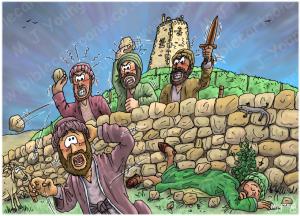
William Herzog thinks the Parable of the Wicked Tenants would have reminded Jesus’ listeners of the peasant revolts that erupted sporadically in Palestine. (Image credit: Martin Young Bible Cartoons)
Sometimes in real life it’s hard to tell the good guys from the bad guys. It can be the same in a parable that Jesus tells. The Parable of the Wicked Tenants may be a story of the bad guys and the really bad guys – just like in real life. In a series of posts I’m thinking about Parables as Subversive Speech, following William Herzog’s book by that title. (See note below.) Previous posts in the series:
- William Herzog Reads Jesus’ Parables, Brings them Down to Earth
- Paulo Freire, the “Pedagogue of the Oppressed”: Is This a Good Fit for Jesus?
- Laborers in the Vineyard: A Reading that Doesn’t Blame the Victims
Herzog takes a parable out of its setting in the Gospel and places it in the world where and when Jesus lived. A big part of Herzog’s interpretive technique is to imagine the response of Jesus’ listeners. Jesus knew how his listeners thought; he was one of them. Herzog thinks that Jesus’ stories would have gotten the oppressed poor of Palestine to think for themselves about their situation and lowly status. If he’s right, then that must be what Jesus intended. At the end of the previous post in this series, I considered how the Parable of the Laborers in the Vineyard seems well-designed for that result. A provocative question at the end of the wicked tenants’ story could have accomplished the same.
Are the parables allegories?
The history of parable interpretation does not often see Jesus’ listeners as thinking for themselves. Commonly one sees a parable as allegorical, a story where many details stand for something other than what they literally are. For instance, seed sown becomes the word of God preached. Different soils become different dispositions of the hearers of the word. This style of parable interpretation begins as early as the Gospel writers themselves. It gives a story an obvious meaning, if not to the crowd that first heard the story, then at least to a Gospel reader. Once you get the referents of the story details, you know exactly what to think. But was that Jesus’ style? Or was allegorizing something the Gospel writers or their sources added to address the needs of their communities? (Such use of history was common in the ancient world and not unknown today in the literary genre we call historical fiction. I imagine God is OK with the presence of historical fiction in his book.)
I have to say that the story of the Wicked Tenants is one that easily turn into allegory. That, in fact, is what we see in our first written record of the story in Mark’s Gospel.
The story allegorically interpreted
A man plants a vineyard and leases it to tenant farmers. At harvest time he sends a series of servants to collect his share of the produce. Each servant in turn gets rough treatment from the tenants but none of the landlord’s share of the crop. Some servants they even kill. At last the owner of the vineyard sends his son, thinking they will surely respect him. Far from respecting, the tenants kill the “beloved son” and imagine that now they will inherit the vineyard.
Jesus has been speaking to or, at least, in the hearing of priests, scribes and elders. He had just embarrassed them in front of a crowd of common people. Now he ends a parable with a quote from Scripture: “The stone that the builders rejected has become the cornerstone.” The religious leaders realize that he has told the parable against them. They are the wicked tenants assigned to take care of a “vineyard” that God planted. In Jewish Scriptures a vineyard often represents the people of Israel. They have failed to take proper care of God’s people in spite of the warnings of many prophets – the servants that the landlord sends again and again. They even contrived to turn their stewardship of God’s people into gain for themselves. Written about 40 years after the event, Mark’s story frames these religious leaders as the ones who killed God’s “beloved Son.”
Jesus concludes the parable with the logical response of the landlord: He will “put the tenants to death and give the vineyard to others.” The others, of course, in Mark’s reckoning, represent a new community, gathering in Mark’s time around the memory of Jesus. In this allegorical reading, Jesus is the cornerstone that the Jewish leaders rejected.
Why so many servants?
Most scholars, though not all, think Jesus didn’t tell allegories. His style was a simple story with one point that didn’t rely on all sorts of allegorical connections. Unfortunately, that one point has been a point of disagreement among interpreters. Herzog thinks the problem is they’re looking for a message outside of the story itself. Perhaps the stories are about what they say they are about, namely, life among rich and poor, powerful and powerless, in a complex agricultural society.
Applying the story to the situation of a Christian community that was becoming separate from the majority of jews may have been Mark’s idea. If so, it would have been important to find support for the new Christian way in Israel’s Scriptures. Jesus found the prophets especially close to his thinking. They often found much to criticize about Israel’s and Judah’s leaders. And there were lots of prophets.
Wanting to bring prophets into his version of Jesus’ story, Mark might have wanted more than three plus Jesus. In the story one servant is beaten and sent away empty. A second is “beat over the head and treated shamefully.” A third is killed. And then we have
So, too, many others; some they beat, others they killed. (Chapter 12, Verse 5b)
That second half of Verse 5 is a literary problem. It spoils the story-telling momentum going from a beating to a beating plus shameful treatment to a murder and, finally, to a murder of a beloved son. Whereas in stories you expect to find threes, this adds an awkward fourth item to the list of pre-Jesus “prophets.” Jesus is a better storyteller than that.
Slicing and dicing the parable
Herzog joins a number of scholars in proposing that Verse 5b was not in the parable as Jesus told it. That opens the possibility that the servants may originally have been just servants and not stand-ins for prophets. A simple problem with identifying the servants with prophets is that the prophets of Israel generally didn’t get killed. Likewise, I think, the “beloved son” may have been just a son, not a figure representing Jesus. Mark could have added “beloved.” Twice in Mark’s Gospel Jesus is called God’s “beloved Son.” The last outrageous murder by the tenants, of course, brings to mind Jesus’ own death by crucifixion. Mark’s community knew how Jesus died, but Jesus may not have been thinking that far ahead.
Another issue for Bible interpreters is where Jesus’ story probably ended. Herzog thinks Jesus stopped in the middle of Verse 9 in our Bibles. We have just heard about the tenants killing the son and throwing him out of the vineyard. Then Jesus asks rhetorically:
What then will the owner of the vineyard do? (Verse 9a)
Mark has Jesus continue and give the answer to his own question:
He will come, put the tenants to death, and give the vineyard to others. (Verse 9b)
I think I know why Herzog slices this half verse out of the parable. If Jesus wanted to get his listeners thinking for themselves, as Herzog suggests, he would not have answered his own question. He would have sat back and watched the discussion and, likely, arguments that followed. Some of these debaters likely had jobs similar to the vineyard tenders. They’d have plenty to say, including about their boss. But that points us toward Herzog’s nontraditional interpretation of the Parable of the Wicked Tenants. The boss won’t represent God. He isn’t even a good person.
The Parable of the Wicked Tenants as Jesus may have told it (Mark 12:1-5a, 6-9a)
This telling omits Verse 5b and the word “beloved.”
A man planted a vineyard, put a hedge around it, dug a wine press, and built a tower. Then he leased it to tenant farmers and left on a journey.
At the proper time he sent a servant to the tenants to obtain from them some of the produce of the vineyard. But they seized him, beat him and sent him away empty. Again he sent them another servant. And that one they beat over the head and treated shamefully. He sent yet another whom they killed.…
He had one other to send, a … son. He sent him to them last of all, thinking, ‘They will respect my son.’ But those tenants said to one another, ‘This is the heir. Come, let us kill him, and the inheritance will be ours.’ So they seized him and killed him and threw him out of the vineyard.
What, then, will the owner of the vineyard do [to those wicked tenants]?
The wicked tenants in a spiral of violence
Herzog sympathizes with the “wicked” tenants. His title for Chapter Six in Parables as Subversive Speech is “Peasant Revolt and the Spiral of Violence.” There are three violent scenes in the parable. In the middle the tenants treat the landlord’s messengers violently. At the end there’s the violent reprisal by the landlord. But the story also begins with a kind of violence, not immediately visible to us:
A man planted a vineyard, put a hedge around it, dug a wine press, and built a tower.
Jesus practically spells it out with all these details. The man is rich, and he’s going to make more money with a luxury crop on a field he recently acquired. To Jesus’ listeners this gain by a rich man means loss for a poor peasant. For generations untold his family has eked out a precarious existence on this piece of land. Now, because of a debt he can’t pay, probably because of bad weather and a poor crop, he has lost his family’s patrimony. Before he was a poor subsistence farmer. Now as just one of many laborers on another person’s land, he’s lucky if he can support his family at all. The violence he experiences is the violence of an economic system that extracts as much as it can from the poor for the benefit of the rich.
Jesus’ audience knows the story all too well. We might be surprised when the workers engage in violence, but they’re not surprised. The picture is one of peasant revolt against a system that crushes them.
But the revolt never amounts to a revolution. Peasants don’t have that kind of power. What will the owner of the vineyard do? The question answers itself. Peasants have revolted before only to be put down mercilessly by the powers that be.
What is Jesus trying to do?
Mark says Jesus was aiming the parable at some chief priests, scribes, and elders, who were within earshot. And they knew it. They didn’t like being cast as the wicked tenants, but they could do nothing because of the crowd.
But maybe Jesus’ tenants are just tenants. Or maybe Jesus intended not religious leaders but the poor people listening to identify with the tenants in the story. After all, it’s only we who call the tenants wicked. (Matthew, in his version of the parable, styles them “wretched” at one point – which is about the same as wicked.)
Interestingly, Jesus doesn’t mention the first violence of the economic system; it’s understood. He skirts over the last violence of the landowner’s revenge with just a question, whose answer also goes without saying. “What, then, will the owner of the vineyard do?” But he drags out over four mini scenes the middle violence of the vine tenders. This is the violence that, at times of direst straits, becomes a very real option for poor people in Palestine.
Jesus’ parable, then, names the stressful conditions weighing down on some of his favorite people and the tempting violent response. With a mere question he brings to mind what deep down everybody knows: violence is worse than useless.
Does that mean the poor of Palestine should just accept their lot in this life and wait for something better in the next? I suppose the conversation that follows the parable could include that thought, but probably much more than that.
The wicked tenants’ story is the second of five parables that Herzog says “codify” the life of Palestine’s poor not as fate but as unjust oppression. After those five, in Herzog’s book, come another four that codify resistance and the power that poor people actually have and wield.
Note: I’m working with an online version of Herzog’s book. That has made it impossible to give citations with page numbers.
Politics and Religion
Previous Post

October 2, 2022
Laborers in the Vineyard: A Reading that Doesn’t Blame the Victims
Next Post
October 11, 2022 The Rich Man and Lazarus, or an Oppressor who Won’t be Taught
Browse Our Archives
Select a Category Advent Christmas Amazon Synod Angels Being Consumed Bible Catholic Modern Creed Ecology Economics Elizabeth Johnson Eucharist Fragments and Filaments Gender and Sex Gospel of Mark Herzog Historical Jesus Liturgy Luke Opening Scriptures on Way to Emmaus Ordinary radicals Parables Pro-Life Reincarnation Rosary Sacraments science Social Justice Souls Stories of Jesus The Creed Torture and Eucharist Tracy Uncategorized War and Peace
Select a Month November 2026 October 2026 June 2025 April 2025 March 2025 February 2025 January 2025 November 2024 July 2024 March 2024 December 2023 October 2023 September 2023 August 2023 May 2023 April 2023 March 2023 February 2023 January 2023 December 2022 November 2022 October 2022 September 2022 August 2022 July 2022 June 2022 April 2022 March 2022 February 2022 January 2022 December 2021 November 2021 October 2021 August 2021 July 2021 June 2021 April 2021 March 2021 February 2021 December 2020 November 2020 October 2020 August 2020 July 2020 June 2020 May 2020 April 2020 March 2020 February 2020 January 2020 December 2019 November 2019 October 2019 September 2019 August 2019 July 2019 June 2019 May 2019 April 2019 March 2019 February 2019 January 2019 December 2018 November 2018 October 2018 September 2018 August 2018 July 2018 June 2018 May 2018
Follow Us!
TAKE THE
Religious Wisdom Quiz
Who saw a vision of a flying scroll with curses written on it?
Select your answer to see how you score.
Zechariah Ezekiel Daniel Micah
Related posts from Lost in a One-Acre Wood
Hope for the World: Thoughts on ‘Credo: A...
Credo: A Story of God Told with the...

Richard A. Horsley Sees Jesus in the Context...

Axios News, Inflation, Justice, and Young Workers in...
TRENDING AT PATHEOS Catholic

The Kingdom Of God In Ordinary Life And...
The kingdom of God is all around us; it is in us...

How Discretion Guides Us Away From Extremes
Prudence is an important virtue for all of us. While we should...

If Baptism Washes Away Sin, Why Do Catholics...
The seven sacraments stand as the foundation of Catholic ecclesial life. The...

The Power of Setting a Good Example
Remember last August when the Chicago White Sox hosted a "Pope Hat...

A Catholic Critique of Biblical Unitarianism
If the statistics are to be believed, Unitarianism is rising worldwide. Although...

How Grandma Tourism Helps Grandparents Live Their Vocation
Grandma, The New Travel Influencer What started as a nostalgia-inspired social media...
view all Catholic blogs
Ad-Free & Subscriber Log-In Subscription Support
- About Us
- 2026 Calendar
- Videos
- Podcasts
- Library of World Religions
- Faith In Media Tracker
- Advertise With Us
- Write for Us
- Privacy Policy
- Terms of Service
- Do Not Sell My Data
- Contact Us
- Radiant Digital
- Manage Newsletter Subscriptions
- Unsubscribe From Notifications
- Sitemap
Copyright 2008-2026, Patheos, part of the Radiant Digital network of media brands. All rights reserved.
Subscription Support Ad-Free & Subscriber Log-In
Follow Patheos