
BuddhistCatholicContemplativeEvangelicalGeneral ChristianHinduJewishLatter-day SaintMuslimNew VisionsProgressive Christian
Beliefs
- Buddhist
- Catholic
- Contemplative
- Evangelical
- General Christian
- Hindu
- Jewish
- Latter-day Saint
- More Voices
- Muslim
- New Visions
- Pagan
- Progressive Christian
Topics
- Religion News
- Food and Religion
- Sports and Religion
- Religious Art
- Religious Music and Entertainment
- Religious Events
- History and Religion
- Style and Religion
- Politics and Religion
- Women in Religion
- Recreation Outdoors and Religion
- Business Finance and Religion
- Careers Workplace and Religion
- Education and Religion
- Family Parenting and Religion
- Health Fitness and Religion
- Home and Religion
- Relationships and Religion
- Technology and Religion
- Travel and Religion
Columnists
- Buddhist Columnists
- Business Finance and Religion Columnists
- Careers Workplace and Religion Columnists
- Catholic Columnists
- Contemplative Columnists
- Education and Religion Columnists
- Evangelists Columnists
- Family Parenting and Religion Columnists
- General Christian Columnists
- Health Fitness and Religion Columnists
- Hindu Columnists
- History and Religion Columnists
- Home and Religion Columnists
- Jewish Columnists
- More Voices Columnists
- Latter Day Columnists
- Muslim Columnists
- New Visions Columnists
- Nonreligious Columnists
- Pagan Columnists
- Politics and Religion Columnists
- Progressive Columnists
- Recreation Outdoors and Religion Columnists
- Relationships and Religion Columnists
- Religion News Columnists
- Religious Art Columnists
- Religious Events Columnists
- Religious Music and Entertainment Columnists
- Sports and Religion Columnists
- Style and Religion Columnists
- Technology and Religion Columnists
- Travel and Religion Columnists
- Women in Religion Columnists
Resource Library
- 2026 Calendar
- Library of World Religions
- The 100 Most Holy Places on Earth
- Patheos Answers
- Podcasts
- Videos
- Faith Leaders Database
- Anglican Episcopalian
- Bahai
- Baptist
- Buddhism
- Christianity
- Confucianism
- Eastern Orthodoxy
- Hinduism
- Holiness and Pentecostal
- ISKCON
- Islam
- Judaism
- Lutheran
- Methodist
- The Church of Jesus Christ of Latter-day Saints
- New Age
- Paganism
- Presbytarian and Reformed
- Protestantism
- Religion Behind the Scenes
- Roman Catholic
- Scientology
- Shia Islam
- Sikhism
- Sufism
- Sunni Islam
- Taoism
- Zen
- See all religions
Research Tools
 Ad-Free & Subscriber Log-In Subscription Support
Ad-Free & Subscriber Log-In Subscription Support
Follow Patheos 

- Trending:
- Forgiveness
- |
- Marriage
- |
- Consciousness
- |
- Death Penalty
- |
- Election
- |
- Halloween

- Home
- Catholic
- Human Composting: California Bishops Say ‘No,’ but Why Not?
Human Composting: California Bishops Say ‘No,’ but Why Not?
Last updated on: October 9, 2022 at 2:28 am by Jack Hartjes
Human Composting: California Bishops Say ‘No,’ but Why Not? 2022-10-09T02:28:46-06:00 Jack Hartjes
Patheos Explore the world's faith through different perspectives on religion and spirituality! Patheos has the views of the prevalent religions and spiritualities of the world.
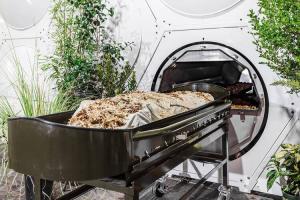
Human composting, recently legal in some states, is opposed by Catholic bishops in those states. But there should be broader discussion.
California now allows human composting as a way of returning the body of a deceased person to nature. It is an eco-friendly alternative to traditional burial or cremation. Other states approving human composting include Washington, Colorado, Oregon, Vermont, and, by now, possibly New York.
The process of human composting takes about 30 days. The body of the deceased is placed in a reusable vessel. Wood chips and aeration create an environment where microbes and bacteria can transform the body into soil.
An article in America Magazine says bishops in California and other states where human composting is permitted oppose the procedure. It “reduces the human body to simply a disposable commodity,” the California Catholic Conference says. It “can create an unfortunate spiritual, emotional and psychological distancing from the deceased.”
Advocates see human composting as more sustainable than cremation. The America article references specialists in death care, who regard the new method as “environmentally friendly [and] crucial as cemeteries fill up and people seek more sustainable practices.”
The California bill allows mourners to use the resulting soil on private land or scatter it with the same restrictions as apply to remains of cremation. Remains may not be “commingled with those of another person” not of the same family, the law says.
Human composting could use more debate
The reasons for opposing human composting voiced by the bishops who have spoken so far are serious. The human body, even after death, deserves utmost respect. It should not be a “disposable commodity.” The “spiritual, emotional and psychological distancing from the deceased” is something to guard against.
I wonder, though, if the subject has received adequate consideration. Statements from a few bishops’ conferences aren’t enough. What are the ways that the decomposed human remains are liable to serve as a commodity? What restrictions are available to prevent that from happening? Does the decomposing process inevitably lead to the kinds of distancing the bishops fear?
The process itself doesn’t seem to be any more disrespectful of the human body than cremation. The Catholic Church allows that, with restrictions on treatment of the ashes. Catholics may not scatter the ashes to the four winds, for example, as that would appear to deny the resurrection of the body. The same restriction could apply to decomposed remains.
One would want to be careful about commodifying the human body. Certainly large-scale selling of remains as fertilizer would constitute commodifying. Spreading a single person’s composted remains on a loved one’s garden is, at least, questionable. A human being, even when dead, is not an item simply to be used – though that happens all too often when the body is alive. I see nothing amiss, however, in burying a person’s “soil” and planting a tree over the “grave.” Surely the first intention there is to supply a marker for the deceased, though the tree would derive some benefit. That latter benefit doesn’t seem out of place in a natural world of which God has made us part.
Denying the resurrection or saving the earth
When it comes to denying the resurrection, I’m not sure traditional funeral home practices can escape censure. Putting a body to rest in as life-like a form as possible in a casket guaranteed to postpone decay until the next millennium almost shouts, “This is all there is, folks. Let’s prolong it as long as possible.” More theologically, the miracle of the resurrection doesn’t need our help. God doesn’t need bodies to stay in A-1 condition for resurrection to work. A body that decomposes, whether in 30 days or in nature’s time, does not deny the doctrine of the resurrection.
Human composting does contribute to saving the earth, and that is very consistent with Church teaching about the end times. After all, it’s not just the bodies of the just that will rise in glory. The earth, too, our God-given home, will participate in the resurrection and the Age to Come.
I don’t want to dismiss the concerns of the bishops in California and other states. I would say, though, that their rejection of human composting seems hasty. This subject could use a longer look from the Church. There should be much more wide-ranging and public discussion than we’ve had so far. I suspect that, along with green burial, human composting will be favored by many people in search of ways of living, and dying, sustainably on the earth.
Image credit: Recompose
Next Post

September 25, 2022 Pope at Economy of Francesco: A Rich Heritage – Except for the Planet
Browse Our Archives
Select a Category Advent Christmas Amazon Synod Angels Being Consumed Bible Catholic Modern Creed Ecology Economics Elizabeth Johnson Eucharist Fragments and Filaments Gender and Sex Gospel of Mark Herzog Historical Jesus Liturgy Luke Opening Scriptures on Way to Emmaus Ordinary radicals Parables Pro-Life Reincarnation Rosary Sacraments science Social Justice Souls Stories of Jesus The Creed Torture and Eucharist Tracy Uncategorized War and Peace
Select a Month October 2026 June 2025 April 2025 March 2025 February 2025 January 2025 November 2024 July 2024 March 2024 December 2023 October 2023 September 2023 August 2023 May 2023 April 2023 March 2023 February 2023 January 2023 December 2022 November 2022 October 2022 September 2022 August 2022 July 2022 June 2022 April 2022 March 2022 February 2022 January 2022 December 2021 November 2021 October 2021 August 2021 July 2021 June 2021 April 2021 March 2021 February 2021 December 2020 November 2020 October 2020 August 2020 July 2020 June 2020 May 2020 April 2020 March 2020 February 2020 January 2020 December 2019 November 2019 October 2019 September 2019 August 2019 July 2019 June 2019 May 2019 April 2019 March 2019 February 2019 January 2019 December 2018 November 2018 October 2018 September 2018 August 2018 July 2018 June 2018 May 2018
Follow Us!
TAKE THE
Religious Wisdom Quiz
In 2 Corinthians, Paul describes a man being caught up to the third heaven. How many years before writing did this happen?
Select your answer to see how you score.
Fourteen years Seven years Twelve years Ten years
Related posts from Lost in a One-Acre Wood

Credo: A Story of God Told with the...

With Carbon Dioxide, 0.014 is a big number
Crucifixion as Breakthrough, Horsley’s Nerviest Claim

Jesus’ Politics of Resistance and Renewal
TRENDING AT PATHEOS Catholic

Creation, Preservation, and Teleology in Catholic Theology
As I write this, it is very early Monday morning. Like millions...

The Parable Of The Sower And The Word...
One of Christ’s most famous parables is that of the sower who...

Rejecting Doom: Christian Hope And Human Action
Christianity is a religion of hope. We are to have hope and...

Why I Choose the Eucharist Over the Sermon
Choose the Eucharist, Not the Sermon What are we supposed to get...

5 Design Elements Found in Spiritually Rooted Homes
Putting Spirituality Into Home Decor Our homes are more than our living...

Credo: A Story of God Told with the...
About 10 years ago, I began to imagine a personal "Credo" that...
view all Catholic blogs
Ad-Free & Subscriber Log-In Subscription Support
- About Us
- 2026 Calendar
- Videos
- Podcasts
- Library of World Religions
- Faith In Media Tracker
- Advertise With Us
- Write for Us
- Privacy Policy
- Terms of Service
- Do Not Sell My Data
- Contact Us
- Radiant Digital
- Manage Newsletter Subscriptions
- Unsubscribe From Notifications
- Sitemap
Copyright 2008-2026, Patheos. All rights reserved.
Subscription Support Ad-Free & Subscriber Log-In
Follow Patheos