
BuddhistCatholicContemplativeEvangelicalGeneral ChristianHinduJewishLatter-day SaintMuslimNew VisionsProgressive Christian
Beliefs
- Buddhist
- Catholic
- Contemplative
- Evangelical
- General Christian
- Hindu
- Jewish
- Latter-day Saint
- More Voices
- Muslim
- New Visions
- Pagan
- Progressive Christian
Topics
- Religion News
- Food and Religion
- Sports and Religion
- Religious Art
- Religious Music and Entertainment
- Religious Events
- History and Religion
- Style and Religion
- Politics and Religion
- Women in Religion
- Recreation Outdoors and Religion
- Business Finance and Religion
- Careers Workplace and Religion
- Education and Religion
- Family Parenting and Religion
- Health Fitness and Religion
- Home and Religion
- Relationships and Religion
- Technology and Religion
- Travel and Religion
Columnists
- Buddhist Columnists
- Business Finance and Religion Columnists
- Careers Workplace and Religion Columnists
- Catholic Columnists
- Contemplative Columnists
- Education and Religion Columnists
- Evangelists Columnists
- Family Parenting and Religion Columnists
- General Christian Columnists
- Health Fitness and Religion Columnists
- Hindu Columnists
- History and Religion Columnists
- Home and Religion Columnists
- Jewish Columnists
- More Voices Columnists
- Latter Day Columnists
- Muslim Columnists
- New Visions Columnists
- Nonreligious Columnists
- Pagan Columnists
- Politics and Religion Columnists
- Progressive Columnists
- Recreation Outdoors and Religion Columnists
- Relationships and Religion Columnists
- Religion News Columnists
- Religious Art Columnists
- Religious Events Columnists
- Religious Music and Entertainment Columnists
- Sports and Religion Columnists
- Style and Religion Columnists
- Technology and Religion Columnists
- Travel and Religion Columnists
- Women in Religion Columnists
Resource Library
- 2026 Calendar
- Library of World Religions
- The 100 Most Holy Places on Earth
- Patheos Answers
- Podcasts
- Videos
- Faith Leaders Database
- Anglican Episcopalian
- Bahai
- Baptist
- Buddhism
- Christianity
- Confucianism
- Eastern Orthodoxy
- Hinduism
- Holiness and Pentecostal
- ISKCON
- Islam
- Judaism
- Lutheran
- Methodist
- The Church of Jesus Christ of Latter-day Saints
- New Age
- Paganism
- Presbytarian and Reformed
- Protestantism
- Religion Behind the Scenes
- Roman Catholic
- Scientology
- Shia Islam
- Sikhism
- Sufism
- Sunni Islam
- Taoism
- Zen
- See all religions
Research Tools
 Ad-Free & Subscriber Log-In Subscription Support
Ad-Free & Subscriber Log-In Subscription Support
Follow Patheos 

- Trending:
- Forgiveness
- |
- Marriage
- |
- Consciousness
- |
- Death Penalty
- |
- Election
- |
- Halloween

- Home
- Catholic
- Politics and Religion
- Nuclear Deterrence: The Church’s Changing Moral Teaching
Nuclear Deterrence: The Church’s Changing Moral Teaching
Last updated on: August 29, 2022 at 11:40 am by Jack Hartjes
Nuclear Deterrence: The Church’s Changing Moral Teaching 2022-08-29T11:40:08-06:00 Jack Hartjes
Patheos Explore the world's faith through different perspectives on religion and spirituality! Patheos has the views of the prevalent religions and spiritualities of the world.
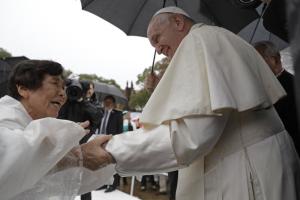
In Nagasaki, Japan, Pope Francis said No to nuclear weapons and the strategy of deterrence.
This post traces the development of Catholic Church teaching on the morality of nuclear weapons. In particular, it looks at the nuclear powers’ strategy of deterrence. Following that strategy Russia and the U.S. keep their nuclear weapons at the ready to deter each other from using them first. For a while conditionally accepting deterrence, the Church now officially condemns even the possession of nuclear weapons.
The immorality of nuclear weapons use
A philosophy prof at Catholic University in the 1960’s told his class that the only moral use of a nuclear weapon would be against a warship at sea. In other words, the vast majority of the world’s nuclear bombs have no moral use. That is the position of the Catholic Church today. Admiral William Leahy, already in 1945, expressed today’s Catholic position precisely: The bombings of Japanese cities were violations, he told President Truman,
… of every Christian ethic I have ever heard of and all of the known laws of war.… I was not taught to make war in that fashion and wars cannot be won by destroying women and children. (University of Baltimore Magazine, “10 Things You May Not Know About U.S. History”)
Longstanding Church teaching and international law agree. Warring nations must not intentionally kill innocent civilians.
Innocent civilians almost inevitably become casualties in war. It’s called collateral damage. An attack meant to kill enemy soldiers may, often does, stray off target unintentionally. Military intelligence is not perfect, particularly regarding the whereabouts of civilians. A military target may be important enough to justify an attack even when some civilians happen to be present. But an attack that destroys a city is not like any of those cases. You can’t deliberately annihilate a city full of innocent civilians and only intend to destroy soldiers and military capabilities. Whether you admit it or not, you intended to kill everyone within the area you aimed at. It wasn’t accidental. That makes the action immoral.
The moral hazard of deterrence
For decades the Church has wrestled with the moral status of possessing weapons that cannot be used morally. The major nuclear powers, including the U.S. and Russia, have stockpiled enough nuclear weapons to destroy civilization as we know it. The belief is that the certainty of “mutual assured destruction” will deter both sides from starting a nuclear war. This strategy of deterrence is a moral conundrum. For deterrence to work, you must intend to do a heinously immoral act, if your enemy does. Essentially, the country tells service people in the missile silos, submarines, and bombers that they must follow orders, not their conscience. I don’t know how a Catholic, or any moral person, could sign up for those jobs.
To deal with this unsatisfactory arrangement, the Catholic Church made a prudential decision. It would not condemn the strategy of deterrence (and the possession of nuclear bombs) as long as there was good faith movement toward eliminating these weapons. A U.S. Catholic article outlines the history of this conditional acceptance of deterrence:
- In his 1963 encyclical Pacem in Terris (Peace on Earth) Pope John XXIII forcefully condemned nuclear weapons. Yet, reluctantly he made an exception for possessing nuclear weapons for deterrence.
- In June 1982 Pope John Paul II clarified: “In current conditions deterrence based on balance, certainly not as an end in itself but as a step on the way toward a progressive disarmament, may still be judged morally acceptable.”
- In 1983 the U.S. Catholic bishops followed up with their conditional endorsement of deterrence: “It is a transitional strategy justifiable only in conjunction with resolute determination to pursue arms control and disarmament.”
The ups and downs of nuclear disarmament
In the next 10 years the world changed. The Soviet Union dissolved into its member states. It seemed the “Cold War” was at an end.
Up to that time progress on controlling nuclear weapons consisted mostly in keeping a bad situation from getting worse. Nuclear weapons states had signed a variety of treaties starting in 1959. Some treaties aimed to keep certain areas of the world, like Antarctica and the seabed, free of nuclear weapons. Other treaties limited the extent to which a country’s nuclear arsenal could grow. Others aimed at preventing more countries from going nuclear.
More ambitious treaties were coming, and stockpiles of nuclear weapons would begin to go down. The U.S. Catholic article notes that “with new partners in Russia, U.S. negotiators made rapid progress on nuclear disarmament.” But, the article laments,
… as the 20th century drew to a close, Vatican diplomats became frustrated by the diminishing pace of disarmament.
A world without nuclear weapons wasn’t a goal the nuclear powers were chasing very seriously.
But the year 2010 saw another highlight in nuclear disarmament. With New START (New Strategic Arms Reduction Treaty), the U.S. and Russia built on previous START treaties. The two countries “met the central limits of the treaty by February 5, 2018, and have stayed at or below them ever since, The U.S. Department of State says. The treaty cut in half the number of nuclear missile delivery systems and cut by two-thirds the number of deployed warheads from the original 1991 START treaty.
Then came the presidency of Donald Trump and backtracking on a number of nuclear arms treaties. New START was in still force, but only until just days after the next presidential inauguration. The new President Joe Biden promptly renewed the treaty, with Russian cooperation, for five years.
The problem remains.
It looks like, by the skin of our teeth, we are still on track for limiting nuclear arms and avoiding a new nuclear arms race. Not necessarily. New START limits the numbers of nuclear weapons, not their quality. Both Russia and the United States are contemplating huge expenditures in the effort to outdo each other in the quality of nuclear weapons and delivery systems.
One new weapons mutation is the development of smaller, lower-yield nuclear weapons. These, presumably, could be used on the battlefield and turn a warring country’s losing effort into victory. Or, just as likely, escalate into all-out nuclear war. The war in Ukraine has seen Russian President Putin engage in just such nuclear saber rattling.
New delivery systems include rockets that fly like planes but at hypersonic speeds. They can maneuver at low altitudes, evading radar detection.
In recent years the U.S. Department of Defense has proposed replacing and upgrading its entire fleet of land-based nuclear missiles. The Biden administration has not yet weighed in on these plans.
The Church says, ‘Enough!’
The new millennium saw the Church’s increasing dissatisfaction with the nations’ reliance on deterrence and the halting pace of disarmament. The U.S. Catholic article enumerates:
- In 2006 Pope Benedict voiced his dissatisfaction with the world’s progress toward nuclear disarmament. The Pope’s message for the World Day of Peace called the possession of nuclear weapons for defense (i.e. for deterrence) “not only baneful but also completely fallacious.”
- Archbishop Celestino Migliore was the Vatican’s permanent observer to the United Nations in 2010 . With utmost diplomacy he said:
The conditions that prevailed during the Cold War, which gave a basis for the church’s limited toleration of nuclear deterrence, no longer apply in a consistent and effective manner.
- In 2014 the Vatican joined the Conference on the Humanitarian Impact of Nuclear Weapons. Even sitting quietly on tops of missiles and in B-1 bomber bays, they constitute an unconscionable theft of resources that should be addressing world poverty and other humanitarian issues.
The Vatican was a leading advocate for and one of the first to sign the Treaty on the Prohibition of Nuclear Weapons. In 2017, one hundred twenty-two nations signed the treaty, but not any of the nuclear powers.
Two months after the signing of the treaty, Pope Francis made a decisive break with the conditional acceptance of deterrence. He condemned not only the threat of using nuclear weapons but also “their very possession.” Commenting for America Magazine, Bishop Robert McElroy of San Diego said:
Pope Francis was clear that because of the significant risks of even an anticipated or accidental war, and of the gargantuan and devastating effects of nuclear war, and of provoking other nations to perhaps use them, the possession itself of these weapons is now condemned, regardless of the intention.
U.S. Catholic bishops address American nuclear policy.
In a major statement in 2018 the United States Catholic bishops noted the Church’s longtime support for treaties and initiatives to reduce and even ban nuclear weapons. They enumerated several objectives for national nuclear policy. Among other recommendations, they said the U.S. must:
- Move away from reliance on nuclear weapons for security,
- Ratify the Comprehensive Test Ban Treaty,
- Commit to never using nuclear weapons first or in response to non-nuclear threats,
- Make deeper cuts in nuclear arsenals,
- Reject plans to invest hundreds of billions of dollars in modernizing nuclear weapons systems.
- Take land-based nuclear weapons off “launch on warning” status to reduce the risk of accidental nuclear war.
The risk that nuclear bombs in missile silos scattered mostly in Western lands pose is one of the concerns of the Union of Concerned Scientists. The final post in this series will take up their recent proposal to eliminate that risk. They suggest taking down the land-based portion of our deterrence strategy. It would leave intact the rest of our nuclear “triad” – bombers and nuclear missile-equipped submarines. Deterrence would still be the name of the game, but in a safer form. Taken unilaterally, it might even challenge Russia to make its own daring move.
Image credit: Arab News
Politics and Religion
Previous Post

August 13, 2022
Trying to Justify the Bomb – Stories and Facts
Next Post
August 28, 2022 Does a Land-based ICBM Force Keep Us Safe from Nuclear Armageddon
Browse Our Archives
Select a Category Advent Christmas Amazon Synod Angels Being Consumed Bible Catholic Modern Creed Ecology Economics Elizabeth Johnson Eucharist Fragments and Filaments Gender and Sex Gospel of Mark Herzog Historical Jesus Liturgy Luke Opening Scriptures on Way to Emmaus Ordinary radicals Parables Pro-Life Reincarnation Rosary Sacraments science Social Justice Souls Stories of Jesus The Creed Torture and Eucharist Tracy Uncategorized War and Peace
Select a Month October 2026 June 2025 April 2025 March 2025 February 2025 January 2025 November 2024 July 2024 March 2024 December 2023 October 2023 September 2023 August 2023 May 2023 April 2023 March 2023 February 2023 January 2023 December 2022 November 2022 October 2022 September 2022 August 2022 July 2022 June 2022 April 2022 March 2022 February 2022 January 2022 December 2021 November 2021 October 2021 August 2021 July 2021 June 2021 April 2021 March 2021 February 2021 December 2020 November 2020 October 2020 August 2020 July 2020 June 2020 May 2020 April 2020 March 2020 February 2020 January 2020 December 2019 November 2019 October 2019 September 2019 August 2019 July 2019 June 2019 May 2019 April 2019 March 2019 February 2019 January 2019 December 2018 November 2018 October 2018 September 2018 August 2018 July 2018 June 2018 May 2018
Follow Us!
TAKE THE
Religious Wisdom Quiz
How many books are in the Old Testament?
Select your answer to see how you score.
39 42 66 27
Related posts from Lost in a One-Acre Wood

Does a Land-based ICBM Force Keep Us Safe...
Trying to Justify the Bomb – Stories and...
Hiroshima, Nagasaki and the Conscience of World War...

Civil Defense Protest, June 15, 1955: 17 Sane...
TRENDING AT PATHEOS Catholic

Creation, Preservation, and Teleology in Catholic Theology
As I write this, it is very early Monday morning. Like millions...

The Parable Of The Sower And The Word...
One of Christ’s most famous parables is that of the sower who...

Rejecting Doom: Christian Hope And Human Action
Christianity is a religion of hope. We are to have hope and...

Why I Choose the Eucharist Over the Sermon
Choose the Eucharist, Not the Sermon What are we supposed to get...

5 Design Elements Found in Spiritually Rooted Homes
Putting Spirituality Into Home Decor Our homes are more than our living...

Credo: A Story of God Told with the...
About 10 years ago, I began to imagine a personal "Credo" that...
view all Catholic blogs
Ad-Free & Subscriber Log-In Subscription Support
- About Us
- 2026 Calendar
- Videos
- Podcasts
- Library of World Religions
- Faith In Media Tracker
- Advertise With Us
- Write for Us
- Privacy Policy
- Terms of Service
- Do Not Sell My Data
- Contact Us
- Radiant Digital
- Manage Newsletter Subscriptions
- Unsubscribe From Notifications
- Sitemap
Copyright 2008-2026, Patheos. All rights reserved.
Subscription Support Ad-Free & Subscriber Log-In
Follow Patheos