
BuddhistCatholicContemplativeEvangelicalGeneral ChristianHinduJewishLatter-day SaintMuslimNew VisionsProgressive Christian
Beliefs
- Buddhist
- Catholic
- Contemplative
- Evangelical
- General Christian
- Hindu
- Jewish
- Latter-day Saint
- More Voices
- Muslim
- New Visions
- Pagan
- Progressive Christian
Topics
- Religion News
- Food and Religion
- Sports and Religion
- Religious Art
- Religious Music and Entertainment
- Religious Events
- History and Religion
- Style and Religion
- Politics and Religion
- Women in Religion
- Recreation Outdoors and Religion
- Business Finance and Religion
- Careers Workplace and Religion
- Education and Religion
- Family Parenting and Religion
- Health Fitness and Religion
- Home and Religion
- Relationships and Religion
- Technology and Religion
- Travel and Religion
Columnists
- Buddhist Columnists
- Business Finance and Religion Columnists
- Careers Workplace and Religion Columnists
- Catholic Columnists
- Contemplative Columnists
- Education and Religion Columnists
- Evangelists Columnists
- Family Parenting and Religion Columnists
- General Christian Columnists
- Health Fitness and Religion Columnists
- Hindu Columnists
- History and Religion Columnists
- Home and Religion Columnists
- Jewish Columnists
- More Voices Columnists
- Latter Day Columnists
- Muslim Columnists
- New Visions Columnists
- Nonreligious Columnists
- Pagan Columnists
- Politics and Religion Columnists
- Progressive Columnists
- Recreation Outdoors and Religion Columnists
- Relationships and Religion Columnists
- Religion News Columnists
- Religious Art Columnists
- Religious Events Columnists
- Religious Music and Entertainment Columnists
- Sports and Religion Columnists
- Style and Religion Columnists
- Technology and Religion Columnists
- Travel and Religion Columnists
- Women in Religion Columnists
Resource Library
- 2026 Calendar
- Library of World Religions
- The 100 Most Holy Places on Earth
- Patheos Answers
- Podcasts
- Videos
- Faith Leaders Database
- Anglican Episcopalian
- Bahai
- Baptist
- Buddhism
- Christianity
- Confucianism
- Eastern Orthodoxy
- Hinduism
- Holiness and Pentecostal
- ISKCON
- Islam
- Judaism
- Lutheran
- Methodist
- The Church of Jesus Christ of Latter-day Saints
- New Age
- Paganism
- Presbytarian and Reformed
- Protestantism
- Religion Behind the Scenes
- Roman Catholic
- Scientology
- Shia Islam
- Sikhism
- Sufism
- Sunni Islam
- Taoism
- Zen
- See all religions
Research Tools
 Ad-Free & Subscriber Log-In Subscription Support
Ad-Free & Subscriber Log-In Subscription Support
Follow Patheos 

- Trending:
- Forgiveness
- |
- Marriage
- |
- Consciousness
- |
- Death Penalty
- |
- Election
- |
- Halloween

- Home
- Catholic
- The Nicene Creed: Thinking with the Bishop Barron Lectures – The First Three Words
The Nicene Creed: Thinking with the Bishop Barron Lectures – The First Three Words
Last updated on: April 24, 2022 at 6:34 am by Jack Hartjes
The Nicene Creed: Thinking with the Bishop Barron Lectures – The First Three Words 2022-04-24T06:34:16-06:00 Jack Hartjes
Patheos Explore the world's faith through different perspectives on religion and spirituality! Patheos has the views of the prevalent religions and spiritualities of the world.
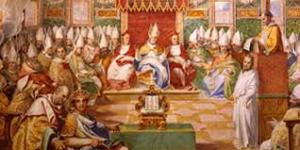
The Nicene Creed came about through the work of two ecumenical councils in the fourth century. (Image credit: Catholic News Herald)
My parish, St. Raphael’s in Springfield, Minnesota, has begun an adult education course on the Nicene Creed. We are listening to and discussing a series of video lectures by Bishop Robert Barron. (From Word on Fire: The Creed) The bishop’s first talk took us all the way through the first three words of the Nicene Creed. There was enough material there for some serious thought.
The Nicene Creed begins
I believe in one God, the Father almighty, maker of heaven and earth, of all things visible and invisible.
Bishop Barron starts out by noting that not every religion has a creed. Christianity does, and it has an important place in our faith lives. That says something distinctive about the Christian faith.
Christianity is more than an attitude toward life and a way of acting. Christianity tells us about the world, ourselves, and God. Christians make claims, and what we say is either true or false. We commit ourselves to defending these claims when we propose a creed to the world.
In the fourth century, some 300 years after Jesus lived, died, and rose, the Church knew it needed an official statement of what Christians believed. The Nicene Creed, worked out in theological debate and through two ecumenical councils at Nicaea and Constantinople, answered that need. Since then practically every Christian denomination expresses its faith with the Nicene Creed.
The first word, “I/We”
In the 1970’s the International Commission on English in the Liturgy adopted a translation of the Nicene Creed. This was the first English version of the Nicene Creed that I learned to recite in Church, and it differed from the Latin text. Mostly it was an attempt at more everyday English rendition of the same ideas, but one change was substantial. It changed “I believe” (Credo in Latin) to “We believe.” In 2011 a Vatican commission reversed this change, along with others. We now say, as the priest did before in Latin, “I believe.”
Bishop Barron discusses this issue and notes that the original Greek text, dating back to the fourth century, says “We believe,” not “I believe.” (Pisteuomen, not Pisteuo, in Greek.) The logic for “We” is twofold. First, and most obviously, in church we are professing this faith together. Second, it’s not as if we come by faith on our own. As Catholic theologian David Tracy says, we believe with the apostles. Or, as I like to say in private prayer:
I believe with the Communion of Saints on earth and in heaven, the Catholic Church; with apostles, martyrs, teachers, and all who encourage me by word and deed; and with the ones who passed on both faith and life to me, Dave, Rose Marie, and all my forebears.
I don’t believe on my own say-so.
But the “I believe” formula has a long tradition in liturgical use. It goes back even farther than the Nicene Creed. From very early times a candidate for entry into the Church would recite a creed at his or her Baptism. He or she would start by saying “I believe.”
Barron believes both forms are important, but I get the impression he would prefer the “We” form at Mass.
The second word, “believe”
Atheists, says the bishop, make an unwarranted criticism of Christian believing. They contrast faith and the knowledge that science procures. As if faith is taking a position arbitrarily, and knowledge is believing with evidence. Actually, nobody lives without a kind of faith guiding most of the things they believe. We rely on the experience of others whom we trust to tell us the truth, whether it’s the backyard gossip or a school textbook.
Our personal relationships depend on faith, especially when that’s a relationship of love. I had gathered a lot of factual, evidence-based knowledge about the person who became my wife, and she about me, before we entered into marriage. All that evidence didn’t add up to proof that she loved me or even that I loved her. Nothing in my experience could ever allow me to say, with the kind of evidence one looks for in science, that loving another person is even possible or reasonable. But what would life be like without the leap of loving commitment?
Barron says faith is not the same as knowledge. But it is not less than knowledge.
The third word, “in”
Like Bishop Barron I make a big deal out of this little word, “in.” I think about someone saying, “I believe in you.” When we say “I believe in God,” it’s like that. Unlike believing a mere fact, it involves one personally. Believing in someone is much more than believing that he or she exists.
The bishop gives this personal involvement some grammatical support from the Latin language. Latin uses the same word, “in,” for both “in” and “into” in English. Speakers of Latin differentiated the two meanings by the endings of the nouns that follow. Latin is a highly inflected language. Endings of words, or inflections, carry specific meanings. One ending implies static presence, in this case “in.” A different ending implies movement, “into.” The Creed in Latin begins “Credo in unum Deum.” The word for God, “Deum,” has the ending that implies movement.
According to the Christian Creed, believing in God isn’t an armchair exercise. To believe is already to start moving on a path of personal involvement. We believe into God. We enter into God’s story when we recite the Nicene Creed at Mass.
Previous Post

March 14, 2022
The Eye of a needle and the Man who would Earn Eternal Life
Browse Our Archives
Select a Category Advent Christmas Amazon Synod Angels Being Consumed Bible Catholic Modern Creed Ecology Economics Elizabeth Johnson Eucharist Fragments and Filaments Gender and Sex Gospel of Mark Herzog Historical Jesus Liturgy Luke Opening Scriptures on Way to Emmaus Ordinary radicals Parables Pro-Life Reincarnation Rosary Sacraments science Social Justice Souls Stories of Jesus The Creed Torture and Eucharist Tracy Uncategorized War and Peace
Select a Month October 2026 June 2025 April 2025 March 2025 February 2025 January 2025 November 2024 July 2024 March 2024 December 2023 October 2023 September 2023 August 2023 May 2023 April 2023 March 2023 February 2023 January 2023 December 2022 November 2022 October 2022 September 2022 August 2022 July 2022 June 2022 April 2022 March 2022 February 2022 January 2022 December 2021 November 2021 October 2021 August 2021 July 2021 June 2021 April 2021 March 2021 February 2021 December 2020 November 2020 October 2020 August 2020 July 2020 June 2020 May 2020 April 2020 March 2020 February 2020 January 2020 December 2019 November 2019 October 2019 September 2019 August 2019 July 2019 June 2019 May 2019 April 2019 March 2019 February 2019 January 2019 December 2018 November 2018 October 2018 September 2018 August 2018 July 2018 June 2018 May 2018
Follow Us!
TAKE THE
Religious Wisdom Quiz
I saw a river flowing from the temple threshold, getting deeper until it became a river no one could cross. What grew along its banks?
Select your answer to see how you score.
Trees Flowers Grass Vines
Related posts from Lost in a One-Acre Wood
The Creed, Entering God’s Dangerous World

What about the Traditional Angels, and What’s the...

Cosmos and History: Connecting the Angels
Angels of the Cosmos or, Are We Alone...
TRENDING AT PATHEOS Catholic

Creation, Preservation, and Teleology in Catholic Theology
As I write this, it is very early Monday morning. Like millions...

The Parable Of The Sower And The Word...
One of Christ’s most famous parables is that of the sower who...

Rejecting Doom: Christian Hope And Human Action
Christianity is a religion of hope. We are to have hope and...

Why I Choose the Eucharist Over the Sermon
Choose the Eucharist, Not the Sermon What are we supposed to get...

5 Design Elements Found in Spiritually Rooted Homes
Putting Spirituality Into Home Decor Our homes are more than our living...

Credo: A Story of God Told with the...
About 10 years ago, I began to imagine a personal "Credo" that...
view all Catholic blogs
Ad-Free & Subscriber Log-In Subscription Support
- About Us
- 2026 Calendar
- Videos
- Podcasts
- Library of World Religions
- Faith In Media Tracker
- Advertise With Us
- Write for Us
- Privacy Policy
- Terms of Service
- Do Not Sell My Data
- Contact Us
- Radiant Digital
- Manage Newsletter Subscriptions
- Unsubscribe From Notifications
- Sitemap
Copyright 2008-2026, Patheos. All rights reserved.
Subscription Support Ad-Free & Subscriber Log-In
Follow Patheos