
BuddhistCatholicContemplativeEvangelicalGeneral ChristianHinduJewishLatter-day SaintMuslimNew VisionsProgressive Christian
Beliefs
- Buddhist
- Catholic
- Contemplative
- Evangelical
- General Christian
- Hindu
- Jewish
- Latter-day Saint
- More Voices
- Muslim
- New Visions
- Pagan
- Progressive Christian
Topics
- Religion News
- Food and Religion
- Sports and Religion
- Religious Art
- Religious Music and Entertainment
- Religious Events
- History and Religion
- Style and Religion
- Politics and Religion
- Women in Religion
- Recreation Outdoors and Religion
- Business Finance and Religion
- Careers Workplace and Religion
- Education and Religion
- Family Parenting and Religion
- Health Fitness and Religion
- Home and Religion
- Relationships and Religion
- Technology and Religion
- Travel and Religion
Columnists
- Buddhist Columnists
- Business Finance and Religion Columnists
- Careers Workplace and Religion Columnists
- Catholic Columnists
- Contemplative Columnists
- Education and Religion Columnists
- Evangelists Columnists
- Family Parenting and Religion Columnists
- General Christian Columnists
- Health Fitness and Religion Columnists
- Hindu Columnists
- History and Religion Columnists
- Home and Religion Columnists
- Jewish Columnists
- More Voices Columnists
- Latter Day Columnists
- Muslim Columnists
- New Visions Columnists
- Nonreligious Columnists
- Pagan Columnists
- Politics and Religion Columnists
- Progressive Columnists
- Recreation Outdoors and Religion Columnists
- Relationships and Religion Columnists
- Religion News Columnists
- Religious Art Columnists
- Religious Events Columnists
- Religious Music and Entertainment Columnists
- Sports and Religion Columnists
- Style and Religion Columnists
- Technology and Religion Columnists
- Travel and Religion Columnists
- Women in Religion Columnists
Resource Library
- 2026 Calendar
- Library of World Religions
- The 100 Most Holy Places on Earth
- Patheos Answers
- Podcasts
- Videos
- Faith Leaders Database
- Anglican Episcopalian
- Bahai
- Baptist
- Buddhism
- Christianity
- Confucianism
- Eastern Orthodoxy
- Hinduism
- Holiness and Pentecostal
- ISKCON
- Islam
- Judaism
- Lutheran
- Methodist
- The Church of Jesus Christ of Latter-day Saints
- New Age
- Paganism
- Presbytarian and Reformed
- Protestantism
- Religion Behind the Scenes
- Roman Catholic
- Scientology
- Shia Islam
- Sikhism
- Sufism
- Sunni Islam
- Taoism
- Zen
- See all religions
Research Tools
 Ad-Free & Subscriber Log-In Subscription Support
Ad-Free & Subscriber Log-In Subscription Support
Follow Patheos 

- Trending:
- Forgiveness
- |
- Marriage
- |
- Consciousness
- |
- Death Penalty
- |
- Election
- |
- Halloween

- Home
- Catholic
- Business, Finance and Religion
- The Eye of a needle and the Man who would Earn Eternal Life
The Eye of a needle and the Man who would Earn Eternal Life
Last updated on: August 16, 2022 at 3:23 pm by Jack Hartjes
The Eye of a needle and the Man who would Earn Eternal Life 2022-08-16T15:23:23-06:00 Jack Hartjes
Patheos Explore the world's faith through different perspectives on religion and spirituality! Patheos has the views of the prevalent religions and spiritualities of the world.
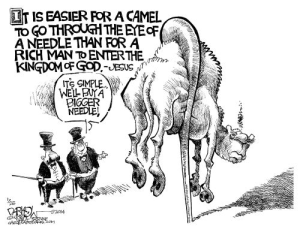
What’s impossible for humans is possible with God’s help, including restructuring economies to benefit the poor and the common good.
Two individuals ask Jesus the same question. Two straightforward answers are given, but they are miles apart from each other. First we hear: Love God and neighbor.” Then we get: “Follow the commandments.” But when Jesus gets down to his usual way of teaching – through parable and parabolic saying, the message is the same. In these two incidents we have two of Jesus most iconic utterances — the parable of the Good Samaritan and the saying about the Eye of a needle. Both of them leave listeners scratching heads and thinking I can’t possibly do that. Jesus solves the dilemma: “What is impossible by human effort is possible for God.”
Meanwhile, the difference and the similarity of two economic systems, that of first century Palestine and our own, come into view. And we suspect Jesus is telling us, Even your own efforts are sorely lacking.
This is the 11th and last, for a while, in a series on social justice in the Gospel of Luke.
The Gospel of Luke devotes lots of space to money—either too much money or not enough. Inheriting is another common theme. Once it’s about inheriting money. Two more times the issue is inheriting eternal life. In one of those money is also a problem, and that’s where the eye of a needle comes in.
The Great Commandment and the lesser ones
A teacher of the law asks Jesus what he must do to inherit eternal life. Jesus, figuring that the man must know a thing or two about his chosen field, turns the question back to him: “What is written in the Law? How do you read it?” The lawyer comes up with an answer of which Jesus approves:
You shall love the Lord, your God, with all your heart, with all your being, with all your strength, and with all your mind, and your neighbor as yourself. (Luke 10:27)
Christians the world over have honored this lawyer’s answer as the Great Commandment.
Later in Luke’s Gospel a rich official approaches Jesus with the same question: “What must I do to inherit eternal life.” This time Jesus gives the answer himself. Jesus’ answer lacks quite a bit of the greatness of the lawyers’. He just gives a list containing part of the Ten Commandments, not even in the right order:
- You shall not commit adultery. (Normally this comes after Number 2.)
- You shall not kill.
- You shall not steal.
- You shall not bear false witness.
- Honor your father and your mother. (Normally this would be the first on this list.)
The parenthetical notes indicate the problem with order, but that makes a person think. Why did Luke change the order. He was copying this whole story almost word for word out of the earlier Gospel of Mark. Mark had the last commandment in an odd place, but he didn’t mix up the first two. One suspects Luke has some point in mind for his way of ordering, but that’s for later in this post. For now let’s consider the rich official.
A little psychologizing
Here’s the story from Luke with some reading into the situation and the minds of the actors (18:18-21):
Official: ‘’Good Teacher…
No one else in Luke’s Gospel calls Jesus good. The official places Jesus (along with himself, of course) among the good people. Jesus will jump on this right away.
Official continuing: What must I do to inherit eternal life?’
One’s deeds are not the way one comes by eternal salvation. In fact, inheriting anything is not accomplished by what a person does. Jesus lets that go for a while.
Jesus: “Why do you call me good? No one is good but God alone.”
And you’re not as good as you think. Jesus in Luke’s Gospel had just delivered two lessons about dividing the world into the more worthy and less worthy. He told the parable of the proud Pharisee and the humble tax collector in the Temple. Only the one not convinced of his own righteousness went home justified. (Luke 18:9-14) Then Jesus welcomed children and infants to come to him. He said this is what you must be like to enter the Kingdom of God. I imagine most of the crowd enjoyed both of these moves and Jesus’ putdown of the rich official.
Jesus, continuing: “You know the commandments. ‘You shall not commit adultery etc.’”
For the time being, Jesus goes along with the official’s idea of earning salvation: Just obey the commandments.
Official: “All of these I have observed from my youth.”
But, he thinks, this does not set a very high bar. This official is up for a bigger challenge. Jesus will give him more than he bargained for. Before getting to that, let’s remember the list that’s out of order and then set the economic context for what Jesus wants the rich man to do.
The commandments not observed
Here is that partial list of commandments again. I’ve also categorized them in terms of how they relate to family. That’s an important factor in the ancient world, especially if you’re rich.
- No to adultery. – Loyalty to family
- Don’t kill. – External to family
- You shall not steal. – External to family
- Don’t bear false witness. – External to family
- Honor father and mother. – Loyalty to family
Moving adultery out of its normal order and out of their order in Mark makes the two categories stand out. The first and last, where the eye lands easily are about loyalty to family. Tucked between these two ends are issues external to family. I’m following Kenneth E. Bailey’s Through Peasant Eyes (p. 157) in thinking about this rearrangement, but going in a different direction. I’m thinking the way I imagine the poor people in the crowd would.
The rich official says he has observed all these commandments from his youth. As for the first and last on the list, a poor person would easily recognize the self-interest behind this loyalty to family. “Of course he observes these. He stands to lose a considerable inheritance if he doesn’t.” Regarding the middle three I can imagine this response: “Yeah, right! Nobody gets rich without stealing from the poor.”
The poor person might go on:
First they take your land because you can’t pay your debts. They also tarnish your good name because you’re poor now and society considers poor people to be sinners. They reduce you to a hardscrabble and most likely short life. It’s not exactly observing the spirit of the middle three commandments on Jesus’ list.
Popular wisdom and the rich and the poor
That response might not seem warranted. Did the rich man really steal from the poor? But Jesus once quoted a popular saying that indicates it must have been a common feeling:
Take care, then, how you hear. To anyone who has, more will be given, and from the one who has not, even what he seems to have will be taken away. (Luke 8:18)
Bible interpreters have jumped through hoops trying to find some spiritual meaning in this saying, but it’s not spiritual at all. The clue is in the words “Take care.” This is not a saying of Jesus. It’s what people say, and, economics being what they are, it’s often true. The rich get richer and the poor get poorer, we’d say. Jesus doesn’t approve and doesn’t want his disciples to approve.
A look at ancient-world economics clarifies further. First-century Mediterranean economies were not designed to create much wealth. It was nearly a zero-sum game. There was only so much wealth to go around, and for somebody to win big, somebody else had to lose. It happened all the time, and no one knew it better than a poor farmer who lost his land because he couldn’t pay a debt.
Say you’re a peasant, working your own inherited land. You have mouths to feed but also taxes to pay to Rome and to the Temple in Jerusalem. Plus you have to pay off your debts. One season’s crop gives you barely enough to survive, and each season you take out another loan for seed at planting time. Debt is a constant reality hounding your precarious existence. One poor crop due to circumstances beyond your control and you could lose the farm.
“To those who have, more will be given. From those who have not ….”
Different economies but the same problem
Jewish Scriptures assume that economies naturally separate rich and poor. That holds today as well as in ancient Israel. Israel had remedies for this tendency. The prophets demanded that the rich see to the needs of the poor. During the Jubilee Year debts were to be forgiven, and lands restored to families who had lost land since the last Jubilee. (See this post.)
Scholars have doubted whether this instruction from the Book of Leviticus (25:8-55) was ever followed. But recent research (Michael Hudson, And Forgive Them Their Debts) shows that debt forgiveness was a common practice in the ancient Middle East.
Today’s economy is designed to create wealth, and it does that well. So we don’t often say to a rich person (as several Church Fathers did), “The wealth you have you’ve stolen from the poor.” Instead, we often hear that the rich are the wealth creators. As in Jesus’ day, though, it’s still necessary to “take care what you hear.”
Is it reasonable to think that owners of corporations, including stockholders, create all the new wealth? Does our growing and increasingly rich financial sector create any new wealth at all? Surely some really important wealth creators are the factory workers and other lower-level employees of corporations. Yet, even with improving production per worker hour, the lower rungs on the economic scale see very little of this new wealth.
The imbalance of our economic system became especially clear during the pandemic. While many poor people lost jobs which could not be done from home, most of the already rich continued to make money, in some cases lots of money. As a retiree on fixed income, I lost nothing but only benefited from pandemic stimulus payments. Stealing from the poor perhaps?
Will the poor always be with us?
Luke is the only Gospel where Jesus doesn’t say, “The poor will always be with you.” Perhaps Luke just didn’t believe it and foresaw the illegitimate use people could make of that saying? Jesus quoted that common saying without indicating he approved of it. Luke took seriously the call for Jubilee debt relief that Jesus made early in his public ministry in Nazareth. (See this post) Only Luke records this event.
Jubilee means rich and poor can go their separate ways only for so long. Then the process of separating economic gainers and losers must start over. There can be no permanent class of the poor. This is the vision of the prophets and the requirement of the Law. Luke believed the vision was renewed with Jesus and the community of his followers. (See Acts 2:42-47)
In our day there is a beginning awareness of the failure of an economy that for a half century has seen increasing separation of the rich into their own world. Anthony M. Annett, along with Pope Francis, identifies extreme inequality as the root of many other social ills. (Cathonomics: How Catholic Tradition Can Create a More Just Economy*) Annett recommends several reforms of our modern, neoliberal economy, or reversions to previous economic forms, that will better serve the common good. (p. 200-213) These include:
- Raising taxes on the rich, including inheritance and wealth taxes, to about where they were in the 1950’s,
- Returning to strong unions,
- Worker participation in company management and profit sharing,
- Strengthening antitrust policies to combat the “too big to fail” syndrome,
- Restructuring the financial sector, including a financial transactions tax,
- Periodic debt write-downs for some kinds of debt, e.g., student loans.
There are many forms that Biblical Jubilee can take today.
The eye of a needle
The Kingdom of Heaven, the land on the other side of the eye of a needle, is not a place outside the universe and time. Jesus proclaimed God’s Kingdom coming to his, and our, time and place. The Gospels say little about the heaven we usually think of, where we go only after we die. Jesus does give us details of life in a Kingdom where God reigns and into which his followers would enter alive on earth.
The episode with the rich official shows how hard Kingdom life is (18:22-27):
Jesus challenges the official:
There is still one thing left for you. Sell all that you have and distribute it to the poor, and you will have a treasure in heaven. Then come, follow me.
This is too much for the official. Luke records that “when he heard this he became sad for he was very rich.” Jesus comments:
How hard it is for those who have wealth to enter the Kingdom of God! For it is easier for a camel to pass through the eye of a needle than for a rich person to enter the Kingdom of God.
Everyone who heard this was dismayed. They hadn’t learned to think like Jesus. Typically one imagined the rich getting into the Kingdom if anybody could. And, if not the rich, “Then who can be saved?” Jesus answered,
What is impossible for human beings is possible for God.
Is an economy without the destitute poor impossible for human beings? That’s an unnecessary question because God has been acting all along in the Church and in the world. Prophets, in the Church and in the world, are speaking in the power of the Holy Spirit. And in that same Spirit some economists and business people are listening.
Note:
* Annett’s recent book is an analysis and critique of the modern global economy. It comes highly recommended by, among others, the president of the European Central Bank, for which Annett once worked; a union president, and a cardinal under-secretary for the Vatican’s Dicastery for Promoting Integral Human Development. It will be the subject of future posts.
Image credit: John Davies – Notes From a Small Vicar
Business, Finance and Religion
Previous Post

February 23, 2022
Righteousness – In Luke It’s More than Being on the Right Side
Browse Our Archives
Select a Category Advent Christmas Amazon Synod Angels Being Consumed Bible Catholic Modern Creed Ecology Economics Elizabeth Johnson Eucharist Fragments and Filaments Gender and Sex Gospel of Mark Herzog Historical Jesus Liturgy Luke Opening Scriptures on Way to Emmaus Ordinary radicals Parables Pro-Life Reincarnation Rosary Sacraments science Social Justice Souls Stories of Jesus The Creed Torture and Eucharist Tracy Uncategorized War and Peace
Select a Month October 2026 June 2025 April 2025 March 2025 February 2025 January 2025 November 2024 July 2024 March 2024 December 2023 October 2023 September 2023 August 2023 May 2023 April 2023 March 2023 February 2023 January 2023 December 2022 November 2022 October 2022 September 2022 August 2022 July 2022 June 2022 April 2022 March 2022 February 2022 January 2022 December 2021 November 2021 October 2021 August 2021 July 2021 June 2021 April 2021 March 2021 February 2021 December 2020 November 2020 October 2020 August 2020 July 2020 June 2020 May 2020 April 2020 March 2020 February 2020 January 2020 December 2019 November 2019 October 2019 September 2019 August 2019 July 2019 June 2019 May 2019 April 2019 March 2019 February 2019 January 2019 December 2018 November 2018 October 2018 September 2018 August 2018 July 2018 June 2018 May 2018
Follow Us!
TAKE THE
Religious Wisdom Quiz
Who is the "friend at midnight" in one of Jesus' parables?
Select your answer to see how you score.
An angel A neighbor seeking bread A fisherman A soldier
Related posts from Lost in a One-Acre Wood
Social Democracy Saves Capitalism: 'Tyranny, Inc.,' Part 2
Economic Coercion and 'Tyranny, Inc.' by Sohrab Ahmari

Axios News, Inflation, Justice, and Young Workers in...
Catholic Church Repudiates the Doctrine of Discovery
TRENDING AT PATHEOS Catholic

Creation, Preservation, and Teleology in Catholic Theology
As I write this, it is very early Monday morning. Like millions...

The Parable Of The Sower And The Word...
One of Christ’s most famous parables is that of the sower who...

Rejecting Doom: Christian Hope And Human Action
Christianity is a religion of hope. We are to have hope and...

Why I Choose the Eucharist Over the Sermon
Choose the Eucharist, Not the Sermon What are we supposed to get...

5 Design Elements Found in Spiritually Rooted Homes
Putting Spirituality Into Home Decor Our homes are more than our living...

Credo: A Story of God Told with the...
About 10 years ago, I began to imagine a personal "Credo" that...
view all Catholic blogs
Ad-Free & Subscriber Log-In Subscription Support
- About Us
- 2026 Calendar
- Videos
- Podcasts
- Library of World Religions
- Faith In Media Tracker
- Advertise With Us
- Write for Us
- Privacy Policy
- Terms of Service
- Do Not Sell My Data
- Contact Us
- Radiant Digital
- Manage Newsletter Subscriptions
- Unsubscribe From Notifications
- Sitemap
Copyright 2008-2026, Patheos. All rights reserved.
Subscription Support Ad-Free & Subscriber Log-In
Follow Patheos