
BuddhistCatholicContemplativeEvangelicalGeneral ChristianHinduJewishLatter-day SaintMuslimNew VisionsProgressive Christian
Beliefs
- Buddhist
- Catholic
- Contemplative
- Evangelical
- General Christian
- Hindu
- Jewish
- Latter-day Saint
- More Voices
- Muslim
- New Visions
- Pagan
- Progressive Christian
Topics
- Religion News
- Food and Religion
- Sports and Religion
- Religious Art
- Religious Music and Entertainment
- Religious Events
- History and Religion
- Style and Religion
- Politics and Religion
- Women in Religion
- Recreation Outdoors and Religion
- Business Finance and Religion
- Careers Workplace and Religion
- Education and Religion
- Family Parenting and Religion
- Health Fitness and Religion
- Home and Religion
- Relationships and Religion
- Technology and Religion
- Travel and Religion
Columnists
- Buddhist Columnists
- Business Finance and Religion Columnists
- Careers Workplace and Religion Columnists
- Catholic Columnists
- Contemplative Columnists
- Education and Religion Columnists
- Evangelists Columnists
- Family Parenting and Religion Columnists
- General Christian Columnists
- Health Fitness and Religion Columnists
- Hindu Columnists
- History and Religion Columnists
- Home and Religion Columnists
- Jewish Columnists
- More Voices Columnists
- Latter Day Columnists
- Muslim Columnists
- New Visions Columnists
- Nonreligious Columnists
- Pagan Columnists
- Politics and Religion Columnists
- Progressive Columnists
- Recreation Outdoors and Religion Columnists
- Relationships and Religion Columnists
- Religion News Columnists
- Religious Art Columnists
- Religious Events Columnists
- Religious Music and Entertainment Columnists
- Sports and Religion Columnists
- Style and Religion Columnists
- Technology and Religion Columnists
- Travel and Religion Columnists
- Women in Religion Columnists
Resource Library
- 2026 Calendar
- Library of World Religions
- The 100 Most Holy Places on Earth
- Patheos Answers
- Podcasts
- Videos
- Faith Leaders Database
- Anglican Episcopalian
- Bahai
- Baptist
- Buddhism
- Christianity
- Confucianism
- Eastern Orthodoxy
- Hinduism
- Holiness and Pentecostal
- ISKCON
- Islam
- Judaism
- Lutheran
- Methodist
- The Church of Jesus Christ of Latter-day Saints
- New Age
- Paganism
- Presbytarian and Reformed
- Protestantism
- Religion Behind the Scenes
- Roman Catholic
- Scientology
- Shia Islam
- Sikhism
- Sufism
- Sunni Islam
- Taoism
- Zen
- See all religions
Research Tools
 Ad-Free & Subscriber Log-In Subscription Support
Ad-Free & Subscriber Log-In Subscription Support
Follow Patheos 

- Trending:
- Forgiveness
- |
- Marriage
- |
- Consciousness
- |
- Death Penalty
- |
- Election
- |
- Halloween

- Home
- Catholic
- Politics and Religion
- Poverty and Power – Messiah’s Story Has Two Visible Contexts
Poverty and Power – Messiah’s Story Has Two Visible Contexts
Last updated on: August 17, 2022 at 6:06 am by Jack Hartjes
Poverty and Power – Messiah’s Story Has Two Visible Contexts 2022-08-17T06:06:35-06:00 Jack Hartjes
Patheos Explore the world's faith through different perspectives on religion and spirituality! Patheos has the views of the prevalent religions and spiritualities of the world.
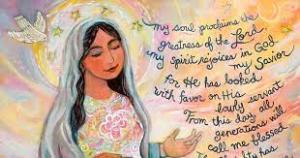
Mary’s prayer, the Magnificat, isn’t as serene as Christian piety often imagines. (Image credit: Your Daily Tripod)
I suppose I ought to say that the two contexts of Jesus’ ministry on earth were sin and grace. But from the beginning of Luke’s Gospel, which I’m following in these posts, what we see is poverty and power. Needless to say poverty and power were not evenly or fairly distributed in Jesus’ world (or any that I know of). What did that mean for Jesus and the evangelist Luke? Jesus’ concern was the Kingdom of God, but Christians have tended to spiritualize God’s kingdom. This post argues that, in Jesus’ and Luke’s minds, the Kingdom of God was never remote from the material conditions under which people lived in the kingdoms of this world.
Fourth in a series on social justice in the Gospel of Luke. For assistance in this series I rely mainly on two Bible scholars. Kenneth E. Bailey in Poet and Peasant and Through Peasant Eyes interprets Jesus’ parables in Luke. John Howard Yoder’s The Politics of Jesus helped Christians recognize Jesus’ concern for social justice, paying special attention to the Gospel of Luke.
After an introductory chapter (see this post) Yoder surveys the Gospel of Luke in a chapter he calls ”The Kingdom Coming.” This chapter will require several posts. Here I’m dealing with Luke’s so-called “infancy narrative.” It’s the story of two births, of John the Baptizer, son of Elizabeth and Zechariah, and Jesus, son of Mary. What is Luke telling us about where God stands in relation to the world’s poverty and power?
God’s favor toward the poor
Yoder begins his second chapter with two war-like hymns. Through centuries of repetition, the Church seems to have forgotten their militant tone. Mary’s “Magnificat” (My Soul Magnifies the Lord” and Simeon’s “Nunc dimitis” (Now you may dismiss your servant”) are constants in the Church’s liturgical morning and evening prayers, respectively. I’ll get to these great biblical prayers shortly. First, I want to look at how often God gives special attention or favor to the poor and powerless in Luke’s first two chapters. For Luke this unequal privileging in his world is important enough to mention at least six times:
- God grants a child to Elizabeth in her old age, to her who had been barren. “So has the Lord done for me at a time when he has seen fit to take away my disgrace before others.” (Luke 1:25)
- The Angel Gabriel appears to Mary: “Hail, favored one! The Lord is with you.” (1:28)
- On a visit to cousin Elizabeth, Mary praises God’s great deeds: “For he has looked upon his handmaid’s lowliness.” (1:48)
- Elizabeth, who had been barren, gives birth in her old age to a son. Her neighbors rejoice with her because “the Lord has shown his great mercy toward her.” (1:58)
- Zechariah, after John the Baptizer’s birth, praises “the tender mercy of our God by which the daybreak from on high will visit us to shine on those who sit in darkness and death’s shadow.” (1:68)
- Angels sing to poor, despised shepherds of the Messiah’s birth: “Glory to God in the highest and on earth peace to those on whom his favor rests.”( 2:14)
This last favor sums up all the rest. The new, more accurate translation (see this post), shows that God doesn’t favor everyone equally. God especially favors the poor.
Poverty and power and two revolutionary prayers
Here are some lines from Mary’s prayer the Magnificat:
He has shown might with his arm, dispersed the arrogant of mind and heart. He has thrown down the rulers from their thrones but lifted up the lowly. (Luke 2:31-32)
In any other book but the Bible, these lines would be about revolution. Yoder makes us wonder, Why should the Bible be different? Mary’s prayer reads like “the one whose birth is now being announced is to be an agent of radical social change.” (Yoder, p. 27)
In Luke’s Gospel the birth of John the Baptizer and his father Zechariah’s prayer comes shortly after Mary’s prayer. Zechariah praises God for
… salvation from our enemies and from the hand of all who hate us.… (1:71)
Jesus has come “to break the bondage of his people” (Yoder, p. 27), and it doesn’t look much like spiritual bondage. It looks more political.
Politics at the start of Luke’s Gospel
Luke brings up politics at the very beginning of his story. It’s setting in time is “in the days of King Herod, King of Judea….” (1:5) Luke isn’t simply being a historian here. Biblical authors aren’t all that concerned about getting history right, and Luke wasn’t too careful about secular history. He sets Jesus’ birth in the time “when Quirinius was governor of Syria.” Quirinius wasn’t governor of Syria until 10 years after Jesus was born. The census that would draw Mary and Joseph to Bethlehem is either historical fiction or another anachronism. But Jesus really was born “in the days of King Herod.” When Luke makes a historical, political claim, especially when he gets it right, it’s because it belongs in the story he wants to tell. Herod is not just a detail that some people might find interesting.
Sin and grace actually are all over Luke’s story, but these spiritual things are embedded in a world of poverty and power, of extremes of inequality and the powers that sustain such a sinful system. As Luke’s Gospel continues, Jesus will deal powerfully with that system.
Politics and Religion
Previous Post

January 9, 2022
Ministries in the Church, Momentum for Change, Again
Next Post
January 18, 2022 While Debt Sinks Nations, Some Hear Jesus’ Call for Jubilee
Browse Our Archives
Select a Category Advent Christmas Amazon Synod Angels Being Consumed Bible Catholic Modern Creed Ecology Economics Elizabeth Johnson Eucharist Fragments and Filaments Gender and Sex Gospel of Mark Herzog Historical Jesus Liturgy Luke Opening Scriptures on Way to Emmaus Ordinary radicals Parables Pro-Life Reincarnation Rosary Sacraments science Social Justice Souls Stories of Jesus The Creed Torture and Eucharist Tracy Uncategorized War and Peace
Select a Month October 2026 June 2025 April 2025 March 2025 February 2025 January 2025 November 2024 July 2024 March 2024 December 2023 October 2023 September 2023 August 2023 May 2023 April 2023 March 2023 February 2023 January 2023 December 2022 November 2022 October 2022 September 2022 August 2022 July 2022 June 2022 April 2022 March 2022 February 2022 January 2022 December 2021 November 2021 October 2021 August 2021 July 2021 June 2021 April 2021 March 2021 February 2021 December 2020 November 2020 October 2020 August 2020 July 2020 June 2020 May 2020 April 2020 March 2020 February 2020 January 2020 December 2019 November 2019 October 2019 September 2019 August 2019 July 2019 June 2019 May 2019 April 2019 March 2019 February 2019 January 2019 December 2018 November 2018 October 2018 September 2018 August 2018 July 2018 June 2018 May 2018
Follow Us!
TAKE THE
Religious Wisdom Quiz
In 1 Peter, what does Peter say Christ was chosen before but revealed in when?
Select your answer to see how you score.
Before Abraham was born, revealed at his baptism Before the creation of the world, revealed in these last times Before time began, revealed at the resurrection Before the prophets spoke, revealed at Pentecost
Related posts from Lost in a One-Acre Wood

Axios News, Inflation, Justice, and Young Workers in...
Catholic Church Repudiates the Doctrine of Discovery

Holy Thursday Theology and the Scientific Quest for...
‘Render to Caesar’ – or Not. The Speech...
TRENDING AT PATHEOS Catholic

Creation, Preservation, and Teleology in Catholic Theology
As I write this, it is very early Monday morning. Like millions...

The Parable Of The Sower And The Word...
One of Christ’s most famous parables is that of the sower who...

Rejecting Doom: Christian Hope And Human Action
Christianity is a religion of hope. We are to have hope and...

Why I Choose the Eucharist Over the Sermon
Choose the Eucharist, Not the Sermon What are we supposed to get...

5 Design Elements Found in Spiritually Rooted Homes
Putting Spirituality Into Home Decor Our homes are more than our living...

Credo: A Story of God Told with the...
About 10 years ago, I began to imagine a personal "Credo" that...
view all Catholic blogs
Ad-Free & Subscriber Log-In Subscription Support
- About Us
- 2026 Calendar
- Videos
- Podcasts
- Library of World Religions
- Faith In Media Tracker
- Advertise With Us
- Write for Us
- Privacy Policy
- Terms of Service
- Do Not Sell My Data
- Contact Us
- Radiant Digital
- Manage Newsletter Subscriptions
- Unsubscribe From Notifications
- Sitemap
Copyright 2008-2026, Patheos. All rights reserved.
Subscription Support Ad-Free & Subscriber Log-In
Follow Patheos