
BuddhistCatholicContemplativeEvangelicalGeneral ChristianHinduJewishLatter-day SaintMuslimNew VisionsProgressive Christian
Beliefs
- Buddhist
- Catholic
- Contemplative
- Evangelical
- General Christian
- Hindu
- Jewish
- Latter-day Saint
- More Voices
- Muslim
- New Visions
- Pagan
- Progressive Christian
Topics
- Religion News
- Food and Religion
- Sports and Religion
- Religious Art
- Religious Music and Entertainment
- Religious Events
- History and Religion
- Style and Religion
- Politics and Religion
- Women in Religion
- Recreation Outdoors and Religion
- Business Finance and Religion
- Careers Workplace and Religion
- Education and Religion
- Family Parenting and Religion
- Health Fitness and Religion
- Home and Religion
- Relationships and Religion
- Technology and Religion
- Travel and Religion
Columnists
- Buddhist Columnists
- Business Finance and Religion Columnists
- Careers Workplace and Religion Columnists
- Catholic Columnists
- Contemplative Columnists
- Education and Religion Columnists
- Evangelists Columnists
- Family Parenting and Religion Columnists
- General Christian Columnists
- Health Fitness and Religion Columnists
- Hindu Columnists
- History and Religion Columnists
- Home and Religion Columnists
- Jewish Columnists
- More Voices Columnists
- Latter Day Columnists
- Muslim Columnists
- New Visions Columnists
- Nonreligious Columnists
- Pagan Columnists
- Politics and Religion Columnists
- Progressive Columnists
- Recreation Outdoors and Religion Columnists
- Relationships and Religion Columnists
- Religion News Columnists
- Religious Art Columnists
- Religious Events Columnists
- Religious Music and Entertainment Columnists
- Sports and Religion Columnists
- Style and Religion Columnists
- Technology and Religion Columnists
- Travel and Religion Columnists
- Women in Religion Columnists
Resource Library
- 2026 Calendar
- Library of World Religions
- The 100 Most Holy Places on Earth
- Patheos Answers
- Podcasts
- Videos
- Faith Leaders Database
- Anglican Episcopalian
- Bahai
- Baptist
- Buddhism
- Christianity
- Confucianism
- Eastern Orthodoxy
- Hinduism
- Holiness and Pentecostal
- ISKCON
- Islam
- Judaism
- Lutheran
- Methodist
- The Church of Jesus Christ of Latter-day Saints
- New Age
- Paganism
- Presbytarian and Reformed
- Protestantism
- Religion Behind the Scenes
- Roman Catholic
- Scientology
- Shia Islam
- Sikhism
- Sufism
- Sunni Islam
- Taoism
- Zen
- See all religions
Research Tools
 Ad-Free & Subscriber Log-In Subscription Support
Ad-Free & Subscriber Log-In Subscription Support
Follow Patheos 

- Trending:
- Forgiveness
- |
- Marriage
- |
- Consciousness
- |
- Death Penalty
- |
- Election
- |
- Halloween

- Home
- Catholic
- Does Copernicus Have to be Wrong? Or, How the Bible Likes Modern Science
Does Copernicus Have to be Wrong? Or, How the Bible Likes Modern Science
Last updated on: February 13, 2023 at 8:21 am by Jack Hartjes
Does Copernicus Have to be Wrong? Or, How the Bible Likes Modern Science 2023-02-13T08:21:33-06:00 Jack Hartjes
Patheos Explore the world's faith through different perspectives on religion and spirituality! Patheos has the views of the prevalent religions and spiritualities of the world.
God’s love will find you no matter how far off the beaten path you are. (Image credit: Blendspace)
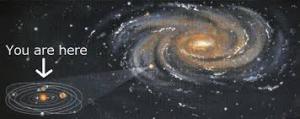
What Nicolai Copernicus said is right. Earth revolves around the Sun, along with all the other planets. After Copernicus, Galileo said the same thing and, more or less, proved it with his telescope. Earth is not the center of the universe. (See this post for a couple reasons why Galileo got in trouble with the church and Copernicus didn’t.) Copernicus needs no defense today, but in this post I want to make an unusual claim. The Bible, as the Catholic Church and many other Christians interpret it, can accommodate modern science. More than that, the Bible likes modern science, and so should you.
An anti-science cult
I’ll get to my main point later in a section I call “the glory of not being at the center.” First, what started this train of thought? In my Southern Minnesota hometown paper I saw a notice about a meeting of a “Scientific and Historical Study Group.” There were teasers like:
- The Moon: Our Enigmatic Neighbor and its “stunning relevance”
- The Mammon of Iniquity and “family-oriented local currency”
- A plea from Archbishop Vigano for “Christians to unite and rebuild – or to certainly perish”
- Evidence that “only a few hundred people in the world have ever seen”
It all sounded cultish to me, but that bit about the moon piqued my curiosity. At the meeting I met a laundry list of minority views. They included right-wing takes on Covid-19 and the vaccines, a plea for private money, and a critique of religious freedom in favor, I guess, of a return to Medieval Christendom. There was some science purporting to show that Earth is not as old as the consensus says it is. The Moon turned out, though, to be the real stunner as minority views go.
I have to be sympathetic toward people who cling to minority views. I once read a book about flying saucers and, for a time, was convinced they were real and patrolling our skies. There’s something very Christian and human about rooting for the underdog. I have a problem when the underdog wants to trade places with the overdog. But that’s getting ahead of the story.
A ‘French Catholic’ versus Copernicus
The odd science about the Moon comes from a French priest Fernand Crombette (1880-1970). Humbly he calls himself simply “a French Catholic.” In his thought Earth, more precisely Jerusalem or, rather, the hill outside Jerusalem where Jesus was crucified, is the center of the universe. The universe revolves around that spot.
To get to this point at the meeting, we started with doubts about what science says about the origin of the Moon. Was there a collision with an asteroid throwing off chunks of Earth that became the Moon, as majority science has it? Maybe the Moon was just a part of Earth flung off into space, instead.
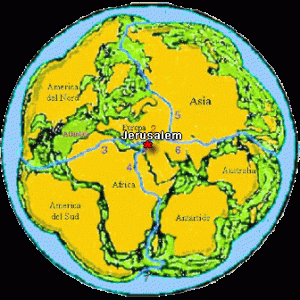
Pangaea as Fr. Crombette drew it. (Image credit: CESHE and Fernand Crombette)
Then we learned about Pangaea, the land mass that at one time included all the continents that now are separated. Fr. Crombette, and our presenter, departed from this well-accepted science in an interesting way. Pursuing his own research, Crombette “discovered” that this primitive continent had the shape of a flower with Jerusalem at its center! You can read more of Crombette’s theories in this online article.)
As if confirming the theory, we heard that a close look at the Moon, reveals a reverse image of the same picture. Apparently, a layer of Pangaea split off from Earth and became the Moon. Most astoundingly, like a fossil preserved for all time, Mt. Calvary appears at the exact center of this image on the Moon.
There’s more to the science that puts Earth and Calvary at the center. Crombette analyses the red shift of light from distant quasars and finds they inhabit concentric spheres surrounding Earth. The few hundred people who understand the theory only need to polish it a little more before going public. Meanwhile, we lucky ones at the meeting got to be in on the parts that we could understand.
Does the Bible say Copernicus has to be wrong?
I’ve heard of an odd group of mathematicians. They once claimed, not seriously but with exquisite mathematics, that Earth might be flat. Sure, people can circumnavigate the “globe.” But with the right number of dimensions, They could explain this on the model of a phonograph needle going around a record. In 1969, though, the group had to disband. That year the Apollo Moon Mission for the first time got far enough away to see the whole spinning Earth at once. Seeing was believing even for these skeptical, but honest, mathematicians.
I can imagine the same mathematicians holding out for an Earth-centered Solar System. Until, that is, more space missions gave us views of the Earth and other planets from the perspective of the farthest planets and beyond. Again, if seeing is believing and regardless of fancy mathematics, the Sun, not the Earth, is the center of the Solar System.
But maybe seeing isn’t believing when seeing conflicts with what the Bible says. The Bible, I think, is the force directing, and misdirecting, Fr. Crombette’s long and lonely scientific investigations. The article mentioned above refers to “his firm conviction of the scientific and historical inerrancy of the Bible.” It also describes Crombette as a “solitary researcher.” Well, he would find himself alone, or at least without many Catholic partners in his work. The Church does not teach that the Bible is scientifically and historically inerrant. Biblical inerrancy for Catholics extends only to “that truth which God wanted put into sacred writings for the sake of salvation. (Second Vatican Council document on Sacred Scripture, Dei Verbum)
The Bible does give us a picture of creation with Earth at the center. But that’s only ancient science. More important for our salvation, the Bible has something to say about being at the center or the periphery.
The glory of not being at the center … OR, How the Bible likes Copernicus
Since Copernicus, science has removed humankind from the center of the universe. Scientifically we are not as significant as we once thought we were. Some Christians find that disturbing, but the Bible’s response is, So what? God’s love can reach us no matter how insignificant a place we hold in creation. In fact God prefers it that way. Let’s look at some texts:
- I will make the wilderness a pool of water, and the dry land springs of water. (Isaiah 41:18
- But you, Israel, my servant, Jacob, whom I have chosen, the offspring of Abraham, my friend, you whom I took from the ends of the earth, and called from its farthest corners, saying to you, “You are my servant, I have chosen you and not cast you off.” (Isaiah 41:8-9)
- But you, O Bethlehem of Ephrathah, who are one of the little clans of Judah, from you shall come forth for me one who is to rule in Israel, whose origin is from of old, from ancient days. (Micah 5:2)
- John the baptizer appeared in the wilderness…. In those days Jesus came from Nazareth of Galilee and was baptized by John in the Jordan. (Mark 1:4,9)
- Philip found Nathanael and said to him, “We have found him about whom Moses in the law and also the prophets wrote, Jesus son of Joseph from Nazareth.” Nathanael said to him, “Can anything good come out of Nazareth?”
The Eucharist at the center
Out of history’s 10,000 years and Earth’s billions of years, God chose a slice of time, about a thousand years. Out of all the lands of earth, God chose an area the size of a smallish U.S. state. And out of all the peoples on this planet, a nondescript nation somewhat behind its neighbors in cultural development became God’s people. Among those people it was often the least that God favored the most. It was a humble carpenter’s son from a town that was the butt of jokes such as Nathanael repeated. But into this Jesus from “Nowheresville” God poured the entire divine essence.
God is best known for loving the tiniest, most insignificant of specks. The flower of the field. The sparrow that falls. That is exactly what God does in centering his attention on a lowly planet circling around the periphery of the Milky Way, one of billions of galaxies in the 13 billion year old universe.
So, yes, Earth is at the center – the center of God’s love. It doesn’t have to be any other center. And because it isn’t any other center, we can see all the more the wonder of God’s love. And we know that the margins of society is where we need to take that love.
In the Eucharistic Bread, a tiny fragment of matter, God’s inmost depth reaches our inmost depths. And it makes no difference if we’re in the grandest cathedral or a hut in a tropical rainforest. Wherever the Eucharist is celebrated, that’s where God centers his love. That’s where Calvary and the entire history of God’s love is present again.
Jerusalem doesn’t have to be the center of the world. Calvary doesn’t have to be anything grander than the hill on which Jesus gave his life for us.
Previous Post

December 8, 2021
‘Angels Unawares’ Sculpture Welcomes the Stranger at Catholic U
Next Post
December 20, 2021 God’s Favor (in the Angel’s Song) Rests on … Whom?
Browse Our Archives
Select a Category Advent Christmas Amazon Synod Angels Being Consumed Bible Catholic Modern Creed Ecology Economics Elizabeth Johnson Eucharist Fragments and Filaments Gender and Sex Gospel of Mark Herzog Historical Jesus Liturgy Luke Opening Scriptures on Way to Emmaus Ordinary radicals Parables Pro-Life Reincarnation Rosary Sacraments science Social Justice Souls Stories of Jesus The Creed Torture and Eucharist Tracy Uncategorized War and Peace
Select a Month October 2026 June 2025 April 2025 March 2025 February 2025 January 2025 November 2024 July 2024 March 2024 December 2023 October 2023 September 2023 August 2023 May 2023 April 2023 March 2023 February 2023 January 2023 December 2022 November 2022 October 2022 September 2022 August 2022 July 2022 June 2022 April 2022 March 2022 February 2022 January 2022 December 2021 November 2021 October 2021 August 2021 July 2021 June 2021 April 2021 March 2021 February 2021 December 2020 November 2020 October 2020 August 2020 July 2020 June 2020 May 2020 April 2020 March 2020 February 2020 January 2020 December 2019 November 2019 October 2019 September 2019 August 2019 July 2019 June 2019 May 2019 April 2019 March 2019 February 2019 January 2019 December 2018 November 2018 October 2018 September 2018 August 2018 July 2018 June 2018 May 2018
Follow Us!
TAKE THE
Religious Wisdom Quiz
Who was known as the doubter among Jesus' disciples?
Select your answer to see how you score.
Peter James Thomas John
Related posts from Lost in a One-Acre Wood

Credo: A Story of God Told with the...

Richard A. Horsley Sees Jesus in the Context...
“Jesus Wept.” Don’t Take the Humanity out of...

Holy Thursday Theology and the Scientific Quest for...
TRENDING AT PATHEOS Catholic

Rejecting Doom: Christian Hope And Human Action
Christianity is a religion of hope. We are to have hope and...

It’s What Comes From Within Which Matters
One of the most difficult things for us to understand is why...

Why I Choose the Eucharist Over the Sermon
Choose the Eucharist, Not the Sermon What are we supposed to get...

5 Design Elements Found in Spiritually Rooted Homes
Putting Spirituality Into Home Decor Our homes are more than our living...

Credo: A Story of God Told with the...
About 10 years ago, I began to imagine a personal "Credo" that...

The Anatomy of Divine Revelation in Catholic Thought
The claim that God has made Himself known to human beings is...
view all Catholic blogs
Ad-Free & Subscriber Log-In Subscription Support
- About Us
- 2026 Calendar
- Videos
- Podcasts
- Library of World Religions
- Faith In Media Tracker
- Advertise With Us
- Write for Us
- Privacy Policy
- Terms of Service
- Do Not Sell My Data
- Contact Us
- Radiant Digital
- Manage Newsletter Subscriptions
- Unsubscribe From Notifications
- Sitemap
Copyright 2008-2026, Patheos. All rights reserved.
Subscription Support Ad-Free & Subscriber Log-In
Follow Patheos