
BuddhistCatholicContemplativeEvangelicalGeneral ChristianHinduJewishLatter-day SaintMuslimNew VisionsProgressive Christian
Beliefs
- Buddhist
- Catholic
- Contemplative
- Evangelical
- General Christian
- Hindu
- Jewish
- Latter-day Saint
- More Voices
- Muslim
- New Visions
- Pagan
- Progressive Christian
Topics
- Religion News
- Food and Religion
- Sports and Religion
- Religious Art
- Religious Music and Entertainment
- Religious Events
- History and Religion
- Style and Religion
- Politics and Religion
- Women in Religion
- Recreation Outdoors and Religion
- Business Finance and Religion
- Careers Workplace and Religion
- Education and Religion
- Family Parenting and Religion
- Health Fitness and Religion
- Home and Religion
- Relationships and Religion
- Technology and Religion
- Travel and Religion
Columnists
- Buddhist Columnists
- Business Finance and Religion Columnists
- Careers Workplace and Religion Columnists
- Catholic Columnists
- Contemplative Columnists
- Education and Religion Columnists
- Evangelists Columnists
- Family Parenting and Religion Columnists
- General Christian Columnists
- Health Fitness and Religion Columnists
- Hindu Columnists
- History and Religion Columnists
- Home and Religion Columnists
- Jewish Columnists
- More Voices Columnists
- Latter Day Columnists
- Muslim Columnists
- New Visions Columnists
- Nonreligious Columnists
- Pagan Columnists
- Politics and Religion Columnists
- Progressive Columnists
- Recreation Outdoors and Religion Columnists
- Relationships and Religion Columnists
- Religion News Columnists
- Religious Art Columnists
- Religious Events Columnists
- Religious Music and Entertainment Columnists
- Sports and Religion Columnists
- Style and Religion Columnists
- Technology and Religion Columnists
- Travel and Religion Columnists
- Women in Religion Columnists
Resource Library
- 2026 Calendar
- Library of World Religions
- The 100 Most Holy Places on Earth
- Patheos Answers
- Podcasts
- Videos
- Faith Leaders Database
- Anglican Episcopalian
- Bahai
- Baptist
- Buddhism
- Christianity
- Confucianism
- Eastern Orthodoxy
- Hinduism
- Holiness and Pentecostal
- ISKCON
- Islam
- Judaism
- Lutheran
- Methodist
- The Church of Jesus Christ of Latter-day Saints
- New Age
- Paganism
- Presbytarian and Reformed
- Protestantism
- Religion Behind the Scenes
- Roman Catholic
- Scientology
- Shia Islam
- Sikhism
- Sufism
- Sunni Islam
- Taoism
- Zen
- See all religions
Research Tools
 Ad-Free & Subscriber Log-In Subscription Support
Ad-Free & Subscriber Log-In Subscription Support
Follow Patheos 

- Trending:
- Forgiveness
- |
- Marriage
- |
- Consciousness
- |
- Death Penalty
- |
- Election
- |
- Halloween

- Home
- Catholic
- Writing about the Infinite God – And Trying to Like Infinity, Part 1
Writing about the Infinite God – And Trying to Like Infinity, Part 1
Last updated on: October 28, 2021 at 12:04 pm by Jack Hartjes
Writing about the Infinite God – And Trying to Like Infinity, Part 1 2021-10-28T12:04:27-06:00 Jack Hartjes
Patheos Explore the world's faith through different perspectives on religion and spirituality! Patheos has the views of the prevalent religions and spiritualities of the world.
On David Tracy’s Fragments, Chapter 5, “Metaphysics, Theology, and Mysticism”
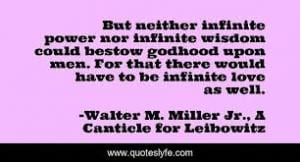
Is infinite power a helpful way to think about God’s infinity?
How do I write about our infinite God? Besides being only finite, my mind has an extra problem – I don’t like infinity. I remember learning that scientists found the universe wasn’t infinite. I realized then that I liked the world better that way. What’s to like about an infinite world, anyway. It’s not a place to feel at home in. As soon as I learned that the scientific world is not infinite, I also saw that I could think of the whole universe as comfortably small.
Fans of modern science often think people in the Middle Ages imagined a small cosmos surrounding a large, and very important, earth. Actually, the Medieval picture was about the opposite of that. The cosmos was huge, with seven angelic spheres and God’s realm beyond that. Earth in the middle was a dot by comparison, not cosmically important compared to the angels’ homes. (But God may have loved Earth and her inhabitants best.) The whole cosmos was finite, like our universe. More than science’s world, it was a place you could feel at home in. Many, though not all, theologians believed that even God was not infinite.
But David Tracy says the Infinite is God’s “most appropriate” name, a name that “pervades all [the other] names” for God. (p. 47) The Bible says, “God is love.” It doesn’t say “infinite love,” but Pope Francis does in his latest encyclical. I have to think again about our infinite God.
Infinite power?
Infinity makes me think about size, length of time, and, especially, power. Just expand these measurable things ad infinitum. As for size, I don’t think of God as having any. Infinite duration isn’t quite right for God, either. God is eternal, outside of time, rather than progressing through infinite time. But power is a different story. Power fascinates. It fascinated the Bible’s authors. In Bible stories kingdoms and the forces of nature all bow to the divine will. Imagining God’s power is like taking all we know about power, on earth, in the sky, or in human hands, and enlarging it to an infinite degree.
As I think about God’s infinity, I want, first, to test this infinite power idea. People so readily imagine power is the key to solving every problem. No matter the issue or the venue, power is always there, ready to keep a conflict going. I prefer not to let that human fixture color my thoughts about God.
The oldest story in the world and the Bible
A story older than the Bible, perhaps the world’s oldest story, dates from before 1750 BCE. It tells about powerful gods in the religious imaginings of Israel’s neighbors. The Bible writers knew this story:
The “Enuma Elish,” the Mesopotamian creation myth, details the birth of the gods Apsu and Tiamat from swirling, chaotic waters. Their union produces the younger gods. Apsu, however, decides to kill the annoying younger gods. Tiamat warns her oldest son, Enki, who kills Apsu. Now Tiamat is upset, not so logically, at the loss of her mate and makes war on her children. Marduk emerges as champion of the otherwise hapless younger gods. He kills Tiamat and out of her corpse creates the heavens and the earth.
From the swirling waters to the creation of heaven and earth, this story is saturated with power and gods who use power against each other. But Israel told a story of a divinity even more impressive. Genesis tells how Yahweh created the heavens and the earth. There is the same initial swirling watery chaos. But in Israel’s story God creates without any struggle, by a mere word – “Let there be.” I used to imagine that this divine power so far surpassed that of the other gods that what was a struggle for them was a cinch for Israel’s God. How could such divine power be less than infinite? But also, How could belief in such a God not justify and encourage our fascination with power?
Another side of God
I remember my young fascination with the new, immensely powerful nuclear weapons of the 1950’s. Speed also, as in faster than sound jets and rockets soaring into space, fascinated me. In high school seminary religion classes, creation ex nihilo elicited the same feelings. A teacher said there’s an infinite distance between nothing and something, so creation must have required infinite power.
Well, my early fascination with H-bombs has turned to a more mature and reasonable fright. I learned to prefer speed on a more human scale like running races and sliding down snowy hillsides. I no longer believe “nothing” is infinitely distant from “something.” Zero and, say, a million and 70 are not infinitely far apart. As for creation, I remembered that in Genesis God simply speaks: “Let there be … and so it happened.” It doesn’t sound like a use of infinite power or any power at all.
Creation didn’t start with nothing (symbolized by chaos in the old stories) that needed to be turned into something. God started with God’s own self. Creation is a gift, even a sacrificial gift, out of God’s fullness. (It’s an echo of the Father’s gift of himself to the Son, but that Trinitarian speculation is another large topic.) I don’t think it’s wrong to think of creation and sacrifice together or even to say that God the Father was, in some way, making a sacrifice. After all, Jesus, by his sacrificial life and death, showed us what the Father is like.
Sacrificing what God otherwise might have been, God creates a world and takes on new relationships, new loves, new commitments (new problems?). God doesn’t become by this sacrifice anything less than infinitely perfect, just different.
Infinitely perfect?
Tracy uses the phrase “infinitely perfect” of God. But what could that mean? How do the two words fit together? We think of infinity as open ended. There are no edges and nothing to hem it in. But perfection signifies completeness. There’s no adding to it or changing it. It’s already finished off—perfect.
Tracy, I think, reveals what most motivates him throughout Fragments in an early paragraph in this chapter on infinity. He contrasts the Christian God with some other conceptions of Absolute, Ultimate Reality:
Unlike some understandings of … the Ultimate, the Absolute, the category Infinite does not close into an encompassing totality…. The true Absolute Infinite is always infinitely open as well as internally related to all other reality, which the Absolute often is not (e.g., as understood by Hegel). (p. 94)
And throughout Fragments Tracy intends to “shatter, fragment, negate any closed totality system.” (p. 1) Perfection, if there is such a thing, must leave room for something new. Progress is one of the idols the modern Western world worships. But take away the idolatry and you still have something good, something that the ancient, static worldview was missing. Change can be a positive thing. Growth is one quality of perfection. I imagine the divine play of love of the Father and the Son in the Holy Spirit as an exchange that keeps growing in its eternal back-and-forth. After all, human love grows when it is returned. I think we’ll find, when we get there, that heaven is more dynamic than the traditional phrase “beatific vision” connotes.
Infinite love
Tracy says the infinite “pervades all [the other] names” for God. So, if power is a name for God, then God’s power must be infinite. With infinite power a super-being could move with infinite velocity. That would reduce the time for getting from point A to point B to zero. You’d be in both places and all the places between simultaneously. That doesn’t sound like movement at all. We say God is present everywhere, but it’s not because God moves so fast. The idea of infinite power brings up other conundrums. Foremost of these is the problem of theodicy. If God is both infinitely powerful and infinitely good, then God should have made a world without undeserved suffering. (See this post for my attempt at theodicy, my defense of God on the issue of suffering.)
“God is love.” The Bible nowhere says “God is power.” We speak of the power of love, but that’s not power in any literal sense. The Creed speaks of God’s almighty power, and that theme is strong in the Bible. But “all powerful” is not the same as “infinitely powerful.” All power is God’s power, but all the power in a finite world does not add up to infinity.
This attempt to think about our infinite God, with the help of Tracy’s book Fragments, Chapter 5, will continue in another post. I’m still trying to understand, or at least like God’s infinity. Maybe infinite Love will make more sense than infinite power. Or infinite Goodness or infinite Beauty. It will be a challenge to try to apply infinity to things we can’t measure.
Image credit: QuotesLyfe
Previous Post

August 27, 2020
BirthStrike Movement to Dissolve Next Week
Next Post
November 14, 2020 The Pro-life President Trump Could Have Been
Browse Our Archives
Select a Category Advent Christmas Amazon Synod Angels Being Consumed Bible Catholic Modern Creed Ecology Economics Elizabeth Johnson Eucharist Fragments and Filaments Gender and Sex Gospel of Mark Herzog Historical Jesus Liturgy Luke Opening Scriptures on Way to Emmaus Ordinary radicals Parables Pro-Life Reincarnation Rosary Sacraments science Social Justice Souls Stories of Jesus The Creed Torture and Eucharist Tracy Uncategorized War and Peace
Select a Month October 2026 June 2025 April 2025 March 2025 February 2025 January 2025 November 2024 July 2024 March 2024 December 2023 October 2023 September 2023 August 2023 May 2023 April 2023 March 2023 February 2023 January 2023 December 2022 November 2022 October 2022 September 2022 August 2022 July 2022 June 2022 April 2022 March 2022 February 2022 January 2022 December 2021 November 2021 October 2021 August 2021 July 2021 June 2021 April 2021 March 2021 February 2021 December 2020 November 2020 October 2020 August 2020 July 2020 June 2020 May 2020 April 2020 March 2020 February 2020 January 2020 December 2019 November 2019 October 2019 September 2019 August 2019 July 2019 June 2019 May 2019 April 2019 March 2019 February 2019 January 2019 December 2018 November 2018 October 2018 September 2018 August 2018 July 2018 June 2018 May 2018
Follow Us!
TAKE THE
Religious Wisdom Quiz
Pride deceived those who dwell in the clefts of the rocks and make their home on the heights. Which nation was being addressed?
Select your answer to see how you score.
Ammon Moab Philistia Edom
Related posts from Lost in a One-Acre Wood
Theologies and a New Paradigm: Mutually Critical Correlations

The Impossible and the Infinitely Loving God: Mystics...

Suffering: No Why’s, No Theodicies, but a Crucified...
Ancient Greek Tragedy, a Response to Horror and...
TRENDING AT PATHEOS Catholic

The Parable Of The Sower And The Word...
One of Christ’s most famous parables is that of the sower who...

Rejecting Doom: Christian Hope And Human Action
Christianity is a religion of hope. We are to have hope and...

Why I Choose the Eucharist Over the Sermon
Choose the Eucharist, Not the Sermon What are we supposed to get...

5 Design Elements Found in Spiritually Rooted Homes
Putting Spirituality Into Home Decor Our homes are more than our living...

Credo: A Story of God Told with the...
About 10 years ago, I began to imagine a personal "Credo" that...

The Anatomy of Divine Revelation in Catholic Thought
The claim that God has made Himself known to human beings is...
view all Catholic blogs
Ad-Free & Subscriber Log-In Subscription Support
- About Us
- 2026 Calendar
- Videos
- Podcasts
- Library of World Religions
- Faith In Media Tracker
- Advertise With Us
- Write for Us
- Privacy Policy
- Terms of Service
- Do Not Sell My Data
- Contact Us
- Radiant Digital
- Manage Newsletter Subscriptions
- Unsubscribe From Notifications
- Sitemap
Copyright 2008-2026, Patheos. All rights reserved.
Subscription Support Ad-Free & Subscriber Log-In
Follow Patheos