
BuddhistCatholicContemplativeEvangelicalGeneral ChristianHinduJewishLatter-day SaintMuslimNew VisionsProgressive Christian
Beliefs
- Buddhist
- Catholic
- Contemplative
- Evangelical
- General Christian
- Hindu
- Jewish
- Latter-day Saint
- More Voices
- Muslim
- New Visions
- Pagan
- Progressive Christian
Topics
- Religion News
- Food and Religion
- Sports and Religion
- Religious Art
- Religious Music and Entertainment
- Religious Events
- History and Religion
- Style and Religion
- Politics and Religion
- Women in Religion
- Recreation Outdoors and Religion
- Business Finance and Religion
- Careers Workplace and Religion
- Education and Religion
- Family Parenting and Religion
- Health Fitness and Religion
- Home and Religion
- Relationships and Religion
- Technology and Religion
- Travel and Religion
Columnists
- Buddhist Columnists
- Business Finance and Religion Columnists
- Careers Workplace and Religion Columnists
- Catholic Columnists
- Contemplative Columnists
- Education and Religion Columnists
- Evangelists Columnists
- Family Parenting and Religion Columnists
- General Christian Columnists
- Health Fitness and Religion Columnists
- Hindu Columnists
- History and Religion Columnists
- Home and Religion Columnists
- Jewish Columnists
- More Voices Columnists
- Latter Day Columnists
- Muslim Columnists
- New Visions Columnists
- Nonreligious Columnists
- Pagan Columnists
- Politics and Religion Columnists
- Progressive Columnists
- Recreation Outdoors and Religion Columnists
- Relationships and Religion Columnists
- Religion News Columnists
- Religious Art Columnists
- Religious Events Columnists
- Religious Music and Entertainment Columnists
- Sports and Religion Columnists
- Style and Religion Columnists
- Technology and Religion Columnists
- Travel and Religion Columnists
- Women in Religion Columnists
Resource Library
- 2026 Calendar
- Library of World Religions
- The 100 Most Holy Places on Earth
- Patheos Answers
- Podcasts
- Videos
- Faith Leaders Database
- Anglican Episcopalian
- Bahai
- Baptist
- Buddhism
- Christianity
- Confucianism
- Eastern Orthodoxy
- Hinduism
- Holiness and Pentecostal
- ISKCON
- Islam
- Judaism
- Lutheran
- Methodist
- The Church of Jesus Christ of Latter-day Saints
- New Age
- Paganism
- Presbytarian and Reformed
- Protestantism
- Religion Behind the Scenes
- Roman Catholic
- Scientology
- Shia Islam
- Sikhism
- Sufism
- Sunni Islam
- Taoism
- Zen
- See all religions
Research Tools
 Ad-Free & Subscriber Log-In Subscription Support
Ad-Free & Subscriber Log-In Subscription Support
Follow Patheos 

- Trending:
- Forgiveness
- |
- Marriage
- |
- Consciousness
- |
- Death Penalty
- |
- Election
- |
- Halloween

- Home
- Catholic
- Analogy vs. Logic: Arguing Matters Close to the Heart
Analogy vs. Logic: Arguing Matters Close to the Heart
Last updated on: February 13, 2023 at 9:05 am by Jack Hartjes
Analogy vs. Logic: Arguing Matters Close to the Heart 2023-02-13T09:05:37-06:00 Jack Hartjes
Patheos Explore the world's faith through different perspectives on religion and spirituality! Patheos has the views of the prevalent religions and spiritualities of the world.
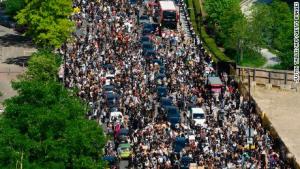
Does analogy help reveal the truth behind protests like this one?
The dangerous use of analogy over protest marches
People often resort to the literary technique of analogy when arguing about emotional issues. In fact, it’s unavoidable. Pure logic simply won’t do for the matters that are closest to the heart, like God, beauty, morality, politics and what we ought to hope for. To my elementary school students I taught what I had learned in college classes, namely, that these are all matters of opinion. I had learned wrong and was teaching wrong. There is truth in all these matters of the heart, even if it’s hard to get at with straight logic. Analogy is one technique people often use.
I’m still thinking, as in the last two posts, about the murder of George Floyd in Minneapolis and the protests that followed. So are many others, and the use of analogy is thriving, at least on social media. Not always in ways that help the conversation along. Here I give two examples of using analogy in politics. In one I try to use the technique correctly.
A man throws a boy off the third-floor balcony at Mall of America
This analogy finds, as one supposes, an inconsistency between two instances of black versus white conflict:
Remember when a black career criminal threw a 5-year-old white boy off the third floor balcony in Minnesota’s Mall of America?
Me too.
Remember the race riots?
Me neither.
(The boy survived, miraculously according to his parents. You can find the legal resolution of this case here.)
David Tracy has been my main blog interest lately and will be for a while. One of his big concepts is what he calls “the Catholic analogical imagination.” Analogy plays a key role in Tracy’s thought, but he doesn’t shy away from ordinary logic. In fact, he says, while theological reasoning may go beyond logic, it must be at least logically coherent.
I didn’t realize how important that seemingly obvious reminder is until someone on social media tried to use a black-on-white attempted murder as an analogy for the murder of a black man by a white police officer. The two are analogous, but to think that protests and riots should follow one if they follow the other is to operate with a faulty definition of political protest. That’s a logical failure. In the Mall of America case there was no real political issue to protest about.
Armed protestors violate lockdown order at Michigan State Capitol
Here’s another analogy. The data comes from Slate News. Two groups violate a law, both engaging in a political protest:
- An armed group of white men march into a state Capitol. (North Carolina and Michigan are two of several where this took place.) Members come within inches of the faces of police standing by, violating a lockdown regulation and social distancing rules. Police, responding only with calm discipline, make no effort to push the men back or clear the space. In Michigan lawmakers decide to close the session so as not to risk violence, aware of death threats against Governor Gretchen Whitmer.
- Last Saturday evening a mixed-race group of unarmed men and women marched through the streets of Minneapolis in violation of a curfew. Everything was peaceful. Suddenly police and national guard arrived and pushed the crowd back with teargas, flash bangs, and rubber bullets. Many protesters were arrested.
There are similarities and differences. Both groups are protesters. One protests against the orders which they are presently violating—lockdown and social distancing. The other protests a longstanding pattern of police action culminating in the recent murder of George Floyd. The biggest difference is in the reaction of law enforcement.
Using the analogy
I’d like to draw some conclusions from this analogy, but it’s tricky. Can I conclude that police should have acted in Minneapolis as they did in Michigan and North Carolina? Or vice versa? Or maybe that white people, but not people of color can get away with violating laws in this unjust world? Actually, while I endorse that last thought, this analogy doesn’t prove it. I believe law enforcement acted properly in both instances. They didn’t make martyrs out of a bunch of ridiculous men in the first, and they countered the violence of previous nights in the second.
One legitimate conclusion is obvious and quite easy to draw since it concerns only what is evident in the different scenes themselves. The peaceful people marching through the streets of Minneapolis were a whole lot braver than the gun-toters at the state capitols. Even if you know nothing about or have no opinion on the respective causes, you naturally respect the marchers in Minneapolis more than the others. Because of that respect, you want to lend an open mind to the cause of racial justice—exactly the result that the marchers want.
Martyrs like Jesus
I like to think of the arrests on that Saturday night in Minneapolis as a kind of martyrdom. It was even more obvious the following night when hundreds of protesters offered themselves peacefully and even joyfully to the arresting officers. They were practicing civil disobedience in the classic style, fully accepting the consequences of their actions.
Those consequences were not much like the consequence that Jesus faced. But the people were like Jesus in their willing acceptance and submission to the law’s demand, even if the whole system in both cases is unjust. Another way they were like Jesus isn’t often remarked upon, but Jesus, like them, practiced civil disobedience. Certainly that was his deliberate intention when he went into the Temple area and made a small ruckus. The action couldn’t have been much more than symbolic given the huge size of that pre-paschal market. I tend to think Jesus was deliberately flouting Sabbath rules also with many of his healings on the day of no work. It wouldn’t have hurt much to have waited till the next day.
But Jesus wasn’t dealing just with isolated incidents of disease, hunger, and possession. The evil Jesus faced was the sin of the world. That sin was festering not just in the minds of individuals, though there were individual bad guys. It existed most powerfully in the unjust systems that controlled that world. The system was responsible for much of the disease, hunger, and poverty of that world. Even the phenomenon of demonic possession (according to some anthropologists) can be an unconscious reaction to being under the thumb (possessed by) an unjust system.
In this way also the marchers in Minneapolis were like Jesus, fighting against an unjust system, one present-day example of the “sin of the world.”
Final note
Along this same line, Minnesota governor Tim Walz made a perceptive comment during a briefing on Monday. He said we are not dealing with a broken system. In the case of George Floyd, the system operated exactly as designed. It’s our job to change the design of that system.
Image credit: Cable News Network
Previous Post

June 1, 2020
Protesters and Rioters: In Minneapolis There’s a Big Difference.
Next Post
June 10, 2020 Invisible Things and the Ultimate Infinite Invisible
Browse Our Archives
Select a Category Advent Christmas Amazon Synod Angels Being Consumed Bible Catholic Modern Creed Ecology Economics Elizabeth Johnson Eucharist Fragments and Filaments Gender and Sex Gospel of Mark Herzog Historical Jesus Liturgy Luke Opening Scriptures on Way to Emmaus Ordinary radicals Parables Pro-Life Reincarnation Rosary Sacraments science Social Justice Souls Stories of Jesus The Creed Torture and Eucharist Tracy Uncategorized War and Peace
Select a Month October 2026 June 2025 April 2025 March 2025 February 2025 January 2025 November 2024 July 2024 March 2024 December 2023 October 2023 September 2023 August 2023 May 2023 April 2023 March 2023 February 2023 January 2023 December 2022 November 2022 October 2022 September 2022 August 2022 July 2022 June 2022 April 2022 March 2022 February 2022 January 2022 December 2021 November 2021 October 2021 August 2021 July 2021 June 2021 April 2021 March 2021 February 2021 December 2020 November 2020 October 2020 August 2020 July 2020 June 2020 May 2020 April 2020 March 2020 February 2020 January 2020 December 2019 November 2019 October 2019 September 2019 August 2019 July 2019 June 2019 May 2019 April 2019 March 2019 February 2019 January 2019 December 2018 November 2018 October 2018 September 2018 August 2018 July 2018 June 2018 May 2018
Follow Us!
TAKE THE
Religious Wisdom Quiz
What year was the King James Bible first published?
Select your answer to see how you score.
1611 1492 1701 1517
Related posts from Lost in a One-Acre Wood

Axios News, Inflation, Justice, and Young Workers in...
Catholic Church Repudiates the Doctrine of Discovery

Holy Thursday Theology and the Scientific Quest for...
‘Render to Caesar’ – or Not. The Speech...
TRENDING AT PATHEOS Catholic

Creation, Preservation, and Teleology in Catholic Theology
As I write this, it is very early Monday morning. Like millions...

The Parable Of The Sower And The Word...
One of Christ’s most famous parables is that of the sower who...

Rejecting Doom: Christian Hope And Human Action
Christianity is a religion of hope. We are to have hope and...

Why I Choose the Eucharist Over the Sermon
Choose the Eucharist, Not the Sermon What are we supposed to get...

5 Design Elements Found in Spiritually Rooted Homes
Putting Spirituality Into Home Decor Our homes are more than our living...

Credo: A Story of God Told with the...
About 10 years ago, I began to imagine a personal "Credo" that...
view all Catholic blogs
Ad-Free & Subscriber Log-In Subscription Support
- About Us
- 2026 Calendar
- Videos
- Podcasts
- Library of World Religions
- Faith In Media Tracker
- Advertise With Us
- Write for Us
- Privacy Policy
- Terms of Service
- Do Not Sell My Data
- Contact Us
- Radiant Digital
- Manage Newsletter Subscriptions
- Unsubscribe From Notifications
- Sitemap
Copyright 2008-2026, Patheos. All rights reserved.
Subscription Support Ad-Free & Subscriber Log-In
Follow Patheos