
BuddhistCatholicContemplativeEvangelicalGeneral ChristianHinduJewishLatter-day SaintMuslimNew VisionsProgressive Christian
Beliefs
- Buddhist
- Catholic
- Contemplative
- Evangelical
- General Christian
- Hindu
- Jewish
- Latter-day Saint
- More Voices
- Muslim
- New Visions
- Pagan
- Progressive Christian
Topics
- Religion News
- Food and Religion
- Sports and Religion
- Religious Art
- Religious Music and Entertainment
- Religious Events
- History and Religion
- Style and Religion
- Politics and Religion
- Women in Religion
- Recreation Outdoors and Religion
- Business Finance and Religion
- Careers Workplace and Religion
- Education and Religion
- Family Parenting and Religion
- Health Fitness and Religion
- Home and Religion
- Relationships and Religion
- Technology and Religion
- Travel and Religion
Columnists
- Buddhist Columnists
- Business Finance and Religion Columnists
- Careers Workplace and Religion Columnists
- Catholic Columnists
- Contemplative Columnists
- Education and Religion Columnists
- Evangelists Columnists
- Family Parenting and Religion Columnists
- General Christian Columnists
- Health Fitness and Religion Columnists
- Hindu Columnists
- History and Religion Columnists
- Home and Religion Columnists
- Jewish Columnists
- More Voices Columnists
- Latter Day Columnists
- Muslim Columnists
- New Visions Columnists
- Nonreligious Columnists
- Pagan Columnists
- Politics and Religion Columnists
- Progressive Columnists
- Recreation Outdoors and Religion Columnists
- Relationships and Religion Columnists
- Religion News Columnists
- Religious Art Columnists
- Religious Events Columnists
- Religious Music and Entertainment Columnists
- Sports and Religion Columnists
- Style and Religion Columnists
- Technology and Religion Columnists
- Travel and Religion Columnists
- Women in Religion Columnists
Resource Library
- 2026 Calendar
- Library of World Religions
- The 100 Most Holy Places on Earth
- Patheos Answers
- Podcasts
- Videos
- Faith Leaders Database
- Anglican Episcopalian
- Bahai
- Baptist
- Buddhism
- Christianity
- Confucianism
- Eastern Orthodoxy
- Hinduism
- Holiness and Pentecostal
- ISKCON
- Islam
- Judaism
- Lutheran
- Methodist
- The Church of Jesus Christ of Latter-day Saints
- New Age
- Paganism
- Presbytarian and Reformed
- Protestantism
- Religion Behind the Scenes
- Roman Catholic
- Scientology
- Shia Islam
- Sikhism
- Sufism
- Sunni Islam
- Taoism
- Zen
- See all religions
Research Tools
 Ad-Free & Subscriber Log-In Subscription Support
Ad-Free & Subscriber Log-In Subscription Support
Follow Patheos 

- Trending:
- Forgiveness
- |
- Marriage
- |
- Consciousness
- |
- Death Penalty
- |
- Election
- |
- Halloween

- Home
- Catholic
- Father J. P. Grayland on Clerics’ Eucharistic Fast during Pandemic
Father J. P. Grayland on Clerics’ Eucharistic Fast during Pandemic
Last updated on: April 15, 2023 at 5:43 am by Jack Hartjes
Father J. P. Grayland on Clerics’ Eucharistic Fast during Pandemic 2023-04-15T05:43:53-06:00 Jack Hartjes
Patheos Explore the world's faith through different perspectives on religion and spirituality! Patheos has the views of the prevalent religions and spiritualities of the world.
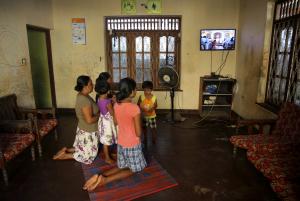
A Sri Lankan family worships with the help of Mass on TV.
A New Zealand parish priest has an interesting take on the Church’s liturgical response to the coronavirus pandemic. Father J. P. Grayland says our clerical bias is showing. What is the place of the baptized lay faithful, Father Grayland wonders, when the Church’s public liturgy can happen without lay people present?
Grayland describes himself as “pastor of three parishes in a small rural diocese in a small, secular country.” A priest for 30 years, he has written books, including Catholics. Prayer, Belief and Diversity in a Secular Context. La Croix International published “Pandemic and the Dilemma of Catholic Liturgy,” an article he wrote recently.
Domestic church and ‘bubble’ prayers
While Catholics are isolated from each other in their homes, we have an opportunity to develop what it means to be a domestic church. In New Zealand language, Grayland calls it the “bubble” church with its “bubble” way of praying. He thinks “we may be underestimating the ability of the lay-domestic Church to pray in new and innovative ways.” That’s especially true at this time when the main new offering of the hierarchical church to the domestic church is more live-streamed TV Masses.
The coronavirus could not have picked a worse time, liturgically, to strike. The Easter Triduum holds the three most solemn and beautiful liturgies of the year. This year Catholics were unable to go to church to celebrate. I did not substitute, as many Catholics did, online services for the real ones. Instead I walked through Holy Week with Jesus and with the help of the Gospel of Mark.
On Sunday I was at my mother-in-law’s with my wife and sister-in-law. We did watch the Easter Mass on TV. We got into answering the prayers, and it started to feel less like watching a show. But it was still a far cry from being there. The biggest disappointment was when the priest gave himself Communion. Should he be partaking in the sacred feast when I and practically all of Christendom can’t?
The whole Church at Mass
Why are priests still saying Masses when they are by themselves? Why does the Vatican’s “Decree in the Time of COVID-19” encourage priests to celebrate Sunday and Holy Week liturgies even without the people? Each liturgical celebration is an act of the whole Body of Christ, head and members. The whole Church, militant, suffering, and triumphant, hierarchy and baptized faithful, is worshiping in that one place, even though that place is multiplied throughout the world. But how is the whole Christ, head and members, or the whole Church present when the baptized faithful are missing? On the other hand, it’s hard to imagine the season of Triduum without there being, somewhere, the ancient memorials of Holy Thursday, Good Friday, and Easter Vigil.
Other worshipers’ virtual experience of liturgy may be more profound than mine. That TV Mass performance I observed included a bishop, who was his own server, and a small group of musicians. I assume they were a family because they were not practicing social distancing. The reason I call it a performance, is that the singers didn’t receive Communion. Only the bishop did. The musicians were there for the benefit of the TV audience.
I think offering a TV Mass for homebound Catholics is a good thing. But that family of singers needed to receive Communion. Their full and active participation is more important than the rule that says the bishop had to give Communion to them. The ordained, even the hierarchy in the person of the bishop, are not the whole Church.
A Eucharistic fast for clerics
There’s something about being there, even in secular pursuits. Sports fans spend hundreds to be at a game when they know they could see better at home on their TVs. In a religious context, especially if it’s the Mass, physically being there is decisive. Even at the tail end of the crowd at Mass in St. Peter’s Square, you are part of the worshiping Body of Christ. That act of worship in that particular place by that particular community, like every parish Mass, is an act of the whole, universal Church.
Jesus is present when a family prays at home and when a priest prays by himself in his own domestic bubble. In neither case, though, is there the special sacramental presence of the whole Christ or the whole Church.
The Church has always discouraged, if not forbidden, private Masses, one priest celebrating alone. In the days before Vatican II priests had a way of dealing with that rule. When there was a large, multi-day gathering of priests, each one would say his own Mass but would invite one other priest to be the “congregation.” Then the two would switch roles. I would hope that actually saying one’s own Mass is less important to priests today than that. There’s nothing second-rate about being a member of a worshiping assembly.
When the assembly can’t assemble to worship, what should the priest do? One might see this as an extraordinary case that justifies priests’ saying private Masses. But I don’t see the importance of that private Mass for the Church–maybe for the priest himself. But wouldn’t it be better for that priest to join the Eucharist fast of the lay faithful? It would contribute more to building up the one Body of Christ than a proliferation of Masses.
Rules for celebrating Eucharist during a time of Covid-19
Grayland rightly criticizes the Vatican’s Covid-19 document for failing to address the role of the faithful at liturgies. Only one sentence even refers to lay Catholics, and that simply reminds clerics to inform people when video Masses will occur. I dare to address that lack by proposing here the following set of rules:
- Priests should refrain from celebrating Mass privately. While most of the People of God must fast from Eucharist, the clergy should fast too, except see below.
- Parishes and dioceses should offer video-recorded Masses each Sunday and holy day. Homebound Catholics have long appreciated the option of watching Mass on TV. This practice should continue. If each parish, or at least each diocese, offers its own recorded Masses, parishioners will better feel part of their own worshiping community.
- Recorded Masses should observe health safety rules but should include at least one lay worshiper. It is hardly possible to represent the whole Church or the whole Body of Christ without the presence of baptized faithful. These lay persons should be invited to full participation in the Mass, including the reception of Communion.
- The assembly, if more than one person, should practice appropriate social distancing or be members of one household. There may be a lector and song leader or small choir.
- In view of the danger of transmitting disease, the method of distributing Communion should depart from the normal. A family member should prepare Communion wafers for that household, placing them on a plate and covering them with a corporal. There should be separate plates and separate corporals for each household present, preferably only a few or even one. Communion wafers should remain covered until Communion time. Then a family member takes that family’s plate and gives communion to himself or herself and the other members.
More quotes from Fr. Grayland’s article:
Watching online is not participating in the Eucharist.
My presbyteral ministry is not defined by the power or need to celebrate Mass. The Sacred Liturgy belongs to the Church and I, alone, do not constitute the Church.
Liturgy is an activity of the whole community. When the community cannot gather, liturgy cannot be celebrated.
COVID-19 has revealed our deepest, unresolved liturgical distinction. [That is, between clergy and laity.] How we respond now will have some impact on how we worship in the future and on the type of Church we encounter when we emerge from our liturgical lockdown.
Previous Post

April 13, 2020
A Jubilee -- What if We Had One Today?
Browse Our Archives
Select a Category Advent Christmas Amazon Synod Angels Being Consumed Bible Catholic Modern Creed Ecology Economics Elizabeth Johnson Eucharist Fragments and Filaments Gender and Sex Gospel of Mark Herzog Historical Jesus Liturgy Luke Opening Scriptures on Way to Emmaus Ordinary radicals Parables Pro-Life Reincarnation Rosary Sacraments science Social Justice Souls Stories of Jesus The Creed Torture and Eucharist Tracy Uncategorized War and Peace
Select a Month October 2026 June 2025 April 2025 March 2025 February 2025 January 2025 November 2024 July 2024 March 2024 December 2023 October 2023 September 2023 August 2023 May 2023 April 2023 March 2023 February 2023 January 2023 December 2022 November 2022 October 2022 September 2022 August 2022 July 2022 June 2022 April 2022 March 2022 February 2022 January 2022 December 2021 November 2021 October 2021 August 2021 July 2021 June 2021 April 2021 March 2021 February 2021 December 2020 November 2020 October 2020 August 2020 July 2020 June 2020 May 2020 April 2020 March 2020 February 2020 January 2020 December 2019 November 2019 October 2019 September 2019 August 2019 July 2019 June 2019 May 2019 April 2019 March 2019 February 2019 January 2019 December 2018 November 2018 October 2018 September 2018 August 2018 July 2018 June 2018 May 2018
Follow Us!
TAKE THE
Religious Wisdom Quiz
Who was the wealthy woman who supported Jesus and the apostles?
Select your answer to see how you score.
Priscilla Lydia Tabitha (Dorcas) Phoebe
Related posts from Lost in a One-Acre Wood

Credo: A Story of God Told with the...

With Carbon Dioxide, 0.014 is a big number
Crucifixion as Breakthrough, Horsley’s Nerviest Claim
Jesus’ Politics of Resistance and Renewal
TRENDING AT PATHEOS Catholic

Creation, Preservation, and Teleology in Catholic Theology
As I write this, it is very early Monday morning. Like millions...

The Parable Of The Sower And The Word...
One of Christ’s most famous parables is that of the sower who...

Rejecting Doom: Christian Hope And Human Action
Christianity is a religion of hope. We are to have hope and...

Why I Choose the Eucharist Over the Sermon
Choose the Eucharist, Not the Sermon What are we supposed to get...

5 Design Elements Found in Spiritually Rooted Homes
Putting Spirituality Into Home Decor Our homes are more than our living...

Credo: A Story of God Told with the...
About 10 years ago, I began to imagine a personal "Credo" that...
view all Catholic blogs
Ad-Free & Subscriber Log-In Subscription Support
- About Us
- 2026 Calendar
- Videos
- Podcasts
- Library of World Religions
- Faith In Media Tracker
- Advertise With Us
- Write for Us
- Privacy Policy
- Terms of Service
- Do Not Sell My Data
- Contact Us
- Radiant Digital
- Manage Newsletter Subscriptions
- Unsubscribe From Notifications
- Sitemap
Copyright 2008-2026, Patheos. All rights reserved.
Subscription Support Ad-Free & Subscriber Log-In
Follow Patheos