
BuddhistCatholicContemplativeEvangelicalGeneral ChristianHinduJewishLatter-day SaintMuslimNew VisionsProgressive Christian
Beliefs
- Buddhist
- Catholic
- Contemplative
- Evangelical
- General Christian
- Hindu
- Jewish
- Latter-day Saint
- More Voices
- Muslim
- New Visions
- Pagan
- Progressive Christian
Topics
- Religion News
- Food and Religion
- Sports and Religion
- Religious Art
- Religious Music and Entertainment
- Religious Events
- History and Religion
- Style and Religion
- Politics and Religion
- Women in Religion
- Recreation Outdoors and Religion
- Business Finance and Religion
- Careers Workplace and Religion
- Education and Religion
- Family Parenting and Religion
- Health Fitness and Religion
- Home and Religion
- Relationships and Religion
- Technology and Religion
- Travel and Religion
Columnists
- Buddhist Columnists
- Business Finance and Religion Columnists
- Careers Workplace and Religion Columnists
- Catholic Columnists
- Contemplative Columnists
- Education and Religion Columnists
- Evangelists Columnists
- Family Parenting and Religion Columnists
- General Christian Columnists
- Health Fitness and Religion Columnists
- Hindu Columnists
- History and Religion Columnists
- Home and Religion Columnists
- Jewish Columnists
- More Voices Columnists
- Latter Day Columnists
- Muslim Columnists
- New Visions Columnists
- Nonreligious Columnists
- Pagan Columnists
- Politics and Religion Columnists
- Progressive Columnists
- Recreation Outdoors and Religion Columnists
- Relationships and Religion Columnists
- Religion News Columnists
- Religious Art Columnists
- Religious Events Columnists
- Religious Music and Entertainment Columnists
- Sports and Religion Columnists
- Style and Religion Columnists
- Technology and Religion Columnists
- Travel and Religion Columnists
- Women in Religion Columnists
Resource Library
- 2026 Calendar
- Library of World Religions
- The 100 Most Holy Places on Earth
- Patheos Answers
- Podcasts
- Videos
- Faith Leaders Database
- Anglican Episcopalian
- Bahai
- Baptist
- Buddhism
- Christianity
- Confucianism
- Eastern Orthodoxy
- Hinduism
- Holiness and Pentecostal
- ISKCON
- Islam
- Judaism
- Lutheran
- Methodist
- The Church of Jesus Christ of Latter-day Saints
- New Age
- Paganism
- Presbytarian and Reformed
- Protestantism
- Religion Behind the Scenes
- Roman Catholic
- Scientology
- Shia Islam
- Sikhism
- Sufism
- Sunni Islam
- Taoism
- Zen
- See all religions
Research Tools
 Ad-Free & Subscriber Log-In Subscription Support
Ad-Free & Subscriber Log-In Subscription Support
Follow Patheos 

- Trending:
- Forgiveness
- |
- Marriage
- |
- Consciousness
- |
- Death Penalty
- |
- Election
- |
- Halloween

- Home
- Catholic
- Rachel Corrie Remembered on the Day she Died Advocating for Palestinians
Rachel Corrie Remembered on the Day she Died Advocating for Palestinians
Last updated on: March 17, 2020 at 2:53 pm by Jack Hartjes
Rachel Corrie Remembered on the Day she Died Advocating for Palestinians 2020-03-17T14:53:45-06:00 Jack Hartjes
Patheos Explore the world's faith through different perspectives on religion and spirituality! Patheos has the views of the prevalent religions and spiritualities of the world.
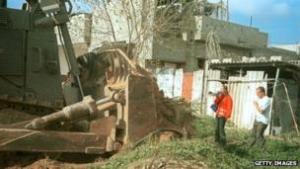
Rachel Corrie standing in front of a bulldozer the day before she died.
I’m reading the e-mails of Rachel Corrie, whom I’m counting among the “ordinary radicals” of my series of posts on that theme. A short paragraph in the March 16 entry of Common Prayer: A Liturgy for Ordinary Radicals brought into my world this courageous human being and another way of living humanly. Rachel Corrie was killed on March 16, 2003, by an Israeli bulldozer on the streets of Rafah in Gaza. She was trying to protect the home of a Palestinian friend. She was 23 years old.
I have taken the side of Palestinians in the Israeli-Palestinian conflict before. (See this post.) In such a long complex history there is no innocent side. One wants to sympathize with Israeli Jews. They are still waiting for security in a state they can justly call Israel. Yet their actions in occupied territories oppress Palestinian people and lengthen conflict. To paraphrase a passage in that earlier post:
We can neither ignore nor justify Palestinian violence against Israel. But Israel’s actions have violated Palestinian territorial rights, sovereignty, refugee rights, access of natural resources, and freedom of movement. Peace will never result from Israel’s reliance on its huge power advantage to enforce present repressive policies.
Rachel Corrie
At the age of 10, growing up in Olympia, Washington, Rachel Corrie was already an advocate for social justice. In this video she speaks at her school’s “Fifth Grade Press Conference on World Hunger.”
Her teenage years found her touring Russia. It was an experience that, a Guardian article says, “turned her from a local activist into one with a global awareness.”At Evergreen State College in Olympia, Rachel Corrie arranged peace events and got in contact with Olympians for Peace and Solidarity. This Palestinian-led organization challenged Israeli army tactics in the West Bank and Gaza. Her father, speaking after she died, said,
Rachel was filled with a love and sense of duty to our fellow man, wherever they lived, and she gave her life trying to protect those that could not protect themselves. (BBC News).
E-mails that Rachel sent home from Rafah in Gaza describe vividly the oppressive conditions in which Palestinians lived under Israeli occupation. They also document the kindness of ordinary Palestinians toward her and other “internationals.” Their purpose in Gaza was to support Palestinians whose homes were being demolished. Israeli authorities claimed Palestinian homes were providing cover for snipers and concealment for arms-smuggling tunnels. Not so according to human rights groups. They denounced the demolitions as “collective punishment.” (BBC article)
March 16, 2003
The following information comes from the BBC article.
Rachel had spent nights sleeping at wells to protect them from bulldozers, her mother said later. She assumed that her international status would protect her. A fellow activist described the event of Rachel’s death on March 16, 2003.
Rachel had climbed a pile of earth in the path of a bulldozer. She was wearing an orange vest.
The bulldozer went towards her very slowly. She was fully in clear view, straight in front of them.
Unfortunately she couldn’t keep her grip there and she started to slip down. You could see she was in serious trouble; there was panic in her face as she was turning around.
All the activists there were screaming, running towards the bulldozer, trying to get them to stop. But they just kept on going,
An internal military investigation concluded within a month of Rachel’s death that Israeli forces were not to blame. The driver had not seen her. She was not run over but “was struck by a hard object, most probably a slab of concrete.”
Rachel’s parents refused to accept the findings and kept pursuing justice. In 2010 a Haifa district court dismissed their civil lawsuit. Rachel’s death, they ruled, was a “regrettable accident.”
Two years after Rachel’s death the Israeli army left Gaza.
Rachel’s parents, Craig and Cindy Corrie, have organized a non-profit organization in Rachel’s honor. The Rachel Corrie Foundation for Peace & Justice aims to:
- Foster connections between people
- Build understanding, respect, and appreciation for differences
- Promote cooperation within and between local and global communities
- Support grassroots efforts for human rights and social, economic, and environmental justice.
They express the hope that
… people will take from our work the same, simple understanding that Rachel expressed as a young child: that we are interconnected.
Rachel Corrie’s e-mails from Rafah
This post is not about the politics of longstanding conflict in the region that both Jews and Palestinians claim as their home. It is about a woman who died very young but left a stirring legacy. Some of the character of Rachel Corrie comes through in the long e-mails she sent home. She describes the conditions she found in Gaza, the people she met, and her own feelings during her short time there.
From the first letter, February 7 2003
I have been in Palestine for two weeks and one hour now, and I still have very few words to describe what I see. … An eight-year-old was shot and killed by an Israeli tank two days before I got here, and many of the children murmur his name to me.
[Rachel contrasts her experience back home with that of people in Gaza. Even in Rafah she feels different: a person with money, a U.S. citizen whom the army wouldn’t dare shoot, who can leave. Rafah borders Egypt.]
Today, as I walked on top of the rubble where homes once stood, Egyptian soldiers called to me from the other side of the border, “Go! Go!” because a tank was coming. And then waving and “What’s your name?”. Something disturbing about this friendly curiosity. It reminded me of how much, to some degree, we are all kids curious about other kids. Egyptian kids shouting at strange women wandering into the path of tanks. Palestinian kids shot from the tanks when they peak out from behind walls to see what’s going on. International kids standing in front of tanks with banners. Israeli kids in the tanks anonymously – occasionally shouting and also occasionally waving – many forced to be here, many just aggressive – shooting into the houses as we wander away.
February 20, 2003
[Rachel writes about the political situation, increasing pressure on the Palestinians, and decreasing hope for peace.]
Know that I have a lot of very nice Palestinians looking after me. I have a small flu bug, and got some very nice lemony drinks to cure me. Also, the woman who keeps the key for the well where we still sleep keeps asking me about you. She doesn’t speak a bit of English, but she asks about my mom pretty frequently – wants to make sure I’m calling you.
February 27, 2003
I think it is maybe official now that Rafah is the poorest place in the world. There used to be a middle class here – recently.
Honestly, a lot of the time the sheer kindness of the people here, coupled with the overwhelming evidence of the willful destruction of their lives, makes it seem unreal to me. I really can’t believe that something like this can happen in the world without a bigger outcry about it. It really hurts me, again, like it has hurt me in the past, to witness how awful we can allow the world to be.
February 28, 2003
The other day, by the way, Grandmother gave me a pantomimed lecture in Arabic that involved a lot of blowing and pointing to her black shawl. I got Nidal to tell her that my mother would appreciate knowing that someone here was giving me a lecture about smoking turning my lungs black.) I met their sister-in-law, who is visiting from Nusserat camp, and played with her small baby…. I am amazed at their strength in being able to defend such a large degree of their humanity – laughter, generosity, family-time – against the incredible horror occurring in their lives and against the constant presence of death.
When I am with Palestinian friends I tend to be somewhat less horrified than when I am trying to act in a role of human rights observer, documenter, or direct-action resister.
Received by Rachel on February 7, 2003
[Here Rachel includes a letter she received from Dan, an Israeli soldier.]
I am a reserve first sergeant in the IDF. The military orisons are filling up with conscientious objectors. Many of them are reservists with families. These are men who have proven their courage under fire in the past. Some have been in jail for more than six months with no end in sight.
I love my country. I believe that Israel is under the leadership of some very bad people right now. I believe that settlers and local police are in collusion with each other and that the border police are acting disgracefully. They are an embarrassment to 40% of the Israeli public and they would be an embarrassment to 90% of the population if they knew what we know.
You are doing a good thing. I thank you for it.
Continuation of her email to her mother, February 28 2003
I think I could see a Palestinian state or a democratic Israeli-Palestinian state within my lifetime. Freedom for Palestine could be an incredible source of hope to people struggling all over the world.
I look forward to increasing numbers of middle-class privileged people like you and me becoming aware of the structures that support our privilege and beginning to support the work of those who aren’t privileged to dismantle those structures.
[Rachel refers to demonstrations back home in support of her work and for Palestinian rights.] Just hearing about what you are doing makes me feel less alone, less useless, less invisible. Those honks and waves help. The pictures help. Colin helps.
Rachel’s last e-mail (undated)
Thank you for your email. … Don’t worry about me too much, right now I am most concerned that we are not being effective. I still don’t feel particularly at risk. Thanks also for stepping up your anti-war work.
I am trying to figure out what I’m going to do when I leave here, and when I’m going to leave. … On the other hand, now that I’ve crossed the ocean I’m feeling a strong desire to try to stay across the ocean for some time. Considering trying to get English teaching jobs – would like to really buckle down and learn Arabic.
Image credit: BBC
Previous Post

March 14, 2020
Maximilian of Thavaste, Martyr, First Recorded Conscientious Objector
Next Post
March 21, 2020 Corona, Global Warming, Sacrifice, and Hope
Browse Our Archives
Select a Category Advent Christmas Amazon Synod Angels Being Consumed Bible Catholic Modern Creed Ecology Economics Elizabeth Johnson Eucharist Fragments and Filaments Gender and Sex Gospel of Mark Herzog Historical Jesus Liturgy Luke Opening Scriptures on Way to Emmaus Ordinary radicals Parables Pro-Life Reincarnation Rosary Sacraments science Social Justice Souls Stories of Jesus The Creed Torture and Eucharist Tracy Uncategorized War and Peace
Select a Month October 2026 June 2025 April 2025 March 2025 February 2025 January 2025 November 2024 July 2024 March 2024 December 2023 October 2023 September 2023 August 2023 May 2023 April 2023 March 2023 February 2023 January 2023 December 2022 November 2022 October 2022 September 2022 August 2022 July 2022 June 2022 April 2022 March 2022 February 2022 January 2022 December 2021 November 2021 October 2021 August 2021 July 2021 June 2021 April 2021 March 2021 February 2021 December 2020 November 2020 October 2020 August 2020 July 2020 June 2020 May 2020 April 2020 March 2020 February 2020 January 2020 December 2019 November 2019 October 2019 September 2019 August 2019 July 2019 June 2019 May 2019 April 2019 March 2019 February 2019 January 2019 December 2018 November 2018 October 2018 September 2018 August 2018 July 2018 June 2018 May 2018
Follow Us!
TAKE THE
Religious Wisdom Quiz
Who was the strongest man in the Bible?
Select your answer to see how you score.
Adam David Samson John
Related posts from Lost in a One-Acre Wood
Remembering Oscar Romero on his Feast Day
Maximilian of Thavaste, Martyr, First Recorded Conscientious Objector
James Groppi, Milwaukee Priest, Civil Rights Activist

Marcella of Rome, the Woman who Taught St....
TRENDING AT PATHEOS Catholic

Creation, Preservation, and Teleology in Catholic Theology
As I write this, it is very early Monday morning. Like millions...

The Parable Of The Sower And The Word...
One of Christ’s most famous parables is that of the sower who...

Rejecting Doom: Christian Hope And Human Action
Christianity is a religion of hope. We are to have hope and...

Why I Choose the Eucharist Over the Sermon
Choose the Eucharist, Not the Sermon What are we supposed to get...

5 Design Elements Found in Spiritually Rooted Homes
Putting Spirituality Into Home Decor Our homes are more than our living...

Credo: A Story of God Told with the...
About 10 years ago, I began to imagine a personal "Credo" that...
view all Catholic blogs
Ad-Free & Subscriber Log-In Subscription Support
- About Us
- 2026 Calendar
- Videos
- Podcasts
- Library of World Religions
- Faith In Media Tracker
- Advertise With Us
- Write for Us
- Privacy Policy
- Terms of Service
- Do Not Sell My Data
- Contact Us
- Radiant Digital
- Manage Newsletter Subscriptions
- Unsubscribe From Notifications
- Sitemap
Copyright 2008-2026, Patheos. All rights reserved.
Subscription Support Ad-Free & Subscriber Log-In
Follow Patheos