
BuddhistCatholicContemplativeEvangelicalGeneral ChristianHinduJewishLatter-day SaintMuslimNew VisionsProgressive Christian
Beliefs
- Buddhist
- Catholic
- Contemplative
- Evangelical
- General Christian
- Hindu
- Jewish
- Latter-day Saint
- More Voices
- Muslim
- New Visions
- Pagan
- Progressive Christian
Topics
- Religion News
- Food and Religion
- Sports and Religion
- Religious Art
- Religious Music and Entertainment
- Religious Events
- History and Religion
- Style and Religion
- Politics and Religion
- Women in Religion
- Recreation Outdoors and Religion
- Business Finance and Religion
- Careers Workplace and Religion
- Education and Religion
- Family Parenting and Religion
- Health Fitness and Religion
- Home and Religion
- Relationships and Religion
- Technology and Religion
- Travel and Religion
Columnists
- Buddhist Columnists
- Business Finance and Religion Columnists
- Careers Workplace and Religion Columnists
- Catholic Columnists
- Contemplative Columnists
- Education and Religion Columnists
- Evangelists Columnists
- Family Parenting and Religion Columnists
- General Christian Columnists
- Health Fitness and Religion Columnists
- Hindu Columnists
- History and Religion Columnists
- Home and Religion Columnists
- Jewish Columnists
- More Voices Columnists
- Latter Day Columnists
- Muslim Columnists
- New Visions Columnists
- Nonreligious Columnists
- Pagan Columnists
- Politics and Religion Columnists
- Progressive Columnists
- Recreation Outdoors and Religion Columnists
- Relationships and Religion Columnists
- Religion News Columnists
- Religious Art Columnists
- Religious Events Columnists
- Religious Music and Entertainment Columnists
- Sports and Religion Columnists
- Style and Religion Columnists
- Technology and Religion Columnists
- Travel and Religion Columnists
- Women in Religion Columnists
Resource Library
- 2026 Calendar
- Library of World Religions
- The 100 Most Holy Places on Earth
- Patheos Answers
- Podcasts
- Videos
- Faith Leaders Database
- Anglican Episcopalian
- Bahai
- Baptist
- Buddhism
- Christianity
- Confucianism
- Eastern Orthodoxy
- Hinduism
- Holiness and Pentecostal
- ISKCON
- Islam
- Judaism
- Lutheran
- Methodist
- The Church of Jesus Christ of Latter-day Saints
- New Age
- Paganism
- Presbytarian and Reformed
- Protestantism
- Religion Behind the Scenes
- Roman Catholic
- Scientology
- Shia Islam
- Sikhism
- Sufism
- Sunni Islam
- Taoism
- Zen
- See all religions
Research Tools
 Ad-Free & Subscriber Log-In Subscription Support
Ad-Free & Subscriber Log-In Subscription Support
Follow Patheos 

- Trending:
- Forgiveness
- |
- Marriage
- |
- Consciousness
- |
- Death Penalty
- |
- Election
- |
- Halloween

- Home
- Catholic
- Bishop Robert Barron Pens “Letter” on Clergy Sex Abuse
Bishop Robert Barron Pens “Letter” on Clergy Sex Abuse
Last updated on: March 6, 2020 at 1:52 pm by Jack Hartjes
Bishop Robert Barron Pens “Letter” on Clergy Sex Abuse 2020-03-06T13:52:47-06:00 Jack Hartjes
Patheos Explore the world's faith through different perspectives on religion and spirituality! Patheos has the views of the prevalent religions and spiritualities of the world.
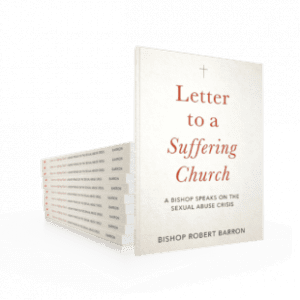
Millions of copies of Barron’s “Letter” are in print.
For a communicator bishop like Bishop Robert Barron, Letter to a Suffering Church, on the sexual abuse crisis would have been almost impossible not to write. Given the bishop’s apologetic mission, you could expect such a letter would be a defense of the Church, and you’d be right. It’s far from a defense of clerics’, including bishops’, actions, though. As you can also expect knowing Barron’s work, it is an appeal to stay with the Church – stay and fight.
My free copy of “Letter” is one of over a million in print, the cover says. Barron’s “Word on Fire” mission clearly intends the book for wide circulation.
The bishop starts with the Church’s recent sexual abuse history, the first of five chapters. He then turns to earlier history in two chapters. One tells of abuse of sex and power in the Bible’s record; the other in the record of the Church through the ages. In Chapter Four Barron turns to his main purpose, explaining “Why We Should Stay.” A final chapter, “The Way Forward,” appeals for renewal of the whole church.
A summary and some comments follow.
Recent history
Bishop Barron first shows just how hard his task in Chapter Four will be. For three chapters he paints a dark a portrait of that Church with which he wants us to stay. Starting with the time of Abraham, four thousand years of abuse of sex and power fill the first three chapters.
Chapter One looks at the most recent of that history. It has a strange title, “The Devil’s Masterpiece.” Is it a only demonic power that “designed” the clerical sexual abuse crisis? Is the bishop trying to avoid blaming the Church? Or is he just emphasizing the priests’ and bishops’ depravity with the devil theme? Barron is quick to add that the devil only works with the cooperation of human actors.
Of that “cooperation” the bishop gives us only a few recent examples. But it’s enough. Barron isn’t hiding anything. From the 2018 Pennsylvania Attorney General’s report we get the astounding numbers of priests and their victims. We also get sordid details of their methods of operation. It wasn’t just individuals but a network of cooperating predators. Bishops cooperated by regularly reassigning known pedophile priests so they could abuse again. Our author mentions this episcopal failing but it deserves more than a mention. In my mind it’s the key element and the Church’s primary failing. I can’t help thinking, What if we had had women in charge?
With the story of Cardinal Theodore McCarrick, Bishops and the rest of Church hierarchy get a fuller treatment. We read examples of his abuse of servers and seminarians. But it’s not just this one bad actor. The point of the story is that McCarrick’s offenses were well known, and he continued to “advance up the ecclesiastical ladder.” Barron concludes:
The average Catholic in America could certainly be forgiven for thinking that something like a conspiracy of silence and a deep corruption obtain within the institutional life of the Church (p. 11-12)
Bible history
Barron’s second chapter, “Light from Scripture,” has only a little light, except at the end. Mostly it’s a rundown of terrible things men (not women) of the Old Testament have done. Barron says “the Bible has a great deal to say about human sexuality.” Well, yes, but not much positive about sex itself. Mostly it’s about “the myriad ways that sin twists and distorts it.” (p. 19) I would have said “people” instead of “sin.” Barron does name the very human urge toward “domination or manipulation.” (p. 22)
Barron includes the story of Eli and his sons, an interesting parallel with today’s ineffective bishops and their wayward priests. Eli knew about his son’s abuses, sexual and otherwise, but neglected to do anything – like kick them out of the priesthood. Finally the Lord tells Samuel:
I am about to do something in Israel that will cause the ears of everyone who hears it to ring. On that day I will carry out in full against Eli everything I threatened against his family. (1 Sam. 3:11-12) (p. 27)
Soon Israel succumbs to her enemies. The Church also has enemies today. Barron says:
[T]he new Israel of the Church had been handed over to its enemies, precisely for the sake of purification. (p. 29)
It wasn’t Bathsheba’s fault.
I learned something from Barron about the well-known David and Bathsheba story. David has no business taking a siesta and strolling around on his roof “in the evening.” Afternoon, not evening, is the time for siestas, Barron says. But David has grown soft, indolent, self-indulgent. It is the time when kings “go to war,” but David hangs around the palace all day.
I disagree, however, with Barron’s suggestion that Bathsheba was partly responsibility for the affair that follows. She had every right to be bathing on her roof. She wasn’t being a temptress. The story is about David’s kingly power to get whatever he wants from his subjects. Correctly Barron concludes:
David stands here as an icon of the abuse of power. (p. 33)
Church history
Between abuse in the kingdom of Israel and abuse in the Church’s history, Barron places Jesus and the children. Jesus welcomes children and makes them examples for the Church to follow. A good rhetorical move, it throws a strong light on the contradiction between Jesus and his Church.
The Church, from the very beginning and at every point in its development, has been marked to varying degrees by sin, scandal, stupidity, misbehavior, misfortune, and wickedness. (p. 41)
In seminary I was lucky to have faithful Catholic teachers who were also realistic and honest about the Church’s faults. I learned it’s possible to love the Church in spite of that. Bishop Barron says the same about his training. It was, he says,
… a real, though odd, grace. Hearing these dark tales was a bit like receiving an immunization. Having taken in the very worst of Church history, we could even more clearly understand that there is nevertheless something good, even indestructibly good, about the Mystical Body of Christ. (p. 44)
The bishop proceeds to “immunize” us with his version of the “dark tales.” He recounts some of the Infamous, and rather interesting, papal and other figures. (pp. 47-53) One pope died in the act of coitus. Another, reportedly, said, “Since God has seen fit to give us the papacy, let us enjoy it.” Just at that time Luther was attempting to reform the Church. In 1049 St. Peter Damian reported to his pope on the “befouling cancer of sodomy … spreading so through the clergy.” Specifically, he meant
… sexual predation by older clergy of young boys and the lax attitude of those religious superiors who knew about such outrages yet did nothing to stop them.
As the title of this chapter says, “We have been here before.”
“Why Should We Stay?”
This is the title of Barron’s longest chapter, the one he’s been getting to all along. The Church holds a treasure in earthen vessels – Barron quotes St. Paul. “And we stay because of the treasure.” (p. 58-59) The bishop has penned “a hymn, a poem, a celebration” of six treasure of the Church.
- “The Church speaks of God” (p. 60-62) in a world that has largely lost “a transcendent point of reference.” I think Barron goes too far when he ties materialism to that loss of transcendence. The atheists that I know are far from being materialistic. But he correctly locates our soul’s longing for something beyond the material. For without transcendent mystery we live in “a cramped space.” (p. 60-62)
- “The Church is the Mystical Body of Jesus Christ.” (p. 62-71) A Lutheran pastor friend once put it more simply: “We have Jesus.” This section is all about Jesus, a life in which it’s hard not to find treasures.
- The Holy Spirit “gives vitality and energy to the Mystical Body.” (p. 71) Strangely, that one sentence is about all Barron says about the Spirit.
- The doctrine of the Trinity “presents the one God as a unity of three persons.” (p. 71-73) This doctrine allows us to affirm the most basic fact about God. “God is love.” Other religions speak about God’s love, but only Christianity sees love as God’s essence. Love is not just something that God bestows on the world, but:
The Father loves the Son. The Son loves the Father. The spirit is the love that binds them together and – I would add – by grace we are not just receivers but also participants in the center of God’s love.
- The seven sacraments are the means through which God brings us the “Christ-life” and sustains that life in us (p. 73-74) The Eucharist contains Jesus himself, and “we are Christified, eternalized, deified, made ready for life on high with God.”
- “The entire purpose of the Church is to produce … saints.” (p. 74-78) For me the Church’s saints are a convincing reason for staying with her. Saints are “lights shining in the gloom.” Barron reminds us of a “wild diversity” of saints. They are men and women, ancient and modern, rich and poor, travelers and stay-at-homes, intellectually brilliant and challenged, mystics and social activists.
“The Way Forward”
A final chapter speaks of what the Church needs to do and has started to do. This is the least satisfactory chapter of the book. Granted we now have a system in place that includes zero tolerance, “one strike and you’re out,” background checks, and training for clergy and lay professionals and volunteers. There have been very few cases of clerical sexual abuse since the 2002 “Charter for Protection of Children and Young People.” (p. 82-86)
That charter failed to address, however, the problem of bishops. They failed in their duties to protect children and vulnerable adults or became abusive themselves. But the incomplete charter’s work is continuing. Perhaps there will be lay-led regional review boards, as Barron advocates.
The Bishop heralds these much need reforms. He proposes also
a formal investigation, both on this side of the Atlantic and in Rome to determine how someone like Theodore McCarrick, whose serious misbehavior was well known, could possibly have risen so high in the government of the Church. (p. 86-87)
Institutional reform
Barron calls these steps “institutional reform.” An article in America calls them “protocols and legal guardrails.” They pretty much leave the institution untouched. They address symptoms but leave festering the underlying reality.
To his credit Barron does not name either celibacy or homosexuality as that basic issue. He recognizes the evil that Pope Francis names clericalism. He even has a good definition: Clericalism is “an attitude in which the link between Baptism and Holy Orders has been severed.”
Aside from calling for holier priests and holier people Barron says little about restoring that link or how to dismantle the culture that separates priests and people.
A recently ordained priest told his congregation that everyone has a guardian angel, but a priest has two. Where he got that idea I don’t know, but I suspect from a seminary prof. Seminary training has not changed much since my seminary days around Vatican II time. For six or more years priests-in-training are largely isolated from lay people, especially women. We tell seminarians that ordination will confer a “mark” on their souls forever distinguishing them essentially from lay people. I don’t know if that teaching counts as Catholic dogma. In the light of clericalism, deference to priests, and priestly privilege, it seems as pernicious as the two-angel theory.
Barron recognizes that the priesthood must be “in service to the baptized, not the prerogative of a privileged class.” (p. 82) The America article calls for more:
Overcoming clericalism means creating open, transparent and equal relationships between priests and laity. Such a community is willing to allow moral correction of priests by the laity and not simply the correction of laity by priests. Such a community is open and willing to learn from all its members.
Spiritual reform
The most disappointing part of Barron’s essay comes here, where he argues for spiritual reform of priesthood and laity. He says,
Something in the moral compass of these men [priests and bishops] was haywire…. A moral relativism, especially in regard to matters sexual, came to be taken for granted in the years following the Second Vatican Council, and this attitude was adopted by too many within the priesthood itself.” (88)
I don’t know if Barron is saying moral relativism is an effect of the Second Vatican Council. It certainly would be easy enough to read this quote that way. Nothing could be more contrary to the teaching of that council.
Society’s sexual morality has, indeed, changed, and it’s common to blame moral relativism. Blame, or even partial blame, for priests’ abusive sexual behavior can’t settle there, however. I don’t know of any moral relativists who think that abusing children and vulnerable adults is OK. Even as the society has become tolerant of what the Church knows as sexual sins and disorders, it has grown less tolerant in other ways. Of particular relevance, modern liberal society condemns more strongly than ever using power against any powerless group, including children. That’s exactly what sexual abuse is.
Barron offers hope for the future
Spiritual reform must begin with the Church, and Bishop Barron has hopeful words to say about that. Every time the Church has been in trouble, he says, God has raised up someone to get the Church back on track. In past ages there have been saints like Benedict, Francis, and Ignatius of Loyola. In the present we have, movements like Communion and Liberation, Cursillo, and Fellowship of Catholic University Students. It seems to me the Catholic Worker Movement and lay people working for Church reform are closer in spirit to those early reformer saints. Barron does mention Catholic Worker’s founder, Dorothy Day, in a concluding hopeful appeal:
Somewhere in the Church right now is a new Benedict, a new Francis, a new Ignatius, a new Teresa of Kolkata, a new Dorothy Day. This is your time. (97)
Image Credit: Word on Fire
Previous Post

March 2, 2020
Consumer Culture Forms us Morally and Spiritually. So does Eucharist.
Next Post
March 10, 2020 Globalization, the One and the Many, and Jesus
Browse Our Archives
Select a Category Advent Christmas Amazon Synod Angels Being Consumed Bible Catholic Modern Creed Ecology Economics Elizabeth Johnson Eucharist Fragments and Filaments Gender and Sex Gospel of Mark Herzog Historical Jesus Liturgy Luke Opening Scriptures on Way to Emmaus Ordinary radicals Parables Pro-Life Reincarnation Rosary Sacraments science Social Justice Souls Stories of Jesus The Creed Torture and Eucharist Tracy Uncategorized War and Peace
Select a Month October 2026 June 2025 April 2025 March 2025 February 2025 January 2025 November 2024 July 2024 March 2024 December 2023 October 2023 September 2023 August 2023 May 2023 April 2023 March 2023 February 2023 January 2023 December 2022 November 2022 October 2022 September 2022 August 2022 July 2022 June 2022 April 2022 March 2022 February 2022 January 2022 December 2021 November 2021 October 2021 August 2021 July 2021 June 2021 April 2021 March 2021 February 2021 December 2020 November 2020 October 2020 August 2020 July 2020 June 2020 May 2020 April 2020 March 2020 February 2020 January 2020 December 2019 November 2019 October 2019 September 2019 August 2019 July 2019 June 2019 May 2019 April 2019 March 2019 February 2019 January 2019 December 2018 November 2018 October 2018 September 2018 August 2018 July 2018 June 2018 May 2018
Follow Us!
TAKE THE
Religious Wisdom Quiz
In 2 Peter, what does Peter say he will soon put aside?
Select your answer to see how you score.
His life His burdens His ministry His job
Related posts from Lost in a One-Acre Wood

Credo: A Story of God Told with the...

With Carbon Dioxide, 0.014 is a big number
Crucifixion as Breakthrough, Horsley’s Nerviest Claim

Jesus’ Politics of Resistance and Renewal
TRENDING AT PATHEOS Catholic

The Parable Of The Sower And The Word...
One of Christ’s most famous parables is that of the sower who...

Rejecting Doom: Christian Hope And Human Action
Christianity is a religion of hope. We are to have hope and...

Why I Choose the Eucharist Over the Sermon
Choose the Eucharist, Not the Sermon What are we supposed to get...

5 Design Elements Found in Spiritually Rooted Homes
Putting Spirituality Into Home Decor Our homes are more than our living...

Credo: A Story of God Told with the...
About 10 years ago, I began to imagine a personal "Credo" that...

The Anatomy of Divine Revelation in Catholic Thought
The claim that God has made Himself known to human beings is...
view all Catholic blogs
Ad-Free & Subscriber Log-In Subscription Support
- About Us
- 2026 Calendar
- Videos
- Podcasts
- Library of World Religions
- Faith In Media Tracker
- Advertise With Us
- Write for Us
- Privacy Policy
- Terms of Service
- Do Not Sell My Data
- Contact Us
- Radiant Digital
- Manage Newsletter Subscriptions
- Unsubscribe From Notifications
- Sitemap
Copyright 2008-2026, Patheos. All rights reserved.
Subscription Support Ad-Free & Subscriber Log-In
Follow Patheos