
BuddhistCatholicContemplativeEvangelicalGeneral ChristianHinduJewishLatter-day SaintMuslimNew VisionsProgressive Christian
Beliefs
- Buddhist
- Catholic
- Contemplative
- Evangelical
- General Christian
- Hindu
- Jewish
- Latter-day Saint
- More Voices
- Muslim
- New Visions
- Pagan
- Progressive Christian
Topics
- Religion News
- Food and Religion
- Sports and Religion
- Religious Art
- Religious Music and Entertainment
- Religious Events
- History and Religion
- Style and Religion
- Politics and Religion
- Women in Religion
- Recreation Outdoors and Religion
- Business Finance and Religion
- Careers Workplace and Religion
- Education and Religion
- Family Parenting and Religion
- Health Fitness and Religion
- Home and Religion
- Relationships and Religion
- Technology and Religion
- Travel and Religion
Columnists
- Buddhist Columnists
- Business Finance and Religion Columnists
- Careers Workplace and Religion Columnists
- Catholic Columnists
- Contemplative Columnists
- Education and Religion Columnists
- Evangelists Columnists
- Family Parenting and Religion Columnists
- General Christian Columnists
- Health Fitness and Religion Columnists
- Hindu Columnists
- History and Religion Columnists
- Home and Religion Columnists
- Jewish Columnists
- More Voices Columnists
- Latter Day Columnists
- Muslim Columnists
- New Visions Columnists
- Nonreligious Columnists
- Pagan Columnists
- Politics and Religion Columnists
- Progressive Columnists
- Recreation Outdoors and Religion Columnists
- Relationships and Religion Columnists
- Religion News Columnists
- Religious Art Columnists
- Religious Events Columnists
- Religious Music and Entertainment Columnists
- Sports and Religion Columnists
- Style and Religion Columnists
- Technology and Religion Columnists
- Travel and Religion Columnists
- Women in Religion Columnists
Resource Library
- 2026 Calendar
- Library of World Religions
- The 100 Most Holy Places on Earth
- Patheos Answers
- Podcasts
- Videos
- Faith Leaders Database
- Anglican Episcopalian
- Bahai
- Baptist
- Buddhism
- Christianity
- Confucianism
- Eastern Orthodoxy
- Hinduism
- Holiness and Pentecostal
- ISKCON
- Islam
- Judaism
- Lutheran
- Methodist
- The Church of Jesus Christ of Latter-day Saints
- New Age
- Paganism
- Presbytarian and Reformed
- Protestantism
- Religion Behind the Scenes
- Roman Catholic
- Scientology
- Shia Islam
- Sikhism
- Sufism
- Sunni Islam
- Taoism
- Zen
- See all religions
Research Tools
 Ad-Free & Subscriber Log-In Subscription Support
Ad-Free & Subscriber Log-In Subscription Support
Follow Patheos 

- Trending:
- Forgiveness
- |
- Marriage
- |
- Consciousness
- |
- Death Penalty
- |
- Election
- |
- Halloween

- Home
- Catholic
- Freedom and Unfreedom in the Free Market: Being Consumed, Chapter 1
Freedom and Unfreedom in the Free Market: Being Consumed, Chapter 1
Last updated on: February 25, 2020 at 1:25 pm by Jack Hartjes
Freedom and Unfreedom in the Free Market: Being Consumed, Chapter 1 2020-02-25T13:25:29-06:00 Jack Hartjes
Patheos Explore the world's faith through different perspectives on religion and spirituality! Patheos has the views of the prevalent religions and spiritualities of the world.
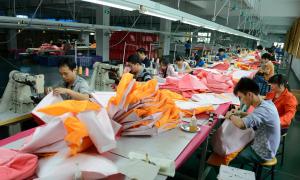
Exploited factory workers oversees make clothing for the American consumer for minimal wages in the free market economy.
Everyone is free in the free market, but what kind of freedom is that? William T. Cavanaugh analyzes the sense in which we are free in the free market, the sense in which we are slaves to that market, and what a truly free market might look like. This is the second in the series on Being Consumed: Economics and Christian Desire.
Rosa’s story
The story of a worker in El Salvador makes me think about connections in a worldwide economy. I see a nearly slave-like existence and what little freedom I have to do anything about it:
‘Rosa Martinez produces apparel for US markets on her sewing machine in El Salvador. You can hire her for 33 cents an hour.’ So goes an advertisement, paid for by the U.S. Agency for International Development, in the textile trade journal Bobbin. (p. 21)
I’m pretty sure the italicized “you” in this ad meant clothing merchants, the Walmarts and Lands Ends of this economy. But I couldn’t help thinking it also meant me. I also employ people just like Rosa Martinez almost any time I buy a new piece of clothing.
The prevailing economic theory in this country says that Rosa Martinez is free. She makes the free choice to work for 33 cents an hour. The company that pays her wage is also free. They hire her for the wage she is willing to work for or they don’t if she demands too much.
Milton Friedman’s story
Milton Friedman is perhaps the free mark economic guru of the 20th century. He was the inspiration behind Chilean dictator Agosto Pinochet’s economic policies, about which I have written. In the U.S. the Republican and Libertarian Parties love Milton Friedman.
Friedman says both Rosa and I are free in the only economically meaningful sense of the word. No one is forcing either of us to act as we do.
It’s a negative concept of freedom: freedom from external coercion. The employee is free to enter into a contract with the employer based solely on the perceived advantage of doing so. The only condition is that the perception must be correct. That is, the employer must not lie to the employee about the responsibilities or the rewards of the job. Likewise, the employer enters into the contract based solely on perceived advantage. He or she is free, again, provided that the employee’s representations are honest. No “extrinsic” considerations should interfere with these self-interested decisions.
Freedom without values
In a free market economy, so conceived, the state’s job is to maintain law and order. The state does not impose its “values,” making sure only that contracts are voluntary in the above sense. Value judgments are out of order. The same goes for consumers’ choices. All exchanges are voluntary, and the only aim is to fulfill each party’s desires. It doesn’t matter what you buy, only that you really wanted it.
As Friedman says, a free-market economy …
gives people what they want instead of what a particular group thinks they ought to want. (p. 4)
This concept of the free market either deliberately or blindly ignores the disparity in power of the parties to a transaction. In Rosa Martinez’ case she chooses between a poverty wage and starvation. The company chooses from a labor market that spans the whole world. In my case, as a consumer and Rosa’s employer in a sense, her situation violates my sense of fairness. But I have no power to pay her what I think she’s worth.
The CEO’s story
CEOs of companies that employ people like Rosa would seem to have a great deal of freedom. Besides having lots of money, they have lots of power. But they, too, find their decisions constrained in certain directions that they might not wish them to go. They are heads of families as well as of companies. Perhaps they sympathize with the mother in El Salvador struggling to feed her family. Let’s see what choices they have.
A manager closes down a factory in the U.S., where workers were working eight-hour days in a safe environment and making a living wage. Then he or she opens a factory overseas. There factory farming or a changing environment has forced former subsistence farmers into the cities. They join a labor force desperate for work under any conditions. Corporations outsource labor this way because, with their power and world-wide reach, they can. But the CEO with sympathies for the poor foreign worker might also feel that it’s a matter of necessity.
…[G]iven the prevailing logic of free exchange, consumers will want to maximize their own gain in any transaction by paying the lowest price possible for a product. … [T]he manager does not feel free to resist this logic, lest his or her own corporation fall victim to competition from other corporations that are better positioned to take advantage of cheap labor. (p. 22)
The “bottom-line” dogma
Even more than consumers, stockholders dictate the decisions of managers. These days stock is concentrated in institutional investment plans. The vast power of corporations shifts to institutional investors. CEO’s “have strong incentives to favor the concerns of stockholders over those of other stakeholders, such as employees and their families and their communities.” (p. 23)
It has been practically dogma that a corporation’s bottom-line requirement it to grow the value of its stock. Recently CEOs who are members of the Business Roundtable issued a statement challenging that dogma. I’m not sure if that is mere public relations or if something like the common good or common decency will enter into CEOs’ decision making.
Augustine’s story – freedom from or freedom for in the free market
Whether true freedom is freedom from or freedom for is something I didn’t understand as a young student of ethics. In the Catholic position being free is not being without external movers but a matter of “to what end the will has been moved.” (11) In other words, what are we free for? St. Augustine illustrates with a personal story about stealing pears:
[A]lone I never would have done it, [he says]. Therefore my love in that act was to be associated with the gang in whose company I did it. (p. 10, quoting Augustine’s Confessions)
Wants are not simply internal only later to become public through the choices we make. What we really desire we often don’t understand ourselves. In Augustine’s case he understood the real desire behind his theft only much later. Cavanaugh interprets Augustine but also echoes modern psychologists:
Desire is a complex and multidimensional network of movement that does not simply originate within the individual self but pulls and pushes the self in different directions from both inside and outside the person. (p. 9)
Augustine says following one’s desires without external pressure or hindrance doesn’t make actions free. Our actions are free when we have our priorities straight. That proper ordering requires “a community of virtue in which we learn to desire rightly.” A self that is independent of others is not a free self; it is merely closed in on itself. (p. 9)
In Augustine’s thought, we desperately need not to be left to the tyranny of our own wills. (p. 11) Sheer desire isn’t enough. We need an objective accounting of what things are good to desire and how these good things rank in levels of goodness. Desire must be for the good and, ultimately, the highest good.
My story
As I said, I didn’t always understand how this “freedom for” works. But an incident from my life as a sometimes more or less free actor throws some light.
I was with my wife, her parents and a couple siblings and our children (two at the time). We were enjoying a fishing outing. For my part I enjoyed the outing more than the fishing. The day was beautiful and warm, the river we fished flowing pleasantly, but not without the danger of snags. Inevitably one of our children’s lines got caught on some submerged growth or other. Try as I might, I could not find a position from shore to free that lure.
Well, it was just a lure, to me not worth caring much about. A number of factors inclined me to cut the line and let the lure go. The water cold, the river bottom mucky, my distaste for getting my clothes wet, plus a sometimes misplaced sense of modesty. But there was my father-in-law, a man who loves fishing and values lures much more than I do. He also thinks a lot about the money that lures cost. I thought about this highly intelligent farmer with his eight grades of formal education and imagined his suspicions of me with my 20-plus years of school and low-paying job as a Catholic school teacher.
If there was a thing I knew I wanted, it wasn’t that lure. It was to rise in my father-in-law’s estimation. And I knew, that day, how to get it. So I stripped down to my boxers, waded into that waist-deep river, and felt as free as ever rescuing that lure.
Augustine said that alone he never would have done his evil deed. I think I could say the same about my good, or neutral, deed. Augustine’s motivations were external, and so were mine. His desire was for the approval of a gang and benefits like companionship and security. My desire was for the approval of a significant figure in my life and the benefits that could lead to in terms of my marriage and, ultimately, my service to God through those relationships. Augustine’s priorities were not in order, mine were. Aside from a few details, that’s about the only difference. My act was free, Augustine’s was not.
Freedom in the marketplace
Can Augustine’s idea of freedom work in the free market? Can a market function if the driving force is not just untutored, unhindered desire but desires directed toward the good? Cavanaugh shows by example that this kind of market freedom is possible and can compete successfully in the broader marketplace. In this chapter Cavanaugh tells about the Mondragón Cooperative Corporation based in Spain’s Basque region.
Mondragón’s 60,000 employees manufacture over $3 billion worth of goods. The principle on which the company runs is the “just distribution of property and a recognition of the dignity of labor.” Workers own and govern Mondragón, one vote per employee. Wages vary from lowest to highest by a factor of only six or less. (That compares to factors in the hundreds for many corporations.) Workers and the community support a credit union that supplies most of the company’s capital. Ten percent of surpluses go to community development. (p. 17)
Cavanaugh summarizes the operation’s benefits:
Not only is the company successful and laborers highly satisfied with their work, but the communities in which Mondragón plays a significant part enjoy lower crime rates, lower rates of domestic violence, higher rates of education, and better physical and emotional health than neighboring communities. (p. 27)
To see how Mondragón is doing today, I searched and found this article. While not ignoring problems, the article corroborates Cavanaugh’s description and adds this:
[W]hen Father Arizmendiarrieta [the company’s founder] came to Mondragón, it was the poorest area of Spain. Today, it is the wealthiest, with the majority of its residents as worker-owners of Mondragon. So, ownership has compounding social benefits, stable wages and livelihoods reduce income inequality and improve public health.
In Augustinian terms Mondragón’s employees are free, and Mondragón itself is a truly free market enterprise.
Image credit: Daily Mail
Next Post

February 26, 2020 Detachment or Attachment: Being Consumed Chapter 2, Part 1
Browse Our Archives
Select a Category Advent Christmas Amazon Synod Angels Being Consumed Bible Catholic Modern Creed Ecology Economics Elizabeth Johnson Eucharist Fragments and Filaments Gender and Sex Gospel of Mark Herzog Historical Jesus Liturgy Luke Opening Scriptures on Way to Emmaus Ordinary radicals Parables Pro-Life Reincarnation Rosary Sacraments science Social Justice Souls Stories of Jesus The Creed Torture and Eucharist Tracy Uncategorized War and Peace
Select a Month October 2026 June 2025 April 2025 March 2025 February 2025 January 2025 November 2024 July 2024 March 2024 December 2023 October 2023 September 2023 August 2023 May 2023 April 2023 March 2023 February 2023 January 2023 December 2022 November 2022 October 2022 September 2022 August 2022 July 2022 June 2022 April 2022 March 2022 February 2022 January 2022 December 2021 November 2021 October 2021 August 2021 July 2021 June 2021 April 2021 March 2021 February 2021 December 2020 November 2020 October 2020 August 2020 July 2020 June 2020 May 2020 April 2020 March 2020 February 2020 January 2020 December 2019 November 2019 October 2019 September 2019 August 2019 July 2019 June 2019 May 2019 April 2019 March 2019 February 2019 January 2019 December 2018 November 2018 October 2018 September 2018 August 2018 July 2018 June 2018 May 2018
Follow Us!
TAKE THE
Religious Wisdom Quiz
Which prophet's book names the birthplace of the Messiah?
Select your answer to see how you score.
Amos Micah Obadiah Jonah
Related posts from Lost in a One-Acre Wood

Economic Scarcity and Eucharistic Abundance: Two Stories about...

Thin Places, McDonald’s World, and the Difference the...

Globalization, the One and the Many, and Jesus
Consumer Culture Forms us Morally and Spiritually. So...
TRENDING AT PATHEOS Catholic

Rejecting Doom: Christian Hope And Human Action
Christianity is a religion of hope. We are to have hope and...

It’s What Comes From Within Which Matters
One of the most difficult things for us to understand is why...

Why I Choose the Eucharist Over the Sermon
Choose the Eucharist, Not the Sermon What are we supposed to get...

5 Design Elements Found in Spiritually Rooted Homes
Putting Spirituality Into Home Decor Our homes are more than our living...

Credo: A Story of God Told with the...
About 10 years ago, I began to imagine a personal "Credo" that...

The Anatomy of Divine Revelation in Catholic Thought
The claim that God has made Himself known to human beings is...
view all Catholic blogs
Ad-Free & Subscriber Log-In Subscription Support
- About Us
- 2026 Calendar
- Videos
- Podcasts
- Library of World Religions
- Faith In Media Tracker
- Advertise With Us
- Write for Us
- Privacy Policy
- Terms of Service
- Do Not Sell My Data
- Contact Us
- Radiant Digital
- Manage Newsletter Subscriptions
- Unsubscribe From Notifications
- Sitemap
Copyright 2008-2026, Patheos. All rights reserved.
Subscription Support Ad-Free & Subscriber Log-In
Follow Patheos