
BuddhistCatholicContemplativeEvangelicalGeneral ChristianHinduJewishLatter-day SaintMuslimNew VisionsProgressive Christian
Beliefs
- Buddhist
- Catholic
- Contemplative
- Evangelical
- General Christian
- Hindu
- Jewish
- Latter-day Saint
- More Voices
- Muslim
- New Visions
- Pagan
- Progressive Christian
Topics
- Religion News
- Food and Religion
- Sports and Religion
- Religious Art
- Religious Music and Entertainment
- Religious Events
- History and Religion
- Style and Religion
- Politics and Religion
- Women in Religion
- Recreation Outdoors and Religion
- Business Finance and Religion
- Careers Workplace and Religion
- Education and Religion
- Family Parenting and Religion
- Health Fitness and Religion
- Home and Religion
- Relationships and Religion
- Technology and Religion
- Travel and Religion
Columnists
- Buddhist Columnists
- Business Finance and Religion Columnists
- Careers Workplace and Religion Columnists
- Catholic Columnists
- Contemplative Columnists
- Education and Religion Columnists
- Evangelists Columnists
- Family Parenting and Religion Columnists
- General Christian Columnists
- Health Fitness and Religion Columnists
- Hindu Columnists
- History and Religion Columnists
- Home and Religion Columnists
- Jewish Columnists
- More Voices Columnists
- Latter Day Columnists
- Muslim Columnists
- New Visions Columnists
- Nonreligious Columnists
- Pagan Columnists
- Politics and Religion Columnists
- Progressive Columnists
- Recreation Outdoors and Religion Columnists
- Relationships and Religion Columnists
- Religion News Columnists
- Religious Art Columnists
- Religious Events Columnists
- Religious Music and Entertainment Columnists
- Sports and Religion Columnists
- Style and Religion Columnists
- Technology and Religion Columnists
- Travel and Religion Columnists
- Women in Religion Columnists
Resource Library
- 2026 Calendar
- Library of World Religions
- The 100 Most Holy Places on Earth
- Patheos Answers
- Podcasts
- Videos
- Faith Leaders Database
- Anglican Episcopalian
- Bahai
- Baptist
- Buddhism
- Christianity
- Confucianism
- Eastern Orthodoxy
- Hinduism
- Holiness and Pentecostal
- ISKCON
- Islam
- Judaism
- Lutheran
- Methodist
- The Church of Jesus Christ of Latter-day Saints
- New Age
- Paganism
- Presbytarian and Reformed
- Protestantism
- Religion Behind the Scenes
- Roman Catholic
- Scientology
- Shia Islam
- Sikhism
- Sufism
- Sunni Islam
- Taoism
- Zen
- See all religions
Research Tools
 Ad-Free & Subscriber Log-In Subscription Support
Ad-Free & Subscriber Log-In Subscription Support
Follow Patheos 

- Trending:
- Forgiveness
- |
- Marriage
- |
- Consciousness
- |
- Death Penalty
- |
- Election
- |
- Halloween

- Home
- Catholic
- At the Consecration: To Elevate or to Show? Liturgical Wishes, Part 2
At the Consecration: To Elevate or to Show? Liturgical Wishes, Part 2
Last updated on: April 15, 2023 at 5:56 am by Jack Hartjes
At the Consecration: To Elevate or to Show? Liturgical Wishes, Part 2 2023-04-15T05:56:38-06:00 Jack Hartjes
Patheos Explore the world's faith through different perspectives on religion and spirituality! Patheos has the views of the prevalent religions and spiritualities of the world.
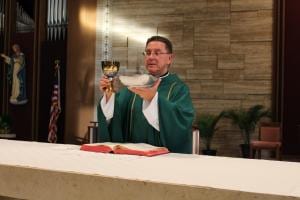
The great offering of the Mass takes place at the end of the Eucharistic Prayer, not at the Consecration.
In recent years I have seen some priests taking a step backwards to my childhood at the Consecration of the Mass. There’s a prolonged pause as the priest raises the host or the chalice as high as he can. I recall such a ritual from the old Latin Mass, but I’ve grown accustomed to a shorter, less exalted and less dramatic Consecration. Is that step back for better or worse or neither? Thinking about backwards and forwards is no way to get an answer. The answer depends on the Consecration itself and its place in the sacrifice of the Mass.
To eliminate suspense, I’ll put the answer up front. Here it is from the General Instruction of the Roman Missal:
- A little before the Consecration, if appropriate, a minister rings a small bell as a signal to the faithful. The minister also rings the small bell at each elevation by the Priest, according to local custom. If incense is being used, when the host and the chalice are shown to the people after the Consecration, a minister incenses them. (emphasis added)
Alright, the GIRM gives two answers (see bold print). I really want to whittle it down to one. There are two ways of looking at the combination of elevating and showing:
- When you elevate something, you are also, incidentally, showing it. The emphasis is on the elevating the Sacrament. To do that well, you probably would raise it high and long.
- In order to show something, you have to elevate it. Now the emphasis is on the showing, and a moderating amount of raising makes for a perfectly good showing.
My preference is for the second interpretation although the text supports either one. I do not think raising the Sacrament high, the first interpretation, is appropriate for this part of the Mass. Neither is the elevation a good time for a long pause. Fr. Anthony Ruff, O.S.B., at the Pray Tell blog and the folks at epicPew will help me make this point.
Ocular Communion
The Consecration is an extraordinary moment, the moment when bread and wine become the body, blood, soul, and divinity of Jesus Christ. I can see why a priest would want to hold on to this moment—to honor, and adore Jesus and to give the congregation time to see, honor, and adore.
Actually, this practice, which above I called a “step back,” goes back further than my childhood. In a Medieval Cathedral some 800 years ago, a priest was saying Mass and had gotten to the Consecration. The congregation was huge. Very few of the people would receive Communion that day. An Augustinian sense of unworthiness kept them away. The Fourth Lateran Council had to make a new law: People must receive communion at least once a year. In my (earlier) days, Catholic children memorized, along with the Ten Commandments, the six Precepts of the Church, of which this is one. It’s an anachronism today, but still on the books.
But back to that Middle Ages Mass. Without the physical touch of the Body of Christ in Communion, hearing none of the priest’s words whispered in Latin, and seeing almost nothing except the priest’s back toward the congregation, one eager worshiper in the back shouted, as the bell for the Elevation rang, “Sir Priest, heave it higher!” That would be his Communion for that Sunday. EpicPer relates that somebody had invented a name for it — “Ocular Communion.”
The mystical power that a former age attributed to the sense of sight is foreign to us, who know how the eye works. Still I can imagine something like Ocular Communion and adoration of Jesus really present going on as the priest raises high the Blessed Sacrament and holds it there. Is that wrong?
Honoring the Father
My answer is that it’s not the best. Consider what Jesus’ purpose in the Eucharistic Prayer is. This prayer is not to honor Jesus. The whole prayer is Jesus’ sacrifice of praise to the Father. Raising the Bread and Cup as high as possible might symbolize Jesus offering himself to the Father, but the words of Consecration don’t mention the Father. They do mention an offering, but it’s not to the Father:
This is my body, which will be given up for you…. This is the chalice of my blood…which will be poured out for you and for many.
The Great offering to God the Father takes place later, at the end of the Eucharistic Prayer:
Through him, and with him, and in him, O God Almighty Father, in the unity of the Holy Spirit, all glory and honor is yours, forever and ever.
This “doxology” (praise words) is the time for a prolonged gesture of elevating the host and cup. It lasts through the recitation or singing of this praise offering and the people’s Amen. The priest holds up the Eucharistic elements, but it’s not these elements but praise that is going “up” to the Father. The elevation doesn’t have to be especially high, but it is dramatic, especially when priest, and not just choir and assembly, sings.
Fr. Ruff on Popular, traditionalist, and third ways
Liturgist Anthony Ruff, on this Pray/Tell blog entry finds three styles of priest leadership at the Consecration. He calls them popular, traditionalist, and third way and demonstrates them with videos.
The well-intentioned populist:
The Well-Intentioned Populist eyeballs the congregation. But the Eucharistic Prayer, though it certainly involves the congregation through their baptism into Christ’s priesthood, is not addressed to the congregation, it is addressed to the Father. To act out the Institution Narrative – “I’ll be Jesus and you all be the disciples” – is to misunderstand this prayer. The priest’s role is to draw the people into his (and ultimately, Jesus’) offering to the Father. The people are not addressees, they are co-actors.
This demonstration included a common practice which I rather liked — until now. As the priest says the words of institution, he slowly rotates the sacred element side to side in a large arc, as if presenting it to every one of the assembled worshipers. As Rupp says, we’re not the disciples at this point.
The holier-than-thou traditionalist
The Holier-Than-Thou Traditionalist … wants the liturgy to be more reverent and serious, which is laudable. But he’s finding his solution in the wrong places. By using a markedly different tone of voice, he rips the Institution Narrative from its larger context and gives the impression that only the magic words (‘hocus pocus’) matter. By staring only at the host, as if to shut out everyone and everything around him, he gives the impression that Christ’s presence is localized there and does not involve the rest of the congregation (not to say all of redeemed creation).
“Holier-than-thou” might be an unfair characterization of the priest, but the prolonged elevation that follows the words of institution is a priest’s personal piety rather than the liturgical rule. As an older Catholic, I remember the intense concentration on the words of institution that was the common practice in the pre-Vatican II Mass. Each word had to be pronounced whole and by itself: “Hoc … est … enim … corpus … meum.” Recently I saw a priest do the same thing in English.
The third way
There is a better way … which the reformed liturgical books allow and suggest. The priest ‘bows slightly,’ as the Missal states, with humble (i.e. understated) reverence. The rubric preserves the objectivity and directionality of this action, without furthering the worst of medieval sacramental misunderstandings which the reforms sought to correct. The showing of the host does not treat it as an isolated relic, but as a strong sign of Christ’s presence among his people. The priest’s manner neither manipulates nor ignores the people.
One of those”medieval sacramental misunderstandings” is to isolate the presence of Jesus in the sacrament from the movement of the Eucharistic Prayer and the whole Mass. The purpose of the Mass is not to contemplate Jesus but to participate in his work. The Consecration is not a climax but an important step on the way to Jesus’ Great Offering of praise to the Father at the Doxology. And that is a step on the way to the climax of the Mass–the Communion.
A liturgical wish: May the form of the liturgy always move the People of God toward active participation in Jesus’ work of bringing creation’s prayer of praise to the seat of God the Father.
Image credit: pxhere.com via Google Images
Previous Post

January 29, 2020
Ecological Sin -- It Makes Sense … and Controversy
Next Post
February 3, 2020 Marcella of Rome, the Woman who Taught St. Jerome
Browse Our Archives
Select a Category Advent Christmas Amazon Synod Angels Being Consumed Bible Catholic Modern Creed Ecology Economics Elizabeth Johnson Eucharist Fragments and Filaments Gender and Sex Gospel of Mark Herzog Historical Jesus Liturgy Luke Opening Scriptures on Way to Emmaus Ordinary radicals Parables Pro-Life Reincarnation Rosary Sacraments science Social Justice Souls Stories of Jesus The Creed Torture and Eucharist Tracy Uncategorized War and Peace
Select a Month October 2026 June 2025 April 2025 March 2025 February 2025 January 2025 November 2024 July 2024 March 2024 December 2023 October 2023 September 2023 August 2023 May 2023 April 2023 March 2023 February 2023 January 2023 December 2022 November 2022 October 2022 September 2022 August 2022 July 2022 June 2022 April 2022 March 2022 February 2022 January 2022 December 2021 November 2021 October 2021 August 2021 July 2021 June 2021 April 2021 March 2021 February 2021 December 2020 November 2020 October 2020 August 2020 July 2020 June 2020 May 2020 April 2020 March 2020 February 2020 January 2020 December 2019 November 2019 October 2019 September 2019 August 2019 July 2019 June 2019 May 2019 April 2019 March 2019 February 2019 January 2019 December 2018 November 2018 October 2018 September 2018 August 2018 July 2018 June 2018 May 2018
Follow Us!
TAKE THE
Religious Wisdom Quiz
Who was the strongest man in the Bible?
Select your answer to see how you score.
David Goliath Moses Samson
Related posts from Lost in a One-Acre Wood

“Drink the Cup” – Liturgy Teaches Us Eucharistic...

Holy Thursday Theology and the Scientific Quest for...

Kneeling Through the Communion Rite: Now I Get...
Ministries in the Church, Momentum for Change, Again
TRENDING AT PATHEOS Catholic

Rejecting Doom: Christian Hope And Human Action
Christianity is a religion of hope. We are to have hope and...

It’s What Comes From Within Which Matters
One of the most difficult things for us to understand is why...

Why I Choose the Eucharist Over the Sermon
Choose the Eucharist, Not the Sermon What are we supposed to get...

5 Design Elements Found in Spiritually Rooted Homes
Putting Spirituality Into Home Decor Our homes are more than our living...

Credo: A Story of God Told with the...
About 10 years ago, I began to imagine a personal "Credo" that...

The Anatomy of Divine Revelation in Catholic Thought
The claim that God has made Himself known to human beings is...
view all Catholic blogs
Ad-Free & Subscriber Log-In Subscription Support
- About Us
- 2026 Calendar
- Videos
- Podcasts
- Library of World Religions
- Faith In Media Tracker
- Advertise With Us
- Write for Us
- Privacy Policy
- Terms of Service
- Do Not Sell My Data
- Contact Us
- Radiant Digital
- Manage Newsletter Subscriptions
- Unsubscribe From Notifications
- Sitemap
Copyright 2008-2026, Patheos. All rights reserved.
Subscription Support Ad-Free & Subscriber Log-In
Follow Patheos