
BuddhistCatholicContemplativeEvangelicalGeneral ChristianHinduJewishLatter-day SaintMuslimNew VisionsProgressive Christian
Beliefs
- Buddhist
- Catholic
- Contemplative
- Evangelical
- General Christian
- Hindu
- Jewish
- Latter-day Saint
- More Voices
- Muslim
- New Visions
- Pagan
- Progressive Christian
Topics
- Religion News
- Food and Religion
- Sports and Religion
- Religious Art
- Religious Music and Entertainment
- Religious Events
- History and Religion
- Style and Religion
- Politics and Religion
- Women in Religion
- Recreation Outdoors and Religion
- Business Finance and Religion
- Careers Workplace and Religion
- Education and Religion
- Family Parenting and Religion
- Health Fitness and Religion
- Home and Religion
- Relationships and Religion
- Technology and Religion
- Travel and Religion
Columnists
- Buddhist Columnists
- Business Finance and Religion Columnists
- Careers Workplace and Religion Columnists
- Catholic Columnists
- Contemplative Columnists
- Education and Religion Columnists
- Evangelists Columnists
- Family Parenting and Religion Columnists
- General Christian Columnists
- Health Fitness and Religion Columnists
- Hindu Columnists
- History and Religion Columnists
- Home and Religion Columnists
- Jewish Columnists
- More Voices Columnists
- Latter Day Columnists
- Muslim Columnists
- New Visions Columnists
- Nonreligious Columnists
- Pagan Columnists
- Politics and Religion Columnists
- Progressive Columnists
- Recreation Outdoors and Religion Columnists
- Relationships and Religion Columnists
- Religion News Columnists
- Religious Art Columnists
- Religious Events Columnists
- Religious Music and Entertainment Columnists
- Sports and Religion Columnists
- Style and Religion Columnists
- Technology and Religion Columnists
- Travel and Religion Columnists
- Women in Religion Columnists
Resource Library
- 2026 Calendar
- Library of World Religions
- The 100 Most Holy Places on Earth
- Patheos Answers
- Podcasts
- Videos
- Faith Leaders Database
- Anglican Episcopalian
- Bahai
- Baptist
- Buddhism
- Christianity
- Confucianism
- Eastern Orthodoxy
- Hinduism
- Holiness and Pentecostal
- ISKCON
- Islam
- Judaism
- Lutheran
- Methodist
- The Church of Jesus Christ of Latter-day Saints
- New Age
- Paganism
- Presbytarian and Reformed
- Protestantism
- Religion Behind the Scenes
- Roman Catholic
- Scientology
- Shia Islam
- Sikhism
- Sufism
- Sunni Islam
- Taoism
- Zen
- See all religions
Research Tools
 Ad-Free & Subscriber Log-In Subscription Support
Ad-Free & Subscriber Log-In Subscription Support
Follow Patheos 

- Trending:
- Forgiveness
- |
- Marriage
- |
- Consciousness
- |
- Death Penalty
- |
- Election
- |
- Halloween

- Home
- Catholic
- Liturgical Wishes, or Things I would Change if I Could: The Tabernacle
Liturgical Wishes, or Things I would Change if I Could: The Tabernacle
Last updated on: April 15, 2023 at 6:02 am by Jack Hartjes
Liturgical Wishes, or Things I would Change if I Could: The Tabernacle 2023-04-15T06:02:53-06:00 Jack Hartjes
Patheos Explore the world's faith through different perspectives on religion and spirituality! Patheos has the views of the prevalent religions and spiritualities of the world.
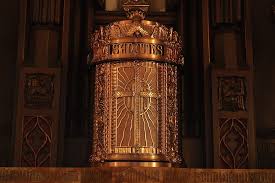
The tabernacle is an important part of church furnishings, but not the most important.
I have just completed in several posts a journey through the Mass, getting help from an imaginaery visitor from space. Imagining this fresh observer helped me see, through her eyes, things that are easy to miss for a Catholic grown perhaps too used to the sights and sounds of typical liturgies. I hope my love for those Sunday gatherings has shown through all of these posts. Now at the end of the journey I want to speak lovingly as I register some complaints. They will range from the small and irksome to some rather significant issues. Most are just things I wish people or priest would do differently. A few would involve changing rubrics. One of them concerns the tabernacle.
This project will take another few posts on some other things like:
- Missalettes
- Silence
- Distributing and receiving Communion
- The Consecration and the Doxology
- Behaviors and personalities, including people, priest, and crying babies
The present post will look at three issues:
- genuflecting or bowing, the sign of reverence,
- where to place the tabernacle,
- and, as an aside, the sanctuary lamp.
Reverencing the deity present in the tabernacle
Generally we know what the tabernacle is. And we know about genuflecting in church. But do we know enough to put these two things together? Often it seems we don’t. This issue arises because the traditional placement of the tabernacle, on the big altar against the far wall of church, has changed in many churches.
We genuflect (or bow) to acknowledge the presence of deity, and that presence is symbolically and really centered in the tabernacle. That’s where consecrated but not consumed hosts remain after Mass. So if that place is somewhere else than directly in front of us when we enter church, that’s where we should face when we genuflect or bow.
Before the reform of the liturgy, people could come into church and genuflect straight ahead. Necessarily that was toward the tabernacle. Today it seems most Catholics don’t look to see where the tabernacle might be but still genuflect straight ahead. That is, when they’re not turning toward the pew and genuflecting to the people who got there first!
Older Catholics probably remember a period of education that helped introduce liturgical changes. It seems this item, where–I mean whither–to genuflect, was left out of those instructions. Younger Catholics get their instructions from the example of their elders. The result: In churches that have moved the tabernacle, most people aim this act of reverence in the wrong direction.
A liturgical wish: There’s a resurgence of interest in reverence in church, for sure among peoplel who like the old liturgy. Let’s find a way to focus on the opportunities for reverence that the new liturgy affords. That would include consciously turning toward the tabernacle before reverently bowing or genuflecting.
Where to put the tabernacle
Before the tabernacle moved, people genuflected toward it, straight ahead. Maybe we should put the tabernacle back where it was. That’s how this article in Patheos thinks and several other articles you can easily find. They all present reasons for putting the tabernacle back front and center. Unfortunately, they ignore the reasons for putting the tabernacle somewhere else. These reasons concern the relative importance of tabernacle and altar and the clarity with which these symbols present themselves.
Outside of Mass, the most important of the church’s furnishings is the tabernacle. During Mass that primacy belongs to the altar. As Mass begins, ministers bow to the altar, not the tabernacle. Incensing on high occasions honors the altar, the ministers, and the people, but not the tabernacle. You can have a Mass without a place to reserve the Eucharistic elements, but you need an altar.
If the altar and the tabernacle are in a direct line from the assembly’s viewpoint, these symbols conflict. You can think them separately, of course, but you see them together. While liturgy offers plenty for the mind to think, its power, humanly speaking, comes from its appeal to the senses.
Altar and tabernacle symbolize different things; they occupy different places in the worshiper’s piety. They ought to be in visually separate places in church. At Mass one’s attention should be on the symbols relevant to Mass—presider’s chair, ambo for the Liturgy of the Word, and altar.
On the other hand, when one comes to church to be with Jesus in the Blessed Sacrament, one ought to be able to focus on the great symbol of that presence alone. That’s another reason for locating the tabernacle prominently but to one side. In most cases this placement will also facilitate the worshiper’s closer approach to the Presence.
The Sanctuary Lamp
Related to the presence of Jesus in the tabernacle is the sanctuary lamp. But the sanctuary lamp could be–I think should be–about more. Even its name suggests it honors the whole sanctuary. Further than that, the concept of sanctuary can extend to more than the area where specially designated ministers perform their functions. Protestants mean by “sanctuary” the entire space where people come for liturgy. Catholic terminology divides the place where ministers function (“sanctuary”) from the place where the rest of the people gather (“Nave”). I see no good reason for this separation.
In many Catholic churches the location of the sanctuary lamp supports the Protestant’s idea of the worship space. It’s placed near enough to the tabernacle so that it honors the divine Presence there. But its location shows that it shines also for the entire space where worship happens, the whole “sanctuary” as Protestants conceive it.
Another liturgical wish: This newer placement of the sanctuary lamp is a praiseworthy development in Catholic church architecture. I hope it leads to development in Catholic thinking. The space where the People of God gather and worship is one holy place, a sanctuary. It’s where the one act of worship in which ministers and the whole assembly partake happens.
Image credit: St. Magdalen de Pazzi, via Google Images
Previous Post

January 20, 2020
“Ite Missa Est” – Go the Mass is … Begun
Next Post
January 29, 2020 Ecological Sin -- It Makes Sense … and Controversy
Browse Our Archives
Select a Category Advent Christmas Amazon Synod Angels Being Consumed Bible Catholic Modern Creed Ecology Economics Elizabeth Johnson Eucharist Fragments and Filaments Gender and Sex Gospel of Mark Herzog Historical Jesus Liturgy Luke Opening Scriptures on Way to Emmaus Ordinary radicals Parables Pro-Life Reincarnation Rosary Sacraments science Social Justice Souls Stories of Jesus The Creed Torture and Eucharist Tracy Uncategorized War and Peace
Select a Month October 2026 June 2025 April 2025 March 2025 February 2025 January 2025 November 2024 July 2024 March 2024 December 2023 October 2023 September 2023 August 2023 May 2023 April 2023 March 2023 February 2023 January 2023 December 2022 November 2022 October 2022 September 2022 August 2022 July 2022 June 2022 April 2022 March 2022 February 2022 January 2022 December 2021 November 2021 October 2021 August 2021 July 2021 June 2021 April 2021 March 2021 February 2021 December 2020 November 2020 October 2020 August 2020 July 2020 June 2020 May 2020 April 2020 March 2020 February 2020 January 2020 December 2019 November 2019 October 2019 September 2019 August 2019 July 2019 June 2019 May 2019 April 2019 March 2019 February 2019 January 2019 December 2018 November 2018 October 2018 September 2018 August 2018 July 2018 June 2018 May 2018
Follow Us!
TAKE THE
Religious Wisdom Quiz
In what city was Jesus born?
Select your answer to see how you score.
Bethlehem Capernaum Nazareth Jerusalem
Related posts from Lost in a One-Acre Wood

“Drink the Cup” – Liturgy Teaches Us Eucharistic...

Holy Thursday Theology and the Scientific Quest for...

Kneeling Through the Communion Rite: Now I Get...
Ministries in the Church, Momentum for Change, Again
TRENDING AT PATHEOS Catholic

Creation, Preservation, and Teleology in Catholic Theology
As I write this, it is very early Monday morning. Like millions...

The Parable Of The Sower And The Word...
One of Christ’s most famous parables is that of the sower who...

Rejecting Doom: Christian Hope And Human Action
Christianity is a religion of hope. We are to have hope and...

Why I Choose the Eucharist Over the Sermon
Choose the Eucharist, Not the Sermon What are we supposed to get...

5 Design Elements Found in Spiritually Rooted Homes
Putting Spirituality Into Home Decor Our homes are more than our living...

Credo: A Story of God Told with the...
About 10 years ago, I began to imagine a personal "Credo" that...
view all Catholic blogs
Ad-Free & Subscriber Log-In Subscription Support
- About Us
- 2026 Calendar
- Videos
- Podcasts
- Library of World Religions
- Faith In Media Tracker
- Advertise With Us
- Write for Us
- Privacy Policy
- Terms of Service
- Do Not Sell My Data
- Contact Us
- Radiant Digital
- Manage Newsletter Subscriptions
- Unsubscribe From Notifications
- Sitemap
Copyright 2008-2026, Patheos. All rights reserved.
Subscription Support Ad-Free & Subscriber Log-In
Follow Patheos