
BuddhistCatholicContemplativeEvangelicalGeneral ChristianHinduJewishLatter-day SaintMuslimNew VisionsProgressive Christian
Beliefs
- Buddhist
- Catholic
- Contemplative
- Evangelical
- General Christian
- Hindu
- Jewish
- Latter-day Saint
- More Voices
- Muslim
- New Visions
- Pagan
- Progressive Christian
Topics
- Religion News
- Food and Religion
- Sports and Religion
- Religious Art
- Religious Music and Entertainment
- Religious Events
- History and Religion
- Style and Religion
- Politics and Religion
- Women in Religion
- Recreation Outdoors and Religion
- Business Finance and Religion
- Careers Workplace and Religion
- Education and Religion
- Family Parenting and Religion
- Health Fitness and Religion
- Home and Religion
- Relationships and Religion
- Technology and Religion
- Travel and Religion
Columnists
- Buddhist Columnists
- Business Finance and Religion Columnists
- Careers Workplace and Religion Columnists
- Catholic Columnists
- Contemplative Columnists
- Education and Religion Columnists
- Evangelists Columnists
- Family Parenting and Religion Columnists
- General Christian Columnists
- Health Fitness and Religion Columnists
- Hindu Columnists
- History and Religion Columnists
- Home and Religion Columnists
- Jewish Columnists
- More Voices Columnists
- Latter Day Columnists
- Muslim Columnists
- New Visions Columnists
- Nonreligious Columnists
- Pagan Columnists
- Politics and Religion Columnists
- Progressive Columnists
- Recreation Outdoors and Religion Columnists
- Relationships and Religion Columnists
- Religion News Columnists
- Religious Art Columnists
- Religious Events Columnists
- Religious Music and Entertainment Columnists
- Sports and Religion Columnists
- Style and Religion Columnists
- Technology and Religion Columnists
- Travel and Religion Columnists
- Women in Religion Columnists
Resource Library
- 2026 Calendar
- Library of World Religions
- The 100 Most Holy Places on Earth
- Patheos Answers
- Podcasts
- Videos
- Faith Leaders Database
- Anglican Episcopalian
- Bahai
- Baptist
- Buddhism
- Christianity
- Confucianism
- Eastern Orthodoxy
- Hinduism
- Holiness and Pentecostal
- ISKCON
- Islam
- Judaism
- Lutheran
- Methodist
- The Church of Jesus Christ of Latter-day Saints
- New Age
- Paganism
- Presbytarian and Reformed
- Protestantism
- Religion Behind the Scenes
- Roman Catholic
- Scientology
- Shia Islam
- Sikhism
- Sufism
- Sunni Islam
- Taoism
- Zen
- See all religions
Research Tools
 Ad-Free & Subscriber Log-In Subscription Support
Ad-Free & Subscriber Log-In Subscription Support
Follow Patheos 

- Trending:
- Forgiveness
- |
- Marriage
- |
- Consciousness
- |
- Death Penalty
- |
- Election
- |
- Halloween

- Home
- Catholic
- St. Ambrose, Reluctant Bishop of Milan
St. Ambrose, Reluctant Bishop of Milan
Last updated on: December 8, 2019 at 9:34 am by Jack Hartjes
St. Ambrose, Reluctant Bishop of Milan 2019-12-08T09:34:02-06:00 Jack Hartjes
Patheos Explore the world's faith through different perspectives on religion and spirituality! Patheos has the views of the prevalent religions and spiritualities of the world.
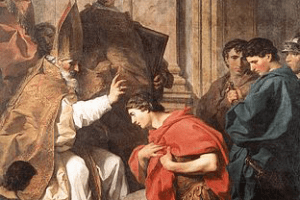
Ambrose castigated Emperor Theodosius for a vengeful massacre of 7000 people.
A provincial governor in fourth-century Italy, Ambrose was drafted to serve as bishop before he was even baptized. Reluctant to serve the chuch at first, he took the task seriously when he finally accepted the call. Ambrose gave away all of his possessions, took up a strict schedule of daily prayer, and committed himself to the study of Scripture. Called from the world of politics to serve the church, Ambrose was a leader who spoke truth to power and did not back down, insisting that “the emperor is in the church, not over it.” (From Common Prayer: A Liturgy for Ordinary Radicals, December 7)
This is the second in the series on heroes of the faith that my favorite prayer book asks us “ordinary radicals” to join in our prayer lives. To a diverse audience of Protestants and Catholics, the authors explain the idea of praying with a very Catholic idea: We never pray alone. For Christians there is a new “we.” “Our family is transnational and borderless.” And, We must connect our prayers to the rest of God’s children throughout the world and through all time and space. These are people who “are reading the same Scriptures, singing the same songs, praying the same prayers, and grafting their lives onto the same old story.”
Ambrose, governor turned bishop
Ambrose was born into a wealthy family, the son of the prefect of the province of Gaul in the Roman Empire. By age 30 he was governor of Italy’s northern provinces. Immediately he had to deal with theological controversy between Arians and those who held what became the orthodox position. Christianity Today says he was “so well regarded that both sides supported him.” CT continues:
When the bishop of Milan (an Arian) died, Ambrose attended the meeteing to elect a replacement, hoping that his presence would preempt violence between the parties. Much to his surprise, both sides shouted their wish for him to be their replacement.
Ambrose had not yet been baptized. In eight days and after the people thought fit to arrest him, Ambrose went from unbaptized to bishop.
Cultured defender of the faith
Ambrose turned out to be a fierce opponent of Arianism and defender of orthodoxy. Ambrose knew Jewish, Greek, and Latin classics and contemporary Pagan as well as Christian writings. He kept this broad background with him and often incorporated neo-Platonic ideas in his sermons. His approach to the Old Testament was highly allegorical, and his sermons were masterpieces of classical literature.
A young man named Augustine, skeptical, searching, and leaning toward Arianism, heard of the famous Ambrose. After four years of Ambrose’s teaching, Augustine accepted baptism and went on to become that age’s greatest expositor of the orthodox faith.
The many-talented Ambrose also left his mark on the music of the Church. He promoted hymn singing during liturgies and “bewitched” the people of Milan with the Eastern melodies of the hymns that he wrote. You can listen to one of Ambrose’s hymns here:
On becoming bishop Ambrose renounced his worldly wealth. He was a persuasive preacher of the ascetic life. Nobles forbade their daughters from attending his sermons for fear they would give up their marriageable status for a life of virginity.
Conflicts with the emperor
The politically powerful Ambrose set a pattern for the relation between Church and state. As Christianity Today puts it, “He wrestled with three emperors—and won each time.” Two incidents especially indicate two different sides of his legacy.
A charioteer from Thessalonica was a people’s favorite, but authorities imprisoned him for homosexuality. A riot broke out and the governor and some others were killed in the chaos. The Charioteer went free.
In revenge Emperor Theodosius announced another chariot race but had something quite other in mind. His soldiers locked the gates on the assembled crowd and within hours killed 7,000 people. Ambrose demanded that Theodosius do public penance and forbade him to attend church until he did. It was the first time that Church triumphed over state.
Britannica reports a second incident that doesn’t seem so benign on Ambrose’s part. Theodosius had punished a bishop for burning a Jewish synagogue. Ambrose rebuked the emperor!
Ambrose remained on friendly terms with Theodosius, who died in Ambrose’s arms. In actions, sermons, letters, and funeral orations for Valentinian II and Theodosius, he established the concept of a Christian emperor. A son of the Church, the emperor serves “under orders from Christ.”
Credit for image of Ambrose and Theodosius: Archdiocese of Washington

Browse Our Archives
Select a Category Advent Christmas Amazon Synod Angels Being Consumed Bible Catholic Modern Creed Ecology Economics Elizabeth Johnson Eucharist Fragments and Filaments Gender and Sex Gospel of Mark Herzog Historical Jesus Liturgy Luke Opening Scriptures on Way to Emmaus Ordinary radicals Parables Pro-Life Reincarnation Rosary Sacraments science Social Justice Souls Stories of Jesus The Creed Torture and Eucharist Tracy Uncategorized War and Peace
Select a Month October 2026 June 2025 April 2025 March 2025 February 2025 January 2025 November 2024 July 2024 March 2024 December 2023 October 2023 September 2023 August 2023 May 2023 April 2023 March 2023 February 2023 January 2023 December 2022 November 2022 October 2022 September 2022 August 2022 July 2022 June 2022 April 2022 March 2022 February 2022 January 2022 December 2021 November 2021 October 2021 August 2021 July 2021 June 2021 April 2021 March 2021 February 2021 December 2020 November 2020 October 2020 August 2020 July 2020 June 2020 May 2020 April 2020 March 2020 February 2020 January 2020 December 2019 November 2019 October 2019 September 2019 August 2019 July 2019 June 2019 May 2019 April 2019 March 2019 February 2019 January 2019 December 2018 November 2018 October 2018 September 2018 August 2018 July 2018 June 2018 May 2018
Follow Us!
TAKE THE
Religious Wisdom Quiz
I saw a river flowing from the temple threshold, getting deeper until it became a river no one could cross. What grew along its banks?
Select your answer to see how you score.
Trees Flowers Grass Vines
Related posts from Lost in a One-Acre Wood
Remembering Oscar Romero on his Feast Day
Rachel Corrie Remembered on the Day she Died...
Maximilian of Thavaste, Martyr, First Recorded Conscientious Objector
James Groppi, Milwaukee Priest, Civil Rights Activist
TRENDING AT PATHEOS Catholic

Creation, Preservation, and Teleology in Catholic Theology
As I write this, it is very early Monday morning. Like millions...

The Parable Of The Sower And The Word...
One of Christ’s most famous parables is that of the sower who...

Rejecting Doom: Christian Hope And Human Action
Christianity is a religion of hope. We are to have hope and...

Why I Choose the Eucharist Over the Sermon
Choose the Eucharist, Not the Sermon What are we supposed to get...

5 Design Elements Found in Spiritually Rooted Homes
Putting Spirituality Into Home Decor Our homes are more than our living...

Credo: A Story of God Told with the...
About 10 years ago, I began to imagine a personal "Credo" that...
view all Catholic blogs
Ad-Free & Subscriber Log-In Subscription Support
- About Us
- 2026 Calendar
- Videos
- Podcasts
- Library of World Religions
- Faith In Media Tracker
- Advertise With Us
- Write for Us
- Privacy Policy
- Terms of Service
- Do Not Sell My Data
- Contact Us
- Radiant Digital
- Manage Newsletter Subscriptions
- Unsubscribe From Notifications
- Sitemap
Copyright 2008-2026, Patheos. All rights reserved.
Subscription Support Ad-Free & Subscriber Log-In
Follow Patheos