
BuddhistCatholicContemplativeEvangelicalGeneral ChristianHinduJewishLatter-day SaintMuslimNew VisionsProgressive Christian
Beliefs
- Buddhist
- Catholic
- Contemplative
- Evangelical
- General Christian
- Hindu
- Jewish
- Latter-day Saint
- More Voices
- Muslim
- New Visions
- Pagan
- Progressive Christian
Topics
- Religion News
- Food and Religion
- Sports and Religion
- Religious Art
- Religious Music and Entertainment
- Religious Events
- History and Religion
- Style and Religion
- Politics and Religion
- Women in Religion
- Recreation Outdoors and Religion
- Business Finance and Religion
- Careers Workplace and Religion
- Education and Religion
- Family Parenting and Religion
- Health Fitness and Religion
- Home and Religion
- Relationships and Religion
- Technology and Religion
- Travel and Religion
Columnists
- Buddhist Columnists
- Business Finance and Religion Columnists
- Careers Workplace and Religion Columnists
- Catholic Columnists
- Contemplative Columnists
- Education and Religion Columnists
- Evangelists Columnists
- Family Parenting and Religion Columnists
- General Christian Columnists
- Health Fitness and Religion Columnists
- Hindu Columnists
- History and Religion Columnists
- Home and Religion Columnists
- Jewish Columnists
- More Voices Columnists
- Latter Day Columnists
- Muslim Columnists
- New Visions Columnists
- Nonreligious Columnists
- Pagan Columnists
- Politics and Religion Columnists
- Progressive Columnists
- Recreation Outdoors and Religion Columnists
- Relationships and Religion Columnists
- Religion News Columnists
- Religious Art Columnists
- Religious Events Columnists
- Religious Music and Entertainment Columnists
- Sports and Religion Columnists
- Style and Religion Columnists
- Technology and Religion Columnists
- Travel and Religion Columnists
- Women in Religion Columnists
Resource Library
- 2026 Calendar
- Library of World Religions
- The 100 Most Holy Places on Earth
- Patheos Answers
- Podcasts
- Videos
- Faith Leaders Database
- Anglican Episcopalian
- Bahai
- Baptist
- Buddhism
- Christianity
- Confucianism
- Eastern Orthodoxy
- Hinduism
- Holiness and Pentecostal
- ISKCON
- Islam
- Judaism
- Lutheran
- Methodist
- The Church of Jesus Christ of Latter-day Saints
- New Age
- Paganism
- Presbytarian and Reformed
- Protestantism
- Religion Behind the Scenes
- Roman Catholic
- Scientology
- Shia Islam
- Sikhism
- Sufism
- Sunni Islam
- Taoism
- Zen
- See all religions
Research Tools
 Ad-Free & Subscriber Log-In Subscription Support
Ad-Free & Subscriber Log-In Subscription Support
Follow Patheos 

- Trending:
- Forgiveness
- |
- Marriage
- |
- Consciousness
- |
- Death Penalty
- |
- Election
- |
- Halloween

- Home
- Catholic
- Offertory vs. Preparation of the Gifts: When does the Offering of the Mass happen?
Offertory vs. Preparation of the Gifts: When does the Offering of the Mass happen?
Last updated on: December 7, 2019 at 8:28 pm by Jack Hartjes
Offertory vs. Preparation of the Gifts: When does the Offering of the Mass happen? 2019-12-07T20:28:57-06:00 Jack Hartjes
Patheos Explore the world's faith through different perspectives on religion and spirituality! Patheos has the views of the prevalent religions and spiritualities of the world.
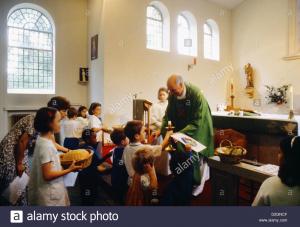
The Preparation of the Gifts is now a minor rite. It is not an offertory, the old name for this rite, because nothing is offered at this time.
The second main part of the Mass, the Liturgy of the Eucharist, begins with what we used to call the Offertory. The imaginary space visitor whom we’ve met in this series remembers that word from a previous visit back in the 1950’s. She was puzzled then. There didn’t seem to be much of an offering going on. Servers carried so-called gifts, mere bread and wine, to the altar. The priest made a kind of fuss over them. But there they stayed. Nothing actually happened to them, at least not at this part of the Mass.
This is the seventh in a series on the Mass. I’ve been letting the various actions and experiences of the Mass speak their meaning to an interested, theologically untutored, and so quite observant space alien. I’m finding that she pays a lot of attention to things we tend to take for granted or even interpret wrongly.
At the moment this visitor notices that the name Offertory has changed to “Preparation of the Gifts.” That makes more sense to her, but I wonder if most of the rest of us have caught the significance of the change. I was present at a liturgy workshop in the mid-1970’s, ten years after the beginning of the liturgical reforms. The presenter asked us, “When in the Mass does the offering occur?” Priests and lay leaders alike thought it was “at the Offertory.” – Wrong! I pictured in my mind the priest raising host and chalice up as high and as close to God as he could and piped up, “At the Consecration.” – Wrong again!
A merely preparatory rite
We’ll get the right answer, but, first, about that old name “Offertory.” It seemed to say: W make our little sacrifice, offering God gifts of bread, wine, and money in the collection basket; later Jesus responds way out of proportion to our small effort. He puts his whole infinite self at our disposal in the forms of the bread and wine. But truly the only offering to God is what Jesus accomplishes. God’s gift to us in no way depends on our gifts to God.
The Preparation of the Gifts is a minor rite now. The prayers are shorter and more in tune with what’s actually happening. The priest no longer says as in the old Offertory:
Receive, O holy Father, almighty and eternal God, this spotless host, which I, Your unworthy servant, offer to you ….
And, after another long prayer,
We offer You the chalice of salvation, Lord ….
Today the priest doesn’t claim to be offering anything at this part of the Mass. The words are:
Blessed are you, Lord God of all creation. Through your goodness we have this bread/wine to offer…. It will become our spiritual food/drink.
This preparatory rite is like cooking and making ready at home before the guests arrive. We, the people in the pews, do some of the preparations, carrying bread and wine forward to the altar. That’s a welcome switch from just having servers carry them from one table in the sanctuary to another.
Actually, we only bring the gifts near the altar. The priest and servers, with perhaps a word of thanks, receive the gifts there and carry them the rest of the way. The people’s work is not honored as well as it might be by this seemingly polite “Thanks, I’ll take it from here.”
The Eucharistic Prayer
That preparatory rite is not a time of offering to God. Our space visitor doesn’t see that the gifts of bread and wine are destined for God at all. The new words “It will become our spiritual food/drink” indicate that she might be right. But it’s necessary to think again about what Jesus was doing on the cross, which the next part of the Mass, the Eucharistic Prayer remembers.
In the past it seemed to me that the most important part of the Mass was the Consecration in the middle of the Eucharistic Prayer. I was awestruck by the words the priest, echoing Jesus at the Last Supper, said: “This is my body…. This is the chalice of my blood….” We didn’t quite worship the words, but we tiptoed around them for fear that a priest might carelessly or maliciously utter them while walking past a bakery or wine shop.
In the previous paragraph I left out parts of what the priest and Jesus said. Here are the words of the Consecration in full:
Take this, all of you, and eat of it,
for this is my Body,
which will be given up for you.Take this, all of you, and drink from it,
for this is the chalice of my Blood,
the Blood of the new and eternal covenant,
which will be poured out for you and for many
for the forgiveness of sins.
Here is not our offering to God but God’s offering to us.
Still, the whole Eucharistic Prayer is an offertory, an offering to God. The prayer’s climactic ending sums up the essence of that offering:
Through him [Christ], and with him, and in him, O God, almighty Father, in the unity of the Holy Spirit, all glory and honor is yours for ever and ever.
Our “Amen” signals our willing participation in Jesus’ offering of all praise to God.
Observing the Crucifixion
Praise in the form of a life of perfect obedience, even extending to the cross, is what Jesus offered to his Father. If our theologically untutored space alien had been there at the crucifixion, she would have seen what the Romans and a few Jewish leaders got out of this offering—Jesus’ body to abuse and destroy. In their contest with Jesus, they were the winners. She might also have noticed that they didn’t win very much. The honor and bragging rights that usually accrue to a winner are missing here. They didn’t get to take Jesus’ life with their overwhelming power. Jesus disrupted that process by not entering the fight at all.
The Roman Empire got Jesus’ suffering and death, but it did not get what empires always want. What empires want and what they need to survive is exactly what Jesus gave to God alone. Empires want our lives to control, our awe in the face of their almighty power. They want the grudging or willing esteem that hopeless and bowed down people give to tyrants. They want our worship. All of that is what Jesus, and after him subversive early Christian martyrs, gave only to God.
In the next post in this series we’ll see what our space visitor makes of the phrase “all glory and honor” in the Mass’s great offering. She sees how that offering to God leads, without a moment’s pause, to the high drama of the Mass—our reaching out, in Communion with God and each other, across our many divisions that depend on the petty honors that we would, except for Jesus, keep for ourselves or offer to our favorite lesser gods.
Image credit: Alamy stock foto
Previous Post

December 6, 2019
Preeminent is Not the Same as Most Urgent
Next Post
December 8, 2019 St. Ambrose, Reluctant Bishop of Milan
Browse Our Archives
Select a Category Advent Christmas Amazon Synod Angels Being Consumed Bible Catholic Modern Creed Ecology Economics Elizabeth Johnson Eucharist Fragments and Filaments Gender and Sex Gospel of Mark Herzog Historical Jesus Liturgy Luke Opening Scriptures on Way to Emmaus Ordinary radicals Parables Pro-Life Reincarnation Rosary Sacraments science Social Justice Souls Stories of Jesus The Creed Torture and Eucharist Tracy Uncategorized War and Peace
Select a Month October 2026 June 2025 April 2025 March 2025 February 2025 January 2025 November 2024 July 2024 March 2024 December 2023 October 2023 September 2023 August 2023 May 2023 April 2023 March 2023 February 2023 January 2023 December 2022 November 2022 October 2022 September 2022 August 2022 July 2022 June 2022 April 2022 March 2022 February 2022 January 2022 December 2021 November 2021 October 2021 August 2021 July 2021 June 2021 April 2021 March 2021 February 2021 December 2020 November 2020 October 2020 August 2020 July 2020 June 2020 May 2020 April 2020 March 2020 February 2020 January 2020 December 2019 November 2019 October 2019 September 2019 August 2019 July 2019 June 2019 May 2019 April 2019 March 2019 February 2019 January 2019 December 2018 November 2018 October 2018 September 2018 August 2018 July 2018 June 2018 May 2018
Follow Us!
TAKE THE
Religious Wisdom Quiz
A hand wrote on the palace wall during a feast, and I interpreted the message: numbered, weighed, divided. What were these three Aramaic words?
Select your answer to see how you score.
Ichabod, Ebenezer, Beulah Babylon, Media, Persia Mene, Mene, Tekel, Parsin Holy, Holy, Holy
Related posts from Lost in a One-Acre Wood

“Drink the Cup” – Liturgy Teaches Us Eucharistic...

Kneeling Through the Communion Rite: Now I Get...
Ministries in the Church, Momentum for Change, Again

Address the Prayer of the Faithful to God,...
TRENDING AT PATHEOS Catholic

Rejecting Doom: Christian Hope And Human Action
Christianity is a religion of hope. We are to have hope and...

It’s What Comes From Within Which Matters
One of the most difficult things for us to understand is why...

Why I Choose the Eucharist Over the Sermon
Choose the Eucharist, Not the Sermon What are we supposed to get...

5 Design Elements Found in Spiritually Rooted Homes
Putting Spirituality Into Home Decor Our homes are more than our living...

Credo: A Story of God Told with the...
About 10 years ago, I began to imagine a personal "Credo" that...

The Anatomy of Divine Revelation in Catholic Thought
The claim that God has made Himself known to human beings is...
view all Catholic blogs
Ad-Free & Subscriber Log-In Subscription Support
- About Us
- 2026 Calendar
- Videos
- Podcasts
- Library of World Religions
- Faith In Media Tracker
- Advertise With Us
- Write for Us
- Privacy Policy
- Terms of Service
- Do Not Sell My Data
- Contact Us
- Radiant Digital
- Manage Newsletter Subscriptions
- Unsubscribe From Notifications
- Sitemap
Copyright 2008-2026, Patheos. All rights reserved.
Subscription Support Ad-Free & Subscriber Log-In
Follow Patheos