
BuddhistCatholicContemplativeEvangelicalGeneral ChristianHinduJewishLatter-day SaintMuslimNew VisionsProgressive Christian
Beliefs
- Buddhist
- Catholic
- Contemplative
- Evangelical
- General Christian
- Hindu
- Jewish
- Latter-day Saint
- More Voices
- Muslim
- New Visions
- Pagan
- Progressive Christian
Topics
- Religion News
- Food and Religion
- Sports and Religion
- Religious Art
- Religious Music and Entertainment
- Religious Events
- History and Religion
- Style and Religion
- Politics and Religion
- Women in Religion
- Recreation Outdoors and Religion
- Business Finance and Religion
- Careers Workplace and Religion
- Education and Religion
- Family Parenting and Religion
- Health Fitness and Religion
- Home and Religion
- Relationships and Religion
- Technology and Religion
- Travel and Religion
Columnists
- Buddhist Columnists
- Business Finance and Religion Columnists
- Careers Workplace and Religion Columnists
- Catholic Columnists
- Contemplative Columnists
- Education and Religion Columnists
- Evangelists Columnists
- Family Parenting and Religion Columnists
- General Christian Columnists
- Health Fitness and Religion Columnists
- Hindu Columnists
- History and Religion Columnists
- Home and Religion Columnists
- Jewish Columnists
- More Voices Columnists
- Latter Day Columnists
- Muslim Columnists
- New Visions Columnists
- Nonreligious Columnists
- Pagan Columnists
- Politics and Religion Columnists
- Progressive Columnists
- Recreation Outdoors and Religion Columnists
- Relationships and Religion Columnists
- Religion News Columnists
- Religious Art Columnists
- Religious Events Columnists
- Religious Music and Entertainment Columnists
- Sports and Religion Columnists
- Style and Religion Columnists
- Technology and Religion Columnists
- Travel and Religion Columnists
- Women in Religion Columnists
Resource Library
- 2026 Calendar
- Library of World Religions
- The 100 Most Holy Places on Earth
- Patheos Answers
- Podcasts
- Videos
- Faith Leaders Database
- Anglican Episcopalian
- Bahai
- Baptist
- Buddhism
- Christianity
- Confucianism
- Eastern Orthodoxy
- Hinduism
- Holiness and Pentecostal
- ISKCON
- Islam
- Judaism
- Lutheran
- Methodist
- The Church of Jesus Christ of Latter-day Saints
- New Age
- Paganism
- Presbytarian and Reformed
- Protestantism
- Religion Behind the Scenes
- Roman Catholic
- Scientology
- Shia Islam
- Sikhism
- Sufism
- Sunni Islam
- Taoism
- Zen
- See all religions
Research Tools
 Ad-Free & Subscriber Log-In Subscription Support
Ad-Free & Subscriber Log-In Subscription Support
Follow Patheos 

- Trending:
- Forgiveness
- |
- Marriage
- |
- Consciousness
- |
- Death Penalty
- |
- Election
- |
- Halloween

- Home
- Catholic
- The Creed, a Story Not an Essay
The Creed, a Story Not an Essay
Last updated on: June 29, 2021 at 3:22 pm by Jack Hartjes
The Creed, a Story Not an Essay 2021-06-29T15:22:35-06:00 Jack Hartjes
Patheos Explore the world's faith through different perspectives on religion and spirituality! Patheos has the views of the prevalent religions and spiritualities of the world.
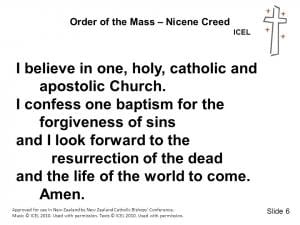
Catholics believe on the foundation of the Church’s, witness. God gives an unworthy instrument a very important task.
Between the Liturgy of the Word (see this post) and the next main part of the Mass stands a small part we call the Creed. Our imaginary visitor from space, who has seen both today’s and the pre-Vatican II Mass, notices little difference here except for the obvious change from Latin to English. But there is something so odd, so contrary to our expectations that she might be the only one noticing it. (Remember she doesn’t have any expectations.)
This is the fourth post in a series on the Mass as we celebrate it today.
When you call something a creed, people expect to get a statement of beliefs. Like, maybe…
- There is an all-good, all-knowing, all-powerful god. Or, there isn’t.
- My job is to know God, to love God, and to serve God in this world so that I may be happy with God forever in heaven. Or, we are here to help each other, but take care of yourself first.
- The world is a valley of tears or maybe a garden of delights.
- The world is getting better (or worse) all the time.
- Every good and bad deed must have its just recompense. An eye for an eye and a tooth for a tooth. God will balance the scales of justice after we die, if not before. Or, forgive seventy times seven times.
It would make a lot of sense if the Creed of the Mass were like that. Just like life in the world, we start out with a period of education, including some stories to get across important points in a meaningful way. We sum up what we’ve learned in some guiding principles. Then we get on with the business of life. But the Creed isn’t like that, and neither is the Mass.
A story, not an essay
The first thing our visitor notices about the Creed is that it’s another story.It’s not an essay detailing things I believe. One little word changes everything. It’s what, or rather Who, I believe IN. When I say “I believe in you,” I’m not saying “I believe you exist.” This is not stating a fact, it’s putting myself into your story and on your side. With the first sentence of the Creed, I declare my loyalty to and trust in God, whose story includes some amazing deeds. I put myself in that story, which is not finished yet.
The next thing to notice is that this Creed is a poor summary of the stories we learn (or rather celebrate) in the Liturgy of the Word. When you summarize a story or a lesson, you can put the original aside. You have what you need with just the summary, especially if the whole point is to get on with living. The Christian Creed is no substitute for the Bible. It’s a guide to reading the Bible. And, the Liturgy of the Word isn’t just preparation. It’s living the story.
Having a story, a counter-cultural thing
The modern world doesn’t have a story. It has stories, all of them set out as if on shelves, consumer goods in our consumer society. If you like, you can choose a story shipped in from oceans away. Or one from the soil where you live. Or even the Christian story. There are any number of reasons why we might choose one or the other. And no shortage of reasons why somebody else might choose a different one.
Notice how independent we are from such stories. Because we are independent choosers, because no choice is forced on us, the existence of multiple stories is not problem. They all get along quite nicely without ever a real encounter of one with another. Freedom of choice and tolerance are partners in this world.
The Christian Creed doesn’t have that kind of tolerance. The story of God, who creates “all things visible and invisible,” looks for an encounter with other stories. Jesus’ story tells of one who lived and died “for us and for our salvation.” It challenges some other stories, the ones that say we save or condemn ourselves. The story of the Spirit, “who has spoken (and still speaks) through prophets,” demands a hearing. Prophets (today think Greta Thunberg) don’t care about your freedom to believe what you want; they care about the truth. The Christian Creed would gather us into one true story. We can disagree. We have fought over it. But at least it calls us together.
I believe in (or with) the Church
Here’s a problem that must unsettle most believers. The faith of Christians depends on the Church. But that Church proves itself over and over to be unworthy. The current crises of sexual abuse and clericalism in the Church are not exceptions to the historical pattern. That would seem to justify the modern world when it makes the individual its own authority on fundamental beliefs. This may be the first place where a dividing line gets drawn: Are we shoppers who can call this story or that story our own, or are we ultimately owned by our story? Are we, perhaps, even made by our stories so that changing a story would mean changing who we are? Do we really choose a story, or is that just the final step along a path which we can opt out of at any point or allow to lead us wherever it will, perhaps to the Church. Maybe that’s what grace means.
The Creed doesn’t explain how an imperfect instrument like the church can handle such an important job as transmitting stories. It leaves that and many other things for us to sort out as best we can. What does creation say about the relation between God and the world? From what and for what does Jesus save us? How do we discern, among all the prophets, which ones give voice to the Spirit and which do not?
The Creed doesn’t make the answers easy, but it does reinforce what binds us into one story. After all, God is the unity of Father, Son, and Spirit. As Mass proceeds, the Liturgy of the Eucharist will unite us even more securely with Jesus and the community of his own throughout the ages. It will anticipate the day when all the walls that divide people give way to the praise of one God through Jesus and in the Holy Spirit.
Previous Post

November 8, 2019
Could this be the Most Anti-life Deed?
Next Post
November 26, 2019 The Creed, Entering God’s Dangerous World
Browse Our Archives
Select a Category Advent Christmas Amazon Synod Angels Being Consumed Bible Catholic Modern Creed Ecology Economics Elizabeth Johnson Eucharist Fragments and Filaments Gender and Sex Gospel of Mark Herzog Historical Jesus Liturgy Luke Opening Scriptures on Way to Emmaus Ordinary radicals Parables Pro-Life Reincarnation Rosary Sacraments science Social Justice Souls Stories of Jesus The Creed Torture and Eucharist Tracy Uncategorized War and Peace
Select a Month October 2026 June 2025 April 2025 March 2025 February 2025 January 2025 November 2024 July 2024 March 2024 December 2023 October 2023 September 2023 August 2023 May 2023 April 2023 March 2023 February 2023 January 2023 December 2022 November 2022 October 2022 September 2022 August 2022 July 2022 June 2022 April 2022 March 2022 February 2022 January 2022 December 2021 November 2021 October 2021 August 2021 July 2021 June 2021 April 2021 March 2021 February 2021 December 2020 November 2020 October 2020 August 2020 July 2020 June 2020 May 2020 April 2020 March 2020 February 2020 January 2020 December 2019 November 2019 October 2019 September 2019 August 2019 July 2019 June 2019 May 2019 April 2019 March 2019 February 2019 January 2019 December 2018 November 2018 October 2018 September 2018 August 2018 July 2018 June 2018 May 2018
Follow Us!
TAKE THE
Religious Wisdom Quiz
Who was the first king of Israel?
Select your answer to see how you score.
Saul Samuel David Solomon
Related posts from Lost in a One-Acre Wood

“Drink the Cup” – Liturgy Teaches Us Eucharistic...

Kneeling Through the Communion Rite: Now I Get...
Ministries in the Church, Momentum for Change, Again
Address the Prayer of the Faithful to God,...
TRENDING AT PATHEOS Catholic

Rejecting Doom: Christian Hope And Human Action
Christianity is a religion of hope. We are to have hope and...

It’s What Comes From Within Which Matters
One of the most difficult things for us to understand is why...

Why I Choose the Eucharist Over the Sermon
Choose the Eucharist, Not the Sermon What are we supposed to get...

5 Design Elements Found in Spiritually Rooted Homes
Putting Spirituality Into Home Decor Our homes are more than our living...

Credo: A Story of God Told with the...
About 10 years ago, I began to imagine a personal "Credo" that...

The Anatomy of Divine Revelation in Catholic Thought
The claim that God has made Himself known to human beings is...
view all Catholic blogs
Ad-Free & Subscriber Log-In Subscription Support
- About Us
- 2026 Calendar
- Videos
- Podcasts
- Library of World Religions
- Faith In Media Tracker
- Advertise With Us
- Write for Us
- Privacy Policy
- Terms of Service
- Do Not Sell My Data
- Contact Us
- Radiant Digital
- Manage Newsletter Subscriptions
- Unsubscribe From Notifications
- Sitemap
Copyright 2008-2026, Patheos. All rights reserved.
Subscription Support Ad-Free & Subscriber Log-In
Follow Patheos