
BuddhistCatholicContemplativeEvangelicalGeneral ChristianHinduJewishLatter-day SaintMuslimNew VisionsProgressive Christian
Beliefs
- Buddhist
- Catholic
- Contemplative
- Evangelical
- General Christian
- Hindu
- Jewish
- Latter-day Saint
- More Voices
- Muslim
- New Visions
- Pagan
- Progressive Christian
Topics
- Religion News
- Food and Religion
- Sports and Religion
- Religious Art
- Religious Music and Entertainment
- Religious Events
- History and Religion
- Style and Religion
- Politics and Religion
- Women in Religion
- Recreation Outdoors and Religion
- Business Finance and Religion
- Careers Workplace and Religion
- Education and Religion
- Family Parenting and Religion
- Health Fitness and Religion
- Home and Religion
- Relationships and Religion
- Technology and Religion
- Travel and Religion
Columnists
- Buddhist Columnists
- Business Finance and Religion Columnists
- Careers Workplace and Religion Columnists
- Catholic Columnists
- Contemplative Columnists
- Education and Religion Columnists
- Evangelists Columnists
- Family Parenting and Religion Columnists
- General Christian Columnists
- Health Fitness and Religion Columnists
- Hindu Columnists
- History and Religion Columnists
- Home and Religion Columnists
- Jewish Columnists
- More Voices Columnists
- Latter Day Columnists
- Muslim Columnists
- New Visions Columnists
- Nonreligious Columnists
- Pagan Columnists
- Politics and Religion Columnists
- Progressive Columnists
- Recreation Outdoors and Religion Columnists
- Relationships and Religion Columnists
- Religion News Columnists
- Religious Art Columnists
- Religious Events Columnists
- Religious Music and Entertainment Columnists
- Sports and Religion Columnists
- Style and Religion Columnists
- Technology and Religion Columnists
- Travel and Religion Columnists
- Women in Religion Columnists
Resource Library
- 2026 Calendar
- Library of World Religions
- The 100 Most Holy Places on Earth
- Patheos Answers
- Podcasts
- Videos
- Faith Leaders Database
- Anglican Episcopalian
- Bahai
- Baptist
- Buddhism
- Christianity
- Confucianism
- Eastern Orthodoxy
- Hinduism
- Holiness and Pentecostal
- ISKCON
- Islam
- Judaism
- Lutheran
- Methodist
- The Church of Jesus Christ of Latter-day Saints
- New Age
- Paganism
- Presbytarian and Reformed
- Protestantism
- Religion Behind the Scenes
- Roman Catholic
- Scientology
- Shia Islam
- Sikhism
- Sufism
- Sunni Islam
- Taoism
- Zen
- See all religions
Research Tools
 Ad-Free & Subscriber Log-In Subscription Support
Ad-Free & Subscriber Log-In Subscription Support
Follow Patheos 

- Trending:
- Forgiveness
- |
- Marriage
- |
- Consciousness
- |
- Death Penalty
- |
- Election
- |
- Halloween

- Home
- Catholic
- Liturgical Reform and This Series amid Contrary Views
Liturgical Reform and This Series amid Contrary Views
Last updated on: April 15, 2023 at 6:24 am by Jack Hartjes
Liturgical Reform and This Series amid Contrary Views 2023-04-15T06:24:01-06:00 Jack Hartjes
Patheos Explore the world's faith through different perspectives on religion and spirituality! Patheos has the views of the prevalent religions and spiritualities of the world.
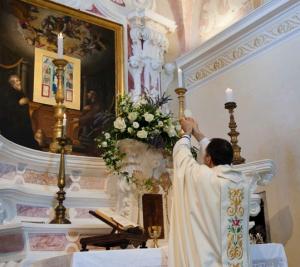
Many Catholics no longer believe the Church’s teaching on the real presence of Christ in the Eucharist. Would going back to the old style of the Mass help?
You can tell from these posts on the Mass that I view the liturgical reform since Vatican II positively. I think most Catholics do too, but many do not. That fact became clear to me last week. My sister mailed me some articles that a priest of the Wisconsin parish where I grew up published in the local newspaper. The articles, she says, disturbed many Catholics. My response to him, which that newspaper may or may not print, also makes up for my ignoring until now the existence of these contrary voices.
Father laments the results of a recent PEW survey showing many Catholics’ loss of faith in Christ’s presence in the Eucharist. Liturgical reform is at fault, he thinks. This includes priest facing the people, the disappearance of the Communion rail, Mass entirely in English, and even congregational hymn singing. He would like to see a trained choir singing Gregorian chant, Latin in at least some parts of the Liturgy, and priest “ad orientem.” That means (symbolically) facing toward the direction from which Jesus will return and (really) praying most of the time with his back to the people on the other side of a Communion rail.
The data in that PEW survey are astonishing. Less than a third of Catholics surveyed stated they know and believe Christ is truly present in the Eucharist. Over two thirds believe that presence is merely symbolic. The percentages are reversed for Catholics who attend Mass weekly. But still it’s disturbing that a third of Catholics at a typical Mass don’t know what they’re doing there. Sadder, and sadly ironic, is that this happens even as Catholics are learning about the many Protestants who do believe in Christ’s real, not just symbolic, presence in the Eucharist.
A Eucharist story from before the reform
My thoughts go back to the 1950’s, before liturgical reform, and a Catholic boy getting up from kneeling at the Communion rail. He has just received “the Body of Christ” on his tongue. Today he’s having trouble swallowing the sacred host without chewing it. That would be irreverent. As the appearance of bread threatens to dissolve in his mouth, he thinks of what he has been taught. Christ is really there but only as long as the sign of bread remains. By the time he gets back to his pew, he has successfully swallowed the host. Then he quietly meditates on the gift of Jesus’ presence within him, wondering how many more seconds or minutes that will be, as digestive juices work on the host.
This story says something true about Catholic Eucharistic belief, but it leave an impression that is at odds with that faith. It seems to say that Jesus is present in the form of bread in the same way any hidden physical thing might occupy its particular space and time. The sign, bread, has, contrary to appearances, become the reality of Jesus. This is about as far as most Catholics’ understanding of the real presence goes, whether they believe it or not.
Failure of education
For me the starting point for better understanding the Eucharist was to know the signs of the Eucharist more exactly. They are not simply what looks like bread and wine. Rather, the signs are bread broken and shared, a cup passed and shared. The signs of the Eucharist are actions that a worshiping assembly takes together. It’s the “Lord’s Supper,” an ancient name for the Mass. It’s the “Breaking of the Bread,” another ancient name and another way of saying to share a meal together. Jesus is present, contrary to the appearance of bread; but the actions going on all around do seem a lot like God at work.
Catholics, but not Protestants, also believe Jesus is truly present in the tabernacle, where consecrated bread that was not consumed at Mass reposes. Even here, while the sign of bread is perfectly still, there is an active meaning. Jesus is not at home here as if in a castle. The tabernacle, a word that once meant tent, is a place from which Jesus is poised to go out to serve the needs of the sick or dying. Taking Communion to the homebound was the original purpose of reserving some of the sacred hosts.
Going back to that memory of having trouble swallowing the host, I needn’t have bothered about how many minutes or seconds the host would retain the form of bread. Jesus was present in the common action of that gathered community, in the meal that was shared. Most of us thought individualistically. But Jesus comes to us together, as a body. Only, the liturgy in those days didn’t show it very well, and today most of us still don’t understand it very well.
An active presence in active signs
Today the liturgy has powerful ways of showing the reality of Christ’s presence in the shared action of the assembly. The Communion procession involves communal singing of a hymn. Holding hands open to receive Communion symbolizes, as well as holding one’s tongue out does, that we are receiving a precious gift. But standing symbolizes better than kneeling that we involve ourselves in Christ’s action. Taking away the Communion rail brought us Mass-goers closer to the action of the Mass.
The same can be said of the priest facing toward the people. This orientation shows clearly the relationship between priest and people. The priest, representing Jesus, the head of the body, is not just the most important celebrant, without whom there cannot be a Mass. He is presider, the leader of the worshiping assembly, drawing together and honoring the various contributions of all the members, without which there cannot be a Mass. None of this comes across when the priest simply faces forward, like any of the rest of us.
Finally, if the Mass is truly the work, with Christ, of God’s holy people—which “liturgy” literally says—then it only makes sense that that work be conducted in the people’s language. Once we thought that the Mass had to be in Latin, a dead, language, because living languages are always changing. Such changes might eventually distort the meaning of the Mass text. That seems an unnecessary worry, but just in case there is still a Latin Mass text, against which experts can check translations that parishes use.
What the people contribute counts
Besides solving a problem that doesn’t exist, Latin in parish liturgies erects another barrier between the people and the Mass. While the priest says the words in Latin, the people may follow along with translations in their “missals.” Whether they do this or not, the Mass goes on because the supposedly “real” Mass is what the priest, with his back to the people, says and does, mostly inaudibly and invisibly. There will be bells announcing important parts of the ceremony. At the Consecration, a raised host and chalice will offer the people the ability to see and adore. But these are poor ways of saying that I in my pew really need, for the Mass’s sake, to be there.
We hear repeatedly, when there are complaints about poor, lifeless liturgies, that it’s not what we get out of the Mass but what we give to it that counts most. I believe that’s true, and I rejoice in the kind of active participation in liturgy, in many different roles, that the Church’s liturgy invites me to.
What about the big issue, liturgical reform and faith in the real presence?
The new form of the liturgy does not support most Catholics’ understanding of the presence of Christ in the Eucharist as well as the old did. We don’t, typically, have as much time to silently adore Christ present in the raised host at the Consecration. Most of us don’t kneel for Communion, although we can if we wish. Now instead of silently meditating on Jesus, dwelling for a time within our individual bodies, we join together in a robust (preferably) singing of a Communion hymn. These are problems for belief in the real presence, though, only because liturgical reform has not come with adequate understanding.
Today’s liturgy does strongly support an experience of Christ really present in assembly gathered and working together, priest presiding, word proclaimed, Living Bread broken and shared, and Saving Cup poured out for all. In short, Christ is present and active in the work of God’s people.
The odds of 100 percent of church-going Catholics saying they believe in the real presence of Christ in the Eucharist would be greatly improved if they understood two things. First, their experience of liturgy embodies a truly active presence of Christ; it actually looks like Christ at work. And, second, in many ways that presence in bold actions of a worshiping assembly points to God’s work in the midst of their faith lives outside of the Liturgy. But that last part is a subject for another long story, toward which this series is heading.
Image credit: New Liturgical Movement via Google Images
Previous Post

November 1, 2019
The Liturgy of the Word: More than Listening
Next Post
November 8, 2019 Could this be the Most Anti-life Deed?
Browse Our Archives
Select a Category Advent Christmas Amazon Synod Angels Being Consumed Bible Catholic Modern Creed Ecology Economics Elizabeth Johnson Eucharist Fragments and Filaments Gender and Sex Gospel of Mark Herzog Historical Jesus Liturgy Luke Opening Scriptures on Way to Emmaus Ordinary radicals Parables Pro-Life Reincarnation Rosary Sacraments science Social Justice Souls Stories of Jesus The Creed Torture and Eucharist Tracy Uncategorized War and Peace
Select a Month October 2026 June 2025 April 2025 March 2025 February 2025 January 2025 November 2024 July 2024 March 2024 December 2023 October 2023 September 2023 August 2023 May 2023 April 2023 March 2023 February 2023 January 2023 December 2022 November 2022 October 2022 September 2022 August 2022 July 2022 June 2022 April 2022 March 2022 February 2022 January 2022 December 2021 November 2021 October 2021 August 2021 July 2021 June 2021 April 2021 March 2021 February 2021 December 2020 November 2020 October 2020 August 2020 July 2020 June 2020 May 2020 April 2020 March 2020 February 2020 January 2020 December 2019 November 2019 October 2019 September 2019 August 2019 July 2019 June 2019 May 2019 April 2019 March 2019 February 2019 January 2019 December 2018 November 2018 October 2018 September 2018 August 2018 July 2018 June 2018 May 2018
Follow Us!
TAKE THE
Religious Wisdom Quiz
I am the count that found over 600,000 men able to go to war. What am I?
Select your answer to see how you score.
A military count The wilderness count The first census of Israel God's numbering
Related posts from Lost in a One-Acre Wood

“Drink the Cup” – Liturgy Teaches Us Eucharistic...

Holy Thursday Theology and the Scientific Quest for...

Kneeling Through the Communion Rite: Now I Get...
Ministries in the Church, Momentum for Change, Again
TRENDING AT PATHEOS Catholic

Rejecting Doom: Christian Hope And Human Action
Christianity is a religion of hope. We are to have hope and...

It’s What Comes From Within Which Matters
One of the most difficult things for us to understand is why...

Why I Choose the Eucharist Over the Sermon
Choose the Eucharist, Not the Sermon What are we supposed to get...

5 Design Elements Found in Spiritually Rooted Homes
Putting Spirituality Into Home Decor Our homes are more than our living...

Credo: A Story of God Told with the...
About 10 years ago, I began to imagine a personal "Credo" that...

The Anatomy of Divine Revelation in Catholic Thought
The claim that God has made Himself known to human beings is...
view all Catholic blogs
Ad-Free & Subscriber Log-In Subscription Support
- About Us
- 2026 Calendar
- Videos
- Podcasts
- Library of World Religions
- Faith In Media Tracker
- Advertise With Us
- Write for Us
- Privacy Policy
- Terms of Service
- Do Not Sell My Data
- Contact Us
- Radiant Digital
- Manage Newsletter Subscriptions
- Unsubscribe From Notifications
- Sitemap
Copyright 2008-2026, Patheos. All rights reserved.
Subscription Support Ad-Free & Subscriber Log-In
Follow Patheos