
BuddhistCatholicContemplativeEvangelicalGeneral ChristianHinduJewishLatter-day SaintMuslimNew VisionsProgressive Christian
Beliefs
- Buddhist
- Catholic
- Contemplative
- Evangelical
- General Christian
- Hindu
- Jewish
- Latter-day Saint
- More Voices
- Muslim
- New Visions
- Pagan
- Progressive Christian
Topics
- Religion News
- Food and Religion
- Sports and Religion
- Religious Art
- Religious Music and Entertainment
- Religious Events
- History and Religion
- Style and Religion
- Politics and Religion
- Women in Religion
- Recreation Outdoors and Religion
- Business Finance and Religion
- Careers Workplace and Religion
- Education and Religion
- Family Parenting and Religion
- Health Fitness and Religion
- Home and Religion
- Relationships and Religion
- Technology and Religion
- Travel and Religion
Columnists
- Buddhist Columnists
- Business Finance and Religion Columnists
- Careers Workplace and Religion Columnists
- Catholic Columnists
- Contemplative Columnists
- Education and Religion Columnists
- Evangelists Columnists
- Family Parenting and Religion Columnists
- General Christian Columnists
- Health Fitness and Religion Columnists
- Hindu Columnists
- History and Religion Columnists
- Home and Religion Columnists
- Jewish Columnists
- More Voices Columnists
- Latter Day Columnists
- Muslim Columnists
- New Visions Columnists
- Nonreligious Columnists
- Pagan Columnists
- Politics and Religion Columnists
- Progressive Columnists
- Recreation Outdoors and Religion Columnists
- Relationships and Religion Columnists
- Religion News Columnists
- Religious Art Columnists
- Religious Events Columnists
- Religious Music and Entertainment Columnists
- Sports and Religion Columnists
- Style and Religion Columnists
- Technology and Religion Columnists
- Travel and Religion Columnists
- Women in Religion Columnists
Resource Library
- 2026 Calendar
- Library of World Religions
- The 100 Most Holy Places on Earth
- Patheos Answers
- Podcasts
- Videos
- Faith Leaders Database
- Anglican Episcopalian
- Bahai
- Baptist
- Buddhism
- Christianity
- Confucianism
- Eastern Orthodoxy
- Hinduism
- Holiness and Pentecostal
- ISKCON
- Islam
- Judaism
- Lutheran
- Methodist
- The Church of Jesus Christ of Latter-day Saints
- New Age
- Paganism
- Presbytarian and Reformed
- Protestantism
- Religion Behind the Scenes
- Roman Catholic
- Scientology
- Shia Islam
- Sikhism
- Sufism
- Sunni Islam
- Taoism
- Zen
- See all religions
Research Tools
 Ad-Free & Subscriber Log-In Subscription Support
Ad-Free & Subscriber Log-In Subscription Support
Follow Patheos 

- Trending:
- Forgiveness
- |
- Marriage
- |
- Consciousness
- |
- Death Penalty
- |
- Election
- |
- Halloween

- Home
- Catholic
- Introductory Rites: “Please, Stand for Some Important Work”
Introductory Rites: “Please, Stand for Some Important Work”
Last updated on: June 17, 2021 at 7:09 am by Jack Hartjes
Introductory Rites: “Please, Stand for Some Important Work” 2021-06-17T07:09:40-06:00 Jack Hartjes
Patheos Explore the world's faith through different perspectives on religion and spirituality! Patheos has the views of the prevalent religions and spiritualities of the world.
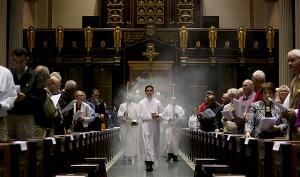
The Entrance Procession retraces some of the steps that God’s people took from their homes to their places in church.
Imagine you are a visitor from space finding yourself in a Catholic church during Sunday liturgy just in time for the Introductory Rites. Not having any previous acquaintance with churchy things, you’d have to interpret what you see according to its most obvious meaning. Not knowing Jesus would be a big disadvantage, but being without preconceptions would be a plus.
I’m not an extraterrestrial, but I have another advantage that will help me look afresh at today’s liturgy: I’m old. Well, old enough to remember how liturgy went before the Vatican II inspired reforms. Liturgy never becomes exactly “old hat” for me because I remember how different it used to be. So I imagine this is my space visitor’s second visit to earth. Fifty years ago she saw a quite different Mass celebration. She assumes that the changes she observes are for the better. They help bring the meaning of the Mass into clearer focus. That surely was the intention of the liturgical reformers so this series on the Mass will pay close attentions to those changes.
This is the second in a series that will take a look at the way the Mass is celebrated in Catholic churches today.
Sunday mornings
I remember getting ready to “go to church.” That part hasn’t changed much except that we don’t need to be as hungry as before. We used to fast from midnight on. That fast, though sometimes a burden, made a lot of sense. We valued spiritual food above material food, so making the material wait until after Mass seemed the right thing to do. Of course, in those days we had Mass only in the morning. With today’s Saturday evening Masses, that would be a long wait.
Now that Communion is not always the first food of the day, the idea behind today’s Eucharistic fast is simply that Communion is necessary food; it fills a hunger. It is not something to munch on after one is full already. The one-hour fast that is today’s rule is enough to make that point. As for spiritual food’s priority, it’s not as though whatever meals we took at home before church were unspiritual. God was with us then too.
In my culture, though not in all, the church is fairly quiet before Mass begins. There may be some talking but in a low voice. During Mass there are several silent moments. This first relative silence is one of anticipation: something important is about to happen.
The entrance procession
The breaking of that silence would be one of the first differences my space visitor notes. In the old days, as a server, I might have been the one breaking that silence by ringing a bell. Then I and another server would lead the priest into the sanctuary from the “sacristy.” That dressing room for the priest had a holier name than ours at home, and the door he used was much closer to the altar than the door that we in the pews had come through. Unconsciously, it reinforced in us a feeling of being different from the priest. I suppose today people take it for granted when the priest enters church not from the sacristy but through the same door that they used. But my space visitor and I, when I remember, pay attention to such things.
Having experienced both ways, I can see what a difference it makes. The priest is one of us. The priest, cross bearer, other servers, lector with the Gospel book, and maybe some other ministers represent all of us in the assembly. Following our path partly, this entrance procession gathers up our journeys from home to church. The Mass isn’t something we came to watch, something someone does but we can’t. It’s a holy work that we all do, and it has its real beginning in our homes. The procession symbolize the heavenward pilgrimage of all God’s people.
Celebrant or presider
What starts this procession isn’t a bell but a human voice. In the early days of the reform, that voice may have announced, “Please, stand to greet our celebrant with hymn number ….” That was unfortunate for several reasons. First, it’s odd to call the priest “celebrant,” since we’re all celebrating. The proper title for the priest’s role is presider. He leads the celebration. Second, this is not a time to greet the priest. A formal greeting will take place shortly, and the presider will lead it. And the hymn is not a greeting for just one of the celebrators but praise to God. (Unfortunately it’s still quite common to call the priest “celebrant.”)
A song leader’s announcement signals the start of the celebration. It may contain a word of greeting and perhaps an invitation for us to greet each other. Then, just something like “Our Entrance Hymn is…. Please, stand.” With respect for persons with disabilities, in some churches you hear, “Stand as you are able.”
There is a lot of standing, sitting, kneeling, and moving about in Catholic liturgy. It’s not just because Catholics are a hyperactive bunch, though I do appreciate the chance to move every once in a while. These postures have meaning. (You can find a post on standing, sitting etc. here.) I can see my imaginary space visitor, who doesn’t know any better, thinking, “These people are all standing. It looks like they’re going to do something.” And that’s exactly right. Liturgy is the “work of the people.” And standing is a posture for getting to work. We also stand to be on lookout for the great day that we anticipate at every Mass, the day when Jesus will come again.
Environment
My space visitor will have noticed a change in the environment where liturgy takes place. Most of the changes make it clearer that liturgy is the people’s work. That’s what liturgy was in the early Church, and if you had been there in those small gatherings, you would have felt it. I suppose the “work of the people” (literal rendering of “liturgy”) was not so easy to see when worship gatherings got much bigger. The place for worship moved from people’s homes to cathedrals.
With the altar far away at the end of a huge oblong structure, the people couldn’t see or hear much. It might not have mattered when the priest turned his back to the people and said his prayers in a low voice. Eventually a Communion Rail separating altar and congregation wrote in stone and wood what was already written in people’s perceptions. The priest did the Mass. It was a work done for the people, not by the people.
We still have large gatherings for liturgy on Sunday. People might keep their distance from the Table of the Lord. But, at least, that Table is placed where everyone can see what is happening on it. New churches keep everyone as close as possible, and the liturgy itself keeps people involved. You can tell that you’re a part of the work being done.
Of course, nothing good comes automatically. It’s easy to be there in the back and even go through the gestures and responses and not realize how important your contribution is. Thanks to liturgical renewal, good liturgical celebrations today have a power to wake people up, gather them in, and sweep them along. That is, if they let it happen and, like my space visitor, pay attention to what is happening.
The Entrance Procession and one greeting too many
The Entrance Procession is one of four processions during the Mass. The others are a procession with the Book of the Gospels, the procession at the Preparation of the Gifts, and the Communion procession. Singing naturally accompanies a procession. The singing of an entrance song helps draw the people together to begin a common action.
A greeting follows the Entrance Procession, and my space visitor, having boned up on greetings ancient and modern, is wondering. Why do priest and people greet each other twice? I wonder, too. There’s a fancy, ages-old greeting, for example, “The Lord be with you…. And with your spirit.” But priests follow that with the ordinary, everyday “Good morning” or “Good evening.” Compared to the first, the second is a letdown. My space visitor was just settling into a very special place, where there was music and exalted language, only to be brought back to the everyday world as the priest merely repeats the casual or business-like greeting that the song leader gave already. That priest’s second greeting is one greeting too many.
A Penitential Act – “Lord, have mercy” – and a suggestion for the Opening Prayer
In spite of its name, this rite is less penitential ,more like a prayer of praise for God’s mercy than formerly. My space visitor notices that right away, but people often misunderstand it. I was at a workshop in which the presenter asked, “Which part of the Mass forgives our sins?” We thought it was here and that, with sins forgiven, we were now prepared to celebrate the rest of the Mass. This rite, along with all the Introductory Rites, is part of the preparation for sure, but forgiveness happens during the Communion Rite. We’re still carrying lots of burdens, including our sins, as we transition to the next part of the Mass, and God’s OK with that.
Except in Lent, we follow up “Lord, have mercy” with a resounding song of praise, the Gloria. Here again we find ourselves asking for God’s mercy. Even as we recognize our sin, we are singing joyfully in praise of our merciful God.
After the Gloria, the priest intones, “Let us pray,” and gives the assembly a few moments to pray silently. My extraterrestrial visitor wonders, if we’re supposed to be praying silently, why is one person moving? That person is the server who carries the priest’s prayer book to him. A truer silence would have everyone still and silently praying. Otherwise, it doesn’t even seem like the pause is for everyone to give God their concerns. It just looks like a time to bring to the priest the book with the “real” prayer in it. My suggestion: The server should bring the book to the priest first. Then the priest says, “Let us pray.” Then a pause for the people to bring to mind their prayers. Finally, the priest reads the prayer that collects all of the prayers and the whole meaning of the Introductory Rites. “Collect” is one name for this prayer.
From Introductory Rites to the Liturgy of the Word
Everyone stands through the Introductory Rites. There is much to do—prayers, invocations, and responses. It ends with the Opening Prayer, which gives a kind of direction or meaning to everything that has gone before, all the way back to our houses, where God began the work of gathering this people together. We make the prayer our own when we respond “Amen.” Then we sit for the Liturgy of the Word.
Think again:
In what ways is it clear, from the very beginning of the Mass, that this liturgy is your work, not something you came to watch? Do you feel welcomed when you come to church, and does that welcome feel like an invitation to join in a common enterprise?
Image credit: Catholic Telegraph via Google Images
Previous Post

October 26, 2019
The Mass -- Is it still the Same?
Next Post
November 1, 2019 The Liturgy of the Word: More than Listening
Browse Our Archives
Select a Category Advent Christmas Amazon Synod Angels Being Consumed Bible Catholic Modern Creed Ecology Economics Elizabeth Johnson Eucharist Fragments and Filaments Gender and Sex Gospel of Mark Herzog Historical Jesus Liturgy Luke Opening Scriptures on Way to Emmaus Ordinary radicals Parables Pro-Life Reincarnation Rosary Sacraments science Social Justice Souls Stories of Jesus The Creed Torture and Eucharist Tracy Uncategorized War and Peace
Select a Month October 2026 June 2025 April 2025 March 2025 February 2025 January 2025 November 2024 July 2024 March 2024 December 2023 October 2023 September 2023 August 2023 May 2023 April 2023 March 2023 February 2023 January 2023 December 2022 November 2022 October 2022 September 2022 August 2022 July 2022 June 2022 April 2022 March 2022 February 2022 January 2022 December 2021 November 2021 October 2021 August 2021 July 2021 June 2021 April 2021 March 2021 February 2021 December 2020 November 2020 October 2020 August 2020 July 2020 June 2020 May 2020 April 2020 March 2020 February 2020 January 2020 December 2019 November 2019 October 2019 September 2019 August 2019 July 2019 June 2019 May 2019 April 2019 March 2019 February 2019 January 2019 December 2018 November 2018 October 2018 September 2018 August 2018 July 2018 June 2018 May 2018
Follow Us!
TAKE THE
Religious Wisdom Quiz
Who was the oldest person recorded in Genesis?
Select your answer to see how you score.
Noah Methuselah Adam Jared
Related posts from Lost in a One-Acre Wood

“Drink the Cup” – Liturgy Teaches Us Eucharistic...

Kneeling Through the Communion Rite: Now I Get...
Ministries in the Church, Momentum for Change, Again
Address the Prayer of the Faithful to God,...
TRENDING AT PATHEOS Catholic

Rejecting Doom: Christian Hope And Human Action
Christianity is a religion of hope. We are to have hope and...

It’s What Comes From Within Which Matters
One of the most difficult things for us to understand is why...

Why I Choose the Eucharist Over the Sermon
Choose the Eucharist, Not the Sermon What are we supposed to get...

5 Design Elements Found in Spiritually Rooted Homes
Putting Spirituality Into Home Decor Our homes are more than our living...

Credo: A Story of God Told with the...
About 10 years ago, I began to imagine a personal "Credo" that...

The Anatomy of Divine Revelation in Catholic Thought
The claim that God has made Himself known to human beings is...
view all Catholic blogs
Ad-Free & Subscriber Log-In Subscription Support
- About Us
- 2026 Calendar
- Videos
- Podcasts
- Library of World Religions
- Faith In Media Tracker
- Advertise With Us
- Write for Us
- Privacy Policy
- Terms of Service
- Do Not Sell My Data
- Contact Us
- Radiant Digital
- Manage Newsletter Subscriptions
- Unsubscribe From Notifications
- Sitemap
Copyright 2008-2026, Patheos. All rights reserved.
Subscription Support Ad-Free & Subscriber Log-In
Follow Patheos