
BuddhistCatholicContemplativeEvangelicalGeneral ChristianHinduJewishLatter-day SaintMuslimNew VisionsProgressive Christian
Beliefs
- Buddhist
- Catholic
- Contemplative
- Evangelical
- General Christian
- Hindu
- Jewish
- Latter-day Saint
- More Voices
- Muslim
- New Visions
- Pagan
- Progressive Christian
Topics
- Religion News
- Food and Religion
- Sports and Religion
- Religious Art
- Religious Music and Entertainment
- Religious Events
- History and Religion
- Style and Religion
- Politics and Religion
- Women in Religion
- Recreation Outdoors and Religion
- Business Finance and Religion
- Careers Workplace and Religion
- Education and Religion
- Family Parenting and Religion
- Health Fitness and Religion
- Home and Religion
- Relationships and Religion
- Technology and Religion
- Travel and Religion
Columnists
- Buddhist Columnists
- Business Finance and Religion Columnists
- Careers Workplace and Religion Columnists
- Catholic Columnists
- Contemplative Columnists
- Education and Religion Columnists
- Evangelists Columnists
- Family Parenting and Religion Columnists
- General Christian Columnists
- Health Fitness and Religion Columnists
- Hindu Columnists
- History and Religion Columnists
- Home and Religion Columnists
- Jewish Columnists
- More Voices Columnists
- Latter Day Columnists
- Muslim Columnists
- New Visions Columnists
- Nonreligious Columnists
- Pagan Columnists
- Politics and Religion Columnists
- Progressive Columnists
- Recreation Outdoors and Religion Columnists
- Relationships and Religion Columnists
- Religion News Columnists
- Religious Art Columnists
- Religious Events Columnists
- Religious Music and Entertainment Columnists
- Sports and Religion Columnists
- Style and Religion Columnists
- Technology and Religion Columnists
- Travel and Religion Columnists
- Women in Religion Columnists
Resource Library
- 2026 Calendar
- Library of World Religions
- The 100 Most Holy Places on Earth
- Patheos Answers
- Podcasts
- Videos
- Faith Leaders Database
- Anglican Episcopalian
- Bahai
- Baptist
- Buddhism
- Christianity
- Confucianism
- Eastern Orthodoxy
- Hinduism
- Holiness and Pentecostal
- ISKCON
- Islam
- Judaism
- Lutheran
- Methodist
- The Church of Jesus Christ of Latter-day Saints
- New Age
- Paganism
- Presbytarian and Reformed
- Protestantism
- Religion Behind the Scenes
- Roman Catholic
- Scientology
- Shia Islam
- Sikhism
- Sufism
- Sunni Islam
- Taoism
- Zen
- See all religions
Research Tools
 Ad-Free & Subscriber Log-In Subscription Support
Ad-Free & Subscriber Log-In Subscription Support
Follow Patheos 

- Trending:
- Forgiveness
- |
- Marriage
- |
- Consciousness
- |
- Death Penalty
- |
- Election
- |
- Halloween

- Home
- Catholic
- Season of Creation Segues to Amazon Synod with Pope’s Tree Planting
Season of Creation Segues to Amazon Synod with Pope’s Tree Planting
Last updated on: October 8, 2019 at 8:27 am by Jack Hartjes
Season of Creation Segues to Amazon Synod with Pope’s Tree Planting 2019-10-08T08:27:03-06:00 Jack Hartjes
Patheos Explore the world's faith through different perspectives on religion and spirituality! Patheos has the views of the prevalent religions and spiritualities of the world.
Representatives of Amazon indigenous peoples take part with Pope Francis in symbolic tree planting.
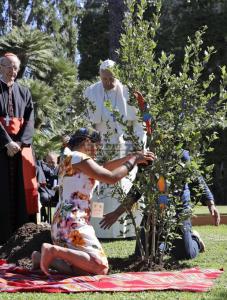
The timing couldn’t have been better for me. Got up for morning prayer on the Feast of St. Francis, and instead found Pope Francis planting a tree, live on my computer. The event marks the close of the month-long Season of Creation. Also with remarkable timing, this ceremony dedicates the upcoming Amazon Synod to St. Francis. The tree Pope Francis symbolically planted – it’s a Holms Oak, supposed to be the species on which birds perched to listen to St. Francis preach.
“Renew us on the pathway of integral ecological conversion” one of the speakers prayed at the ceremony. Integral ecology is the theme of Pope Francis’ encyclical Laudato Si, “Praised Be.” These words are from St. Francis’ “Canticle of the Creatures.” The singing of this prayer accompanied the tree planting ceremony.
The Amazon region shows clearly what integral ecology is about. There the health of ecosystems and the wellbeing of people go hand in hand, as do the many threats to both. “Everything is connected,” as Laudato Si says repeatedly. In the case of the Amazon, the so-called “lungs of the planet, that connection extends to the whole world.
Also accompanying the pope and assisting in the ceremony were two Amazon indigenous persons. They brought soil from their native land, representing, Vatican News says, “the wealth of the bioregion’s cultures and traditions” and the spilled “blood of those who have died fighting against [Amazon’s] destruction.”
More symbols
There was also soil from India and soil representing refugees and migrants. The former represented “countries most vulnerable to the climate crisis.” The latter was for people “forced to leave their homes because of war, poverty, and ecological devastation. More symbolic soil came from places of human trafficking and places where sustainable development projects have improved environments and human livelihoods.
Pope Francis closed the ceremony by simply reciting the Our Father in Spanish. He omitted his prepared remarks, which placed the Amazon Synod under the protection of St. Francis, patron saint of ecology. I guess the symbols of timing, tree, soils, song, and Amazon people made the connection between the synod and the Season of Creation clear enough.
The Season of Creation
For a season that isn’t quite exactly on the Church’s liturgical calendar, this year’s Season of Creation has been quite remarkable. Here are some of the bigger personalities and moments:
- Greta Thunberg, sailing across the Atlantic in a solar-powered yacht, talking to Congress and the U.N;
- More young climate activists – a panel of four interviewed by a U.S. House committee plus a U.N. sponsored Youth Climate Summit with invitees from across the globe.;
- Youth and adults around the world striking on two successive Fridays for climate action.
- Secretary General Antonio Guterres calling the nations of the world—those who have significant proposals—to a Climate Summit days after the Youth Summit;
- Pope Francis telling to the U.N. gathering that nations need to do more.
- And, of course, Pope Francis planting that tree, one of billions that nations committed to plant.
And it was remarkable for one non-moment – the failure of the U.S. government to make any significant contribution.
The Amazon Synod
Barely a heartbeat after the Season of Creation, the Church turns to the Amazon. There natural and human ecology is threatened. Putting the two ecologies together is the task of integral ecology. The title of the synod’s Preparatory Document is “Amazonia: New Paths for the Church and for an Integral Ecology.” The synod will deal with the worldwide ecological importance of “Amazonia,” but first in the Preparatory Document comes a concern for its peoples. Here and in coming posts I gather thoughts from that document.
From the Preamble:
- A “culture of waste” and an “extractivist mentality” have triggered “a deep crisis.”
- The Amazon region is a “mirror of all humanity,” “multi-ethnic, multi-cultural, and multi-religious.”
- The document promises to listen to indigenous peoples, “the first interlocutors of this Synod.”
From Part I. Seeing: Identity and Cries of the Pan-Amazonia
- The Amazon River is “the mother and father river of all.”
- The excessive growth of agricultural, extractive, and logging activities in the Amazonia has not only damaged the ecological richness of the region, its rainforest, and its waters, but has also impoverished its social and cultural wealth.
- Amazonia hosts “about three million indigenous people, representing about 390 different peoples and nationalities … each with its own particular way of seeing the world and its surroundings and of relating to it out of their specific worldview and territoriality.”
- Amazonian people’s “relationship of belonging and participation” with the natural world contrasts with “a mercantilist vision.”
- Catholic people’s history in Amazonia includes cooperation with the colonial occupation by Spain and Portugal. Voices “raised in defense of indigenous peoples’ were few and far between.” The importation of “an enormous number” of Africans as slaves was an “unrecognized holocaust.” The Church begs forgiveness for this “scandalous stain.”
- That sordid history continues with “ferocious neocolonialism, carried out under the auspices of progress. It is likely that … the indigenous peoples of the Amazon Basin have never been as threatened as they are at present.” Those with power do not recognize indigenous rights, especially “their ancestral and collective [land] ownership.”
- If they had paid attention, those early and late “conquistadors” would have found “multiple bridges and points-of-contact” between Christianity and native religions. They would have found “openness to God’s activity … gratitude for the fruits of the earth … solidarity and co-responsibility … worship” and more.
Spirituality and wisdom
This first section concludes with a positive assessment of indigenous spirituality. The majority – but, the statement notes, not all – “promote the good life as a project of harmony between God, peoples, and nature.” More comprehensively, this good life
Comes from living in communion with other people, with the world, with the creatures ofo their environment, and with the Creator. Indigenous peoples, in fact, live within the home that God created and gave them as a gift: the Earth. Their diverse spiritualities and beliefs motivate them to live in communion with the soil, water, trees, animals, and with day and night. Wise elders … promote the harmony of people among themselves and with the cosmos. Indigenous peoples are a living memory of the mission that God has entrusted to us all: the protection of our common home.
This preparatory statement is meant to guide discussion during the synod. It will undergo discussion and alteration as 185 voting members, mostly from Amazon countries, meet in Rome in the coming weeks.
Imagae credit: Bulgarian News Agency via Google Images
Previous Post

October 2, 2019
Priests: Through Holy Orders God’s Supports Us as We Do God’s Work
Browse Our Archives
Select a Category Advent Christmas Amazon Synod Angels Being Consumed Bible Catholic Modern Creed Ecology Economics Elizabeth Johnson Eucharist Fragments and Filaments Gender and Sex Gospel of Mark Herzog Historical Jesus Liturgy Luke Opening Scriptures on Way to Emmaus Ordinary radicals Parables Pro-Life Reincarnation Rosary Sacraments science Social Justice Souls Stories of Jesus The Creed Torture and Eucharist Tracy Uncategorized War and Peace
Select a Month October 2026 June 2025 April 2025 March 2025 February 2025 January 2025 November 2024 July 2024 March 2024 December 2023 October 2023 September 2023 August 2023 May 2023 April 2023 March 2023 February 2023 January 2023 December 2022 November 2022 October 2022 September 2022 August 2022 July 2022 June 2022 April 2022 March 2022 February 2022 January 2022 December 2021 November 2021 October 2021 August 2021 July 2021 June 2021 April 2021 March 2021 February 2021 December 2020 November 2020 October 2020 August 2020 July 2020 June 2020 May 2020 April 2020 March 2020 February 2020 January 2020 December 2019 November 2019 October 2019 September 2019 August 2019 July 2019 June 2019 May 2019 April 2019 March 2019 February 2019 January 2019 December 2018 November 2018 October 2018 September 2018 August 2018 July 2018 June 2018 May 2018
Follow Us!
TAKE THE
Religious Wisdom Quiz
What did Jesus turn water into at a wedding?
Select your answer to see how you score.
Milk Bread Wine Fish
Related posts from Lost in a One-Acre Wood
Ministries Appropriate to the Amazon and the First...
Ezra and Nehemiah vs. Jonah and Ruth –...
The Amazon Synod Opening Day and Fighting Fires...

Credo: A Story of God Told with the...
TRENDING AT PATHEOS Catholic

Creation, Preservation, and Teleology in Catholic Theology
As I write this, it is very early Monday morning. Like millions...

The Parable Of The Sower And The Word...
One of Christ’s most famous parables is that of the sower who...

Rejecting Doom: Christian Hope And Human Action
Christianity is a religion of hope. We are to have hope and...

Why I Choose the Eucharist Over the Sermon
Choose the Eucharist, Not the Sermon What are we supposed to get...

5 Design Elements Found in Spiritually Rooted Homes
Putting Spirituality Into Home Decor Our homes are more than our living...

Credo: A Story of God Told with the...
About 10 years ago, I began to imagine a personal "Credo" that...
view all Catholic blogs
Ad-Free & Subscriber Log-In Subscription Support
- About Us
- 2026 Calendar
- Videos
- Podcasts
- Library of World Religions
- Faith In Media Tracker
- Advertise With Us
- Write for Us
- Privacy Policy
- Terms of Service
- Do Not Sell My Data
- Contact Us
- Radiant Digital
- Manage Newsletter Subscriptions
- Unsubscribe From Notifications
- Sitemap
Copyright 2008-2026, Patheos. All rights reserved.
Subscription Support Ad-Free & Subscriber Log-In
Follow Patheos