
BuddhistCatholicContemplativeEvangelicalGeneral ChristianHinduJewishLatter-day SaintMuslimNew VisionsProgressive Christian
Beliefs
- Buddhist
- Catholic
- Contemplative
- Evangelical
- General Christian
- Hindu
- Jewish
- Latter-day Saint
- More Voices
- Muslim
- New Visions
- Pagan
- Progressive Christian
Topics
- Religion News
- Food and Religion
- Sports and Religion
- Religious Art
- Religious Music and Entertainment
- Religious Events
- History and Religion
- Style and Religion
- Politics and Religion
- Women in Religion
- Recreation Outdoors and Religion
- Business Finance and Religion
- Careers Workplace and Religion
- Education and Religion
- Family Parenting and Religion
- Health Fitness and Religion
- Home and Religion
- Relationships and Religion
- Technology and Religion
- Travel and Religion
Columnists
- Buddhist Columnists
- Business Finance and Religion Columnists
- Careers Workplace and Religion Columnists
- Catholic Columnists
- Contemplative Columnists
- Education and Religion Columnists
- Evangelists Columnists
- Family Parenting and Religion Columnists
- General Christian Columnists
- Health Fitness and Religion Columnists
- Hindu Columnists
- History and Religion Columnists
- Home and Religion Columnists
- Jewish Columnists
- More Voices Columnists
- Latter Day Columnists
- Muslim Columnists
- New Visions Columnists
- Nonreligious Columnists
- Pagan Columnists
- Politics and Religion Columnists
- Progressive Columnists
- Recreation Outdoors and Religion Columnists
- Relationships and Religion Columnists
- Religion News Columnists
- Religious Art Columnists
- Religious Events Columnists
- Religious Music and Entertainment Columnists
- Sports and Religion Columnists
- Style and Religion Columnists
- Technology and Religion Columnists
- Travel and Religion Columnists
- Women in Religion Columnists
Resource Library
- 2026 Calendar
- Library of World Religions
- The 100 Most Holy Places on Earth
- Patheos Answers
- Podcasts
- Videos
- Faith Leaders Database
- Anglican Episcopalian
- Bahai
- Baptist
- Buddhism
- Christianity
- Confucianism
- Eastern Orthodoxy
- Hinduism
- Holiness and Pentecostal
- ISKCON
- Islam
- Judaism
- Lutheran
- Methodist
- The Church of Jesus Christ of Latter-day Saints
- New Age
- Paganism
- Presbytarian and Reformed
- Protestantism
- Religion Behind the Scenes
- Roman Catholic
- Scientology
- Shia Islam
- Sikhism
- Sufism
- Sunni Islam
- Taoism
- Zen
- See all religions
Research Tools
 Ad-Free & Subscriber Log-In Subscription Support
Ad-Free & Subscriber Log-In Subscription Support
Follow Patheos 

- Trending:
- Forgiveness
- |
- Marriage
- |
- Consciousness
- |
- Death Penalty
- |
- Election
- |
- Halloween

- Home
- Catholic
- Reconciliation Happens, Against All Odds
Reconciliation Happens, Against All Odds
Last updated on: September 13, 2019 at 6:12 am by Jack Hartjes
Reconciliation Happens, Against All Odds 2019-09-13T06:12:04-06:00 Jack Hartjes
Patheos Explore the world's faith through different perspectives on religion and spirituality! Patheos has the views of the prevalent religions and spiritualities of the world.
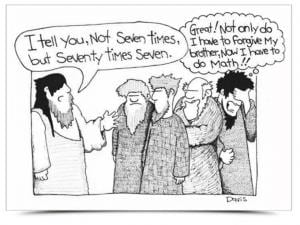
Seventy times seven — four hundred ninety — and that’s probably not even an exaggeration.
Celebrations of Grace: The Sacraments of the Catholic Church, Part 14
We often think about the Sacrament of Reconciliation—or any occasion when reconciliation might be in order—backwards. We think: First, the person who committed the offense shows some evidence of sorrow. Then the injured party forgives and reconciliation can occur. Actually, it works much better the other way around. It’s easier to be sorry when you know you’ve been forgiven already.
The many sayings of Jesus on this subject are at least as much about forgiving as they are about going to someone to say, “Sorry.” The Lord’s Prayer is about forgiving and receiving forgiveness equally. The Prodigal Son doesn’t expect forgiveness, just a slave’s job; but he finds a father who has forgiven him already and is waiting and watching for the sinner’s return.
In a third saying Jesus tells Peter to forgive his brother seventy times seven times. This is not an exaggeration. You can expect to have to forgive a family member easily that many times. But what if you were to say each time, “I’ll forgive you, but first you must be truly sorry, pay restitution, and promise not to do it again”? I don’t think either forgiveness or repentance could happen that way—at least, not 490 times.
Real power from the Spirit
Then there’s the passage in which the Church finds much of its theology of the Sacrament of Reconciliation: ”Receive the Holy Spirit. Whose sins you forgive are forgiven them. Whose sins you retain are retained.” (John 20:22-23) Here’s an interpretation: ”The Holy Spirit is giving you real power. Accept it. If you forgive your sons and daughters, your spouses, your brothers, sisters, friends, even enemies, then forgiveness happens. But if you withhold your forgiveness or carry on politely but hold a grudge in your heart, how are they going to find sorrow in their hearts? If you say, ‘I will forgive you but only provided such and such or so and so,’ you treat them as inferiors. Where will they find the will to approach someone who seems to be assuming the role of the guiltless one? And who can they get forgiveness from if not from you, the one that matters?”
Forgiveness is one of the most important skills we can have. It’s also one of the most difficult, but without true forgiveness true sorrow is next to impossible.
Forgiveness first
I used to think that Jesus died such a horrible death on the cross so the world would see how bad its sin is. Then we’d somehow find the humility to approach God for forgiveness. Now I believe that it’s only through being forgiven (“Father, forgive them, they know not what they do.”—Luke 23:34) that we can acquire the courage to see our sin and how terrible it is.
The hardest part about the skill of forgiveness is that it’s not something we do. It’s not giving advice, blaming, giving orders or suggestions, threatening, preaching, giving logical arguments, making judgments, explaining, or even making excuses for the other. We’re tempted to begin right away trying to fix whatever we imagine is wrong inside the other person. That person needs to respond to the truth—what really happened and how it hurts—not our righteous anger and our threats and conditions, but also not our attempts to make things better, not our condescension, not our attempts at being strong and hiding the hurt, and not even our willingness to forget.
All these are actions of a superior toward an inferior, punishments or favors bestowed freely or with strings attached. Forgiveness is not seeing justice done or doing someone a favor. Can you possibly think of what the Loving Father did to the Prodigal Son as a favor? The Father was just being a father. To be true to ourselves, we have to forgive. And we have to forgive in order to find healing ourselves–healing of our own inevitable emotions of anger, resentment, and that hidden fear that we are not as innocent as we like to think we are. Reconciliation is a sacrament of healing on many sides.
Reconciliation, God’s work
God’s grace often makes our actions into instruments of divine power, but with the grace of reconciling, the action is almost all God’s. It’s hard to let God do so much! You want to do something to make reconciliation happen; yet often the only thing that doesn’t make things worse is to wait and worry and continue in love. It’s a strange kind of skill, letting another person feel sorrow, giving a person a chance and time to be sorry. You can’t help much. You can examine yourself and be honest about your own role in the conflict, and you can allow time for a gradual clearing of vision.
Unpressured, unhurried time makes sorrow possible. You must protect yourself physically and emotionally. I’ve seen parents try their hardest to continue loving wayward children even while trying to maintain an emotional and physical distance, and I’m convinced God’s forgiveness was touching those children. That’s what “Receive the Holy Spirit. Whose sins you shall forgive….” is about.
The grace of forgiveness and contrition is real. Against all odds and almost against human nature, reconciliation does happen. We do make up, make amends and make changes, even if it’s not always for the best reasons and even if it sometimes seems more like ignoring the problem than working it out. The Sacrament of Reconciliation celebrates this fact of our tarnished but still wonderful lives.
A community sacrament
Reconciliation includes our reconciliation with God and with each other. The community dimension in this sacrament was not very obvious when going to Confession was always a private ceremony. We believed, and still do believe, that the priest represents Christ and the community in which one seeks reconciliation. But this connection to community is stronger when on regular occasions the peace-seeking community, the community that forgives and asks for forgiveness, gathers to celebrate, and when a reading from the community’s story, Sacred Scripture, is a prominent part of the celebration.
The two sides of reconciliation, forgiving and being forgiven, are especially obvious if the ceremony includes a sign of peace. As in the other sacraments, the gathering of sinners is an important sign. It’s the first of the signs in which God is present.
The battle with sin
Some say there are no mistakes, only different roads to the goal. Mistakes are just “learning experiences.” Christians believe the part about the different roads, but they also believe in turning away from sin. Christians believe in mistakes and in conversion. They believe in forgiveness, and so they have the courage to acknowledge the sin that is forgiven. They believe in a savior, whom they will find waiting down every road.
The sacrament of Reconciliation is about struggling with sin, that age-old battle with the devil. We cannot think, “I’m going to win this fight.” Jesus already won it. But our struggle isn’t any less intense or any less a part of God’s plan for transforming us into the people we were meant to be. It simply fills the struggle with hope.
God brings good out of everything, including our sin. Through the grace of humility we can realize that. We can even think back on our past sins and thank God for another time of special closeness and love. That’s what the Church does during the Easter Vigil. We think back on the story of the first sin and sing in the Easter Proclamation: “O happy fault!”
In the celebration of Reconciliation, we say words and perform gestures that express our sorrow for offending our loving God. The real sacramental sign, however, is not these outward things. The sorrow that we feel inside and other feelings, too, including our confidence in God’s mercy and the peace and joy that reconciliation brings, are the real sign of what Christ is doing in our lives—forgiving us, giving us the grace of contrition, fashioning us into people who forgive seventy times seven, and reconciling us to each other and to God.
Think again:
In times of temptation, especially when we are tempted to be unforgiving, our battle against sin and the devil becomes real. In Reconciliation we think about forgiving and being forgiven, and we celebrate. What kind of battle is it if celebrating forgiveness is one of the necessary strategies? What does it take to be sorry or forgiving?
Image credit Phillip Chircop via Google Images
Previous Post

September 6, 2019
Confirmation, Support for a Journey that isn’t Nearly Complete
Next Post
September 11, 2019 It’s Patriot Day. What Have We Learned from 9/11?
Browse Our Archives
Select a Category Advent Christmas Amazon Synod Angels Being Consumed Bible Catholic Modern Creed Ecology Economics Elizabeth Johnson Eucharist Fragments and Filaments Gender and Sex Gospel of Mark Herzog Historical Jesus Liturgy Luke Opening Scriptures on Way to Emmaus Ordinary radicals Parables Pro-Life Reincarnation Rosary Sacraments science Social Justice Souls Stories of Jesus The Creed Torture and Eucharist Tracy Uncategorized War and Peace
Select a Month October 2026 June 2025 April 2025 March 2025 February 2025 January 2025 November 2024 July 2024 March 2024 December 2023 October 2023 September 2023 August 2023 May 2023 April 2023 March 2023 February 2023 January 2023 December 2022 November 2022 October 2022 September 2022 August 2022 July 2022 June 2022 April 2022 March 2022 February 2022 January 2022 December 2021 November 2021 October 2021 August 2021 July 2021 June 2021 April 2021 March 2021 February 2021 December 2020 November 2020 October 2020 August 2020 July 2020 June 2020 May 2020 April 2020 March 2020 February 2020 January 2020 December 2019 November 2019 October 2019 September 2019 August 2019 July 2019 June 2019 May 2019 April 2019 March 2019 February 2019 January 2019 December 2018 November 2018 October 2018 September 2018 August 2018 July 2018 June 2018 May 2018
Follow Us!
TAKE THE
Religious Wisdom Quiz
Pride deceived those who dwell in the clefts of the rocks and make their home on the heights. Which nation was being addressed?
Select your answer to see how you score.
Ammon Moab Philistia Edom
Related posts from Lost in a One-Acre Wood

“Drink the Cup” – Liturgy Teaches Us Eucharistic...

Kneeling Through the Communion Rite: Now I Get...
Ministries in the Church, Momentum for Change, Again

Address the Prayer of the Faithful to God,...
TRENDING AT PATHEOS Catholic

The Parable Of The Sower And The Word...
One of Christ’s most famous parables is that of the sower who...

Rejecting Doom: Christian Hope And Human Action
Christianity is a religion of hope. We are to have hope and...

Why I Choose the Eucharist Over the Sermon
Choose the Eucharist, Not the Sermon What are we supposed to get...

5 Design Elements Found in Spiritually Rooted Homes
Putting Spirituality Into Home Decor Our homes are more than our living...

Credo: A Story of God Told with the...
About 10 years ago, I began to imagine a personal "Credo" that...

The Anatomy of Divine Revelation in Catholic Thought
The claim that God has made Himself known to human beings is...
view all Catholic blogs
Ad-Free & Subscriber Log-In Subscription Support
- About Us
- 2026 Calendar
- Videos
- Podcasts
- Library of World Religions
- Faith In Media Tracker
- Advertise With Us
- Write for Us
- Privacy Policy
- Terms of Service
- Do Not Sell My Data
- Contact Us
- Radiant Digital
- Manage Newsletter Subscriptions
- Unsubscribe From Notifications
- Sitemap
Copyright 2008-2026, Patheos. All rights reserved.
Subscription Support Ad-Free & Subscriber Log-In
Follow Patheos