
BuddhistCatholicContemplativeEvangelicalGeneral ChristianHinduJewishLatter-day SaintMuslimNew VisionsProgressive Christian
Beliefs
- Buddhist
- Catholic
- Contemplative
- Evangelical
- General Christian
- Hindu
- Jewish
- Latter-day Saint
- More Voices
- Muslim
- New Visions
- Pagan
- Progressive Christian
Topics
- Religion News
- Food and Religion
- Sports and Religion
- Religious Art
- Religious Music and Entertainment
- Religious Events
- History and Religion
- Style and Religion
- Politics and Religion
- Women in Religion
- Recreation Outdoors and Religion
- Business Finance and Religion
- Careers Workplace and Religion
- Education and Religion
- Family Parenting and Religion
- Health Fitness and Religion
- Home and Religion
- Relationships and Religion
- Technology and Religion
- Travel and Religion
Columnists
- Buddhist Columnists
- Business Finance and Religion Columnists
- Careers Workplace and Religion Columnists
- Catholic Columnists
- Contemplative Columnists
- Education and Religion Columnists
- Evangelists Columnists
- Family Parenting and Religion Columnists
- General Christian Columnists
- Health Fitness and Religion Columnists
- Hindu Columnists
- History and Religion Columnists
- Home and Religion Columnists
- Jewish Columnists
- More Voices Columnists
- Latter Day Columnists
- Muslim Columnists
- New Visions Columnists
- Nonreligious Columnists
- Pagan Columnists
- Politics and Religion Columnists
- Progressive Columnists
- Recreation Outdoors and Religion Columnists
- Relationships and Religion Columnists
- Religion News Columnists
- Religious Art Columnists
- Religious Events Columnists
- Religious Music and Entertainment Columnists
- Sports and Religion Columnists
- Style and Religion Columnists
- Technology and Religion Columnists
- Travel and Religion Columnists
- Women in Religion Columnists
Resource Library
- 2026 Calendar
- Library of World Religions
- The 100 Most Holy Places on Earth
- Patheos Answers
- Podcasts
- Videos
- Faith Leaders Database
- Anglican Episcopalian
- Bahai
- Baptist
- Buddhism
- Christianity
- Confucianism
- Eastern Orthodoxy
- Hinduism
- Holiness and Pentecostal
- ISKCON
- Islam
- Judaism
- Lutheran
- Methodist
- The Church of Jesus Christ of Latter-day Saints
- New Age
- Paganism
- Presbytarian and Reformed
- Protestantism
- Religion Behind the Scenes
- Roman Catholic
- Scientology
- Shia Islam
- Sikhism
- Sufism
- Sunni Islam
- Taoism
- Zen
- See all religions
Research Tools
 Ad-Free & Subscriber Log-In Subscription Support
Ad-Free & Subscriber Log-In Subscription Support
Follow Patheos 

- Trending:
- Forgiveness
- |
- Marriage
- |
- Consciousness
- |
- Death Penalty
- |
- Election
- |
- Halloween

- Home
- Catholic
- Confirmation, Support for a Journey that isn’t Nearly Complete
Confirmation, Support for a Journey that isn’t Nearly Complete
Last updated on: November 5, 2021 at 5:12 pm by Jack Hartjes
Confirmation, Support for a Journey that isn’t Nearly Complete 2021-11-05T17:12:26-06:00 Jack Hartjes
Patheos Explore the world's faith through different perspectives on religion and spirituality! Patheos has the views of the prevalent religions and spiritualities of the world.
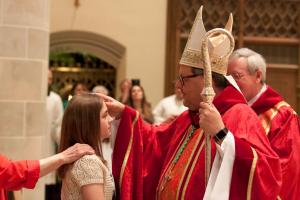
The presence of bishop, sponsor, and community emphasizes the importance of Confirmation for the Church.
Celebrations of Grace: The Sacraments of the Catholic Church, Part 13
It wasn’t easy to decide what to tell 11th graders about the Sacrament of Confirmation. From their older brothers and sisters to their teachers to the shape of the Confirmation program itself, the common perception of the sacrament is: “sacrament of maturity in the faith.”
Joanna Wahlund (“Stop Holding the Sacraments Hostage: Confirmation”) has an excellent critique of this way of looking at Confirmation. My textbook didn’t say Confirmation is the sacrament of maturity, but it didn’t say it isn’t either.
These were 11th graders. There was a time when that was nearly old enough to be an adult in society, to think about getting married, to start a career. But these adult things are four or more years in the future for most of this class. Add in the fact that many of the young people were in class only because of parent pressure.
Confirmation as gift
I received Confirmation as a fourth grader, and the teaching I got definitely spoke of maturity. I was told I would receive the grace to be a “soldier of Christ.” I would be ready to suffer and die for the faith like so many martyrs of old. It was a romantic notion that I readily accepted at that naïve age. It didn’t hurt that all the martyrs I learned about lived in the distant past.
The thing is, this grace to be a soldier of Christ – or the grace to personally affirm my baptismal vows, as we usually say today – is what I was to receive with Confirmation. It would be Confirmation’s gift, not something I earned. That’s not the impression that our Confirmation program gives today. We have requirements, like so many service hours and only so many missed classes or you’ll have make-up work. We still teach grace is a gift, but the program teaches it’s a gift you have to earn in this case.
Readiness for Confirmation and bats in church
The focus of our program was to be ready for Confirmation. By the program’s end the pastor and program leaders were to judge each candidate on that point. I struggled against the idea that readiness meant willingness to become an adult in the Church or to commit oneself to Christ.
Some in my class came from families who faithfully practiced their Catholic faith. Some did not. Either way, for most of them adult commitment to Jesus or the Church lay a long way off. Many years of “Faith Formation” had not given them even a basic understanding of the Church, her teachings and what they would be committing to. (That’s a topic for a different post.)
A sacrament celebrates graces God gives to the Church, both as a body and individual members. What I ended up telling my class is:
The life of faith is a journey, and on a journey you don’t stay in one place very long. God gives you the graces you need all along the way. If you are ready to celebrate your journey and your abilities and whatever courage God is giving you to take just the next step, you are ready for Confirmation.
But what about the following steps? Would my students continue learning about their Catholic faith? Here’s where the program’s structure worked most powerfully against its own purposes. Confirmation, coming at the end of 12 or so years, just looks and feels like a graduation from faith formation. This old joke from U.S. Catholic tells me that’s a common problem:
Fr. Brown was complaining to Fr. Smith about bats in the church. “I just can’t get rid of them, and I’ve tried everything.” Fr. Smith said, “I just had the bishop come and confirm my bats. They never returned.”
Restoring the order of the Sacraments of Initiation
Confirmation as graduation, or as reward for staying in a faith formation program until the very end. Practically and theologically, that’s a problem. Some dioceses mitigate it by placing the celebration of Confirmation in the middle of their religious education programs. A few have taken a more radical step.
Confirmation is one of three Sacraments of Initiation: Baptism, Confirmation, and Eucharist. This is the sequence in which the early Church celebrated these sacraments. The Rite of Christian Initiation of Adults has restored in the original order. A few dioceses are saying, Let that same order apply to Catholics who were baptized as infants.
According to the Team RCIA website, 13 dioceses in the U.S. and several in Canada have moved Confirmation to around age seven, before the reception of First Communion. Quoting from that website:
In 1910, Pius X wanted to end the delay of admitting children to the Eucharist. It was common practice in the western Church to delay brining children to the table until they were twelve or fourteen. Pius lowered the age for first communion to the age of reason or about age seven. That had the unreflected result of placing the celebration of Eucharist before confirmation.
Once that happened, our pastoral understanding of the need for the sacrament of confirmation began to wander off into uncharted ground. If in the celebration of the Eucharist we receive the fullness of Christ, what does confirmation do? An understandable, but incorrect, conclusion was that confirmation would be a mature affirmation of the faith promised at baptism and the fullness received in Eucharist.
Confirmation was, seemingly, no longer ordered to Eucharist but something added to Eucharist. Maybe, just a further requirement before a person could get married in the Church.
Confirmation, a gift for the Church
Putting Confirmation in its proper place, before Eucharist makes the moment of Confirmation less crucial for the individual person. After all, Eucharist is the crucial sacrament. But Confirmation is an important moment in the life of the Church. The presence of the bishop implicitly affirms this importance. When possible, parishes schedule Confirmation at a regular parish Mass. Confirmation celebrates graces God gives to all of us.
Not just family and sponsors but the Christian community joins in a whole-parish celebration. Along with the confirmands, we celebrate our own ongoing journeys of faith, the journey of their faith community, and that of the entire Church. We celebrate the gifts of the Spirit, which come not to one individual at a time but as we all grow together and in all the ways we support each other.
What stands out for me in my own Confirmation experience is the spiritual gift of courage. As a parent I recognized how important courage is for my children and my own role in fostering that gift. When there are difficult decisions to make, difficult steps to take, or difficult changes to go through, there is no greater support we can give to one another than encouragement. As Christians we are challenged to believe in each other’s gifts and to communicate that belief.
When a person is baptized, the community promises to support him or her on this new journey of faith. Teachers and mentors, sponsors, and all who come together to celebrate with those being confirmed help make good on this promise. We support each other on our way and come together in Confirmation to celebrate the journey, the gifts of the Spirit, and the support.
Image credit: Greensburg Diocese via Google Images
Previous Post

September 4, 2019
Have you heard of Greta Thunberg?
Next Post
September 9, 2019 Reconciliation Happens, Against All Odds
Browse Our Archives
Select a Category Advent Christmas Amazon Synod Angels Being Consumed Bible Catholic Modern Creed Ecology Economics Elizabeth Johnson Eucharist Fragments and Filaments Gender and Sex Gospel of Mark Herzog Historical Jesus Liturgy Luke Opening Scriptures on Way to Emmaus Ordinary radicals Parables Pro-Life Reincarnation Rosary Sacraments science Social Justice Souls Stories of Jesus The Creed Torture and Eucharist Tracy Uncategorized War and Peace
Select a Month October 2026 June 2025 April 2025 March 2025 February 2025 January 2025 November 2024 July 2024 March 2024 December 2023 October 2023 September 2023 August 2023 May 2023 April 2023 March 2023 February 2023 January 2023 December 2022 November 2022 October 2022 September 2022 August 2022 July 2022 June 2022 April 2022 March 2022 February 2022 January 2022 December 2021 November 2021 October 2021 August 2021 July 2021 June 2021 April 2021 March 2021 February 2021 December 2020 November 2020 October 2020 August 2020 July 2020 June 2020 May 2020 April 2020 March 2020 February 2020 January 2020 December 2019 November 2019 October 2019 September 2019 August 2019 July 2019 June 2019 May 2019 April 2019 March 2019 February 2019 January 2019 December 2018 November 2018 October 2018 September 2018 August 2018 July 2018 June 2018 May 2018
Follow Us!
TAKE THE
Religious Wisdom Quiz
Where was Jesus placed after He died?
Select your answer to see how you score.
A tomb A temple A cave of fire A pyramid
Related posts from Lost in a One-Acre Wood

“Drink the Cup” – Liturgy Teaches Us Eucharistic...

Kneeling Through the Communion Rite: Now I Get...
Ministries in the Church, Momentum for Change, Again
Address the Prayer of the Faithful to God,...
TRENDING AT PATHEOS Catholic

Rejecting Doom: Christian Hope And Human Action
Christianity is a religion of hope. We are to have hope and...

It’s What Comes From Within Which Matters
One of the most difficult things for us to understand is why...

Why I Choose the Eucharist Over the Sermon
Choose the Eucharist, Not the Sermon What are we supposed to get...

5 Design Elements Found in Spiritually Rooted Homes
Putting Spirituality Into Home Decor Our homes are more than our living...

Credo: A Story of God Told with the...
About 10 years ago, I began to imagine a personal "Credo" that...

The Anatomy of Divine Revelation in Catholic Thought
The claim that God has made Himself known to human beings is...
view all Catholic blogs
Ad-Free & Subscriber Log-In Subscription Support
- About Us
- 2026 Calendar
- Videos
- Podcasts
- Library of World Religions
- Faith In Media Tracker
- Advertise With Us
- Write for Us
- Privacy Policy
- Terms of Service
- Do Not Sell My Data
- Contact Us
- Radiant Digital
- Manage Newsletter Subscriptions
- Unsubscribe From Notifications
- Sitemap
Copyright 2008-2026, Patheos. All rights reserved.
Subscription Support Ad-Free & Subscriber Log-In
Follow Patheos